World Heritage Identification Number: 1188
World Heritage since: 2005
Category: Cultural Heritage
WHE Type: Historic Cities & Urban Areas
Transboundary Heritage: No
Endangered Heritage: No
Country: 🇮🇷 Iran (Islamic Republic of)
Continent: Asia
UNESCO World Region: Asia and the Pacific
Map
Soltaniyeh: A Glimpse into the Grandeur of Persian Architecture
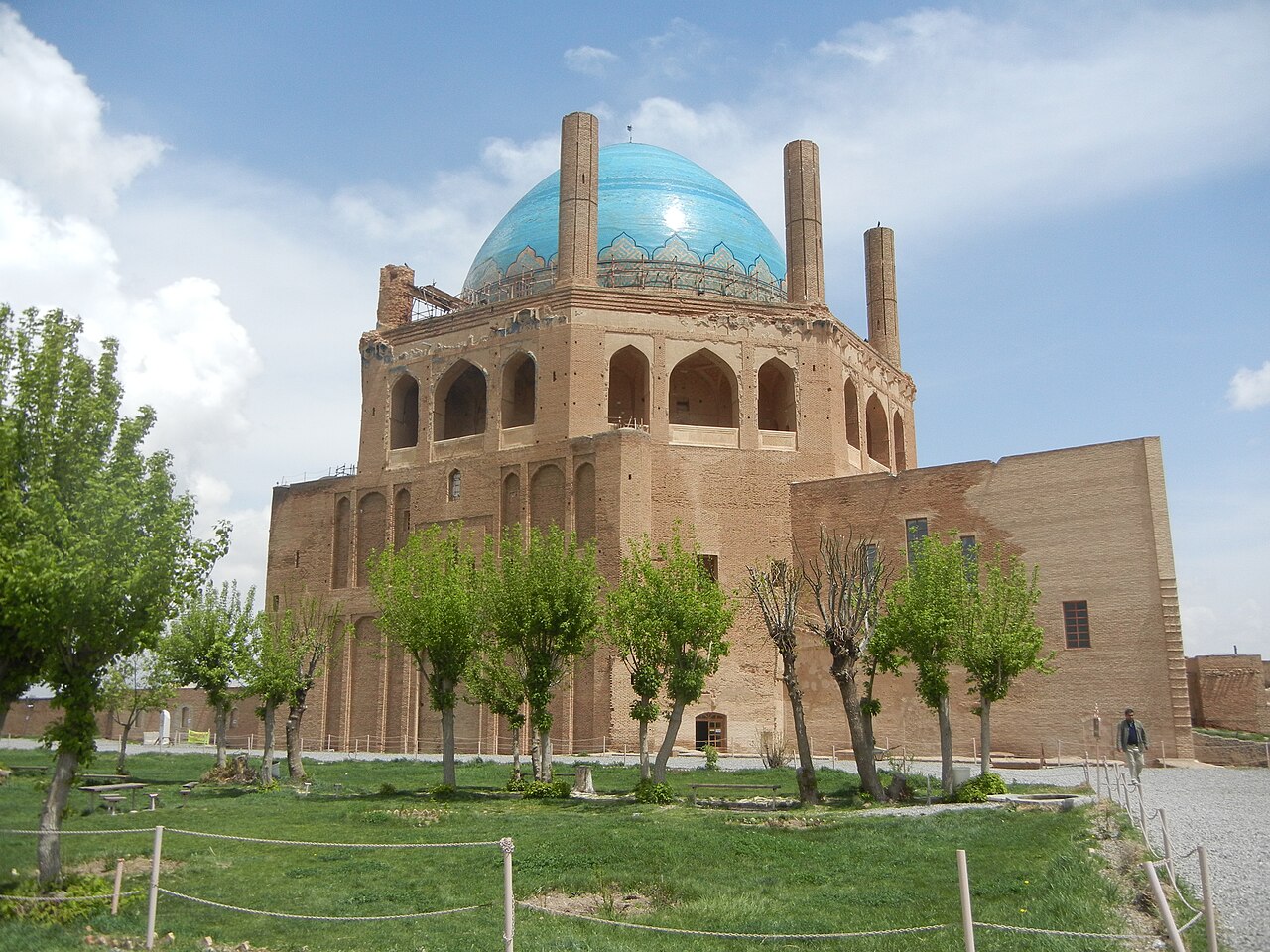
Soltaniyeh, located in the Central District of Soltaniyeh County, Zanjan Province, Iran, serves as the administrative center for both the county and the district. However, it is not just a city; it is a testament to the grandeur and artistic prowess of Persian architecture that has left an indelible mark on the annals of history. Inscribed as a UNESCO World Heritage Site in 2005, Soltaniyeh stands as one of the most significant examples of Islamic architecture and a pivotal milestone in the evolution of Persian architecture.
More to come…UNESCO Description of the World Heritage Site
The mausoleum of Oljaytu was constructed in 1302–12 in the city of Soltaniyeh, the capital of the Ilkhanid dynasty, which was founded by the Mongols. Situated in the province of Zanjan, Soltaniyeh is one of the outstanding examples of the achievements of Persian architecture and a key monument in the development of its Islamic architecture. The octagonal building is crowned with a 50 m tall dome covered in turquoise-blue faience and surrounded by eight slender minarets. It is the earliest existing example of the double-shelled dome in Iran. The mausoleum’s interior decoration is also outstanding and scholars such as A.U. Pope have described the building as ‘anticipating the Taj Mahal’.
UNESCO Justification of the World Heritage Site
Criterion (ii): The Mausoleum of Oljaytu forms an essential link in the development of the Islamic architecture in central and western Asia, from the classical Seljuk phase into the Timurid period. This is particularly relevant to the double-shell structure and the elaborate use of materials and themes in the decoration.
Criterion (iii): Soltaniyeh, as the ancient capital of the Ilkhanid dynasty, represents an exceptional testimony to the history of 13th and 14th centuries.
Criterion (iv): The Mausoleum of Oljaytu represents an outstanding achievement in the development of Persian architecture, particularly in the Ilkhanid period, characterised by its innovative engineering structure, spatial proportions, architectural forms, and the decorative patterns and techniques.
Encyclopedia Record: Soltaniyeh
Soltaniyeh is a city in the Central District of Soltaniyeh County, Zanjan province, Iran, serving as capital of both the county and the district.Additional Site Details
Area: 790.146 hectares
Number of Components: 14
(iii) — Unique or exceptional testimony to a cultural tradition
(iv) — Outstanding example of a type of building or landscape
Coordinates: 36.43528 , 48.79667
World Heritage Research
Discover scientific research and academic studies that deepen our understanding of Soltaniyeh from its history and significance to its conservation, management, and contemporary challenges.
-
Seismic assessment of a dome structure with minarets as secondary elements: The case of Soltaniyeh Dome in Iran
A seismic assessment of the Soltaniyeh Dome, a 14th-century Iranian mausoleum renowned for its double-shell dome construction, reveals that minarets are the most vulnerable part of the structure. The study employed three-dimensional numerical models and advanced seismic analyses, including pushover and limit analysis, to evaluate the dome's collapse mechanisms under seismic scenarios. This research highlights the structural weaknesses in secondary elements like minarets, offering critical insights for preserving such architectural masterpieces. The findings underscore the importance of targeted seismic retrofitting strategies to ensure the longevity of historically significant structures.
Feizolahbeigi, A., Ramirez, R., & Lourenço, P. B. (2024). Seismic assessment of a dome structure with minarets as secondary elements: The case of Soltaniyeh Dome in Iran. Structures, 63, 106408. https://doi.org/10.1016/j.istruc.2024.106408
View Publication Record | Read Publication -
Il mausoleo di Oljeitu a Soltaniyeh in Iran. Bilanci e prospettive per un sito UNESCO
The Oljeitu Mausoleum at Soltaniyeh, inscribed on the UNESCO World Heritage List in 2005, stands as a testament to international conservation efforts that began decades prior. This monumental structure, commissioned by Ilkhān dynasty ruler Oljeitu in the early 14th century, features a distinctive double-shell dome akin to Brunelleschi's design and ranks among the world's largest. A comprehensive assessment of its restoration trajectory reveals the enduring impact of collaborative heritage conservation strategies, spearheaded by Piero Sanpaolesi, who bridged global expertise with local initiatives during his tenure at both the University of Florence and Tehran. The mausoleum's preservation reflects the principles enshrined in UNESCO's Heritage Convention, offering a model for balancing cultural integrity with adaptive reuse.
Pisani, F. (2023). Il mausoleo di Oljeitu a Soltaniyeh in Iran. Bilanci e prospettive per un sito UNESCO. Restauro Archeologico, 30(1). https://doi.org/10.36253/rar-14281
View Publication Record | Read Publication -
Soltaniyeh and Santa Maria del Fiore: A historic relationship?
A comparative-historical study of 26 domes spanning 2,000 years reveals striking structural similarities between the Soltaniyeh Dome in Iran and the dome of Santa Maria del Fiore (Florence Cathedral) in Italy. The research supports a long-standing theory that the Italian dome may have drawn inspiration from its Iranian counterpart, with both exhibiting comparable proportions and forms. Analyzing construction timelines and architectural sources, the study suggests direct influence, reinforcing Professor Sanpaolesi's 1972 hypothesis. Additionally, it explores the broader impact of Islamic golden-age achievements on European Renaissance mathematics and geometry.
Moghaddasi, A., Moghaddasi, M. H., & Hosseini, S. B. (2022). Soltaniyeh and Santa Maria del Fiore: A historic relationship? Tercio Creciente, 55–75. https://doi.org/10.17561/rtc.22.7067
View Publication Record | Read Publication -
Seismic vulnerability study of Soltaniyeh dome using nonlinear static and dynamic analyses
A seismic vulnerability study of the Soltaniyeh dome, the world's largest brick dome and a UNESCO World Heritage Site, reveals significant structural weaknesses under seismic loads. The research, employing finite element modeling (FEM) validated by experimental data, identified critical crack formation and propagation originating from openings on the second and third floors during a 475-year return period earthquake. Nonlinear static and dynamic analyses demonstrated that while the dome performs adequately under gravity loads, its top is particularly vulnerable to seismic stress, necessitating urgent rehabilitation efforts.
Kalantari, H., Nasserasadi, K., & Arjmandi, S. A. (2018). Seismic vulnerability study of Soltaniyeh dome using nonlinear static and dynamic analyses. International Journal of Advanced Structural Engineering, 10(4), 367–380. https://doi.org/10.1007/s40091-018-0203-3
View Publication Record | Read Publication -
A Study on the Decorations of Ilkhani Era: A Case Study of Dome of Soltaniyeh
The Dome of Soltaniyeh, a surviving masterpiece from the Ilkhani era (13th–14th centuries), showcases unparalleled decorative techniques that reflect the cultural and artistic flourishing under Mongol rule in Iran. This study reveals how the integration of Iranian craftsmanship—including intricate plasterwork, tiling, lattice brickwork, Mogharnas, and Quranic inscriptions—elevated architectural aesthetics during a period marked by devastation and transition. The analytical approach examines these decorative elements, highlighting their historical significance as both artistic innovation and cultural preservation. The findings underscore the Dome's role in bridging Mongol military dominance with the revival of Islamic and Persian artistic traditions.
Sobouti, H., Ghasemi, A., & Ebadei, H. (2016). A STUDY ON THE DECORATIONS OF ILKHANI ERA: A CASE STUDY OF DOME OF SOLTANIYEH. Turkish Online Journal of Design, Art and Communication, 6(JLYSPCL), 614–623. https://doi.org/10.7456/1060jse/028
View Publication Record | Read Publication -
Narrative of a Journey into Persia, in the Suite of the Imperial Russian Embassy, in the Year 1817
Moritz von Kotzebue's 'Narrative of a Journey into Persia' provides a unique and detailed account of the social history of 19th-century Persia, particularly focusing on the court of Fath Ali Shah Qajar. The work offers a rare perspective from a Russian embassy member, blending day-to-day observations with astute and witty commentary. Published in both German and English in 1819, it serves as an invaluable resource for understanding the region's cultural and political landscape during that period.
Kotzebue, M. v. (2012). Narrative of a Journey into Persia, in the Suite of the Imperial Russian Embassy, in the Year 1817. https://doi.org/10.1017/cbo9781139177610
View Publication Record | Read Publication