World Heritage Identification Number: 1716
World Heritage since: 2024
Category: Cultural Heritage
WHE Type: Archaeological Sites
Transboundary Heritage: No
Endangered Heritage: No
Country: 🇮🇷 Iran (Islamic Republic of)
Continent: Asia
UNESCO World Region: Asia and the Pacific
Map
Ancient Hegmataneh: A Glimpse into the Rich History of the Medes and Persian Empires
The archaeological remains of Hegmataneh, inscribed as a UNESCO World Heritage Site in 2024, offer a captivating window into the rich history of the Medes civilization and the subsequent Persian empires that ruled over this region. Situated in northwestern Iran, Hegmataneh's continuous habitation spans close to three millennia, making it a significant historical site that sheds light on the cultural, political, and economic developments of the ancient world.
More to come…UNESCO Description of the World Heritage Site
The archaeological remains of ancient Hegmataneh are located in northwestern Iran. Continuously inhabited for nearly three millennia, Hegmataneh provides important and rare evidence of the Medes civilization in the 7th and 6th centuries BCE and later served as a summer capital of Achaemenid, Seleucid, Parthian, and Sasanian rulers.UNESCO Justification of the World Heritage Site
Criterion (ii): Hegmataneh exhibits important evidence of the cultural interchanges among the cultures and civilisations of the Middle East in antiquity. The archaeological remains of town planning and architecture of the Parthian period, as well as the presence of artefacts made for the royal palaces in Susa and Persepolis, testify to the craftsmanship of the masters of Hegmataneh and the transfer of knowledge from Hegmataneh to other major ancient cities.
Criterion (iii): Hegmataneh, one of the ancient government seats in the Middle East, provides exceptional evidence of the cultural, social, economic and political developments in the Iranian Plateau in the 1st millennium BCE. The property provides important and rare evidence of the Medes civilisation and important evidence of the cultures and civilisations that successively occupied the city. Among these, the archaeological remains of the Parthian era present an exceptional testimony of the creative planning and architectural solutions developed through interactions amongst diverse ethnicities and religions.
Encyclopedia Record: Ecbatana
Ecbatana was an ancient city, the capital of the Median kingdom, and the first capital in Iranian history. It later became the summer capital of the Achaemenid and Parthian empires. It was also an important city during the Seleucid and Sasanian empires. Ecbatana was located in the Zagros Mountains, the east of central Mesopotamia, on Hagmatana Hill. Its strategic location and resources probably made it a popular site even before the 1st millennium BC. It is identified with the current city of Hamadan.Additional Site Details
Area: Not available
Number of Components: 1
(iii) — Unique or exceptional testimony to a cultural tradition
Coordinates: 34.8023888889 , 48.5166861111
Image
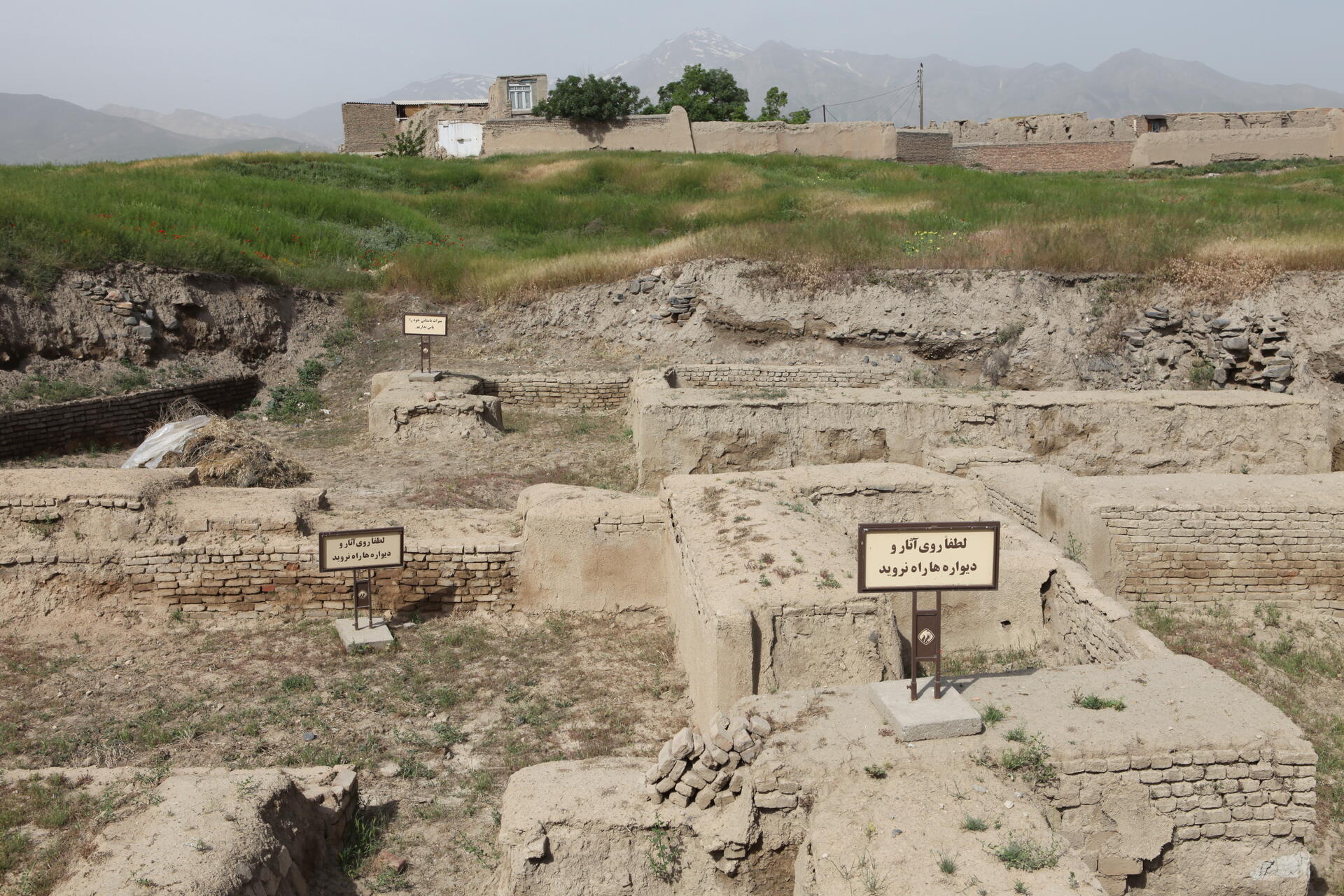
© ninara, CC BY-SA 2.0 Resized from original. (This derivative is under the same CC BY-SA license.)
World Heritage Research
Discover scientific research and academic studies that deepen our understanding of Hegmataneh from its history and significance to its conservation, management, and contemporary challenges.
-
Archaeology and the ancient names of the old cities under Sulaimani in the light of the cuneiform & Classical records and the archaeological evidence
A re-evaluation of historical and archaeological evidence challenges the long-held identification of modern Sulaimani with the ancient city of Celonae, mentioned by Roman historian Quintus Curtius Rufus. The study suggests that Celonae was likely located in the northern edges of Garmian district within the Qaradagh ranges, based on Alexander the Great's documented route and Assyrian royal inscriptions referring to a mountain called Siluna. Additionally, the paper dismisses other proposed identifications for Sulaimani, such as Arrakdi (capital of Zamuan Lullubu) or Lagalaga, citing inconsistencies with cuneiform records and geographical evidence. Archaeological findings in Sulaimani, including Ubaid potsherds, Jamdet-Nasr seals, and human skulls, indicate a settlement dating back to the 5th-4th millennium BCE, providing new insights into the region's ancient history.
Aziz Marif, D. (2021). Archaeology and the ancient names of the old cities under Sulaimani in the light of the cuneiform & Classical records and the archaeological evidence. Twejer, 4(2), 547–588. https://doi.org/10.31918/twejer.2141.13
View Publication Record | Read Publication -
Akhaİmenİd Dönemİnde Yol Ağlari
During the Achaemenid Empire (550–330 BCE), a vast network of roads was strategically developed to facilitate governance and connectivity across its extensive territories. These 'Royal Roads' linked key capitals such as Susa, Persepolis, Pasargad, Hegmataneh, Sardes, and Babylon, while secondary routes connected peripheral regions. The study reveals that the empire maintained existing roads, constructed new ones, and established rest stations along them to provide supplies for travelers, including food, water, and horses, alongside military personnel for security. By synthesizing written records and archaeological evidence, this research reconstructs the planning and functionality of Achaemenid road infrastructure, offering insights into its administrative efficiency and logistical organization.
AFSHARI, L., & AKARSU, R. (2021). AKHAİMENİD DÖNEMİNDE YOL AĞLARI. Anasay, (16), 133–150. https://doi.org/10.33404/anasay.891845
View Publication Record | Read Publication -
Decontextualization and the Search for Origins: A Persian Architectural Fragment in the Ackland Art Museum
A Persian architectural fragment, acquired by the Ackland Art Museum in 1998, has been recontextualized through comparative analysis with similar fragments from major Euro-American collections and the Hegmataneh Hill Museum in Hamadan, Iran. This study challenges the museum's emphasis on aesthetic qualities by examining the fragment as part of a broader network of architectural pieces, rather than an isolated decontextualized object. The research approach involves cross-collection analysis to trace origins and reconstruct historical context, providing new insights into Persian architectural heritage beyond conventional narratives.
Halsted, Lyla. (2016). Decontextualization and the Search for Origins: A Persian Architectural Fragment in the Ackland Art Museum. The University of North Carolina at Chapel Hill University Libraries. https://doi.org/10.17615/95GZ-SE58
View Publication Record | Read Publication -
Parthian Burials in the Hamedan City, Western Iran
Archaeological excavations at Tepe Hegmataneh in Hamedan, western Iran, have uncovered 14 Parthian burial sites, revealing diverse burial practices. These include both coffin and non-coffin burials, with the latter being simple dug graves or pits, often associated with the Stone Lion cemetery. Coffin burials feature clay caskets shaped like boats, humanoid forms, or rectangular stone coffins, most of which are empty. Burials are oriented northeast-southwest, with skeletons positioned in open arched postures facing right, left, or straight, covered by thin stone slabs. Notably, many of these burials were discovered accidentally during construction, highlighting the potential for further archaeological insights in Hamedan's historical landscape.
Mohamadifar, Y., Azandaryani, E. H., Dailar, A., Hasanlou, S., & Babapiri, J. (2019). Parthian Burials in the Hamedan City, Western Iran. Iran, 59(1), 77–89. https://doi.org/10.1080/05786967.2019.1679033
View Publication Record | Read Publication -
Rémy Boucharlat. « Les traces archéologiques des palais achéménides de Hamadan »
Archaeological evidence suggests the existence of Achaemenid palaces in Hamadan, supported by numerous stone fragments, including column bases and capitals. However, excavations at Tepe Hegmataneh, a site northeast of modern Hamadan, have not uncovered royal Achaemenid quarters. Instead, these fragments are now recognized as relics from the Parthian period, indicating that the true center of Achaemenid activity remains to be identified. The study relies on thorough analysis of architectural remnants and their historical context to challenge previous assumptions about the location and nature of Achaemenid palaces in the region.
Nunn, A. (2019). Rémy Boucharlat. « Les traces archéologiques des palais achéménides de Hamadan ». Abstracta Iranica, Volume 40-41. https://doi.org/10.4000/abstractairanica.49343
View Publication Record | Read Publication -
A Review of Gender and Estimate of Age the Human Skeleton (Case Study: The Human Skeleton ofKorijan of Kabudarahang in Hegmataneh Museum)
A study of the human skeleton from Korijan of Kabudarahang, housed in Hegmataneh Museum, reveals significant insights into gender and age estimation techniques. Researchers analyzed skeletal remains to determine biological sex and approximate age, employing morphological and metric methods. The findings contribute to understanding past populations' demographic characteristics, particularly in the context of UNESCO World Heritage Sites like Hegmataneh, which holds archaeological significance. This case study highlights the importance of skeletal analysis in reconstructing historical human life, providing a foundation for further anthropological research.
Rahmani, E., Nasiri, E., Abolgasemi, Y.,. (2018). A Review of Gender and Estimate of Age the Human Skeleton (Case Study: The Human Skeleton of Korijan of Kabudarahang in Hegmataneh Museum). Parseh Journal of Archaeological Studies, 2(3), 53–66. https://doi.org/10.30699/pjas.2.3.53
View Publication Record | Read Publication -
Masoud Azarnoush, Ali Sharifi, Ali Hozhabri. « Bāznegari gāhnegāri nesbi va motlaq tepe Hegmatāneh, barāsās yāfteh-ha va netāyakh āzmāyesh garmāliān va rādiokarbon/ Revising the Relative and Absolute Chronology of Tepe Hegmataneh, Hamadan, Iran : Based on the Finds and the Results of Thermo-Luminescent and Radiocarbon Dating »
A significant revision of the chronology for Tepe Hegmataneh, Iran, establishes that its grand Parthian architectural level dates definitively to the middle-to-late Parthian period, spanning the first few centuries CE and potentially extending into the early 4th century. This conclusion was reached through precise stratigraphic analyses conducted between 2004 and 2007 by Masoud Azarnoush, complemented by thermoluminescence and radiocarbon dating of recovered materials. The study resolves earlier uncertainties by combining relative and absolute dating methods, providing a robust framework for understanding the site's historical timeline.
Boucharlat, R. (2018). Masoud Azarnoush, Ali Sharifi, Ali Hozhabri. « Bāznegari gāhnegāri nesbi va motlaq tepe Hegmatāneh, barāsās yāfteh-ha va netāyakh āzmāyesh garmāliān va rādiokarbon/ Revising the Relative and Absolute Chronology of Tepe Hegmataneh, Hamadan, Iran : Based on the Finds and the Results of Thermo-Luminescent and Radiocarbon Dating ». Abstracta Iranica, Volume 37-38-39. https://doi.org/10.4000/abstractairanica.46943
View Publication Record | Read Publication