World Heritage Identification Number: 1222
World Heritage since: 2006
Category: Cultural Heritage
WHE Type: Archaeological Sites
Transboundary Heritage: No
Endangered Heritage: No
Country: 🇮🇷 Iran (Islamic Republic of)
Continent: Asia
UNESCO World Region: Asia and the Pacific
Map
The Archaeological Wonders of Bisotun: A Testament to Ancient Persian History
The Archaeological Wonders of Bisotun: A Testament to Ancient Persian History
More to come…UNESCO Description of the World Heritage Site
Bisotun is located along the ancient trade route linking the Iranian high plateau with Mesopotamia and features remains from the prehistoric times to the Median, Achaemenid, Sassanian, and Ilkhanid periods. The principal monument of this archaeological site is the bas-relief and cuneiform inscription ordered by Darius I, The Great, when he rose to the throne of the Persian Empire, 521 BC. The bas-relief portrays Darius holding a bow, as a sign of sovereignty, and treading on the chest of a figure who lies on his back before him. According to legend, the figure represents Gaumata, the Median Magus and pretender to the throne whose assassination led to Darius’s rise to power. Below and around the bas-reliefs, there are ca. 1,200 lines of inscriptions telling the story of the battles Darius waged in 521-520 BC against the governors who attempted to take apart the Empire founded by Cyrus. The inscription is written in three languages. The oldest is an Elamite text referring to legends describing the king and the rebellions. This is followed by a Babylonian version of similar legends. The last phase of the inscription is particularly important, as it is here that Darius introduced for the first time the Old Persian version of his res gestae (things done). This is the only known monumental text of the Achaemenids to document the re-establishment of the Empire by Darius I. It also bears witness to the interchange of influences in the development of monumental art and writing in the region of the Persian Empire. There are also remains from the Median period (8th to 7th centuries B.C.) as well as from the Achaemenid (6th to 4th centuries B.C.) and post-Achaemenid periods.
UNESCO Justification of the World Heritage Site
Criterion (ii): The monument created by Darius I the Great in Bisotun in 521 BCE is an outstanding testimony to the important interchange of human values on the development of monumental art and writing. The symbolic representation of the Achaemenid king in relation to his enemy reflects traditions in monumental bas-reliefs that date from ancient Egypt and the Middle East, and which were subsequently further developed during the Achaemenid and later empires.
Criterion (iii): The site of Bisotun is located along one of the main routes linking Persia with Mesopotamia and associated with the sacred Bisotun mountain. There is archaeological evidence of human settlements that date from the prehistoric times, while the most significant period was from the 6th century BCE to the 6th century CE. The Bisotun inscription is unique, being the only known monumental text of the Achaemenids to document a specific historic event, that of the re-establishment of the empire by Darius I the Great. It was the first cuneiform writing to be deciphered in the 19th century.
Encyclopedia Record: Behistun inscription
The Behistun inscription is a multilingual Achaemenid royal inscription and large rock relief on a cliff at Mount Behistun in the Kermanshah Province of Iran, near the city of Kermanshah in western Iran, established by Darius the Great. It was important to the decipherment of cuneiform, as it is the longest known trilingual cuneiform inscription, written in Old Persian, Elamite, and Babylonian.Additional Site Details
Area: 187 hectares
Number of Components: 1
(iii) — Unique or exceptional testimony to a cultural tradition
Coordinates: 34.3883333333 , 47.4366666666
Image
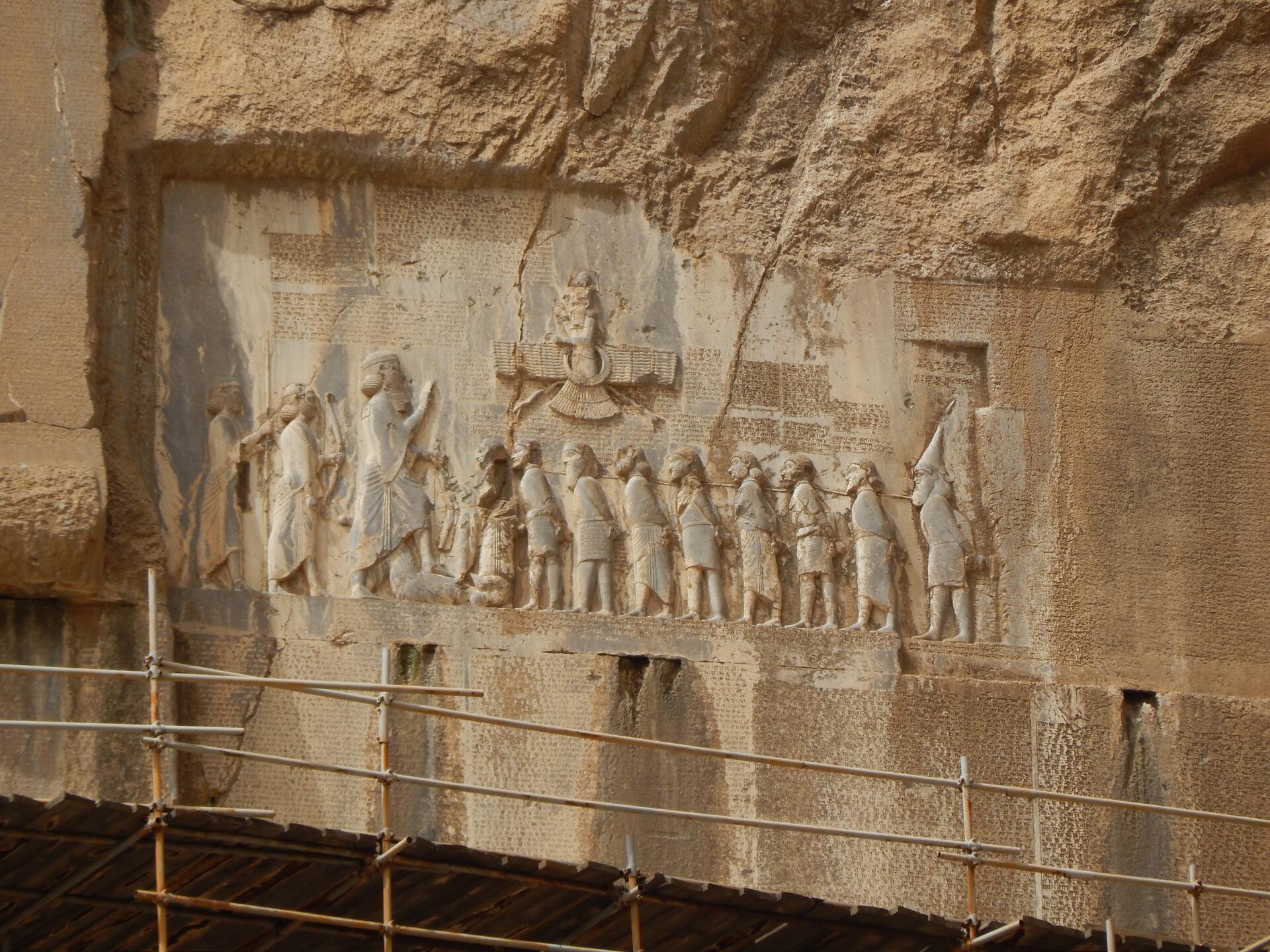
© Korosh.091, CC BY-SA 4.0 Resized from original. (This derivative is under the same CC BY-SA license.)
World Heritage Research
Discover scientific research and academic studies that deepen our understanding of Bisotun from its history and significance to its conservation, management, and contemporary challenges.
-
Abd Ṣāliḥ, Dhū'l-Qarnayn, and Monotheistic Agency in Achaemenid Iran: A Qurʾānic Perspective
A groundbreaking analysis reveals that the Qurʾānic concept of ʿabd ṣāliḥ ('righteous servant') serves as a lens to interpret Achaemenid Iran's monotheistic agency, particularly through Cyrus II and Darius I. This study challenges conventional theological readings by positioning ʿabd ṣāliḥ at the intersection of divine authority, political power, and historical responsibility. By comparing ethical-monotheistic principles from the Gāthās with Achaemenid inscriptions—especially Darius’s Bisotun inscription—and Qurʾānic frameworks, the research uncovers structural affinities in ritual practices between pre-Islamic Zoroastrianism and Islam. It also situates the Magians within a broader monotheistic historical tradition, avoiding anachronistic or doctrinal judgments. This approach facilitates comparative dialogue between Achaemenid political ideology, Qurʾānic thought, and pre-Islamic Iranian religion, offering a novel methodological framework for understanding divinely guided agency in ancient Iran.
aghajafari, amir. (2026). Abd Ṣāliḥ, Dhū'l-Qarnayn, and Monotheistic Agency in Achaemenid Iran: A Qurʾānic Perspective. Zenodo. https://doi.org/10.5281/ZENODO.18403675
View Publication Record | Read Publication -
Mil.avv.VI-IV asrlarda Markaziy Osiyoda madaniy hayot.
A comprehensive analysis of Central Asia's cultural life from the 6th to 4th centuries BCE reveals significant cultural synthesis processes that shaped the region's identity and its role in global civilization. The study, leveraging archaeological excavations (including sites like Afrosiyob, Qiziltepa, and Takhti Sangin), ancient texts (such as Doro I’s Bisotun inscriptions, Herodotus’ 'Histories,' and Avestan texts), and modern research (by scholars like P. Briant, V. Sarianidi, B. Marshak, and archaeologists from Uzbekistan and Tajikistan), examines distinct regions like Sogdiana, Bactria, Khorezm, and Margiana. It highlights the interconnected cultural developments that positioned Central Asia as a pivotal bridge between Eastern and Western civilizations during this transformative period.
Nasriddinov Dilovar, & Almuradov Iskandar. (2026). Mil.avv.VI-IV asrlarda Markaziy Osiyoda madaniy hayot. Zenodo. https://doi.org/10.5281/ZENODO.20140649
View Publication Record | Read Publication -
The Bisotun–Madharan route: the reconstruction of a lost communication route in the southern part of the Bisotun–Sahneh plain
A significant historical communication route connecting Kermanshah, Bisotun, Madharan, Kangavar, and Nahavand was reconstructed through a comprehensive analysis of Islamic geographical texts, primarily from the 9th and 10th centuries, alongside archaeological evidence. The study identifies seven historical toponyms along the southern bank of the Gamasiab River in the Bisotun–Sahneh plain, shedding light on its importance during the early Islamic period, particularly due to extensive Sassanid construction projects, including roads, bridges, palaces, and mansions developed by later kings like Khosrow II. This research marks the first detailed investigation of this route, integrating textual, archaeological, topographical, and geographical data to localize key historical landmarks.
Rezaei, I. (2026). The Bisotun–Madharan route: the reconstruction of a lost communication route in the southern part of the Bisotun–Sahneh plain. Journal of the Royal Asiatic Society, 36(3), 649–666. https://doi.org/10.1017/s1356186325101223
View Publication Record | Read Publication -
Some New Clues from the Ancient Land of Niššāya and its Related Toponyms
New evidence links the ancient land of Niššāya, known for horse breeding during the Neo-Assyrian period, to the modern Nahavand Plain in Hamadan Province. The study, based on Assyrian and Achaemenid inscriptions—including Darius I's Bisotun inscription—and classical historical accounts, identifies Niššāya/Irnisa (Neo-Assyrian), Nisāya (Achaemenid), and the Nesaean region mentioned by Herodotus and Strabo as one geographical entity. It also proposes locations for related toponyms Ṣibur/Ṣibar and Urimzan/Urenzan within Nahavand County, supported by archaeological and textual analysis. This challenges previous assumptions about Niššāya's significance in equine culture.
Rezaei, I. (2026). Some New Clues from the Ancient Land of Niššāya and its Related Toponyms. State Archives of Assyria Bulletin, 31(State Archives of Assyria Bulletin, V. 31 (2025), 25–34. https://doi.org/10.13136/1120-4699/31/025
View Publication Record | Read Publication -
Fors Yozma Adabiyot Tarixida Na’tlarning Muqaddimadagi O‘rni Xususida
A groundbreaking study reveals that Abulqosim Firdavsi's epic 'Shohnoma' marked the first instance of dedicating a separate section (na't) to Prophet Muhammad in Persian literary tradition, establishing a precedent for such poetic tributes in prefaces and introductions. Prior to this, na'ts were embedded within longer works without distinct structural placement. The research analyzes Behistun inscriptions—a foundational written source—and Firdavsi's 10th-century text to demonstrate how the latter formalized this literary convention, reshaping Persian prose and poetry. This finding challenges traditional assumptions about the evolution of devotional writing in Islamic literature.
Olimova Shuhrat qizi, G. (2026). FORS YOZMA ADABIYOTI TARIXIDA NA’TLARNING MUQADDIMADAGI O‘RNI XUSUSIDA. Science Time, 4(7/2), 89–91. https://doi.org/10.66345/st.6991
View Publication Record | Read Publication -
Sassanid Artifacts in Western Iran
Western Iran emerged as a pivotal region during the Sassanid Empire, characterized by its strategic significance and architectural grandeur. The presence of monumental structures such as Bisotun, Taq-e-Bostan, and Qasr-e-Shirin underscores the empire's focus on this area, driven by favorable climate and fertile lands. These sites, including palaces, caravanserais, rock carvings, and bridges—particularly those commissioned under Khosrow Parviz—highlight the Sassanids' ambition and power. The study identifies key buildings like Taq-e-Shirin, Farhad-e-Tarash Wall, and Bisotun Bridge, analyzing their functions and the empire's motivations for development in this region. Employing a library-based, descriptive-analytical approach, the research addresses two central questions: the purpose behind each structure's construction and the reasons for Sassanid attention to western Iran. This work offers insights into the empire's architectural achievements and regional strategies.
Moradi, S. (2025). Sassanid Artifacts in Western Iran. Universum Humanitarium, (1), 108–122. https://doi.org/10.25205/2499-9997-2025-1-108-122
View Publication Record | Read Publication -
On the Rocks: The Unfinished Story of the Babylonian Version of the Bīsotūn (Behistun) Inscription (Db Bab.)
A critical re-examination of the Babylonian (Akkadian) version of the Bīsotūn (Behistun) Inscription reveals that the surviving text is approximately two-thirds longer than previously recorded, challenging the reliability of the standard edition. The study, led by Hackl, scrutinizes new readings from Von Voigtlander's work, supported by correspondence with George G. Cameron and Matthew W. Stolper, which significantly expand our understanding of this ancient inscription. This research sheds light on the inscription's editorial history and its implications for interpreting Babylonian historical records.
Hackl, J. (2025). ON THE ROCKS: THE UNFINISHED STORY OF THE BABYLONIAN VERSION OF THE BĪSOTŪN (BEHISTUN) INSCRIPTION (DB BAB.). Iraq, 87, 143–162. https://doi.org/10.1017/irq.2025.10033
View Publication Record | Read Publication