World Heritage Identification Number: 1077
World Heritage since: 2003
Category: Cultural Heritage
WHE Type: Archaeological Sites
Transboundary Heritage: No
Endangered Heritage: No
Country: 🇮🇷 Iran (Islamic Republic of)
Continent: Asia
UNESCO World Region: Asia and the Pacific
Map
Takht-e Soleyman: A Unique Blend of Ancient Persian and Islamic Architecture
Takht-e Soleyman, located in the West Azerbaijan province of Iran, is a remarkable archaeological site that offers a fascinating glimpse into the rich cultural heritage of ancient Persia. Inscribed as a UNESCO World Heritage Site in 2003, this significant historical complex is nestled in a valley within a volcanic mountain region, providing a striking natural backdrop to its ancient structures.
More to come…UNESCO Description of the World Heritage Site
The archaeological site of Takht-e Soleyman, in north-western Iran, is situated in a valley set in a volcanic mountain region. The site includes the principal Zoroastrian sanctuary partly rebuilt in the Ilkhanid (Mongol) period (13th century) as well as a temple of the Sasanian period (6th and 7th centuries) dedicated to Anahita. The site has important symbolic significance. The designs of the fire temple, the palace and the general layout have strongly influenced the development of Islamic architecture.
UNESCO Justification of the World Heritage Site
Criterion (i): Takht-e Soleyman is an outstanding ensemble of royal architecture, joining the principal architectural elements created by the Sasanians in a harmonious composition inspired by their natural context.
Criterion (ii): The composition and the architectural elements created by the Sasanians at Takht-e Soleyman have had strong influence not only in the development of religious architecture in the Islamic period, but also in other cultures.
Criterion (iii): The ensemble of Takht-e Soleyman is an exceptional testimony of the continuation of cult related to fire and water over a period of some two and half millennia. The archaeological heritage of the site is further enriched by the Sasanian town, which is still to be excavated.
Criterion (iv): Takht-e Soleyman represents an outstanding example of Zoroastrian sanctuary, integrated with Sasanian palatial architecture within a composition, which can be seen as a prototype.
Criterion (vi): As the principal Zoroastrian sanctuary, Takht-e Soleyman is the foremost site associated with one of the early monotheistic religions of the world. The site has many important symbolic relationships, being also a testimony of the association of the ancient beliefs, much earlier than the Zoroastrianism, as well as in its association with significant biblical figures and legends.
Encyclopedia Record: Takht-e Soleymān
Takht-e Soleymān, is an archaeological site in West Azerbaijan, Iran dating back to the Sasanian Empire. It lies midway between Urmia and Hamadan, very near the present-day town of Takab, and 400 km (250 mi) west of Tehran.Additional Site Details
Area: 10 hectares
Number of Components: 1
(ii) — Significant interchange of human values
(iii) — Unique or exceptional testimony to a cultural tradition
(iv) — Outstanding example of a type of building or landscape
(vi) — Directly associated with events or living traditions
Coordinates: 36.60388889 , 47.235
Image
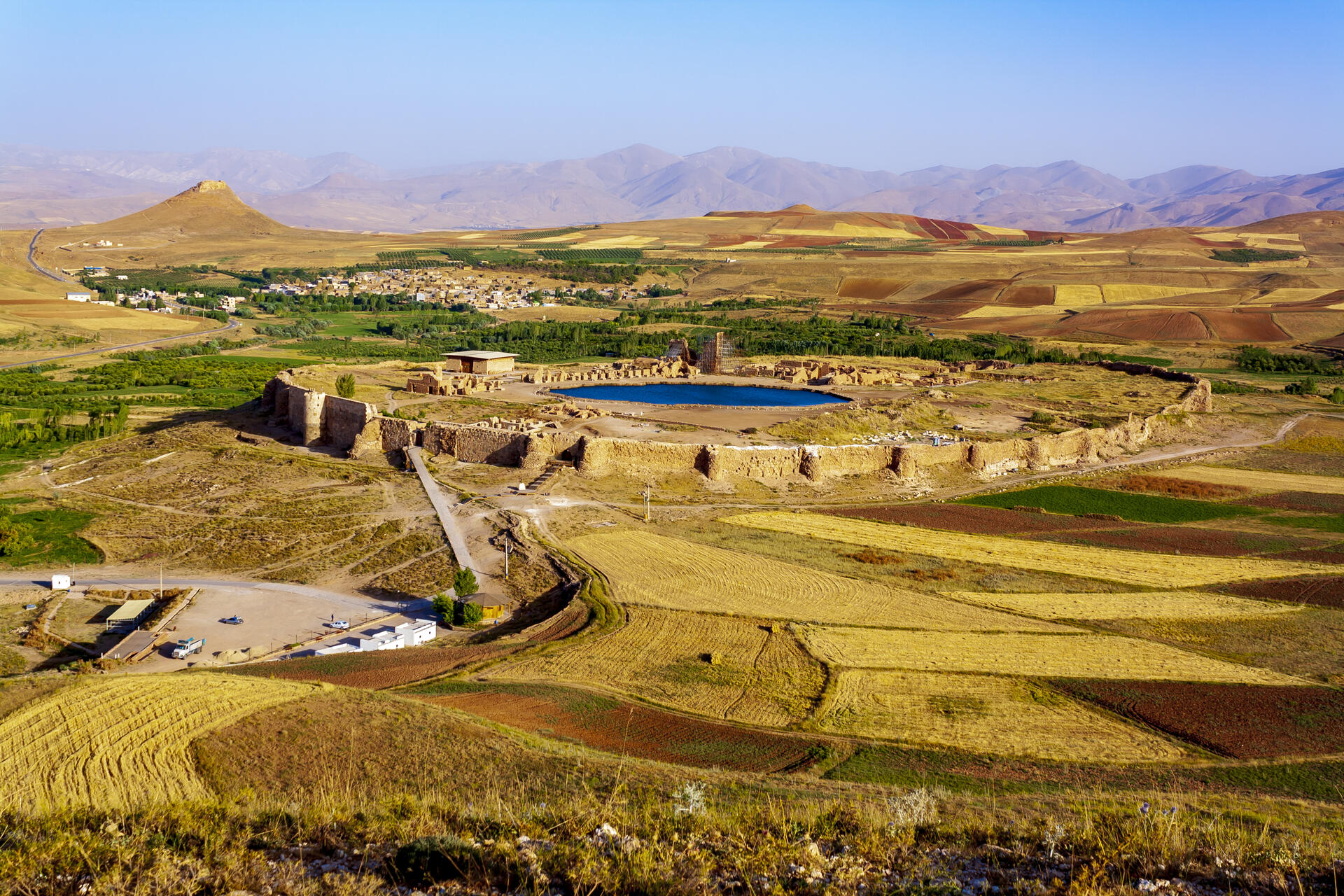
© Elaheabed, CC BY-SA 4.0 Resized from original. (This derivative is under the same CC BY-SA license.)
World Heritage Research
Discover scientific research and academic studies that deepen our understanding of Takht-e Soleyman from its history and significance to its conservation, management, and contemporary challenges.
-
Optimization of multi-element geochemical anomaly recognition in the Takht-e Soleyman area of northwestern Iran using swarm-intelligence support vector machine
A groundbreaking approach using the grasshopper optimization algorithm combined with support vector machine (SVM) has achieved over 95% accuracy in detecting multi-element geochemical anomalies at Takht-e Soleyman, a UNESCO World Heritage Site in northwestern Iran. This method eliminates the need for trial-and-error hyperparameter tuning, significantly reducing training time while maintaining high precision. The optimized SVM model, utilizing polynomial and radial basis kernel functions, not only advances mineral exploration under barren cover but also sets a precedent for applying swarm-intelligence techniques in geoscientific applications. This innovation could revolutionize the identification of undiscovered mineral deposits, addressing a critical challenge in industrial progress.
Sabbaghi, H., Tabatabaei, S. H., & Fathianpour, N. (2025). Optimization of multi-element geochemical anomaly recognition in the Takht-e Soleyman area of northwestern Iran using swarm-intelligence support vector machine. Frontiers in Earth Science, 13. https://doi.org/10.3389/feart.2025.1352912
View Publication Record | Read Publication -
Ritual Architecture and Cultural Identity: A Comparative Study of the Anahita Temples at Bishapur and Takht-e Soleyman
A comparative analysis of the Anahita temples at Bishapur and Takht-e Soleyman reveals their pivotal role in sustaining Iran's ritual architectural traditions. These sacred sites, dedicated to the goddess of water (Anahita), were strategically located near water sources, symbolizing a deep spiritual connection with nature. The study highlights differences in architectural designs, religious functions, symbolic meanings, and construction materials between the two temples, emphasizing their significance in preserving cultural identity across historical periods. By integrating library-based research with field observations, this work underscores how these temples reflect Iran's enduring architectural and religious heritage.
Asadi, M., & Mahmoudi, M. K. (2026). Ritual Architecture and Cultural Identity: A Comparative Study of the Anahita Temples at Bishapur and Takht-e Soleyman. Archaeology of Iran, 16(1). https://doi.org/10.82101/AOI.2026.1220196
View Publication Record | Read Publication -
Regimentation of geochemical indicator elements employing convolutional deep learning algorithm
A convolutional deep learning (CDL) algorithm has demonstrated high accuracy in clustering geochemical indicator elements, achieving root mean square error (RMSE) values below 20% and adjusted R² values above 90%. This approach significantly outperforms traditional methods for recognizing multi-element geochemical anomalies, particularly in mineral exploration contexts. Applied to the Takht-e Soleyman District in Iran, the algorithm effectively predicted dependent variables such as lead (Pb) and silver (Ag) using their independent variables, confirming its robustness and potential for broader geological studies.
Sabbaghi, H., & Tabatabaei, S. H. (2023). Regimentation of geochemical indicator elements employing convolutional deep learning algorithm. Frontiers in Environmental Science, 11. https://doi.org/10.3389/fenvs.2023.1076302
View Publication Record | Read Publication -
Geology, geochemistry, fluid inclusion data, stable isotope characteristics, and ore genesis of the Barout Aghaji gold deposit, NW Zanjan, Iran
Gold mineralization at the Barout Aghaji deposit, located within Iran's Takht-e Soleyman region, exhibits characteristics of both orogenic and intrusion-related gold deposits. The study reveals that low-salinity fluids derived from metamorphic rocks mixed with high-salinity fluids possibly sourced from granitic gneisses during syn- to post-tectonic magmatism. Fluid inclusion analysis indicates homogenization temperatures ranging from 199–446°C, with a mode of 270–300°C, and salinities varying between 0.8–49.02 wt% NaCl Equiv., suggesting complex fluid dynamics. Sulfur isotope data (δ³⁴S values of +2.9 to +7.1‰) further supports a metamorphic origin for sulfur. The research integrates field observations, geochemistry, and stable isotopes to elucidate the deposit's ore genesis.
Asli, B., Ali Asghar Mokhtari, M., & Jamali, H. (2023). Geology, geochemistry, fluid inclusion data, stable isotope characteristics, and ore genesis of the Barout Aghaji gold deposit, NW Zanjan, Iran. Journal of Asian Earth Sciences: X, 9, 100139. https://doi.org/10.1016/j.jaesx.2023.100139
View Publication Record | Read Publication -
Bodies and Glazes of Architectural Ceramics from the Ilkhanid Period at Takht-e Soleyman (North-Western Iran)
Architectural ceramics from the Ilkhanid period at Takht-e Soleyman reveal that tiles were predominantly made with clay or stonepaste and decorated with a mixed alkaline lead glaze containing 8–25 wt% PbO. This glaze composition was also found on kiln furniture residues, suggesting consistent production techniques. The study used non-invasive μXRF for qualitative analysis and SEM/EDX for quantitative insights, providing detailed material characterization. While the findings highlight the technical characteristics of these ceramics, further petrographic analysis is recommended to clarify local or regional production origins.
Röhrs, S., Dumazet, A., Kuntz, K., & Franke, U. (2022). Bodies and Glazes of Architectural Ceramics from the Ilkhanid Period at Takht-e Soleyman (North-Western Iran). Minerals, 12(2), 158. https://doi.org/10.3390/min12020158
View Publication Record | Read Publication -
Mineral chemistry, P-T and tectonometamorphic evolutions of garnet amphibolites from the Takht-e-Soleyman, NW Takab
Garnet amphibolites from Takht-e-Soleyman, a UNESCO World Heritage Site in Iran, reveal distinct mineral chemistry and metamorphic evolution linked to tectonic processes. The study identifies pressure-temperature (P-T) conditions of approximately 6–8 kbar and 700–750°C during the metamorphic peak, suggesting subduction-related metamorphism. Mineral compositions indicate complex fluid-rock interactions, with garnet showing zoning patterns that reflect changes in pressure and temperature over time. This research provides critical insights into the tectonometamorphic history of the region, contributing to a better understanding of the geological dynamics that shaped Takht-e-Soleyman's unique landscape.
Hajialioghli, R.,. (2018). Mineral chemistry, P-T and tectonometamorphic evolutions of garnet amphibolites from the Takht-e-Soleyman, NW Takab. Iranian Journal of Crystallography and Mineralogy, 25(4), 749–760. https://doi.org/10.29252/ijcm.25.4.749
View Publication Record | Read Publication -
Safeguarding and retrofitting works at the UNESCO World Heritage Site Takht‐e Soleyman, Iran
A collaborative effort between the Technical University of Dresden and Iran's cultural heritage organization successfully stabilized the Western Eivan at Takht-e Soleyman, a 6th-century AD fire temple and UNESCO World Heritage Site. The project, supported by Germany’s Federal Foreign Office, employed advanced safeguarding techniques to address structural decay caused by centuries of abandonment and neglect. Preliminary investigations in 2016 laid the groundwork for further stabilization planned for 2018, ensuring the preservation of this historically significant Ilkhanid-era complex.
Burkert, T., Fuchs, C., & Schweinfurth, J. (2018). Safeguarding and retrofitting works at the UNESCO World Heritage Site Takht‐e Soleyman, Iran. Mauerwerk, 22(2), 91–102. Portico. https://doi.org/10.1002/dama.201800009
View Publication Record | Read Publication