World Heritage Identification Number: 1433
World Heritage since: 2012
Category: Cultural Heritage
WHE Type: Religious Sites & Sacred Architecture
Transboundary Heritage: No
Endangered Heritage: No
Country: 🇵🇸 State of Palestine
Continent: Asia
UNESCO World Region: Arab States
Map
The Church of the Nativity and the Pilgrimage Route in Bethlehem: A Spiritual Journey through History
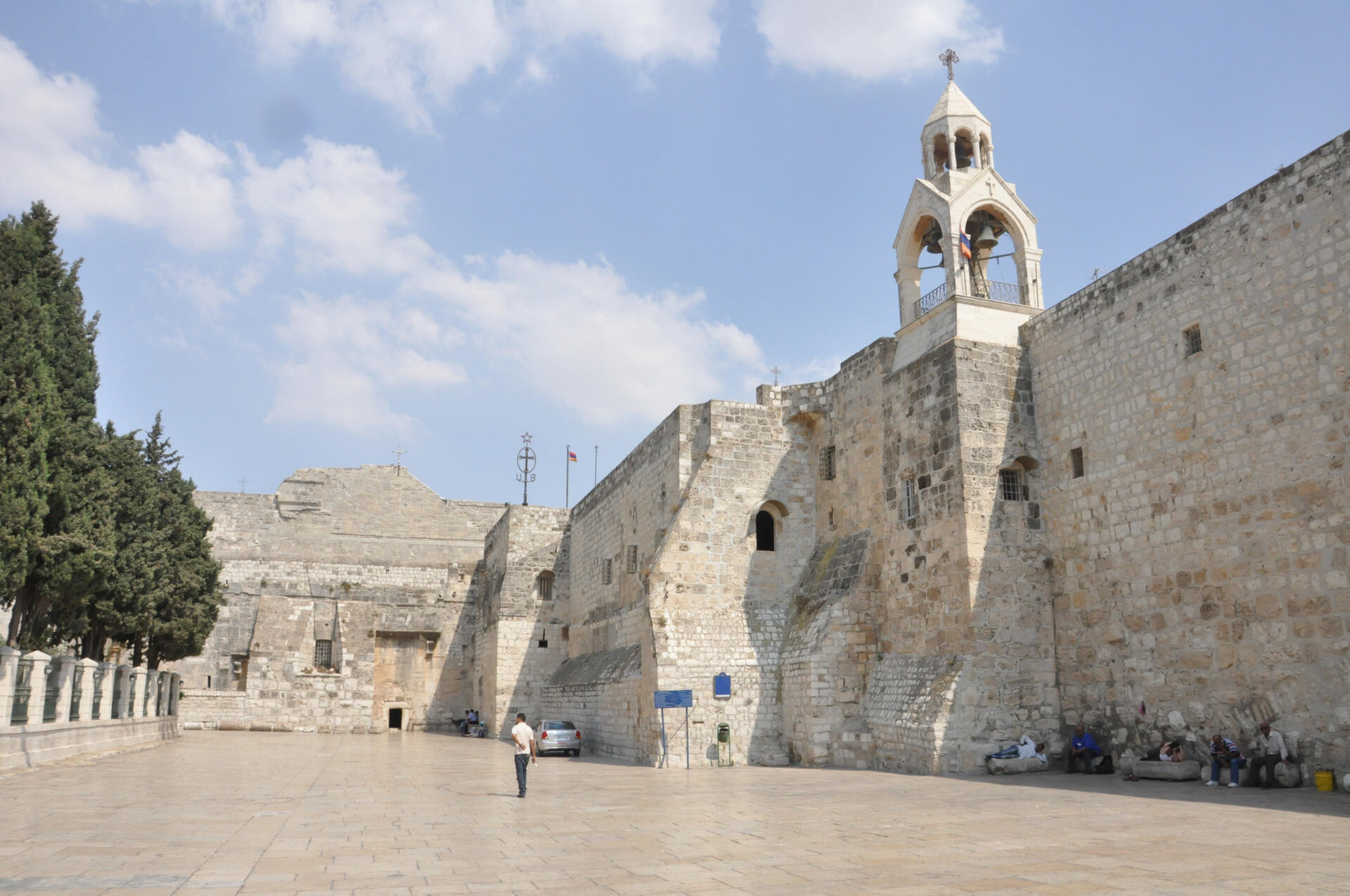
The Church of the Nativity and the Pilgrimage Route in Bethlehem, Palestine, is a significant religious site for Christians around the world. Inscribed as a UNESCO World Heritage Site in 2012, this location has been a focal point of Christian pilgrimage for centuries due to its association with the birthplace of Jesus Christ.
The Church of the Nativity, officially known as the Basilica of the Nativity, is among the oldest continuously used Christian churches in the world. It stands on the site identified by Christian tradition as the birthplace of Jesus since the 2nd century. The first monumental church was commissioned in the 4th century by Emperor Constantine the Great and his mother Helena, and was completed around AD 339.
The Constantinian church was damaged during the Samaritan revolts in the early 6th century. It was subsequently rebuilt and expanded under Emperor Justinian I, whose structure largely survives today. Excavations within the basilica reveal floor mosaics from the original 4th-century church, visible through protective glass panels, offering rare insight into the site’s early history.
Architecturally, the Church of the Nativity is characterized primarily by Early Christian and Byzantine design. Later alterations, particularly during the Crusader period, added decorative elements such as 12th-century wall mosaics. One of the church’s most distinctive features is its low entrance, known as the Door of Humility, which requires visitors to bow as they enter. Beneath the main altar lies the Grotto of the Nativity, a small cave revered by Christian tradition as the place where Jesus was born.
The church complex is shared by several Christian denominations under a long-standing arrangement known as the Status Quo. The principal communities are the Greek Orthodox, Armenian Apostolic, and Roman Catholic (Franciscan) churches, each maintaining convents and chapels adjacent to the basilica. Together, these structures reflect the long and sometimes complex history of Christian presence in Bethlehem.
The Pilgrimage Route associated with the Church of the Nativity extends beyond the basilica itself. It traditionally guides pilgrims through sites linked to the Nativity story, including the Shepherds’ Fields, where angels are said to have announced Jesus’ birth to shepherds, and the Milk Grotto, believed to be where Mary nursed Jesus. These locations form an integral part of the spiritual and historical landscape of Bethlehem.
The Church of the Nativity and the Pilgrimage Route in Bethlehem serve as a testament to the enduring power of faith and the importance of preserving historical sites. They offer a unique opportunity for visitors to walk in the footsteps of history and connect with their religious heritage. Despite the challenges faced by the region, the site continues to attract large numbers of pilgrims and visitors every year, reinforcing its status as a sacred place of global significance.
UNESCO Description of the World Heritage Site
The inscribed property is situated 10 km south of Jerusalem on the site identified by Christian tradition as the birthplace of Jesus since the 2nd century. A church was first completed there in ad 339 and the edifice that replaced it after a fire in the 6th century retains elaborate floor mosaics from the original building. The site also includes Latin, Greek Orthodox, Franciscan and Armenian convents and churches, as well as bell towers, terraced gardens and a pilgrimage route.
UNESCO Justification of the World Heritage Site
Criterion (iv): The Church of the Nativity is an outstanding example of an early church in a remarkable architectural ensemble; which illustrates two significant stages in human history in the 4th-6th centuries AD the conversion of the Roman Empire to Christianity, which led to the development of the Church of the Nativity on the site believed to be associated with the birth of Jesus; and to the power and influence of Christianity in the period of the Crusades that led to the embellishment of the Church of the Nativity and the development of three major convents in its environs.
Criterion (vi): The Church of the Nativity, and the Pilgrimage Route to it, are directly associated with the birth of Jesus, an event of outstanding universal significance, through the buildings of which were constructed in the 4th century AD and re-constructed in the 6th century AD. These are a strong symbol for more than 2 billion Christian believers in the world; and are Holy to Christians as well as to Muslims.
Encyclopedia Record: Church of the Nativity
The Church of the Nativity, or Basilica of the Nativity, is a basilica located in Bethlehem, West Bank, Palestine. The grotto holds a prominent religious significance to Christians of various denominations as the birthplace of Jesus. The grotto is the oldest site continuously used as a place of worship in Christianity, and the basilica is the oldest major church in the Holy Land.Additional Site Details
Area: 2.98 hectares
Number of Components: 1
(vi) — Directly associated with events or living traditions
Coordinates: 31.7043527778 , 35.2075
World Heritage Research
Discover scientific research and academic studies that deepen our understanding of Birthplace of Jesus: Church of the Nativity and the Pilgrimage Route, Bethlehem from its history and significance to its conservation, management, and contemporary challenges.
-
Writing in the Church of the Nativity in Bethlehem
The Church of the Nativity in Bethlehem is revealed as a rich epigraphic site with hundreds of inscriptions and graffiti spanning multiple languages and centuries. A recent study, involving a collaborative effort by epigraphists, historians, and art historians, uncovers a 'graphic symphony' of Latin, Greek, Arabic, Syriac, Armenian, Georgian, Slavic, and Rus scripts. This research challenges traditional labels like 'graffiti' and 'inscriptions,' instead exploring their purposes, materials, techniques, and distribution within the church's complex. The study highlights the interactions between different writings and languages, offering a new chapter in the history of this holy site and its use by pilgrims.
Ingrand-Varenne, E., & Dussart, C. (Eds.). (2026). Writing in the Church of the Nativity in Bethlehem. Cultural Encounters in Late Antiquity and the Middle Ages. https://doi.org/10.1484/m.celama-eb.5.150719
View Publication Record | Read Publication -
Portraits, Graffiti, and Tattoos. Visual Indicators of Individual Piety on the Columns and Walls of the Nativity Church in Bethlehem
A comparative analysis of visual indicators—portraits, graffiti, and tattoos—reveals how these elements serve as strategies for pilgrims to metonymically incorporate themselves into the sanctity of the Church of the Nativity in Bethlehem. The study highlights the significance of supplicant images from the 12th century, offering new interpretations of their functions within performative contexts. Additionally, it examines the exponential increase in graffiti post-Crusader period, suggesting these markings aim to inscribe and perpetuate the embodied experience of the divine sphere in this sacred locus. The research employs a methodical approach to analyze these visual indicators, providing insights into their roles and impacts on individual piety.
(Ed.). (2026). Portraits, Graffiti, and Tattoos. Visual Indicators of Individual Piety on the Columns and Walls of the Nativity Church in Bethlehem. Writing in the Church of the Nativity in Bethlehem, 133–153. https://doi.org/10.1484/m.celama-eb.5.151595
View Publication Record | Read Publication -
From Abraham to Christ. A Family Tree on the Scale of the Church and its Epigraphic Exegesis
A monumental Tree of Jesse on the counter-façade of the Church of the Nativity in Bethlehem, depicting genealogical ramifications and integrating prophetic inscriptions from the Old Testament and Gospels, offers a rare surviving example of such depictions in the East. This visual representation provides theological commentary linking Christ's first coming to his Second Coming (Parousia) and connects with Advent and Christmas liturgies. The study examines how Latin inscriptions were used to enhance the narrative, revealing the church's epigraphic exegesis and its role in religious symbolism.
(Ed.). (2026). From Abraham to Christ. A Family Tree on the Scale of the Church and its Epigraphic Exegesis. Writing in the Church of the Nativity in Bethlehem, 61–78. https://doi.org/10.1484/m.celama-eb.5.151591
View Publication Record | Read Publication -
How is Graffiti Done? . Scratching, Incising, and Engraving Stone in Bethlehem
Stone graffiti in the Church of the Nativity, Bethlehem, reveals sophisticated techniques contrary to the notion of spontaneous creation. The study identifies three primary methods: incision with simple tools like knives or points, often aided by rulers; hollow engraving using percussed dots, either isolated or connected; and V-shaped engraving through lateral percussion. These varied approaches, involving a range of skills and instruments, challenge the idea that such graffiti was created impulsively. Instead, they suggest a deliberate, premeditated process, blending improvisation with precision.
(Ed.). (2026). How is Graffiti Done? . Scratching, Incising, and Engraving Stone in Bethlehem. Writing in the Church of the Nativity in Bethlehem, 125–132. https://doi.org/10.1484/m.celama-eb.5.151594
View Publication Record | Read Publication -
Quotation and Glorification. Bethlehem’s Conciliar Texts in Local Context
A re-evaluation of the Church of the Nativity’s mosaics challenges conventional views, revealing that local Arabic-speaking mosaicists played an active role in their design. Contrary to the typical interpretation as mere 'Crusader' art reflecting Mediterranean exchange, this study demonstrates that the conciliar representations in the nave were deeply rooted in a Palestinian epigraphic tradition. The Greek texts on the walls functioned as signs of identity and history for a multilingual audience, suggesting a more complex local context than previously understood.
(Ed.). (2026). Quotation and Glorification. Bethlehem’s Conciliar Texts in Local Context. Writing in the Church of the Nativity in Bethlehem, 41–59. https://doi.org/10.1484/m.celama-eb.5.151590
View Publication Record | Read Publication -
Ancient Georgian Inscriptions in the Church of the Nativity in Bethlehem and ‘Bethlehems’ in Georgia
Thirteen ancient Georgian inscriptions, including one attributed to Catholicos Maxime I of western Georgia (1639–1657), have been identified within the Church of the Nativity in Bethlehem. These inscriptions reveal a rich history of Georgian pilgrimage and religious engagement in the Holy Land during the 14th to 16th centuries, with Georgians establishing their own monasteries or residing alongside monks from other nationalities. The study highlights how Georgians brought sacral toponyms like 'Bethlehem' back to Georgia, leading to the founding of churches and monasteries dedicated to the Virgin of Bethlehem across the region.
(Ed.). (2026). Ancient Georgian Inscriptions in the Church of the Nativity in Bethlehem and ‘Bethlehems’ in Georgia. Writing in the Church of the Nativity in Bethlehem, 225–239. https://doi.org/10.1484/m.celama-eb.5.151600
View Publication Record | Read Publication -
Armenian Inscriptions and Graffiti of the Nativity Church in Bethlehem
Over seventy Armenian inscriptions and graffiti, the oldest dating to the early 13th century, have been identified within the Church of the Nativity in Bethlehem. This study highlights twenty of these inscriptions, providing a glimpse into the historical presence and contributions of Armenians in the Holy Land, particularly at this UNESCO World Heritage Site. The research involved two brief visits to the church, during which inscriptions were meticulously documented and analyzed. These findings contribute to our understanding of medieval Armenian cultural and religious activity in a significant Christian pilgrimage destination.
(Ed.). (2026). Armenian Inscriptions and Graffiti of the Nativity Church in Bethlehem. Writing in the Church of the Nativity in Bethlehem, 203–223. https://doi.org/10.1484/m.celama-eb.5.151599
View Publication Record | Read Publication