World Heritage Identification Number: 1585
World Heritage since: 2021
Category: Cultural Heritage
WHE Type: Infrastructure & Industry
Transboundary Heritage: No
Endangered Heritage: No
Country: 🇮🇷 Iran (Islamic Republic of)
Continent: Asia
UNESCO World Region: Asia and the Pacific
Map
The Trans-Iranian Railway: A Testament to Engineering and National Pride
The Trans-Iranian Railway, inscribed as a UNESCO World Heritage Site in 2021, stands as a remarkable testament to engineering prowess, national resilience, and the spirit of collaboration. This expansive railway network stretches across 1,394 kilometers, connecting the Caspian Sea in the northeast with the Persian Gulf in the southwest, traversing diverse landscapes and climates.
More to come…UNESCO Description of the World Heritage Site
The Trans-Iranian Railway connects the Caspian Sea in the northeast with the Persian Gulf in the southwest crossing two mountain ranges as well as rivers, highlands, forests and plains, and four different climatic areas. Started in 1927 and completed in 1938, the 1,394-kilometre-long railway was designed and executed in a successful collaboration between the Iranian government and 43 construction contractors from many countries. The railway is notable for its scale and the engineering works it required to overcome steep routes and other difficulties. Its construction involved extensive mountain cutting in some areas, while the rugged terrain in others dictated the construction of 174 large bridges, 186 small bridges and 224 tunnels, including 11 spiral tunnels. Unlike most early railway projects, construction of the Trans-Iranian Railway was funded by national taxes to avoid foreign investment and control.UNESCO Justification of the World Heritage Site
Criterion (ii): The Trans-Iranian Railway is the living manifestation of the multi-faceted interchange of human values, represented by the application of railway skills and experience in railway construction, leading to the emergence of a mixed Iranian-Western architectural style. The Trans-Iranian Railway boosted the economy and trade by speeding up transportation, which led to the revival of cultural-historical routes such as the Silk Road and the Spice Route at a specific period in the contemporary history in Central and West Asia during the early 20th century. This practice was later expanded to European countries. The Trans-Iranian Railway also served to connect the Persian Gulf to the Caspian Sea. In addition, at the time it was built, the Trans-Iranian Railway promoted exemplary project management, which was achieved as a result of the successful working relations established between the Iranian Government, the project managers and the 40 Iranian or international companies established in 43 construction zones en route with a totally deployed work force of over 65,000 engineers, office staff members and labourers. Located in a mountainous landscape, the Trans-Iranian Railway proved an outstanding tool for solving unexpected problems, an achievement owing to the international breadth of experience that was applied in its construction, enabling the Trans-Iranian Railway project, overall, to stay on time and on budget.
Criterion (iv): The Trans-Iranian Railway is a fine example of a technological and architectural ensemble representing major stages of long-term development of human, technical and economic activities as early as the 20th century, in Western Asia. It played a unique role in the modernization of Iran. This role was firstly maintained through the function of the Trans-Iranian Railway in importing and domesticating western technologies, and secondly through national financing, enabling and also managing construction activities and their implementation, and finally through its unique impact on the country's social, economic, and cultural spheres. It has also caused a huge increase in trade, and cultural and economic relations between different regions within Iran and between Iran and other countries of the region. Thus, it has marked a significant and decisive stage in the process of the historical development of Iran and other countries of the region. This altogether paved the way for later communication and transportation activities with many parts of the world. The Trans-Iranian Railway is the embodiment of the creative usage of various technologies aimed at gaining access to plains, highlands, forests and coastal regions at both ends of the country and linking the northern and southern shores of Iran.
Encyclopedia Record: Trans-Iranian Railway
The Trans-Iranian Railway was a major railway building project started in Pahlavi Iran in 1927 and completed in 1938, under the direction of the then-Iranian monarch Reza Shah. It was entirely built with indigenous capital, and links the capital Tehran with Bandar Shahpur on the Persian Gulf in the south and Bandar Shah on the Caspian Sea in the north, via Ahvaz and Ghom. In 1961, under Reza Shah's son Mohammad Reza Pahlavi, it was extended from Bandar Shah to a new terminus in Gorgan. During the land reforms of Mohammad Reza Pahlavi in 1963, as part of the "White Revolution", the Trans-Iranian railway was extended to link Tehran to Mashhad, Tabriz and Isfahan.Additional Site Details
Area: 5,784 hectares
Number of Components: 1
(iv) — Outstanding example of a type of building or landscape
Coordinates: 35.6583055556 , 51.3983333333
Image
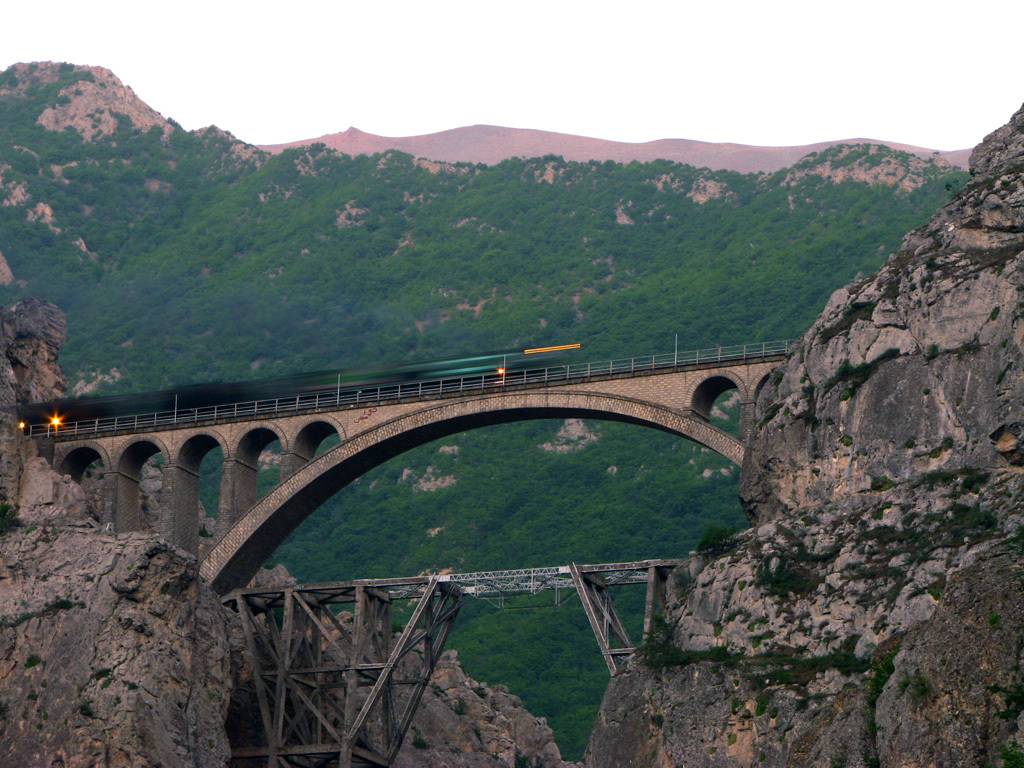
© Alireza Shakernia, CC BY-SA 3.0 Resized from original. (This derivative is under the same CC BY-SA license.)