World Heritage Identification Number: 1422
World Heritage since: 2013
Category: Cultural Heritage
WHE Type: Buildings & Architectural Ensembles
Transboundary Heritage: No
Endangered Heritage: No
Country: 🇮🇷 Iran (Islamic Republic of)
Continent: Asia
UNESCO World Region: Asia and the Pacific
Map
Golestan Palace: A Gem of Qajar Era Architecture
The Golestan Palace, located in the heart of Tehran, Iran, stands as a testament to the harmonious fusion of traditional Persian craftsmanship with Western influences during the Qajar era. Inscribed as a UNESCO World Heritage Site in 2013, this architectural marvel offers a unique blend of history, art, and culture that continues to inspire contemporary Iranian artists and architects.
More to come…UNESCO Description of the World Heritage Site
The lavish Golestan Palace is a masterpiece of the Qajar era, embodying the successful integration of earlier Persian crafts and architecture with Western influences. The walled Palace, one of the oldest groups of buildings in Teheran, became the seat of government of the Qajar family, which came into power in 1779 and made Teheran the capital of the country. Built around a garden featuring pools as well as planted areas, the Palace’s most characteristic features and rich ornaments date from the 19th century. It became a centre of Qajari arts and architecture of which it is an outstanding example and has remained a source of inspiration for Iranian artists and architects to this day. It represents a new style incorporating traditional Persian arts and crafts and elements of 18th century architecture and technology.
UNESCO Justification of the World Heritage Site
Criterion (ii): The complex of Golestan Palace represents an important example of the merging of Persian arts and architecture with European styles and motifs and the adaptation of European building technologies, such as the use of cast iron for load bearing, in Persia. As such Golestan Palace can be considered an exceptional example of an east-west synthesis in monumental arts, architectural layout and building technology, which has become a source of inspiration for modern Iranian artists and architects.
Criterion (iii): Golestan Palace contains the most complete representation of Qajari artistic and architectural production and bears witness to the centre of power and arts at the time. Hence, it is recognized as an exceptional testimony to the Qajari Era.
Criterion (iv): Golestan Palace is a prime example of the arts and architecture in a significant period in Persia, throughout the 19th century when the society was subject to processes of modernization. The influential role of artistic and architectural values of ancient Persia as well as the contemporary impacts of the West on the arts and architecture were integrated into a new type of arts and architecture in a significant transitional period.
Encyclopedia Record: Golestan Palace
The Golestan Palace, is the former official royal Qajar complex in Tehran, Iran. One of the oldest historic monuments in the capital and a UNESCO World Heritage Site, the Golestan Palace consists of a group of royal buildings that were once enclosed within the mud-thatched defensive walls of Tehran's citadel. It also houses vast gardens and a huge collection of Iranian and European crafts and gifts from the 18th and 19th centuries.Additional Site Details
Area: 5.3 hectares
Number of Components: 1
(iii) — Unique or exceptional testimony to a cultural tradition
(iv) — Outstanding example of a type of building or landscape
Coordinates: 35.6803666667 , 51.4205111111
Image
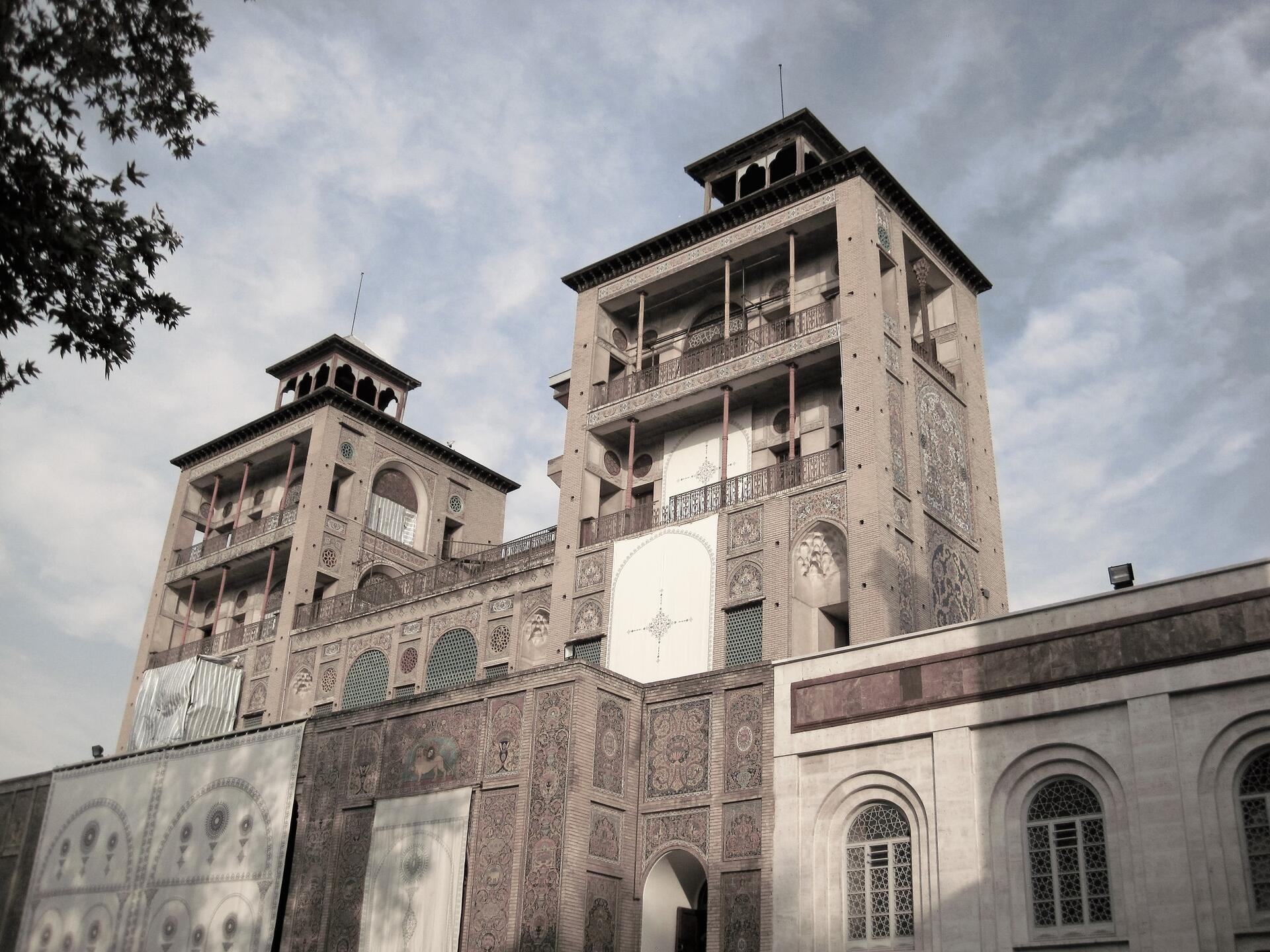
© Miladpoorali, CC BY-SA 4.0 Resized from original. (This derivative is under the same CC BY-SA license.)
World Heritage Research
Discover scientific research and academic studies that deepen our understanding of Golestan Palace from its history and significance to its conservation, management, and contemporary challenges.
-
Akbar’s History of the Mongols
A rare and exquisitely illustrated manuscript, 'Akbar’s History of the Mongols' (Chingīznāma), originating from the atelier of Mughal emperor Akbar (r. 1556–1605), has been meticulously documented in its current state after surviving theft, dispersal, and partial recovery. This study reconstructs the manuscript's history, detailing the loss and renumbering of 98 paintings, which were part of Rashīd al-Dīn’s 'Jāmiʿ al-tavārīkh,' a celebrated but understudied work on Mongol history. The research employs a combination of historical analysis, codicological examination, and provenance tracking to identify missing illustrations and clarify the manuscript's complex journey from Akbar's royal library in India to its eventual return to the Golestan Palace Museum Library in Tehran. This work sheds light on the cultural significance and artistic legacy of Mughal-era manuscripts while preserving a fragment of their lost visual narrative.
Melville, C. (2026). Akbar’s History of the Mongols. Journal of Islamic Manuscripts, 17(2), 121–169. https://doi.org/10.1163/1878464x-01604008
View Publication Record | Read Publication -
Cleaning Methods for Historic Building Facades: A Systematic Review and Decision-Making Framework
No single cleaning method universally suits historic building facades; effective intervention demands material-specific and climate-specific diagnostics. A systematic review of 78 peer-reviewed studies (1990–2025) across six linguistic traditions introduces a multi-criteria decision-making framework that operationalizes the principle of minimum intervention, emphasizing necessity assessment, substrate characterization, contaminant diagnosis, and post-intervention monitoring. The study highlights femtosecond laser cleaning, biocleaning, and nanostructured controlled-release gels as promising emerging technologies for sensitive materials in arid and semi-arid climates, where moisture ingress and salt crystallization pose significant risks. Applied to Golestan Palace—a UNESCO World Heritage Site with diverse facades—this approach underscores the need for pollutant control at source, targeted advanced cleaning, and intelligent monitoring to ensure sustainable conservation.
Khalili Zonouz, H. (2026). Cleaning Methods for Historic Building Facades: A Systematic Review and Decision-Making Framework. Zenodo. https://doi.org/10.5281/ZENODO.21378309
View Publication Record | Read Publication -
Aliyeh Shirazi and the Museum: The Museum in an Iranian Woman’s Travelogue in the Nineteenth Century
Aliyeh Shirazi's 19th-century travelogue offers the first known Iranian woman's account of Naser al-Din Shah Qajar's royal museums, providing overlooked details about these institutions. Her observations from visits to a British royal collection in Mumbai and Tehran's Golestan Palace complement existing accounts by male courtiers and Western travelers, enriching the historical record of Iran's early museum culture. This study highlights Shirazi's unique perspective as a female traveler, contributing to the understudied history of museums in Iran through her brief but valuable notes.
JAHANGIRFAR, M. (2026). Aliyeh Shirazi and the Museum: The Museum in an Iranian Woman’s Travelogue in the Nineteenth Century. Historia I Świat, 15, 539–548. https://doi.org/10.34739/his.2026.15.24
View Publication Record | Read Publication -
Aliyeh Shirazi and the Museum: The Museum in an Iranian Woman's Travelogue in the Nineteenth Century
A rare firsthand account by Aliyeh Shirazi, an Iranian woman traveler, sheds light on the early Iranian museums established under Naser al-Din Shah Qajar. Her 1892 pilgrimage journey from Kerman to Mecca, passing through Mumbai and Tehran, included visits to a royal collection in Mumbai and Iran's first modern museum at Golestan Palace. Her brief but detailed observations provide overlooked insights into these historical collections, complementing existing accounts by male courtiers and Western travelers. This study highlights the significance of Shirazi's narrative in expanding our understanding of Iran's museum history during the 19th century.
Jahangirfar, M. (2026). Aliyeh Shirazi and the Museum: The Museum in an Iranian Woman's Travelogue in the Nineteenth Century. Zenodo. https://doi.org/10.5281/ZENODO.21395014
View Publication Record | Read Publication -
Representation of Power Relations in Court Photographs of the Naserid Era: A Case Study of 50 Photographs from the Album House of Golestan Palace
Court photography during the Naserid era served as a tool for consolidating and surveilling royal power, revealing how visual representation was intricately tied to the discourse of authority. A study analyzing 50 photographs from Golestan Palace's Album House demonstrated that the king was positioned as the central figure, often larger or more prominently framed than others, while servants and enslaved attendants were depicted in submissive poses, reinforcing a hierarchy of command. Naser al-Din Shah's annotations on the images—such as naming, correcting, or erasing individuals—further illustrated his absolute control over representation. The photographs functioned as visual archives, extending the king's surveillance beyond the palace walls. This research challenges the notion that photography captures 'naked reality,' instead framing it as a constructed truth shaped by power dynamics. The study employed qualitative methods, including visual and semiotic analysis, grounded in Foucault's theories of power and Tagg's concept of photographic evidence.
Farzadi, S., Khamseh, H., & Kolbadinejad, M. (2027). Representation of Power Relations in Court Photographs of the Naserid Era: A Case Study of 50 Photographs from the Album House of Golestan Palace. Journal of Historical Research, Law and Policy, 0(0), 1–19. https://doi.org/10.61838/jhrlp.364
View Publication Record | Read Publication -
Within the Realm of a Dying Harem
A notable finding from the Golestan Palace Archives reveals the complex social dynamics and photographic culture within the Qajar harem during the late 19th century. The study highlights how photography, already a staple of court life, shaped relationships among women, including the shah’s temporary wife, Khanom Bashi, and Anis al-Dowleh, the 'Queen of Iran.' By analyzing these photographs through Ariella Azoulay’s framework, which treats photography as an act rather than a mere document, the research demonstrates how visual representation influenced courtly behavior and hierarchy. This approach offers a unique lens to understand the agency and ontology of women in Iranian court life during this period.
Scheiwiller, S. G. (2025). Within the Realm of a Dying Harem. Women’s Agency and Ontology in Nineteenth-Century Iranian Photography, 115–133. https://doi.org/10.4324/9781003543190-6
View Publication Record | Read Publication -
Revisiting the fall of the Veramin meteorite
Historical records of the Veramin meteorite, one of the few witnessed falls of a rare mesosiderite, reveal significant inconsistencies regarding its fall location and date. The study clarifies that the meteorite likely fell in the Booghin-Eshtehard area west of Tehran between February and April 1880, not near the village of Karand as previously reported. Key sources include accounts by Ferdinand Dietzsch (1881), Iranian official Mohammad Hassan Khan Sani' od-Dowlah, explorer Sven Hedin, and a preserved Persian text from Golestan Palace. The research relies on historical documentation and eyewitness reports, including those from the Shahsevan-e Baghdadi tribal confederacy. Geologist Henry A. Ward's 1901 description confirmed the meteorite's composition, securing its scientific significance.
Holtstam, D., & Hassani, A. (2025). Revisiting the fall of the Veramin meteorite. History of Geo- and Space Sciences, 16(2), 23–29. https://doi.org/10.5194/hgss-16-23-2025
View Publication Record | Read Publication