World Heritage Identification Number: 1668
World Heritage since: 2023
Category: Cultural Heritage
WHE Type: Buildings & Architectural Ensembles
Transboundary Heritage: No
Endangered Heritage: No
Country: 🇮🇷 Iran (Islamic Republic of)
Continent: Asia
UNESCO World Region: Asia and the Pacific
Map
The Persian Caravanserai: A Network of Ancient Roadside Inns
The Persian Caravanserai, inscribed as a UNESCO World Heritage Site in 2023, represents a significant chapter in the history of travel and trade in Iran. Comprising 54 distinct caravanserais, this extensive network of roadside inns offers a unique glimpse into the past, revealing the ingenuity, adaptability, and cultural richness that characterized the region's architecture, economy, and society.
Caravanserais emerged as essential infrastructure along the ancient trade routes connecting the East and West, particularly during the Parthian, Sassanian, and Islamic periods. While their earliest roots can be traced to pre-Islamic Iran, the construction and widespread use of caravanserais expanded significantly during the Islamic era. These roadside inns provided shelter, food, and water, as well as space for animals for weary travelers, including merchants, pilgrims, officials, and nomads. Their strategic placement was determined by factors such as the availability of water, geographical conditions, travel distances, and security concerns.
The Persian Caravanserai encompasses a diverse array of architectural styles, reflecting the various historical periods and regional influences that shaped these structures. Some caravanserais exhibit intricate geometric patterns and elaborate decorative elements, while others feature more modest designs adapted to local climates and materials. This diversity underscores the flexibility and adaptability of the caravanserai concept, allowing it to endure for centuries and span vast distances.
One notable example included in the World Heritage inscription is the Zein-o-Din Caravanserai in Yazd Province, dating to the Safavid period (16th century). This rare circular caravanserai was designed to accommodate long-distance desert travel, combining functional efficiency with architectural refinement. Its enclosed layout, central courtyard, and evenly distributed chambers provided secure accommodation for travelers and their animals while offering protection from harsh climatic conditions.
Another significant site is Robat-e Sharaf, located in northeastern Iran and dating to the Seljuq period (12th century). Celebrated as one of the masterpieces of Islamic architecture in Iran, this caravanserai is renowned for its monumental scale, intricate brickwork, and sophisticated spatial organization. Featuring richly decorated iwans, vaulted halls, and carefully articulated courtyards, Robat-e Sharaf transcends purely functional design and demonstrates how caravanserais could also serve as symbols of political authority and artistic achievement.
Beyond their structural grandeur, the Persian Caravanserais were marvels of ancient engineering, particularly in their integration with the environment. In the arid heart of the plateau, their survival depended on sophisticated water management systems. Many sites were strategically linked to qanats—underground aqueducts—and featured vast cisterns known as ab-anbars to store precious water. This ingenious infrastructure not only sustained thousands of travelers and their livestock but also transformed these desert outposts into green oases, utilizing traditional cooling techniques like badgirs (wind catchers) to provide respite from the blistering heat.
Furthermore, these inns served as the intellectual and social hubs of the ancient world, functioning much like modern-day information networks. Within their walls, a diverse tapestry of people—from Silk Road scholars to local storytellers—exchanged news, religious philosophies, and poetic traditions. This constant cultural friction fostered an environment where ideas from the Far East met Mediterranean thought, making the caravanserai a "melting pot" that significantly contributed to the spread of science, art, and literature across the Iranian plateau and beyond.
In addition to their role as accommodations and markets, caravanserais played a crucial part in maintaining security along the trade routes. Many were enclosed by thick walls and fortified gates to protect against bandits and other threats. This emphasis on safety helped foster a sense of trust among traders, encouraging the flow of goods and ideas between distant lands.
Today, the Persian Caravanserai stands as a symbol of Iran's rich cultural heritage and its vital role in facilitating trade and communication across continents. By preserving these historic sites, we honor the ingenuity and resilience of their builders and the countless travelers whose stories they have preserved for generations. As we continue to explore and learn from these remarkable relics of the past, we gain a deeper appreciation for the connections that bind us together, transcending time and distance.
UNESCO Description of the World Heritage Site
Caravanserais were roadside inns, providing shelter, food and water for caravans, pilgrims and other travellers. The routes and the locations of the caravanserais were determined by the presence of water, geographical conditions and security concerns. The fifty-four caravanserais of the property are only a small percentage of the numerous caravanserais built along the ancient roads of Iran. They are considered to be the most influential and valuable examples of the caravanserais of Iran, revealing a wide range of architectural styles, adaptation to climatic conditions, and construction materials, spread across thousands of kilometres and built over many centuries. Together, they showcase the evolution and network of caravanserais in Iran, in different historical stages.UNESCO Justification of the World Heritage Site
Criterion (ii): The fifty-four component parts of the Persian Caravanserai serial property reflect the diversity and variety of caravanserais built along the ancient roads of Iran for over two millennia. Caravanserais were the meeting point for travellers, merchants, and many other people from different cultures, facilitating the exchange of human values.
Criterion (iii): The Persian Caravanserai bears testimony to the continuity of the Persian tradition of building caravanserais from the 5th century BC to the early years of the 20th century. The network of caravanserais and its related infrastructures in different time periods were of significant importance for the expansion of trading among different areas of the known world as well as the growth of economic and cultural interactions among various peoples.
Encyclopedia Record: The Persian Caravanserai
The Persian Caravanserai is a UNESCO World Heritage site composed of 54 different caravanserais. It was inscribed in 2023. Caravanserais were roadside inns, which would provide shelter to travelers.Additional Site Details
Area: 30.34 hectares
Number of Components: 54
(iii) — Unique or exceptional testimony to a cultural tradition
Coordinates: 35.0583527778 , 51.4201361111
Image
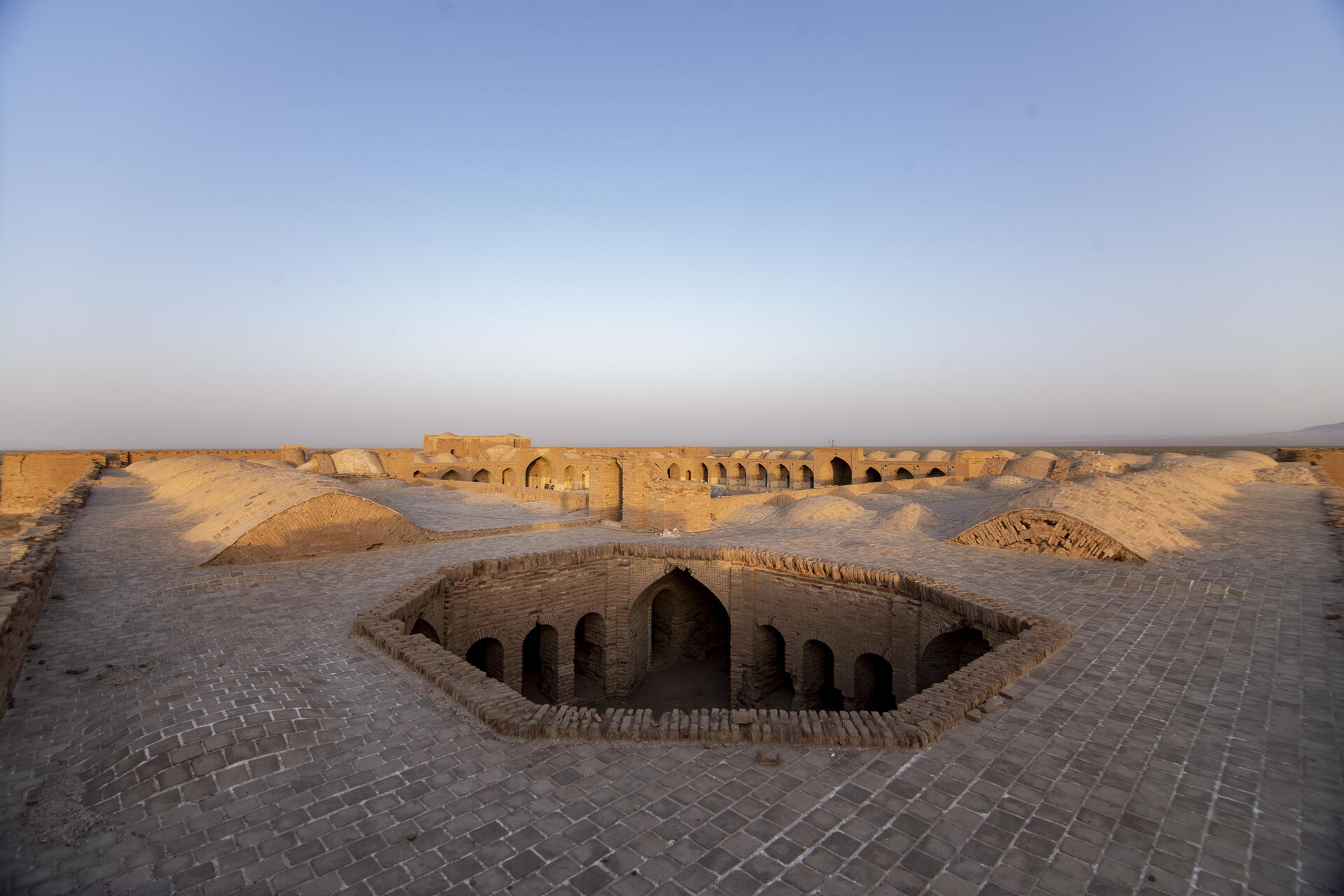
© Mostafameraji, CC BY-SA 4.0 Resized from original. (This derivative is under the same CC BY-SA license.)
World Heritage Research
Discover scientific research and academic studies that deepen our understanding of The Persian Caravanserai from its history and significance to its conservation, management, and contemporary challenges.
-
Iranian Urban and Regional Caravanserais: Processes of Change and Strategies for Future Revitalization
Iranian caravanserais, recognized as part of UNESCO's World Heritage List in 2023, exhibit divergent evolutionary trajectories that challenge traditional conservation approaches. Regional caravanserais have transitioned into heritage and tourism destinations, while urban ones like the Vakil Caravanserai in Kerman have maintained commercial functionality through adaptive reuse. This study reveals that effective future conservation requires network-based, typology-sensitive strategies integrating heritage preservation, urban morphology, and adaptive reuse to sustain regional development and preserve the historical continuity of the Silk Roads. The research employs a historical-interpretative methodology, analyzing documentary sources, UNESCO documentation, historical maps, and architectural analysis to uncover these processes.
Abaee, M. (2026). Iranian Urban and Regional Caravanserais: Processes of Change and Strategies for Future Revitalization. Proceedings of the International Conference of Contemporary Affairs in Architecture and Urbanism-ICCAUA, 9(Special Issue 1), 2610542. https://doi.org/10.38027/iccaua2026en0542
View Publication Record | Read Publication -
Developing a Multi-Criteria Decision Model to Unlock Sustainable Heritage Tourism Potential
A significant portion (34%) of Isfahan Province's Persian caravanserais, newly inscribed UNESCO World Heritage Sites, exhibits very high potential for sustainable heritage tourism development. This finding emerges from a multi-criteria decision-making model, the BMW-WLC framework, which evaluated 39 criteria across eight sites—including network connectivity, tourist attractions, facilities, climate, geomorphology, and hazards. The analysis revealed that while Gaz and Gaba Abad rank highest overall, they require tailored climate adaptation strategies to mitigate risks. This study demonstrates a data-driven approach to assessing tourism potential in heritage contexts, offering actionable insights for balancing preservation with development.
Salehipour, M., Kazemi, N., Jokar Arsanjani, J., & Karimi Firozjaei, M. (2025). Developing a Multi-Criteria Decision Model to Unlock Sustainable Heritage Tourism Potential. Sustainability, 17(8), 3703. https://doi.org/10.3390/su17083703
View Publication Record | Read Publication -
Comparison of Anatolian and Persian Caravanserais in the Seljuk Period
A comparative analysis of Seljuk-era caravanserais in Anatolia and Iran reveals that while their interior spaces and functions were largely similar, serving as hubs for trade and cultural exchange along the Silk Road, significant differences existed in their plan design and spatial organization. The study examined six caravanserais—three from Iran (Deyre Gachin, Robat-e Mahi, and Robat-e Sharaf) and three from Anatolia (Evdir Han, Aksaray Sultan Han, and Alara Han)—focusing on their architectural characteristics, construction dates, and functional attributes. Findings highlight the distinct regional adaptations of this Seljuk imperial policy aimed at connecting cities within its borders, offering insights into the evolution of caravanserai architecture during this period.
DELJAVAN, N., & ÇINAR, K. (2023). Selçuklu Dönemi Anadolu ve İran Kervansaraylarının Karşılaştırılması. Karatay Sosyal Araştırmalar Dergisi, (11), 27–43. https://doi.org/10.54557/karataysad.1333320
View Publication Record | Read Publication -
Early modern caravan networks in Afghanistan
New remotely-sensed data reveals the critical role of caravan routes and caravanserai networks in Afghanistan during the early modern period (15th to 18th centuries AD), highlighting their significance as infrastructural ties between Safavid Persian and Mughal empires. The study demonstrates how these routes facilitated a 'meeting on the edge' of political economies, integrating frontiers through shared institutions. Researchers combined historical maps with accounts from travelers—including merchants, mercantile agents, and British Afghan Boundary Commission representatives—to reconstruct the politics, mechanics, and cultures of caravan networks in Central Asia. This interdisciplinary approach bridges satellite/aerial imagery with firsthand narratives, offering insights into early modern trade dynamics.
Franklin, K., & Boak, E. (2021). Early modern caravan networks in Afghanistan. Caravans in Global Perspective, 1–16. https://doi.org/10.4324/9781003229810-1
View Publication Record | Read Publication -
Imperative Role of Nur Jahan and Her Persian Roots in the Evolution of Mughal Garden Tombs
Mughal garden tombs, epitomized by the Taj Mahal, owe their evolution significantly to Nur Jahan's Persian influence during Jahangir's reign. This study highlights her pivotal role in integrating Persian arts and crafts into Mughal architecture, fostering a unique amalgamation of styles that enriched funerary traditions. Nur Jahan, an influential Mughal queen with deep Persian roots, commissioned structures that showcased subtle yet profound Persian elements, such as Chahar Bagh and Hasht Bihisht, while nurturing the growth of artists and artisans. The research establishes her imperative contribution to bridging Persian and Mughal artistic traditions, emphasizing her lasting impact on architectural innovation in India.
Perveen, S. (2021). Imperative Role of Nur Jahan and Her Persian Roots in the Evolution of Mughal Garden Tombs. Art and Architectural Traditions of India and Iran, 165–175. https://doi.org/10.4324/9781003229421-15
View Publication Record | Read Publication -
Medieval and Early Modern European Travelers on the Jewish Epigraphy of Southeastern Europe and Caucasus
A Jewish inscription from the 16th century, discovered on the wall of a caravanserai in Azerbaijan and later published by German traveler Adam Olearius (1599–1671), provides epigraphic evidence linking medieval Jewish communities in Transcaucasia to accounts by Western European travelers. The inscription, dating back to 1224/5 AD, mentions a figure named Faraj, son of Yitzhak, and aligns with testimony from William (or Guillaume) Rubruck, who visited the region in 1254. This finding suggests that the stone block was repurposed during the construction of the caravanserai after the Jewish communities had disappeared or left the area. The study reconstructs and translates the inscription's text, offering new insights into medieval Jewish epigraphy in Southeastern Europe and the Caucasus.
Rashkovskiy, B. (2021). Medieval and Early Modern European Travelers on the Jewish Epigraphy of Southeastern Europe and Caucasus. Tirosh. Jewish, Slavic & Oriental Studies, (21), 25–43. https://doi.org/10.31168/2658-3380.2021.21.1.1
View Publication Record | Read Publication -
“A labor of love”: on the perils and seductions of writing about Iran. An Interview with Jill Worrall
Jill Worrall's travelogue, Two Wings of a Nightingale: Persian Soul, Islamic Heart, challenges and subverts dominant Orientalist stereotypes about Iran through a deeply personal and immersive narrative. Published in 2011, the book recounts her journey across Iran with her guide, Reza, along ancient caravanserai routes, offering rich insights into Iranian culture, history, literature, and arts. Worrall's work stands out for its attempt to humanize Iran, contrasting with a global publishing industry often complicit in perpetuating dehumanizing narratives about the region. Conducted as an interview in 2016, this discussion sheds light on her writing process, her disillusionment with stereotypical portrayals, and her commitment to presenting authentic, alternative perspectives.
Nazari, H. (2018). “A labor of love”: on the perils and seductions of writing about Iran. An Interview with Jill Worrall. Studies in Travel Writing, 22(3), 325–336. https://doi.org/10.1080/13645145.2018.1528666
View Publication Record | Read Publication