World Heritage Identification Number: 1726
World Heritage since: 2025
Category: Cultural Heritage
WHE Type: Buildings & Architectural Ensembles
Transboundary Heritage: No
Endangered Heritage: No
Country: 🇩🇪 Germany
Continent: Europe
UNESCO World Region: Europe and North America
Map
The Enchanting Palaces of King Ludwig II of Bavaria: A Journey Through Time and Imagination
In the heart of Bavaria's picturesque alpine region lies a series of grandiose palace complexes that transport visitors to the romantic and eclectic spirit of the 19th century. Inscribed as a UNESCO World Heritage Site in 2025, "The Palaces of King Ludwig II of Bavaria: Neuschwanstein, Linderhof, Schachen, and Herrenchiemsee" offer a captivating glimpse into the artistic vision and personal retreats of one of history's most intriguing monarchs.
Neuschwanstein Castle, perhaps the most famous of the four palaces, stands majestically atop a rugged hill in the municipality of Schwangau. Its fairytale silhouette against the backdrop of the Alps has inspired countless artists and dreamers since its construction began in 1869. Inspired by the Wartburg Castle and Richard Wagner's operas, this masterpiece of historicism boasts a richly ornate interior filled with frescoes, stained-glass windows, and intricate woodcarvings.
A mere 15 kilometers away - like the crow flies - lies Linderhof Palace, completed in 1878. This smaller but no less enchanting palace was designed as a more intimate retreat for King Ludwig II. Modeled heavily after the French palaces of the 18th century and Rococo style, Linderhof features a sumptuous Hall of Mirrors, a Venus Grotto, and the Moroccan House, a pavilion adorned with exotic materials and motifs.
Schachen, nestled high in the mountains, remains largely unfinished due to Ludwig's untimely death in 1886. Despite its incomplete state, the palace exudes an air of mystery and allure. Its eclectic architecture, a blend of neo-Gothic and Oriental styles, seamlessly blends into the surrounding alpine landscape, further enhancing its mystique.
Herrenchiemsee Palace, situated on an island in Lake Chiemsee, was intended to be a replica of the grand Palace of Versailles. Construction began in 1878, but was halted upon Ludwig’s death in 1886. Although incomplete, the palace’s magnificent design is still impressive. Visitors can explore the partially finished rooms, including the grand Hall of Mirrors, and marvel at the ambitious vision that Ludwig had for this monumental project.
Each of these palaces reflects not only the historical context of the time but also the unique personality and artistic sensibilities of King Ludwig II. Carefully integrated into their respective natural landscapes, they serve as enduring testaments to the power of imagination and the beauty of architectural ingenuity.
Since their opening to the public shortly after Ludwig's death, these palaces have become cherished cultural landmarks, attracting millions of visitors each year. They stand as a reminder of a bygone era, inviting us to step into the world of dreams and wonder that once captivated a king.
UNESCO Description of the World Heritage Site
This serial property consists of four grand palace complexes in Bavaria’s alpine region, built under King Ludwig II between 1864 and 1886. Designed as personal retreats and imaginative escapes, they reflect the romantic and eclectic spirit of the era. Drawing inspiration from the Wartburg Castle, Versailles, German fairy tales, and Wagner’s operas, the palaces showcase historicist styles and advanced 19th-century techniques. Carefully integrated into stunning natural landscapes, they embody Ludwig’s artistic vision. Opened to the public shortly after his death in 1886, these sites are now preserved as museums and remain major cultural landmarks.
UNESCO Justification of the World Heritage Site
Criterion (iv): The Palaces of King Ludwig II of Bavaria are remarkably well-preserved, and display a varied range of architectural and artistic styles. They testify to great intellectual and symbolic depth, and demonstrate a high level of artistic and technological skill. The four component parts individually and collectively represent a symbiosis of popular architectural trends during the second half of the 19th century, particularly the penchant for historicism and eclecticism. Conceived as places of seclusion, the four castles were built under the meticulous direction of King Ludwig II. They were designed as total works of art of remarkable beauty, scale and luxury, and incorporate scenic and theatrical effects.
Encyclopedia Record: Neuschwanstein Castle
Neuschwanstein Castle is a 19th-century historicist palace on a rugged hill of the foothills of the Alps in the very south of Germany, near the border with Austria. It is located in the Swabia region of Bavaria, in the municipality of Schwangau, above the incorporated village of Hohenschwangau, which is also the location of Hohenschwangau Castle. The closest larger town is Füssen. The castle stands above the narrow gorge of the Pöllat stream, east of the Alpsee and Schwansee lakes, close to the mouth of the Lech into Lake Forggensee. Since 2025, the castle is part of the UNESCO World Heritage Site "The Palaces of King Ludwig II of Bavaria: Neuschwanstein, Linderhof, Schachen and Herrenchiemsee". According to Guinness World Records, at 65 metres, it is the tallest castle in the world.Additional Site Details
Area: 75.875 hectares
Number of Components: 4
Coordinates: 47.5575 , 10.7494444444
Image
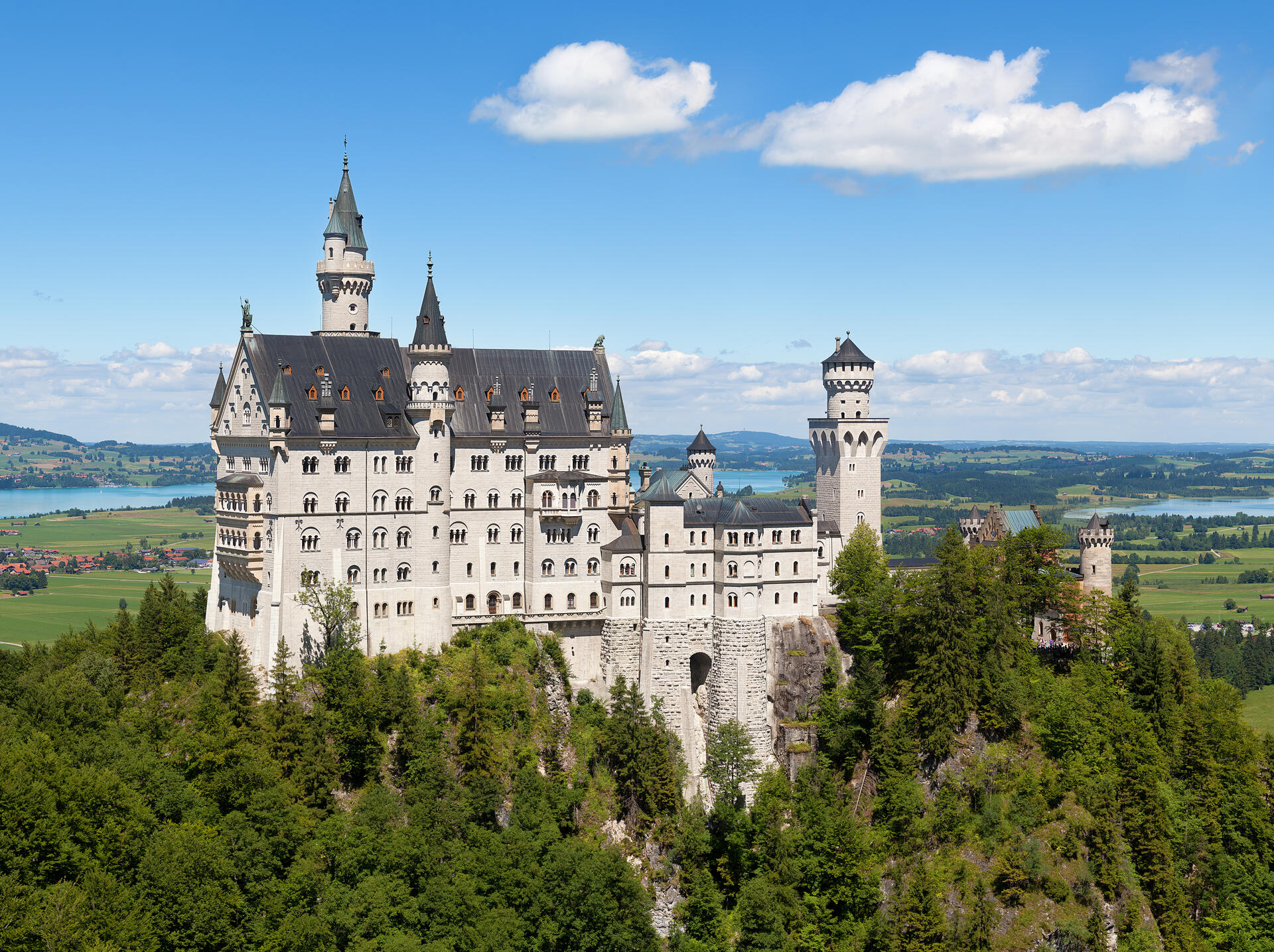
© Thomas Wolf, www.foto-tw.de, CC BY-SA 3.0 de Resized from original. (This derivative is under the same CC BY-SA license.)