World Heritage Identification Number: 269
World Heritage since: 1983
Category: Cultural Heritage
WHE Type: Religious Sites & Sacred Architecture
Transboundary Heritage: No
Endangered Heritage: No
Country: 🇨🇭 Switzerland
Continent: Europe
UNESCO World Region: Europe and North America
Map
The Benedictine Convent of St John at Müstair: A Treasure Trove of Carolingian Art
The Benedictine Convent of St John at Müstair, nestled within the picturesque Val Müstair in the Swiss canton of Graubünden, stands as a testament to the rich cultural and artistic legacy of the Carolingian period. Inscribed as a UNESCO World Heritage Site in 1983, this remarkable monastery boasts some of Switzerland's most significant collections of figurative murals, dating back to approximately A.D. 800.
More to come…UNESCO Description of the World Heritage Site
The Convent of Müstair, which stands in a valley in the Grisons, is a good example of Christian monastic renovation during the Carolingian period. It has Switzerland's greatest series of figurative murals, painted c. A.D. 800, along with Romanesque frescoes and stuccoes.
UNESCO Justification of the World Heritage Site
Criterion (iii): The conventual ensemble is one of the most coherent architectural works of the Carolingian period and High Middle Ages, with the most extensive cycle of known paintings for the first half of the 9th century. The figurative paintings of the Roman era, and especially the Carolingian period, are particularly important for understanding the evolution of certain iconographic Christian themes, such as the Last Judgement.
Encyclopedia Record: Saint John Abbey, Müstair
The Abbey of Saint John is an early medieval Benedictine monastery in the Swiss municipality of Val Müstair, in the Canton of Graubünden. By reason of its exceptionally well-preserved heritage of Carolingian art, it has been a UNESCO World Heritage Site since 1983.Additional Site Details
Area: 2.036 hectares
Number of Components: 1
Coordinates: 46.62945 , 10.44765
Image
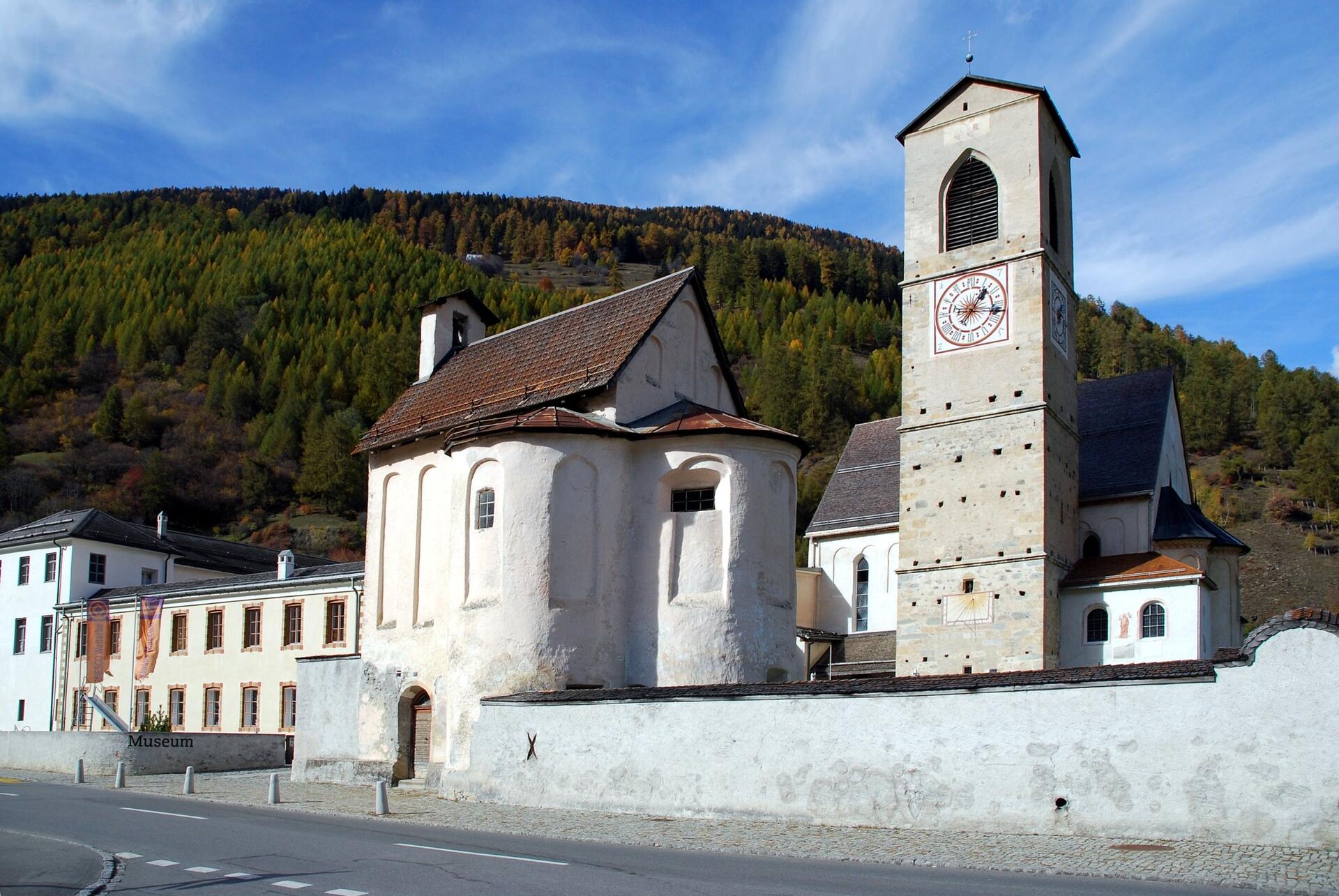
© Wladyslaw, CC BY-SA 3.0 Resized from original. (This derivative is under the same CC BY-SA license.)
World Heritage Research
Discover scientific research and academic studies that deepen our understanding of Benedictine Convent of St John at Müstair from its history and significance to its conservation, management, and contemporary challenges.
-
Preliminary research on potential raw material sources for dolomitic lime mortars at St. John's convent at Müstair, Switzerland
Research on the Benedictine Convent of St. John at Müstair reveals that while dolomitic rocks were likely the primary raw material for historic lime mortars, their high variability in crystal size and fabric makes them unreliable as direct indicators for provenance studies. However, the presence of silicate phases in underburnt relics may serve as potential proxies. The study combined Polarizing Light Microscopy (PLM) and X-ray Powder Diffraction (XRPD) analysis to investigate textural features and mineralogical composition, providing new insights into the historical construction practices of the Val Müstair region.
Cavallo, G., Caroselli, M., Jornet, A., & Cassitti, P. (2019). Preliminary research on potential raw material sources for dolomitic lime mortars at St. John's convent at Müstair, Switzerland. Zenodo. https://doi.org/10.5281/ZENODO.7882646
View Publication Record | Read Publication