World Heritage Identification Number: 94
World Heritage since: 1979
Category: Cultural Heritage
WHE Type: Archaeological Sites
Transboundary Heritage: No
Endangered Heritage: No
Country: 🇮🇹 Italy
Continent: Europe
UNESCO World Region: Europe and North America
Map
The Enigmatic Rock Drawings in Valcamonica: A Unique Testimony of Prehistoric Art
The enchanting landscape of the Italian Alps conceals a hidden treasure that has captivated scholars, archaeologists, and art enthusiasts for centuries - the Rock Drawings in Valcamonica. This extraordinary collection of prehistoric petroglyphs, dating back approximately 8,000 years, is not only the largest of its kind in the world but also offers a unique insight into the lives, beliefs, and cultural practices of our distant ancestors.
More to come…UNESCO Description of the World Heritage Site
Valcamonica, situated in the Lombardy plain, has one of the world's greatest collections of prehistoric petroglyphs – more than 140,000 symbols and figures carved in the rock over a period of 8,000 years and depicting themes connected with agriculture, navigation, war and magic.
UNESCO Justification of the World Heritage Site
Criterion (iii): The Rock Drawings of Valcamonica stretch over a period of eight thousand years leading up to our present era, making these human renderings absolutely invaluable.
Criterion (vi): The Rock Drawings of Valcamonica constitute an extraordinary figurative documentation of prehistoric customs and mentality. The systematic interpretation, typological classification, and the chronological study of these configurations in stone represent a considerable contribution to the fields of prehistory, sociology and ethnology.
Encyclopedia Record: Rock Drawings in Valcamonica
The rock drawings in Valcamonica are located in the Province of Brescia, Italy, and constitute the largest collections of prehistoric petroglyphs in the world. The collection was recognized by UNESCO in 1979 and was Italy's first recognized World Heritage Site. UNESCO has formally recognized more than 140,000 figures and symbols, but new discoveries have increased the number of catalogued incisions to between 200,000 and 300,000. The petroglyphs are spread on all surfaces of the valley, but concentrated in the areas of Darfo Boario Terme, Capo di Ponte, Nadro, Cimbergo and Paspardo.Additional Site Details
Area: 432.3 hectares
Number of Components: 6
(vi) — Directly associated with events or living traditions
Coordinates: 45.95705556 , 10.29733333
Image
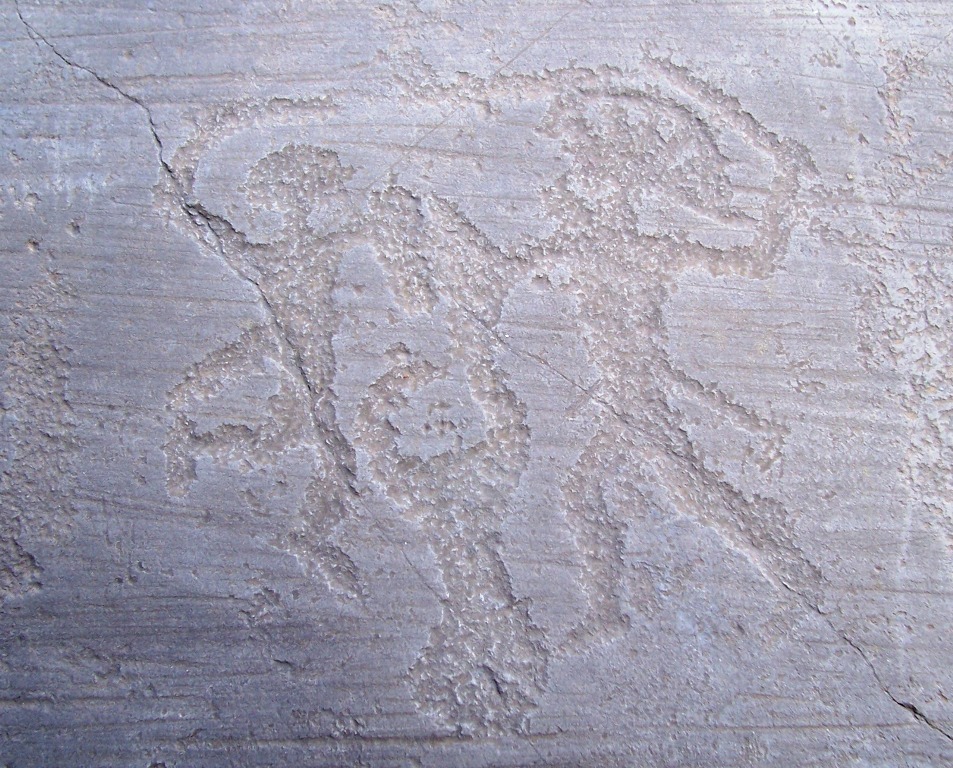
© Luca Giarelli, CC BY-SA 3.0 Resized from original. (This derivative is under the same CC BY-SA license.)
World Heritage Research
Discover scientific research and academic studies that deepen our understanding of Rock Drawings in Valcamonica from its history and significance to its conservation, management, and contemporary challenges.
-
The Great Rock of the Aquane: A masterpiece of Valcamonica recounted (and made consultable) with 21st-century tools.
A groundbreaking study on the rock drawings of Valcamonica, Italy, reveals new interpretations and cultural connections through innovative digital documentation. Andrea Arcà's work, 'The Great Rock of Naquane,' combines meticulous archaeological research with 21st-century technologies to analyze one of Europe's most significant engraved rock surfaces in the Alps. The study highlights how digital tools enhance both the recording and interpretation of archaeological heritage, offering fresh insights into the symbols and narratives depicted. This interdisciplinary approach not only advances our understanding of Alpine archaeology but also sets a new standard for the study of rock art worldwide.
BOZZARELLI, O. (2026). The Great Rock of the Aquane: A masterpiece of Valcamonica recounted (and made consultable) with 21st-century tools. Zenodo. https://doi.org/10.5281/ZENODO.20524540
View Publication Record | Read Publication -
Rock Art in Three Dimensions: Comments on the Use and Possibilities of 3D Rock Art Documentation
Advanced 3D documentation methods for rock art have become a standardized approach, offering significant advantages over older reductive techniques. This study addresses common misunderstandings and highlights recent developments in visualization workflows that can solve most challenges associated with 3D rock art documentation. The research also explores how these methods serve broader scientific purposes, including the discovery of new images and the application of machine learning algorithms. By comparing 3D techniques to traditional approaches, the study provides insights into their effectiveness and potential for enhancing rock art research, particularly in UNESCO World Heritage Sites like Valcamonica.
Horn, C., Peternell, M., Ling, J., Green, A., & Potter, R. (2024). Rock Art in Three Dimensions: Comments on the Use and Possibilities of 3D Rock Art Documentation. The 3 Dimensions of Digitalised Archaeology, 87–108. https://doi.org/10.1007/978-3-031-53032-6_6
View Publication Record | Read Publication -
An ecological investigation on lichens and other lithobionts colonizing rock art in Valle Camonica (UNESCO WHS n. 94) addresses preventive conservation strategies
A preventive conservation strategy for outdoor rock art, such as the UNESCO-listed Rock Drawings in Valcamonica (Italy), shows promise in mitigating biodeterioration. The study found that constructing a small wall to shield part of a cleaned rock surface from prolonged water exposure effectively reduced recolonization by lithobionts—cyanobacteria-dominated biofilms and lichens—over 40 months. Environmental factors like tree cover and upstream vegetation, which prolong wetness and nutrient supply, were identified as key drivers for microbial and lichen recolonization on recently cleaned surfaces. The research highlights the potential of targeted interventions to preserve outdoor stone heritage, contrasting with traditional indoor conservation methods.
Favero-Longo, S. E., Matteucci, E., Castelli, D., Iacomussi, P., Martire, L., Ruggiero, M. G., & Segimiro, A. (2023). An ecological investigation on lichens and other lithobionts colonizing rock art in Valle Camonica (UNESCO WHS n. 94) addresses preventive conservation strategies. The Lichenologist, 55(5), 409–422. https://doi.org/10.1017/s0024282923000452
View Publication Record | Read Publication -
From the core to the periphery: notes on recent research in western rock art areas of Central Valcamonica
Recent research in the western rock art areas of Central Valcamonica, including Capo di Ponte, Nadro di Ceto, and Paspardo, has revealed a significant expansion of known prehistoric carved panels. Systematic fieldwork in Seradina and Bedolina, core parts of UNESCO World Heritage Site No. 94, has nearly completed the documentation and analysis of all identified panels, while new discoveries in neighboring, less-explored areas have increased the density and territorial extent of these carvings. This growing dataset supports the hypothesis that certain rock art features in western and eastern Valcamonica reflect localized phenomena, though their causes and evolution remain unexplained. Additionally, emerging data on the relationship between rock art and other human presence indicators—such as settlements or cult sites—suggests potential links that warrant further investigation.
Marretta, A. (2023). From the core to the periphery: notes on recent research in western rock art areas of Central Valcamonica. Adoranten, 85–102. https://doi.org/10.65611/ador.vi.63742
View Publication Record | Read Publication -
Rock Art in the Landscapes of Motion: Proceedings of a session of the 20th International Rock Art Congress IFRAO 2018 in Valcamonica, Italy
Rock art across continents and millennia reveals profound connections to movement, motion, and mobility. This volume synthesizes findings from the 20th International Rock Art Congress (IFRAO 2018), demonstrating how rock art reflects dynamic interactions between humans and their landscapes. Spanning the European Palaeolithic to South America's Colonial Period, the studies employ diverse methodologies—ranging from chronological analysis to spatial mapping—to uncover how mobility shapes artistic expression and cultural practices. The collection highlights that motion is not merely a theme in rock art but an intrinsic element of its creation, preservation, and interpretation, offering new perspectives on the significance of movement in human history.
Polkowski, P. L., & Förster, F. (Eds.). (2022). Rock Art in the Landscapes of Motion: Proceedings of a session of the 20th International Rock Art Congress IFRAO 2018 in Valcamonica, Italy. https://doi.org/10.30861/9781407359892
View Publication Record | Read Publication -
Arms and the Armed: The Evocative Ritual Language in Val Camonica Rock Art
Depictions of armed human figures and weapons in Val Camonica rock art serve as an evocative ritual language, commemorating mythical forefathers, ancestral heroes, and departed warriors. These engravings, found across megalithic sanctuaries and Alpine spiritual centers from the Copper Age to the Iron Age, represent a dynamic visual tradition that not only memorialized significant figures but also invoked their presence during times of need. The study highlights the cultural and chronological importance of these depictions, which vary in stylistic and iconographic arrangements, providing insights into the ritual practices and societal structures of prehistoric communities.
Priuli, A. (2022). Arms and the Armed: The Evocative Ritual Language in Val Camonica Rock Art. Martial Culture and Historical Martial Arts in Europe and Asia, 3–43. https://doi.org/10.1007/978-981-19-2037-0_1
View Publication Record | Read Publication -
Rock Art Research in the Digital Era: Case Studies from the 20th International Rock Art Congress IFRAO 2018, Valcamonica (Italy)
Advancements in digital archaeology are transforming the study and interpretation of rock art, particularly in making eroded panels more visible. The 20th International Rock Art Congress (IFRAO) 2018 in Valcamonica, Italy, showcased how cutting-edge digital technologies, such as 3D modelling and interactive dissemination, enhance documentation and public engagement. Specialists demonstrated innovative methodologies that address limitations of traditional techniques like raking light, providing new insights into rock art preservation and analysis.
Carrero-Pazos, M., Döhl, R., van Rensburg, J. J., Medici, P., & Vázquez-Martínez, A. (Eds.). (2022). Rock Art Research in the Digital Era: Case Studies from the 20th International Rock Art Congress IFRAO 2018, Valcamonica (Italy). https://doi.org/10.30861/9781407360119
View Publication Record | Read Publication