World Heritage Identification Number: 797
World Heritage since: 2000
Category: Cultural Heritage
WHE Type: Historic Cities & Urban Areas
Transboundary Heritage: No
Endangered Heritage: No
Country: 🇮🇹 Italy
Continent: Europe
UNESCO World Region: Europe and North America
Map
The Historic City of Verona: A UNESCO World Heritage Site
The Historic City of Verona, located in the northeastern region of Veneto, Italy, is a testament to the rich history and cultural significance that spans over two millennia. Inscribed as a UNESCO World Heritage Site in 2000, this vibrant city offers a unique blend of Roman, medieval, and Renaissance architecture, making it a must-visit destination for history enthusiasts and casual tourists alike.
More to come…UNESCO Description of the World Heritage Site
The historic city of Verona was founded in the 1st century B.C. It particularly flourished under the rule of the Scaliger family in the 13th and 14th centuries and as part of the Republic of Venice from the 15th to 18th centuries. Verona has preserved a remarkable number of monuments from antiquity, the medieval and Renaissance periods, and represents an outstanding example of a military stronghold.
UNESCO Justification of the World Heritage Site
Criterion (ii): In its urban structure and its architecture, Verona is an outstanding example of a town that has developed progressively and uninterruptedly over 2,000 years, incorporating artistic elements of the highest quality from each succeeding period.
Criterion (iv): Verona represents in an exceptional way the concept of the fortified town at several seminal stages of European history.
Encyclopedia Record: Verona
Verona is the largest city in the region of Veneto in Italy, with 255,131 inhabitants. It is one of the seven provincial capitals of the region, and is the largest city municipality in the region and in northeastern Italy. The metropolitan area of Verona covers an area of 1,426 km2 (550.58 sq mi) and has a population of 714,310 inhabitants. It is one of the main tourist destinations in Northern Italy because of its artistic heritage and several annual fairs and shows as well as the opera season in the Arena, an ancient Roman amphitheater.Additional Site Details
Area: 444.4 hectares
Number of Components: 1
(iv) — Outstanding example of a type of building or landscape
Coordinates: 45.43861111 , 10.99388889
Image
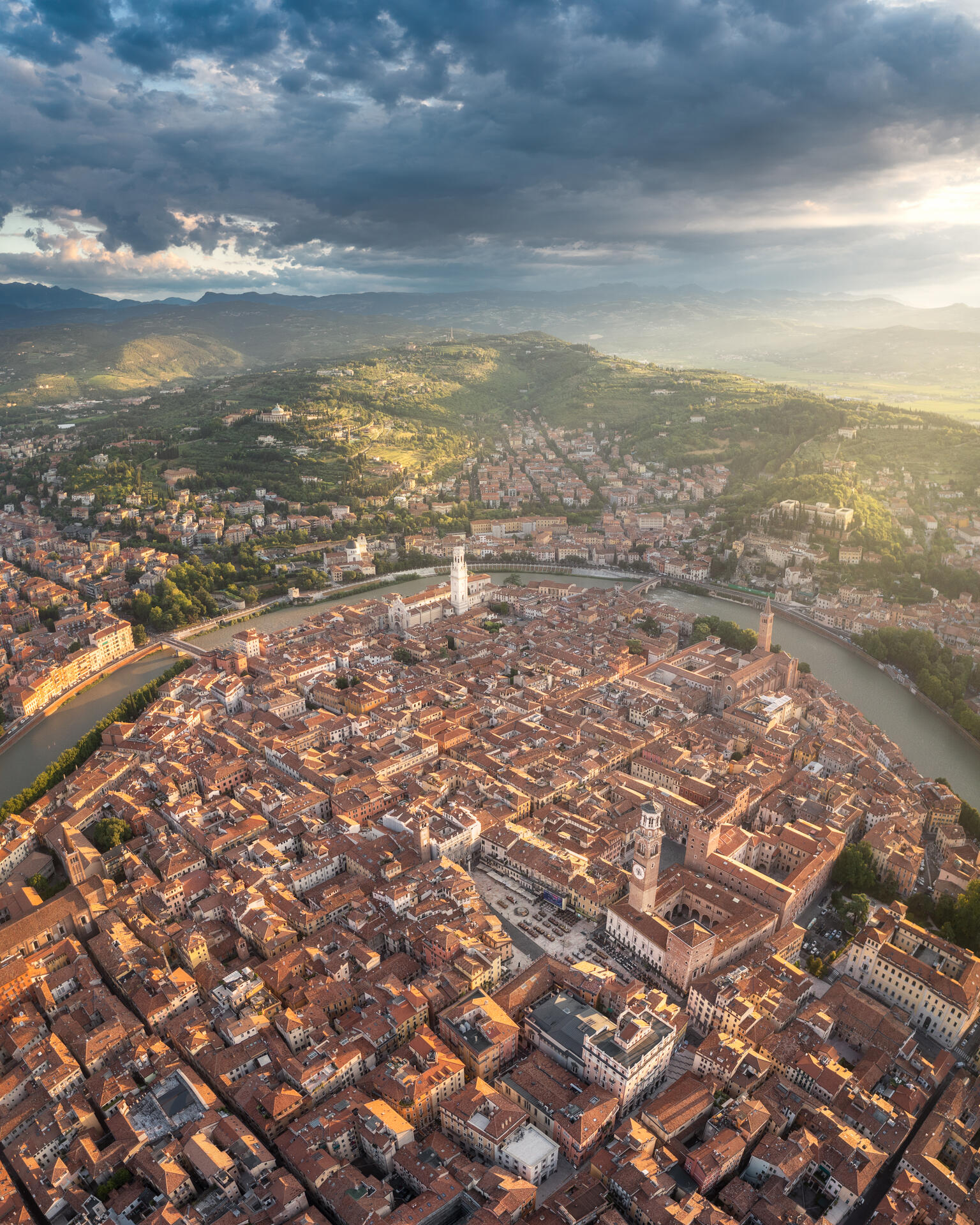
© Guglielmo Giambartolomei, CC BY-SA 4.0 Resized from original. (This derivative is under the same CC BY-SA license.)
World Heritage Research
Discover scientific research and academic studies that deepen our understanding of City of Verona from its history and significance to its conservation, management, and contemporary challenges.
-
Identitarian Movements in the Touristic City : The Marketing of Hate in VeronaVerona, renowned for its tourist appeal as the city of Romeo and Juliet, also serves as a strategic node for far-right and populist right movements. This study reveals how these groups exploit the city's historical center to construct an exclusionary territorial identity rooted in white supremacy, northern pride, and Catholic fundamentalism. Through practices of bordering and territorialization, they market Verona as a 'model' city for a transnational identitarian network, leveraging its preserved heritage and assumed authenticity to promote anti-modernist nostalgia. The research, based on ethnographic fieldwork, archival analysis, and in-depth interviews, uncovers the mechanisms by which certain historical centers are showcased to build such networks through everyday boundary-drawing practices.
Demirsu, I. (2023).
View Publication Record | Read PublicationIDENTITARIAN MOVEMENTS IN THE TOURISTIC CITY : The Marketing of Hate in Verona. International Journal of Urban and Regional Research, 47(5), 725–744. Portico. https://doi.org/10.1111/1468-2427.13198 -
The Walled City of Verona. Integrated Survey Systems for the Enhancement and Promotion of Verona's City Walls
Integrated survey systems, including TLS (Terrestrial Laser Scanning), MLS (Mobile Laser Scanning), and UAVs (Unmanned Aerial Vehicles), have been validated for their potential to enhance the documentation, conservation, and promotion of Verona's city walls. The study, conducted as part of the 'Verona Città Murata' project, demonstrates that these technologies can provide high-accuracy planimetric and elevation data, which are crucial for timely restoration and management studies. The research also emphasizes the importance of multi-disciplinary approaches and flexible tools in managing complex cultural heritage sites like Verona's fortified system and Veronese Park. This methodology not only aids in diagnostic and conservative analysis but also serves as a valuable tool for narrating and disseminating the military technology fabric of Verona, contributing to its valorization.
Dell’Amico, A. (2023). THE WALLED CITY OF VERONA. INTEGRATED SURVEY SYSTEMS FOR THE ENHANCEMENT AND PROMOTION OF VERONA’S CITY WALLS. The International Archives of the Photogrammetry, Remote Sensing and Spatial Information Sciences, XLVIII-M-2-2023, 481–489. https://doi.org/10.5194/isprs-archives-xlviii-m-2-2023-481-2023
View Publication Record | Read Publication -
‘Feminizing’ Saint Augustine’s City of God: Sister Veronica, the library and scriptorium at Santo Spirito, Verona
A rare Italian codex of Saint Augustine's 'City of God,' copied by nun scribe Veronica in 1472 at the Benedictine convent Santo Spirito in Verona, reveals how women religious interpreted and engaged with this influential text. Unlike known iconographic models, Veronica’s manuscript features unique pen-and-ink miniatures that convey emotional tension, philosophical depth, and allegorical mediation, offering a distinct visual and intellectual lens on Augustine's work. The study also highlights the convent’s vibrant scribal culture, supported by a c. 1475 library inventory and other extant manuscripts, showcasing both elementary and advanced devotional literature accessible to its community. This is the first analysis of a vernacular 'City of God' produced by a nun, shedding light on women's active role in medieval humanist practices and their unique contributions to religious scholarship.
Arthur, K. G. (2019). ‘Feminizing’ Saint Augustine’s City of God: Sister Veronica, the library and scriptorium at Santo Spirito, Verona. Renaissance Studies, 35(2), 188–211. Portico. https://doi.org/10.1111/rest.12659
View Publication Record | Read Publication -
Accommodation prices on Airbnb: effects of host experience and market demand
Hosts on Airbnb dynamically adjust accommodation prices based on their experience and market demand, according to a study analyzing 1,056 listings in Verona, Italy. The research, using regression analysis, found that price flexibility increases with host experience and responds to booking date demand. This challenges traditional pricing models and offers insights for hotels facing Airbnb's disruptive growth. The findings support innovator’s dilemma theory, suggesting strategies for conventional hospitality businesses to adapt.
Magno, F., Cassia, F., & Ugolini, M. M. (2018). Accommodation prices on Airbnb: effects of host experience and market demand. The TQM Journal, 30(5), 608–620. https://doi.org/10.1108/tqm-12-2017-0164
View Publication Record | Read Publication -
Holistic model-based monitoring of the human health status in an urban environment system: pilot study in Verona city, Italy
A pilot study in Verona, Italy, reveals significant correlations between urban environmental factors and human health outcomes. Researchers found that hospitalization rates for cancerous diseases were four times lower in the municipal population compared to a regional reference group, with similar trends observed for cardiocirculatory and respiratory pathologies linked to air pollution and landscape ecological quality. The study employed a holistic model integrating landscape ecology, environmental quality indexes, and health indicators, utilizing GIS technology to analyze spatial data. Fisher exact test confirmed non-independence between cardiocirculatory diseases, air pollution, and landscape ecological quality, suggesting that urban environment systems can effectively represent the complexity of human health dynamics.
Tarocco, S., Amoruso, I., & Caravello, G. (2011). Holistic model-based monitoring of the human health status in an urban environment system: pilot study in Verona city, Italy. Journal of Preventive Medicine and Hygiene, Vol 52, No 2 (2011). https://doi.org/10.15167/2421-4248/JPMH2011.52.2.253
View Publication Record | Read Publication