World Heritage Identification Number: 1287
World Heritage since: 2008
Category: Cultural Heritage
WHE Type: Buildings & Architectural Ensembles
Transboundary Heritage: No
Endangered Heritage: No
Country: 🇮🇹 Italy
Continent: Europe
UNESCO World Region: Europe and North America
Map
Urban Testaments of Renaissance Ideals: Mantua and Sabbioneta
Mantua and Sabbioneta, twin jewels nestled within the verdant plains of northern Italy, stand as enduring testaments to the architectural and cultural achievements of the Renaissance era. Inscribed as a UNESCO World Heritage Site in 2008, these two cities offer a unique glimpse into the urban, architectural, and artistic realizations of the period, bound together by the visionary influence of the powerful Gonzaga family.
More to come…UNESCO Description of the World Heritage Site
Mantua and Sabbioneta represent two aspects of Renaissance town planning: Mantua shows the renewal and extension of an existing city, while some 30 km away, Sabbioneta represents the implementation of the period’s theories about planning the ideal city. Typically, Mantua’s layout is irregular with regular parts showing different stages of its growth since the Roman period and includes many historical buildings, among them an 11th century rotunda and a Baroque theatre. Sabbioneta, created in the second half of the 16th century under the rule of Vespasiano Gonzaga Colonna, can be described as a single-period city and has a right-angle grid layout. Both cities offer exceptional testimonies to the urban, architectural and artistic realizations of the Renaissance, linked through the visions and actions of the ruling Gonzaga family. The two towns are important for the value of their architecture and for their prominent role in the dissemination of Renaissance culture. The ideals of the Renaissance, fostered by the Gonzaga family, are present in the towns’ morphology and architecture.
UNESCO Justification of the World Heritage Site
Criterion (ii): Mantua and Sabbioneta are exceptional witnesses to the interchange of human values of the Renaissance culture. They illustrate the two main forms of Renaissance town planning: the newly founded town, based on the concept of ideal city planning, and the transformed existing town. Their importance relates also to architecture, technology and monu¬mental art. The properties have played a prominent role in the diffusion of the Renaissance culture in and outside Europe.
Criterion (iii): Mantua and Sabbioneta are exceptional testimonies to a particular civilization during a specific period of history, with reflections on urbanism, architecture and fine arts. The ideals of the Renaissance, fostered by the Gonzaga family, are present in their urban morphology and architecture, their functional systems and traditional productive activities, which have mostly been preserved over time. Both properties meet the required conditions of integrity and authenticity, since their most significant urban and architectural components have been preserved over time, as has their relationship with their settings. The legal protective structure and management system are adequate, as both properties exhibit a good state of conservation.
Encyclopedia Record: Mantua
Mantua is a city and comune (municipality) in the Italian region of Lombardy, and capital of the eponymous province.Additional Site Details
Area: 235.43 hectares
Number of Components: 2
(iii) — Unique or exceptional testimony to a cultural tradition
Coordinates: 45.1594444444 , 10.7944444444
Image
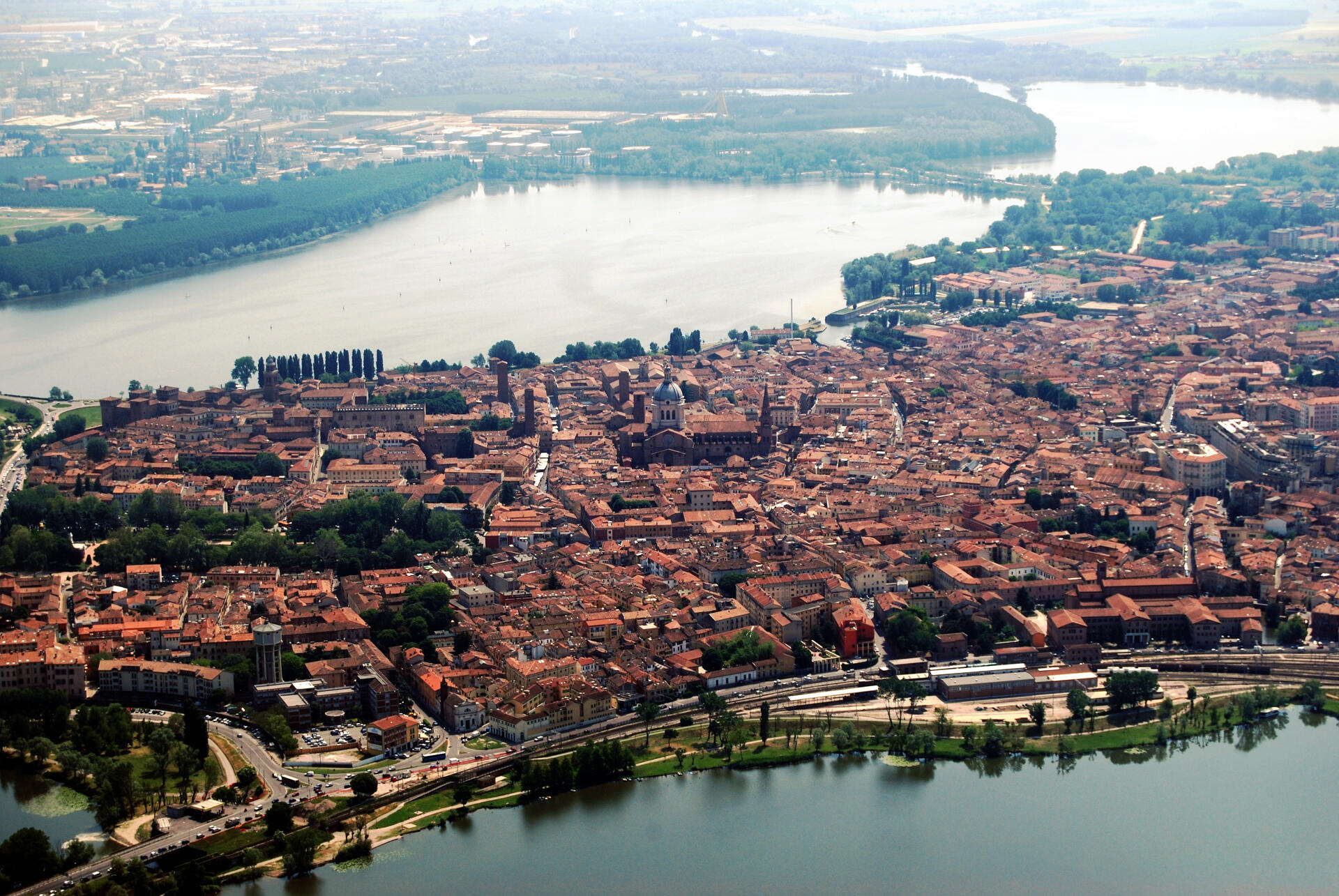
© User:EdoM, CC BY-SA 3.0 Resized from original. (This derivative is under the same CC BY-SA license.)
World Heritage Research
Discover scientific research and academic studies that deepen our understanding of Mantua and Sabbioneta from its history and significance to its conservation, management, and contemporary challenges.
-
Integration of Historical and Recent Data for 3D Conceptual Site Modeling and Quantitative Assessment of Contaminant Evolution in the Mantua Lakes, Italy
A comprehensive analysis of the Mantua Lakes, Italy, reveals significant reductions in sediment contaminants such as cadmium and hydrocarbons over time, with arsenic and chromium showing localized variations. The study integrated historical (2008) and recent (2024–2025) data—totaling over 2000 points—to construct a 3D geological model and estimate contaminant masses. Findings indicate strong bioattenuation in surface waters, mirroring sediment trends. This approach demonstrates the value of combining historical datasets with modern sampling to enhance Conceptual Site Models (CSMs), providing quantitative insights into contaminant dynamics and natural attenuation processes for sustainable site management.
Valle, A., Petrangeli Papini, M., Michielin, G., Savazzi, S., & Ciampi, P. (2026). Integration of Historical and Recent Data for 3D Conceptual Site Modeling and Quantitative Assessment of Contaminant Evolution in the Mantua Lakes, Italy. Sustainability, 18(14), 6942. https://doi.org/10.3390/su18146942
View Publication Record | Read Publication -
Cultural heritage as a key to engagement and participation in Learning Cities programmes
Cultural heritage emerges as a pivotal element in fostering engagement and participation within Learning Cities programmes, serving as a catalyst for urban learning ecosystems. The study re-examines the case of Mantua and Sabbioneta, initially part of the Mobartech industrial research project, to demonstrate how cultural heritage—both tangible and intangible—can drive collective action when paired with participatory interpretation methods. Despite not being designed as a Learning City initiative, its institutional collaboration (involving municipalities and UNESCO offices) and inclusive approach to heritage interpretation revealed significant evaluative potential for urban learning frameworks. This underscores the need for tailored mechanisms to assess such processes effectively.
De Nicola, A., & Zuccoli, F. (2026). Cultural heritage as a key to engagement and participation in Learning Cities programmes. Form@Re - Open Journal per La Formazione in Rete, 26(1), 229–237. https://doi.org/10.36253/form-19784
View Publication Record | Read Publication -
The Foàs and the Erreras: Piero's story
This work reconstructs the intertwined histories of two Italian Jewish families, the Foàs and the Erreras, through meticulous analysis of heirlooms, letters, photographs, official records, and family recollections. It traces their lineage from the 16th-century Hebrew press of Tobia Foà in Sabbioneta to modern Italy, capturing pivotal moments such as Fascism, the racial laws, war, persecution, and emigration. Central to the narrative is the author's own journey, offering a candid account of his transition from privileged Italian childhood to a distinguished career in medical research in the U.S., marked by contributions like the discovery of glucagon counterregulation and fetal electrocardiogram history. The study serves as an act of preservation, resurrecting objects and documents while reflecting on achievement and loss with humor and affection.
Foa, P. P. (2026). The Foàs and the Erreras: Piero's story (R. Katz, Ed.). Zenodo. https://doi.org/10.5281/ZENODO.22211434
View Publication Record | Read Publication -
Remote sensing for asbestos roofing mapping: Mantua case study using WorldView-3 images
A high-accuracy remote sensing method for identifying asbestos-containing cement (AC) roofs was developed, achieving 87% precision using the Maximum Likelihood classifier with WorldView-3 satellite imagery. This study, conducted in Mantua, Italy, demonstrates that multispectral imaging combined with advanced algorithms can effectively map AC roofing—a common and hazardous material—enabling targeted interventions for safe removal. The research compared two classification techniques, finding that while the Spectral Angle Mapper performed less accurately (62%), it remains a viable alternative for broader applications. This approach offers a scalable solution for global asbestos management efforts, supporting legislative actions aimed at mitigating health risks from exposure.
Bellagamba, S., Malinconico, S., Paglietti, F., Bonifazi, G., Serranti, S., & Aurigemma, A. (2026). Remote sensing for asbestos roofing mapping: Mantua case study using WorldView-3 images. Spectrochimica Acta Part A: Molecular and Biomolecular Spectroscopy, 348, 127160. https://doi.org/10.1016/j.saa.2025.127160
View Publication Record | Read Publication -
Die Fognatura in Sabbioneta
Research on the Fognatura, Sabbioneta's 16th-century urban drainage system, reveals it as a groundbreaking engineering achievement. Originally dismissed for its age, the system is now recognized as an integral part of the city's design, reflecting Vespasiano Gonzaga's visionary approach to urban planning and water management. The study, led by Jan Pieper's team from Aachen, employed historical analysis to demonstrate that the Fognatura was not merely a functional addition but a foundational element in Sabbioneta's creation, showcasing advanced ingenuity in hydraulic infrastructure for its time.
Schindler, B. (2018). Die Fognatura in Sabbioneta. Archimaera, 7(7), 71–82. https://doi.org/10.60857/ARCHIMAERA.7.71-82
View Publication Record | Read Publication -
Die Relevanz der historischen Bauforschung für neue Impulse in Stadtplanung und Architektur
Historical building research on Mantua and Sabbioneta, particularly focusing on the 'Hochkorridore' of Sabbioneta, has uncovered new insights into the layout and connections of elevated passageways within the city. The study revealed previously unknown details about the route of the Hochkorridor near the Chiesa della SS. Maria Incoronata and the adjacent Servite Monastery, leading to a reinterpretation of this architectural ensemble's significance in the ideal city design. These findings have sparked innovative ideas for repurposing the former monastery and its surrounding areas, which were further developed through student designs in collaboration with chairs in building history, preservation, and landscape architecture at RWTH Aachen. This demonstrates how historically grounded research can serve as a catalyst for urban planning, architecture, and heritage conservation.
Fissabre, A. (2018). Die Relevanz der historischen Bauforschung für neue Impulse in Stadtplanung und Architektur. Archimaera, 7(7), 99–105. https://doi.org/10.60857/ARCHIMAERA.7.99-105
View Publication Record | Read Publication -
Der inkorporierte Schutzbau im Casino del Giardino in Sabbioneta
A groundbreaking discovery challenges the long-held assumption that Sabbioneta's Casino del Giardino was entirely a new construction. Research led by Jan Pieper from Aachen reveals that the building, one of the first erected by Herzog Vespasiano Gonzaga after his 1577 appointment, actually incorporated an existing smaller structure. This finding was made possible through meticulous architectural investigations and simultaneous studies on the city's ideal urban planning metrics, shedding new light on the relationship between the Casino and Sabbioneta's broader design vision.
Helmenstein, C. (2018). Der inkorporierte Schutzbau im Casino del Giardino in Sabbioneta. Archimaera, 7(7), 83–88. https://doi.org/10.60857/ARCHIMAERA.7.83-88
View Publication Record | Read Publication