World Heritage Identification Number: 827
World Heritage since: 1997
Category: Cultural Heritage
WHE Type: Buildings & Architectural Ensembles
Transboundary Heritage: No
Endangered Heritage: No
Country: 🇮🇹 Italy
Continent: Europe
UNESCO World Region: Europe and North America
Map
A Glimpse into the Majestic World Heritage Site: Cathedral, Torre Civica, and Piazza Grande, Modena
The city of Modena, nestled in the Emilia-Romagna region of Italy, boasts a rich cultural heritage that is epitomized by the UNESCO World Heritage Site encompassing the Cathedral, Torre Civica, and Piazza Grande. This architectural ensemble, dating back to the 12th century, stands as a testament to the faith, power, and artistic prowess of the era.
More to come…UNESCO Description of the World Heritage Site
The magnificent 12th-century cathedral at Modena, the work of two great artists (Lanfranco and Wiligelmus), is a supreme example of early Romanesque art. With its piazza and soaring tower, it testifies to the faith of its builders and the power of the Canossa dynasty who commissioned it.
UNESCO Justification of the World Heritage Site
Criterion (i): The joint creation of Lanfranco and Wiligelmo is a masterpiece of human creative genius in which a new dialectical relation between architecture and sculpture was created in Romanesque art.
Criterion (ii): Between the 12th and 13th centuries, the monumental complex represented one of the principal forming grounds for a new figurative language, destined greatly to influence the development of the Romanesque in the Po valley. Wiligelmo’s great innovations were to have a wide-reaching influence over late Italian medieval sculpture. At the European level, the sculpture of the Cathedral of Modena represents a privileged observatory for the understanding of the cultural context accompanying the revival of monumental stone sculpture. Only very few other monumental complexes, such as Toulouse and Moissac, can claim to be so important in this respect.
Criterion (iii): The Modena complex bears exceptional witness to the cultural traditions of the 12th century in northern Italy’s urban society where its organization, religious character, beliefs, and values are all reflected in the history of the buildings.
Criterion (iv): The monumental complex constituted by the cathedral, the tower, and the square is one of the best examples of an architectural complex where religious and civic values are combined in a medieval Christian town; when urban development was closely connected with the values of civic life, especially in the relationships it reveals between economy, religion and the political-social life of the city.
Encyclopedia Record: Modena Cathedral
Modena Cathedral is a Roman Catholic cathedral in Modena, Italy, dedicated to the Assumption of the Virgin Mary and Saint Geminianus. Formerly the seat of the Diocese, later Archdiocese, of Modena, it has been since 1986 the archiepiscopal seat of the Archdiocese of Modena-Nonantola. Consecrated in 1184, it is an important Romanesque building in Europe, and along with its bell tower, the Torre della Ghirlandina, is designated as a World Heritage Site.Additional Site Details
Area: 1.2 hectares
Number of Components: 1
(ii) — Significant interchange of human values
(iii) — Unique or exceptional testimony to a cultural tradition
(iv) — Outstanding example of a type of building or landscape
Coordinates: 44.64624 , 10.92568
Image
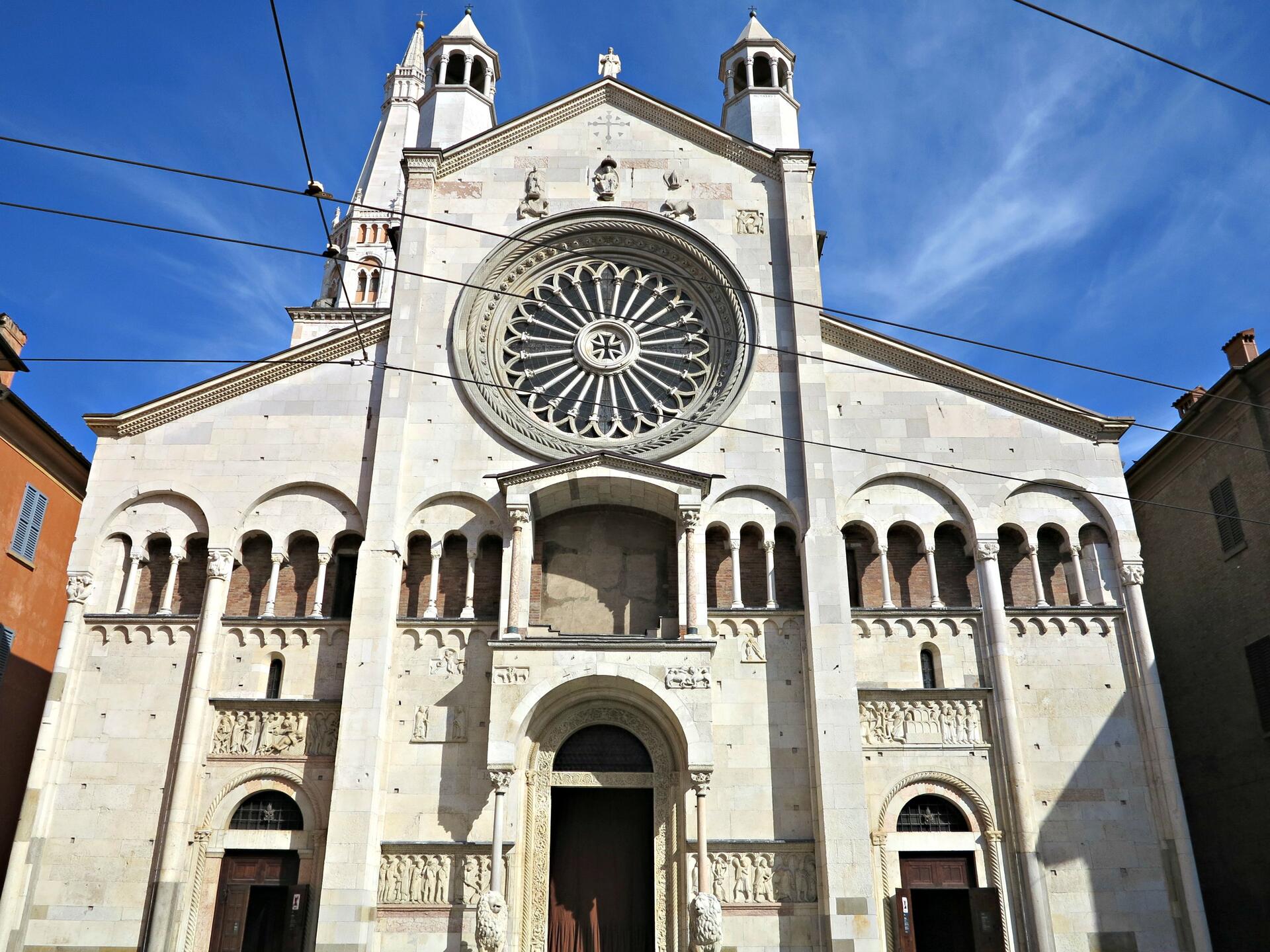
© Mongolo1984, CC BY-SA 4.0 Resized from original. (This derivative is under the same CC BY-SA license.)