World Heritage Identification Number: 131
World Heritage since: 1980
Category: Cultural Heritage
WHE Type: Historic Cities & Urban Areas
Transboundary Heritage: No
Endangered Heritage: No
Country: 🇲🇹 Malta
Continent: Europe
UNESCO World Region: Europe and North America
Map
A Historical Gem: The City of Valletta, Malta
The City of Valletta, located on the island of Malta in the Mediterranean Sea, stands as a testament to the rich cultural and historical heritage of the region. Inscribed as a UNESCO World Heritage Site in 1980, this city has a unique concentration of architectural and artistic treasures that reflect its tumultuous past.
Valletta's origins can be traced back to the Knights Hospitaller, also known as the Order of St. John of Jerusalem. Founded in the 11th century following the First Crusade, the order originally began as a hospital organization in Jerusalem. Over time, it evolved into a military order. The order took control of Malta in 1530, when the island was granted to them by Charles V of Spain as a fief following the Knights' expulsion from Rhodes.
In response to the Ottoman threat, Grand Master Jean Parisot de la Valette initiated the construction of a new fortified city in 1566. The task was entrusted to the architect Francesco Laparelli, who designed the city plan based on a grid pattern, with broad streets and numerous squares. The city was named after de la Valette, who successfully defended Malta against the Ottomans in the Great Siege of 1565.
One of the most notable landmarks within Valletta is St. John's Co-Cathedral, completed in 1578. Commissioned by Grand Master Jean de la Cassière, the cathedral serves as the Conventual Church of Saint John. Its intricate Baroque architecture, adorned with gold leaf and marble, houses some of the finest works of art from the period, including Caravaggio's masterpiece, 'The Beheading of St. John the Baptist'.
Another significant site within Valletta is the Grandmaster's Palace, which served as the official residence of the Grand Masters of the Order of St. John. Today, it is the most visited site in Valletta and houses the Office of the President of Malta. From 1921 to 2015, the Palace was also the seat of the Parliament of Malta. The palace boasts an impressive collection of art, including works by Mattia Preti and Antoine de Favray.
Valletta's defensive structures, such as the city walls, bastions, and forts, played a crucial role in the city's history. These fortifications were designed to protect the city from external threats, particularly from the Ottomans. Notable among these are the Barrakka Gardens, offering panoramic views of the Grand Harbour, and Fort St Elmo, which was the site of intense fighting during the Great Siege of 1565.
In addition to its historical significance, Valletta is renowned for its vibrant cultural scene. The city hosts numerous festivals throughout the year, including the Malta Arts Festival, the Valletta Film Festival, and the International Fireworks Festival. Influenced by its diverse history, the city's rich culinary traditions, offer visitors a unique gastronomic experience.
In conclusion, the City of Valletta stands as a remarkable example of a historically significant urban center. Its well-preserved architecture, rich cultural heritage, and vibrant contemporary life make it a must-visit destination for anyone interested in history, culture, or simply exploring the beauty of the Mediterranean.
UNESCO Description of the World Heritage Site
The capital of Malta is inextricably linked to the history of the military and charitable Order of St John of Jerusalem. It was ruled successively by the Phoenicians, Greeks, Carthaginians, Romans, Byzantines, Arabs and the Order of the Knights of St John. Valletta’s 320 monuments, all within an area of 55 ha, make it one of the most concentrated historic areas in the world.
UNESCO Justification of the World Heritage Site
Criterion (i): The city is pre-eminently an ideal creation of the late Renaissance with its uniform urban plan, inspired by neo-platonic principles, its fortified and bastioned walls modelled around the natural site and the voluntary implantation of great monuments in well-chosen locations.
Criterion (vi): The city is irrevocably affiliated with the history of the military and charitable Order of the Knights of St John of Jerusalem, which founded the city in 1566 and maintained it throughout two and a half centuries. Valletta is thus associated with the history of one of the greatest military and moral forces of modern Europe.
Encyclopedia Record: Saint John's Co-Cathedral
St John's Co-Cathedral is a Catholic co-cathedral in Valletta, Malta, dedicated to Saint John the Baptist. It was built by the Order of St. John between 1573 and 1578, having been commissioned by Grand Master Jean de la Cassière as the Conventual Church of Saint John.Additional Site Details
Area: 55.5 hectares
Number of Components: 1
(vi) — Directly associated with events or living traditions
Coordinates: 35.90056 , 14.51444
Image
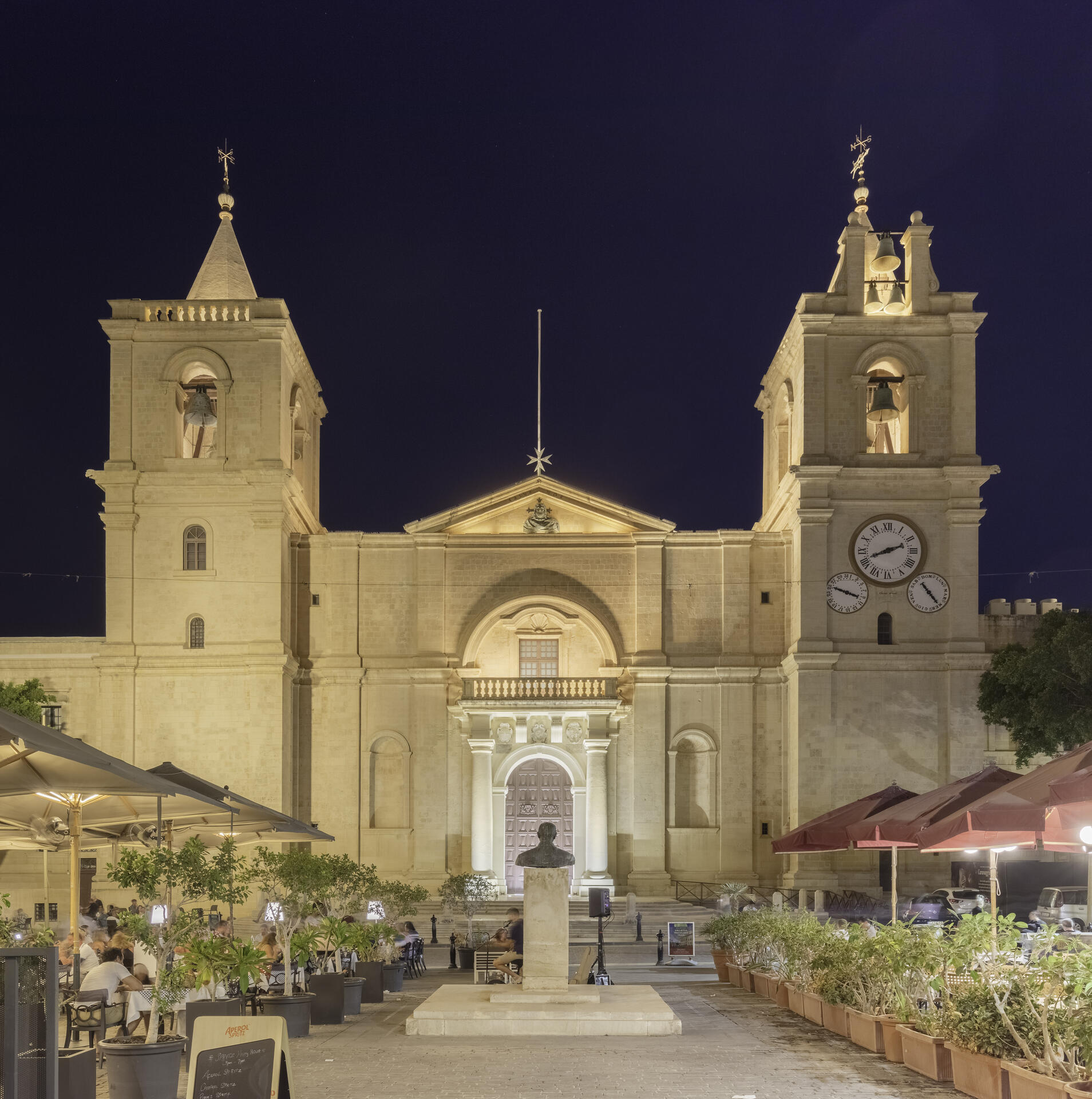
© Diego Delso, CC BY-SA 4.0 Resized from original. (This derivative is under the same CC BY-SA license.)
World Heritage Research
Discover scientific research and academic studies that deepen our understanding of City of Valletta from its history and significance to its conservation, management, and contemporary challenges.
-
City Narratives in Music: Creating musical works that reflect urban realities relating to Valletta
Urban narratives can be preserved, investigated, and extended through musical composition. This research demonstrates that cities like Valletta are not merely collections of spaces but the sum of their narratives—personal, communal, and historical—which face threats from gentrification, demographic displacement, and property speculation. By combining documentary sources, interviews, and fieldwork, the study created three distinct musical works: a piano concerto exploring physical city space as both result and catalyst for human activity; a symphony integrating identity, community ritual, folklore, and football; and an antiphonary work examining Valletta's spiritual dimension through sacred musical forms. These compositions reflect broader global urban challenges while remaining deeply rooted in local cultural contexts.
Vella Gregory, A. (2019). City Narratives in Music: Creating musical works that reflect urban realities relating to Valletta [Edinburgh Napier University]. https://doi.org/10.17869/ENU.2090688
View Publication Record | Read Publication -
Large-Scale Photogrammetric Documentation of St. John's Co-Cathedral: A Workflow for Cultural Heritage Preservation
A groundbreaking method for large-scale photogrammetric documentation of complex Baroque architecture, exemplified by St. John's Co-Cathedral in Valletta (Malta), has been developed. This approach overcomes challenges posed by reflective metallic surfaces, dark materials, and intricate tapestries through a multi-modal data acquisition strategy involving DSLR cameras, drone photography, and LIDAR scanning, capturing 99,000 images over seven nights. The resulting 3D reconstruction, comprising 25-30 billion triangles, combines automated workflows with manual intervention to ensure accuracy. Innovative techniques such as AI-assisted denoising and Gaussian splatting were employed to address low-light conditions and enhance visualization. This methodology sets a new standard for cultural heritage preservation, enabling comprehensive digital archives that support disaster recovery, conservation analysis, virtual tourism, and scholarly research.
Kenely, M., Bugeja, M., Grima, A., Pullicino, P., Pullicino, M., & Seychell, D. (2026). Large-Scale Photogrammetric Documentation of St. John’s Co-Cathedral: A Workflow for Cultural Heritage Preservation. Proceedings of the ACM on Computer Graphics and Interactive Techniques, 9(3), 1–17. https://doi.org/10.1145/3816089
View Publication Record | Read Publication -
The Order, Its City, and Its Peripheries
A groundbreaking study reveals how the Order of St John reshaped Malta's landscape and governance during its first century, challenging feudal structures and redefining the center-periphery dynamic. This transformation allowed the Knights to exert influence over Europe's most powerful courts, demonstrating a strategic approach to land control and urban development that extended beyond local boundaries. The research uses Malta as a case study, analyzing the Order's land policies, city-building efforts, and economic strategies within a broader European context. By dissecting the interplay between Valletta and its hinterland, the study provides new insights into how territorial redefinition can drive geopolitical influence.
Borg, D., & Mifsud, C. (2025). The Order, Its City, and Its Peripheries. The Land and the Cross, 170–188. https://doi.org/10.4324/9781003244226-15
View Publication Record | Read Publication -
Human Security, UN Sustainable Development Goals, and Smart Cities—Dubrovnik, Valletta, and Limassol in Comparative Perspective
A comparative analysis of Dubrovnik, Valletta, and Limassol reveals that smart city solutions can effectively enhance human security and quality of life while advancing the UN Sustainable Development Goals (SDGs), particularly Goal 11 on sustainable cities. The study highlights how these Mediterranean cities integrate sustainability, inclusiveness, resilience, and safety into their urban policies, demonstrating diverse yet aligned approaches to smart urban development. By examining public policy implementations, the research underscores the practical implications of global SDG frameworks at a local level, offering insights for Croatia, Malta, Cyprus, and broader European Union sustainable development agendas.
Jakešević, R. (2025). Human Security, UN Sustainable Development Goals, and Smart Cities—Dubrovnik, Valletta, and Limassol in Comparative Perspective. The Art of Being Smart, 36–51. https://doi.org/10.4324/9781003600466-3
View Publication Record | Read Publication -
Creating the Brand of Mediterranean Port Cities
Mediterranean port cities, including Valletta, face significant challenges in balancing mass tourism with the preservation of local identity and sustainable urban development. A study on place branding reveals that these cities employ strategic tactics to enhance their international appeal while integrating smart city concepts for efficient urban management. The research highlights the importance of differentiation through unique cultural and historical assets, while also leveraging a broader Mediterranean identity as a unifying narrative. By adopting a holistic approach, these strategies aim to create a compelling and credible brand image that resonates globally.
Skoko, B., Mulović Trgovac, A., & John, R. (2025). Creating the Brand of Mediterranean Port Cities. The Art of Being Smart, 74–103. https://doi.org/10.4324/9781003600466-5
View Publication Record | Read Publication -
Characteristics of a Smart City
Smart city development varies significantly even among Mediterranean port cities, with Dubrovnik, Valletta, and Limassol showcasing distinct smart city characteristics. A framework categorizing these dimensions into Technology, Human, and Institutional factors was used to analyze existing assets, solutions, and services. The study reveals that while all three cities meet certain smart city benchmarks, their potential for further development differs based on local preconditions and available resources. This analysis highlights the need for tailored approaches to smart urban planning in historic contexts like Valletta.
Cesarec, I., Portolan, A., & Stanković, M. (2025). Characteristics of a Smart City. The Art of Being Smart, 52–73. https://doi.org/10.4324/9781003600466-4
View Publication Record | Read Publication -
Cities as Actors in International Relations
Cities, including UNESCO World Heritage Sites like Dubrovnik and Valletta, are emerging as influential actors in international relations, demonstrating capabilities in negotiation, humanitarian response, and policy innovation. A study analyzing these cities' roles during the COVID-19 pandemic found that they effectively reconciled goals of being thriving cruise ports, preserving their heritage status, and adopting smart city concepts through paradiplomatic strategies and international network engagement. This challenges traditional views of cities as mere administrative units under national control, positioning them as key participants in global governance.
Kos-Stanišić, L., & Luša, Đ. (2025). Cities as Actors in International Relations. The Art of Being Smart, 126–144. https://doi.org/10.4324/9781003600466-7
View Publication Record | Read Publication