World Heritage Identification Number: 832
World Heritage since: 1997
Category: Cultural Heritage
WHE Type: Buildings & Architectural Ensembles
Transboundary Heritage: No
Endangered Heritage: No
Country: 🇮🇹 Italy
Continent: Europe
UNESCO World Region: Europe and North America
Map
The Magnificent Villa Romana del Casale: A Glimpse into the Luxurious Life of the Late Roman Empire
The Villa Romana del Casale, situated approximately 3 kilometers from the town of Piazza Armerina in Sicily, stands as a testament to the opulence and grandeur of the late Roman Empire. This magnificent villa or palace, excavated since the 1920s, offers a unique insight into the lifestyle of the wealthy aristocrats who once resided there during the early 4th century AD. In recognition of its historical significance and the exceptional quality of its mosaics, the Villa Romana del Casale was designated as a UNESCO World Heritage Site in 1997.
More to come…UNESCO Description of the World Heritage Site
Roman exploitation of the countryside is symbolized by the Villa Romana del Casale (in Sicily), the centre of the large estate upon which the rural economy of the Western Empire was based. The villa is one of the most luxurious of its kind. It is especially noteworthy for the richness and quality of the mosaics which decorate almost every room; they are the finest mosaics in situ anywhere in the Roman world.
UNESCO Justification of the World Heritage Site
The Committee decided to inscribe this property on the basis of criteria (i), (ii) and (iii), considering that the Villa del Casale at Piazza Armerina is the supreme example of a luxury Roman villa, which graphically illustrates the predominant social and economic structure of its age. The mosaics that decorate it are exceptional for their artistic quality and invention as well as their extent.
Encyclopedia Record: Villa Romana del Casale
The Villa Romana del Casale is a large and elaborate Roman villa or palace located about 3 km from the town of Piazza Armerina, Sicily. Excavations have revealed Roman mosaics which, according to the Grove Dictionary of Art, are the richest, largest and most varied collection that remains, for which the site was designated as a UNESCO World Heritage Site in 1997. The villa and its artwork date to the early 4th century AD.Additional Site Details
Area: 8.92 hectares
Number of Components: 1
(ii) — Significant interchange of human values
(iii) — Unique or exceptional testimony to a cultural tradition
Coordinates: 37.36611 , 14.33417
Image
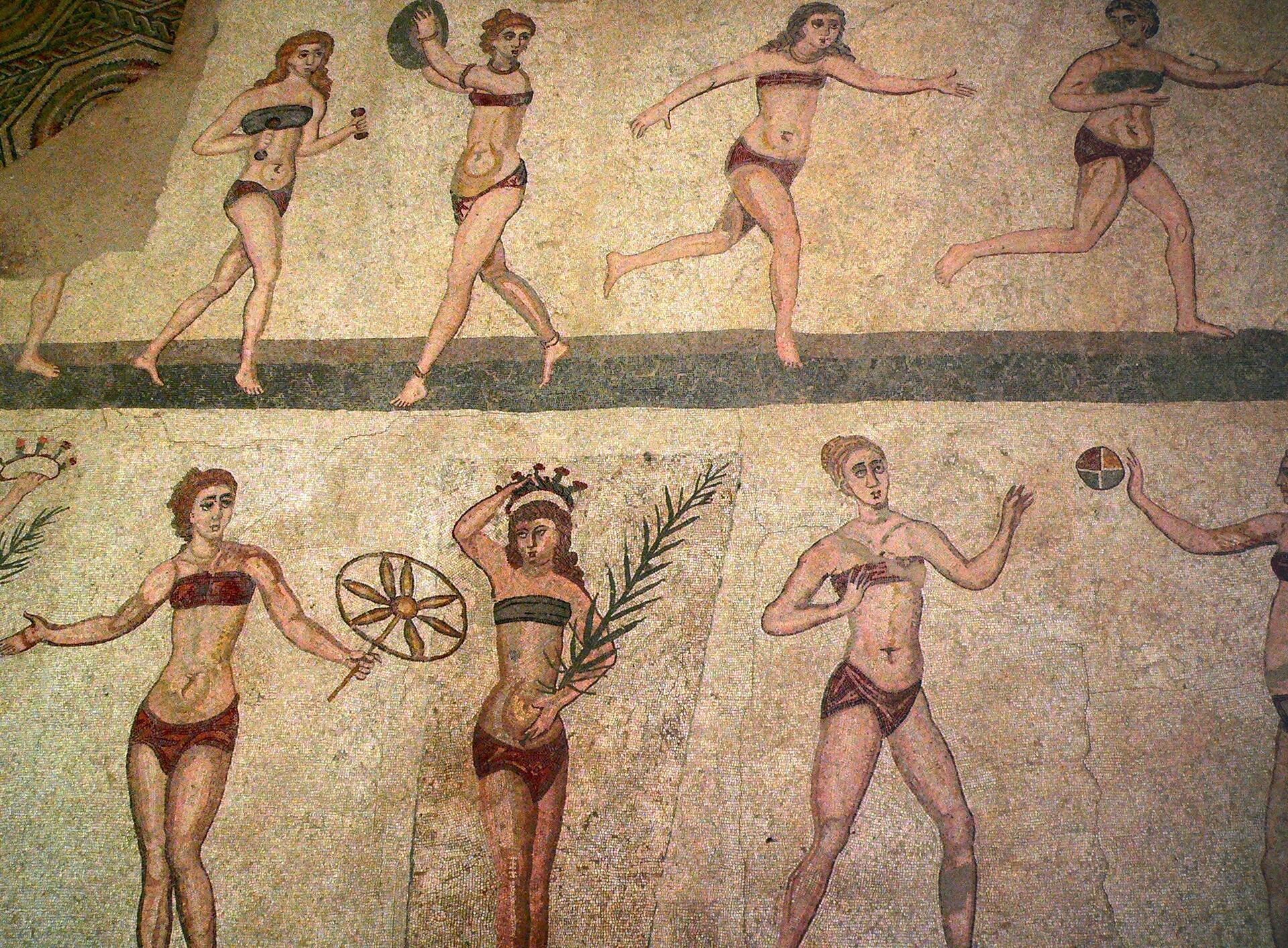
© modification by AlMare of photograph taken by Disdero, CC BY-SA 2.5 Resized from original. (This derivative is under the same CC BY-SA license.)
World Heritage Research
Discover scientific research and academic studies that deepen our understanding of Villa Romana del Casale from its history and significance to its conservation, management, and contemporary challenges.
-
Safeguarding of the Villa Romana del Casale UNESCO site from severe weather events: the case study of Apollo medicane occurred in October 2021
A comprehensive recovery and conservation project, completed in 2012, significantly enhanced the resilience of the Villa Romana del Casale UNESCO World Heritage Site to extreme weather events. This was demonstrated during the 'Apollo medicane' in October 2021, which subjected the site to severe flooding. The study, conducted using ground-based and satellite measurements, analyzed the impacts of this event on the monumental complex and compared it with previous damage from a flood in 1991. The findings highlight the effectiveness of the conservation strategies implemented, particularly the new covering system and preventive maintenance protocol, which mitigated the effects of the extreme meteorological phenomenon.
Prestileo, F., Mascitelli, A., Meli, G., Petracca, M., Giorgi, C., Melfi, D., Puca, S., & Dietrich, S. (2022). Safeguarding of the Villa Romana del Casale UNESCO site from severe weather events: the case study of Apollo medicane occurred in October 2021. https://doi.org/10.5194/egusphere-plinius17-44
View Publication Record | Read Publication -
Diagnostic Activities for the Planned and Preventive Conservation of Mosaic Pavements: The Case Study of the Triclinium of the Villa Romana del Casale (Sicily)
A breakthrough in the conservation of ancient mosaics, particularly those at the UNESCO World Heritage Site Villa Romana del Casale in Sicily, has been achieved through an innovative diagnostic procedure. This method combines laser scanning and thermo-hygrometric investigations to monitor the physical condition of mosaic pavements over time and assess the effectiveness of maintenance work. Unlike traditional approaches, this user-friendly procedure offers a sustainable, long-term solution for preserving these exceptional Roman mosaics, addressing challenges such as economic and technical constraints. The study highlights the potential of integrating advanced technologies into preventive conservation strategies, ensuring the longevity of cultural heritage sites worldwide.
Versaci, A., Cardaci, A., & Fauzia, L. R. (2016). Diagnostic Activities for the Planned and Preventive Conservation of Mosaic Pavements: The Case Study of the Triclinium of the Villa Romana del Casale (Sicily). Digital Heritage. Progress in Cultural Heritage: Documentation, Preservation, and Protection, 241–253. https://doi.org/10.1007/978-3-319-48496-9_20
View Publication Record | Read Publication