World Heritage Identification Number: 907
World Heritage since: 1999
Category: Cultural Heritage
WHE Type: Archaeological Sites
Transboundary Heritage: No
Endangered Heritage: No
Country: 🇮🇹 Italy
Continent: Europe
UNESCO World Region: Europe and North America
Map
Hadrian's Villa: An Architectural Marvel at Tivoli
Hadrian's Villa, located near Tivoli, Italy, is a remarkable testament to the architectural prowess and artistic vision of one of Rome's most celebrated emperors, Hadrian. Inscribed as a UNESCO World Heritage Site in 1999, this vast villa complex offers a unique blend of architectural styles from three distinct civilizations – Egypt, Greece, and Rome.
More to come…UNESCO Description of the World Heritage Site
The Villa Adriana (at Tivoli, near Rome) is an exceptional complex of classical buildings created in the 2nd century A.D. by the Roman emperor Hadrian. It combines the best elements of the architectural heritage of Egypt, Greece and Rome in the form of an 'ideal city'.
UNESCO Justification of the World Heritage Site
Criterion (i): The Villa Adriana is a masterpiece that uniquely brings together the highest expressions of the material cultures of the ancient Mediterranean world.
Criterion (ii): Study of the monuments that make up Villa Adriana played a crucial role in the rediscovery of the elements of classical architecture by the architects of the Renaissance and the Baroque periods. It also profoundly influenced many 19th and 20th century architects and designers.
Criterion (iii): Villa Adriana is an exceptional survival from the Early Roman Empire. The great number of buildings and other structures within it, and the collection of statues and sculptures that decorate the interior and exterior rooms, illustrate the taste and erudition of one of the greatest Roman Emperors. Hadrian was a man of immense culture, who personally oversaw the construction of the villa, inspired by his travels through his extensive Empire, he brought the best of the varied cultures back to this palatial complex.
Encyclopedia Record: Hadrian's Villa
Hadrian's Villa is a UNESCO World Heritage Site comprising the ruins and archaeological remains of a large villa complex built around AD 120 by Roman emperor Hadrian near Tivoli outside Rome.Additional Site Details
Area: 80 hectares
Number of Components: 1
(ii) — Significant interchange of human values
(iii) — Unique or exceptional testimony to a cultural tradition
Coordinates: 41.94416667 , 12.77197222
Image
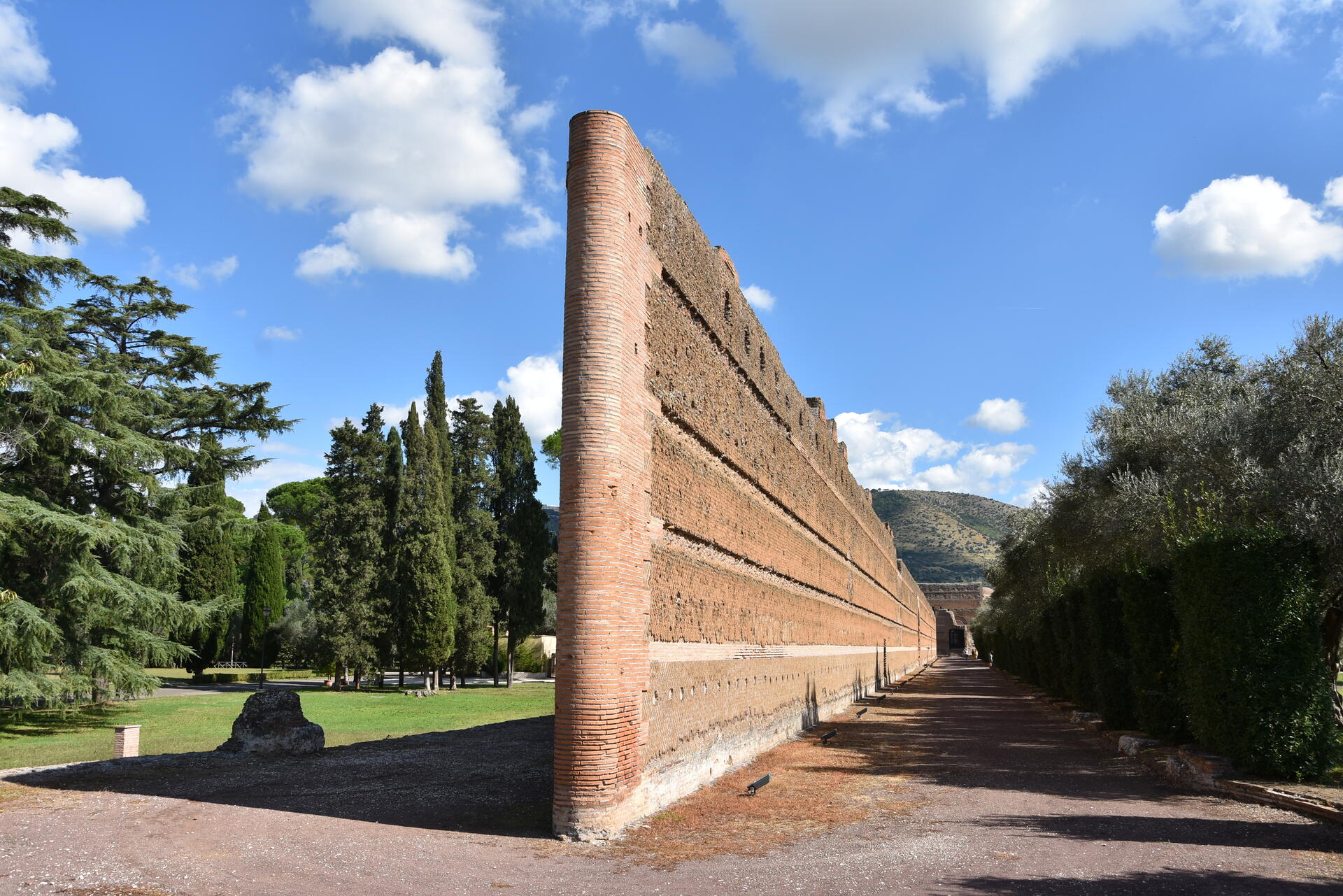
© Patrik Kunec, CC BY-SA 4.0 Resized from original. (This derivative is under the same CC BY-SA license.)
World Heritage Research
Discover scientific research and academic studies that deepen our understanding of Villa Adriana (Tivoli) from its history and significance to its conservation, management, and contemporary challenges.
-
Villa Adriana as Collection. Hearst Castle and The Getty Center
Villa Adriana, an ancient Roman site built by Emperor Hadrian near Tivoli, has evolved into a powerful symbol inspiring modern literature, film, and architecture. Its influence extends to contemporary structures like Hearst Castle and the Getty Center, both designed as 'villa-museums' that blend art, history, and identity. While Hearst Castle reflects a collector's desire to control history through eclectic styles, the Getty Center reimagines ancient concepts with modern design elements such as travertine stone and overlapping grids. This essay highlights Villa Adriana's enduring legacy as a timeless link between past and present, demonstrating its capacity to inspire new narratives and spaces.
Froio, G. (2026). Villa Adriana as Collection. Hearst Castle and The Getty Center. Athens Journal of Architecture, 12(2), 229. https://doi.org/10.30958/aja.12-2-5
View Publication Record | Read Publication -
Mineralized carbonates contribute to the millennial durability of Roman concrete
Roman concrete's millennial durability is significantly enhanced by carbonation, not just the pozzolanic reaction. A study of Hadrian's Villa in Tivoli, Italy, reveals that calcite cementation and radiaxial fibrous calcite formation from atmospheric CO2 and moisture reinforce structural strength and occlude porosity, offering potential for modern concrete resilience. The research used multiscale spectroscopic and tomographic approaches to analyze the concrete's microstructure, uncovering its self-healing properties and sustainable construction implications.
Zhu, X., Chae, S. R., McElhany, S., Liang, C., Zheng, Q., Li, J., Fondi, V., Del Ferro, S., Modena Altieri, A., Lisabeth, H. P., Bhattacharjee, A., Fouke, B. W., Wenk, H.-R., & Monteiro, P. J. M. (2026). Mineralized carbonates contribute to the millennial durability of Roman concrete. Science Advances, 12(28). https://doi.org/10.1126/sciadv.aeb0754
View Publication Record | Read Publication -
The Liceo area - a forgotten but essential part of Hadrian's villa
New evidence from the Liceo area, south of Hadrian’s Villa in Tivoli, reveals that its buildings—including recently excavated thermae (Building A), an ambulatorium, and two large cisterns—were integral to the imperial estate. Analysis of their location, chronology, and function suggests direct connection to both the late Republican predecessor villa and Hadrian’s later expansion, challenging long-standing assumptions about the area's exclusion from state-protected archaeological zones. The study, based on Norwegian-Swedish fieldwork (2011–2015), sheds light on a neglected but essential component of this UNESCO World Heritage Site.
Lindhagen, A. (2025). The Liceo area - a forgotten but essential part of Hadrian’s villa. Acta Ad Archaeologiam et Artium Historiam Pertinentia, 37(24 N.S.), 85–100. https://doi.org/10.5617/acta.10473
View Publication Record | Read Publication -
La testa del Doriforo dalla “Palestra” di Villa Adriana a Tivoli
A newly discovered head of the Doryphoros, unearthed during excavations at Hadrian's Villa (Villa Adriana) in Tivoli, Italy, reveals a dual purpose for the site's 'Palestra'—serving both as an athletic training space and a cult area. The analysis suggests that the inclusion of this iconic Polykleitos sculpture, along with other works attributed to the ancient Greek sculptor, reflects Hadrian's imperial patronage and a deliberate connection to classical art. This finding supports Pirro Ligorio's original identification of the Palestra, while also highlighting its significance in housing statues of Egyptian deities, thereby enriching our understanding of the villa's multifunctional design and its cultural context.
Calandra, E. (2025). The head of the Doryphoros from the “Palestra” of Hadrian’s Villa in Tivoli. LANX. Rivista Della Scuola Di Specializzazione in Beni Archeologici - Università Degli Studi Di Milano, (33), 44–61. https://doi.org/10.54103/2035-4797/30352
View Publication Record | Read Publication -
A Portrait Bust of Julia Mamaea from the Pantanello of Hadrian’s Villa?
A portrait bust of Julia Mamaea, likely originating from the Pantanello at Hadrian’s Villa (Villa Adriana) in Tivoli, has been identified through analysis of 18th-century antiquarian records and collection histories. The study suggests that this bust, now housed in Potsdam’s Schloss Sanssouci, was part of a collection acquired by Cardinal Polignac before being transferred to Frederick II of Prussia. This finding strengthens the evidence linking Julia Mamaea, a prominent figure in the Severan dynasty, to Hadrian’s Villa, further illuminating its use during the early 3rd century. The research combines antiquarian sources with provenance tracking to reconstruct the bust’s journey and its significance within the villa’s imperial portrait sequence.
Colzani, G. (2025). A Portrait Bust of Julia Mamaea from the Pantanello of Hadrian’s Villa? LANX. Rivista Della Scuola Di Specializzazione in Beni Archeologici - Università Degli Studi Di Milano, (33), 34–43. https://doi.org/10.54103/2035-4797/30353
View Publication Record | Read Publication -
An urban image in an urbanized landscape: measuring the visual impact of Tibur's amphitheater
A novel GIS visibility analysis reveals that Tibur's amphitheater, though extramural and infrequently used, significantly amplified the city's urban image from a distance. This monumental structure not only integrated suburban growth into the older urban center but also emphasized the city's status as both an annex of Rome and an autonomous municipium. The study quantifies its visual impact using empirical and qualitative scales adapted from modern assessments, demonstrating how it monumentalized alternative routes frequented by the villa-owning elite, thereby countering the ambiguous civic identity of Tibur.
Notarian, M. (2024). An urban image in an urbanized landscape: measuring the visual impact of Tibur’s amphitheater. Journal of Roman Archaeology, 37(1), 53–88. https://doi.org/10.1017/s1047759424000059
View Publication Record | Read Publication -
The Plutonium Project, Hadrian's Villa, Tivoli (Comune di Tivoli, Provincia di Roma, Regione Lazio)
Recent excavations at Hadrian's Villa in Tivoli, Italy, specifically in the Plutonium area, have shed new light on the architectural and symbolic significance of this ancient complex. The Plutonium, traditionally interpreted as a reproduction of the Underworld, was investigated through two trenches (T and D) during a two-week excavation from June 27 to July 16, 2022. Trench T, located on a high podium within the built-up complex, revealed structural details that contribute to understanding the villa's layout and function. Meanwhile, Trench D connected previous excavations, providing insights into the semicircular structure projecting southwest of the Plutonium's front. This research, conducted by the Universities of Pavia and Oxford, aims to deepen our knowledge of Hadrian's Villa, one of Rome's most significant UNESCO World Heritage Sites.
Gorrini, M. E., Melfi, M., & Montali, G. (2023). THE PLUTONIUM PROJECT, HADRIAN’S VILLA, TIVOLI (COMUNE DI TIVOLI, PROVINCIA DI ROMA, REGIONE LAZIO). Papers of the British School at Rome, 91, 328–331. https://doi.org/10.1017/s0068246223000107
View Publication Record | Read Publication