World Heritage Identification Number: 1158
World Heritage since: 2004
Category: Cultural Heritage
WHE Type: Archaeological Sites
Transboundary Heritage: No
Endangered Heritage: No
Country: 🇮🇹 Italy
Continent: Europe
UNESCO World Region: Europe and North America
Map
Exploring the Etruscan Necropolises of Cerveteri and Tarquinia: A Journey into Ancient Civilization
The Etruscan Necropolises of Cerveteri and Tarquinia, inscribed as a UNESCO World Heritage Site in 2004, offer a unique glimpse into the rich cultural heritage and early urban civilization of the Etruscans. Located in the Metropolitan City of Rome Capital, Italy, these two extensive cemeteries span nine centuries, providing valuable insights into Etruscan society, art, and architectural practices.
More to come…UNESCO Description of the World Heritage Site
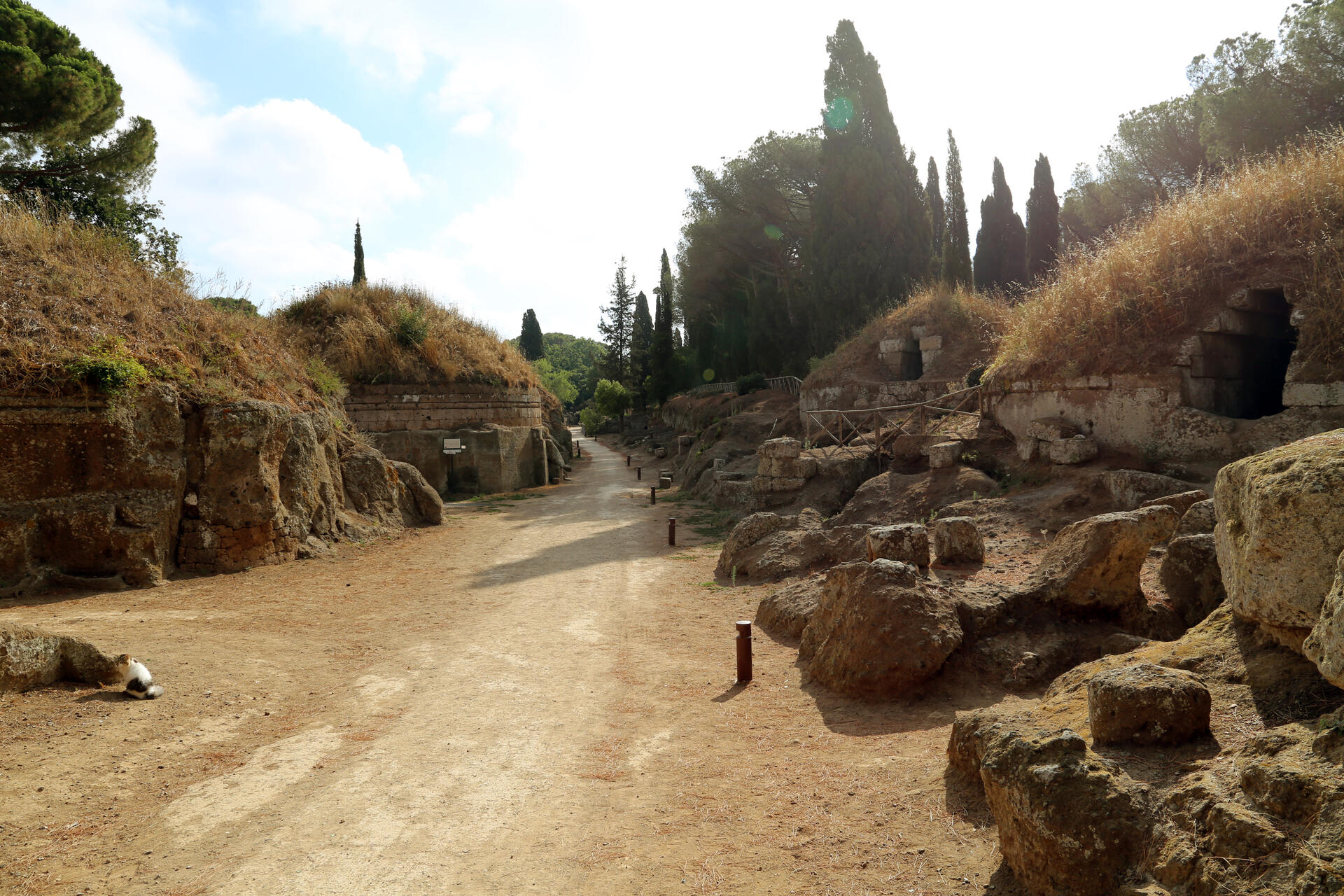
These two large Etruscan cemeteries reflect different types of burial practices from the 9th to the 1st century BC, and bear witness to the achievements of Etruscan culture. Which over nine centuries developed the earliest urban civilization in the northern Mediterranean. Some of the tombs are monumental, cut in rock and topped by impressive tumuli (burial mounds). Many feature carvings on their walls, others have wall paintings of outstanding quality. The necropolis near Cerveteri, known as Banditaccia, contains thousands of tombs organized in a city-like plan, with streets, small squares and neighbourhoods. The site contains very different types of tombs: trenches cut in rock; tumuli; and some, also carved in rock, in the shape of huts or houses with a wealth of structural details. These provide the only surviving evidence of Etruscan residential architecture. The necropolis of Tarquinia, also known as Monterozzi, contains 6,000 graves cut in the rock. It is famous for its 200 painted tombs, the earliest of which date from the 7th century BC.
UNESCO Justification of the World Heritage Site
Criterion (i): The necropolises of Tarquinia and Cerveteri are masterpieces of creative genius: Tarquinia's large-scale wall paintings are exceptional both for their formal qualities and for their content, which reveal aspects of life, death, and religious beliefs of the ancient Etruscans. Cerveteri exceptionally testifies in a funerary context the same town planning and architectural schemes used in an ancient city.
Criterion (iii): The two necropolises constitute a unique and exceptional testimony to the ancient Etruscan civilisation, the only urban type of civilisation in pre-Roman Italy. Moreover, the depiction of daily life in the frescoed tombs, many of which are replicas of Etruscan houses, is a unique testimony to this vanished culture.
Criterion (iv): Many of the tombs of Tarquinia and Cerveteri represent types of buildings that no longer exist in any other form. The cemeteries, replicas of Etruscan town planning schemes, are some of the earliest existing in the region.
Encyclopedia Record: Cerveteri
Cerveteri is a comune (municipality) in the Metropolitan City of Rome Capital, in the Italian region of Lazio. Known by the ancient Romans as Caere, and previously by the Etruscans as Caisra or Cisra, and as Agylla by the Greeks, its modern name derives from Caere Vetus used in the 13th century to distinguish it from Caere Novum.Additional Site Details
Area: 326.93 hectares
Number of Components: 2
(iii) — Unique or exceptional testimony to a cultural tradition
(iv) — Outstanding example of a type of building or landscape
Coordinates: 42.00683333 , 12.10188889
World Heritage Research
Discover scientific research and academic studies that deepen our understanding of Etruscan Necropolises of Cerveteri and Tarquinia from its history and significance to its conservation, management, and contemporary challenges.
-
Bioconsolidation of calcarenite for cultural heritage conservation: Effects of application methods on mechanical and petrophysical properties
Bioconsolidation using carbonatogenic bacteria significantly enhances the mechanical and petrophysical properties of calcarenite, a highly porous rock, offering a promising eco-friendly conservation technique for weathered stone materials. The study, conducted under laboratory conditions, examined the efficacy of different bioconsolidation application methods—spray and immersion—on Macco calcarenite from the Etruscan Necropolises of Cerveteri and Tarquinia. Results showed that while spray treatment led to higher mass gain, immersion provided greater mechanical reinforcement, including increased uniaxial unconfined compressive strength and seismic wave velocity. These findings support bioconsolidation as an effective non-invasive intervention for the restoration of ancient Etruscan hypogeal tombs, addressing conservators' needs while advancing sustainable conservation practices.
Benedetti, F., Volpe, G., Rinaldi, T., & Trippetta, F. (2026). Bioconsolidation of calcarenite for cultural heritage conservation: Effects of application methods on mechanical and petrophysical properties. Environmental Technology & Innovation, 42, 104909. https://doi.org/10.1016/j.eti.2026.104909
View Publication Record | Read Publication -
Egyptian blue in Etruscan funerary wall paintings: A multi-analytical study from the Monterozzi necropolis (Tarquinia)
A groundbreaking multi-analytical study of the Monterozzi Necropolis in Tarquinia, Italyreveals the extensive use of Egyptian blue in Etruscan funerary wall paintings from the 7th to 3rd century BCE. The research, part of the ARANTH campaign, identified this pigment not only as a primary color but also in combination with others across green, red, blue, and whitish areas. A novel application of micro-fluorescence in near-infrared imaging enabled rapid localization of luminescent grains, later confirmed by Raman spectroscopy, providing unprecedented insights into the spatial distribution of Egyptian blue within pictorial layers. Additionally, azurite was identified for the first time in Etruscan mural painting, offering new evidence on pigment use and painting technology. The study integrated advanced techniques such as VIS–NIR hyperspectral analysis, X-ray fluorescence, and FT-IR spectroscopy to map and analyze five painted tombs, contributing significantly to our understanding of Etruscan funerary art.
Casanova Municchia, A., Adinolfi, G., Boccuto, A., Botteon, A., Buti, D., Carmagnola, R., Catrambone, M., Conti, C., Di Tullio, V., Luvidi, L., Mattana, S., Miliani, C., Romani, A., & Tomassetti, M. C. (2026). Egyptian blue in Etruscan funerary wall paintings: A multi-analytical study from the Monterozzi necropolis (Tarquinia). Journal of Cultural Heritage, 79, 345–360. https://doi.org/10.1016/j.culher.2026.04.009
View Publication Record | Read Publication -
Sustainable Management of UNESCO Landscapes to Foster Natural and Cultural Capital
A study of the Etruscan Necropolises of Cerveteri and Tarquinia reveals significant landscape changes from 1954 to 2023, with a 23% alteration in land cover. While the site's recognition as a UNESCO area has mitigated some fragmentation, concerns persist, particularly in its buffer zone, which includes the ancient Etruscan city and lacks adequate protection. The research identifies critical management strategies, such as expanding the core area to include the ancient city, restoring naturalistic connections like the ancient path, and reforesting sensitive archaeological areas to combat landscape fragmentation. These actions aim to foster both natural and cultural capital, ensuring sustainable conservation for future generations.
Petrosillo, I., Lovello, E. M., Ria, L., Tartara, P., & Valente, D. (2025). Sustainable Management of UNESCO Landscapes to Foster Natural and Cultural Capital. Sustainability, 17(19), 8895. https://doi.org/10.3390/su17198895
View Publication Record | Read Publication -
Innovative, Multidisciplinary Approach for Restoring Paintings in Hypogeal Environment: Etruscan Tomba Degli Scudi (4th Century Bc) in Tarquinia
A groundbreaking discovery in the restoration of Etruscan mural paintings at the 4th-century BC Tomba degli Scudi, a UNESCO-listed hypogeum in Tarquinia, Italy, reveals that Etruscan artists used modular templates—termed patroni and antibola—to depict human figures, challenging long-held assumptions about the origin of this technique by predating its known use in medieval art by nearly a millennium. This finding refines our understanding of technological transitions from Classical Antiquity to the Middle Ages. The study employed an innovative, multidisciplinary approach combining conservation, archaeology, and microbiology, including ultraviolet fluorescence with 3D techniques and rigorous pre-, during-, and post-restoration microbial analyses. Notably, moonmilk—a microbial-derived calcite—was identified as a preservative agent in the paintings, while challenges in post-restoration disinfestation highlighted the need for targeted conservation strategies. The research was conducted collaboratively by restorers, archaeologists, and scientists, funded by the Italian Environment Fund and archaeological authorities.
Cirigliano, A., Pelosi, C., Rinaldi, T., Kruif, F., Lanteri, L., Porcelli, G., Pogliani, P., Tomassetti, M., & Arrighi, C. (2024). Innovative, Multidisciplinary Approach for Restoring Paintings in Hypogeal Environment: Etruscan Tomba Degli Scudi (4th Century Bc) in Tarquinia. Current Approaches, Solutions and Practices in Conservation of Cultural Heritage, 341–373. https://doi.org/10.26650/b/aa9ps34.2024.006.017
View Publication Record | Read Publication -
The Etruscans – a Society of Masters and Servants? A Modern Topos and its Origins
A pervasive modern narrative portraying Etruscan society as rigidly divided between masters and servants is challenged by new research, which traces the origins of this 'two-class topos' from 19th-century scholarship to contemporary interpretations. While ancient literary sources and theories about Etruscan immigration have long fueled this perspective, a critical reassessment reveals its limitations. The study instead advocates for deeper engagement with Etruscan source material, exemplified by an analysis of the late Etruscan necropolis at Fondo Scataglini in Tarquinia, to better understand societal hierarchies without relying on problematic ancient accounts.
Amann, P. (2024). The Etruscans – a Society of Masters and Servants? A Modern Topos and its Origins. Dependency and Social Inequality in Pre-Roman Italy, 15–48. https://doi.org/10.1515/9783111558417-002
View Publication Record | Read Publication -
Long-term monitoring of the hypogeal Etruscan Tomba degli Scudi, Tarquinia, Italy. Early detection of black spots, investigation of fungal community, and evaluation of their biodeterioration potential
A multi-analytical investigation of the Tomba degli Scudi in Tarquinia, Italy, identified common subterranean fungal strains—such as Gliomastix murorum and Pseudogymnoascus pannorum—as responsible for expanding black spots on its ancient Etruscan mural paintings. These fungi, found globally in similar environments like Lascaux Cave, pose a biodeterioration risk to the site's priceless artistic heritage. Long-term monitoring since 2016 enabled early detection and assessment of their harmful potential, demonstrating the efficacy of preventive conservation strategies for fragile hypogeal sites.
Kratter, M., Beccaccioli, M., Vassallo, Y., Benedetti, F., La Penna, G., Proietti, A., Zanellato, G., Faino, L., Cirigliano, A., Neisje de Kruif, F., Tomassetti, M. C., Rossi, M., Reverberi, M., Quagliariello, A., & Rinaldi, T. (2024). Long-term monitoring of the hypogeal Etruscan Tomba degli Scudi, Tarquinia, Italy. Early detection of black spots, investigation of fungal community, and evaluation of their biodeterioration potential. Journal of Applied Microbiology, 135(10). https://doi.org/10.1093/jambio/lxae258
View Publication Record | Read Publication -
An archaeological landscape amid nature, culture, and atmosphere: preliminary considerations for the Co.R.A.Ve. Research and Conservation Project
The Etruscan Necropolises of Cerveteri and Tarquinia, particularly the Banditaccia necropolis, represent a unique archaeological landscape where native vegetation and funerary structures coexist symbiotically. This study introduces preliminary considerations for the Co.R.A.Ve. Research and Conservation Project, which aims to develop conservation methodologies that preserve this delicate balance without compromising the site's historical and emotional value. By employing theories from Carlson and Assunto, the research frames the necropolis as a 'historic landscape,' emphasizing the interplay between nature, culture, and human perception. The project addresses challenges posed by traditional restoration practices, advocating for interventions that maintain the integrity of both vegetation and ruins while enhancing their long-term protection.
Vagnarelli, T., & Morezzi, E. (2024). An archaeological landscape amid nature, culture, and atmosphere: preliminary considerations for the Co.R.A.Ve. Research and Conservation Project. Restauro Archeologico, 32(1), 20–39. https://doi.org/10.36253/rar-16317
View Publication Record | Read Publication