World Heritage Identification Number: 1025
World Heritage since: 2001
Category: Cultural Heritage
WHE Type: Buildings & Architectural Ensembles
Transboundary Heritage: No
Endangered Heritage: No
Country: 🇮🇹 Italy
Continent: Europe
UNESCO World Region: Europe and North America
Map
A Masterpiece of Renaissance Culture: Villa d'Este, Tivoli
The Villa d'Este, nestled in the picturesque town of Tivoli, approximately 30 kilometers east of Rome, stands as a testament to the grandeur and innovation of the Italian Renaissance. Inscribed as a UNESCO World Heritage Site in 2001, this villa, with its palace and garden, offers a captivating glimpse into the cultural, architectural, and horticultural achievements of the 16th century.
More to come…UNESCO Description of the World Heritage Site
The Villa d'Este in Tivoli, with its palace and garden, is one of the most remarkable and comprehensive illustrations of Renaissance culture at its most refined. Its innovative design along with the architectural components in the garden (fountains, ornamental basins, etc.) make this a unique example of an Italian 16th-century garden. The Villa d'Este, one of the first giardini delle meraviglie , was an early model for the development of European gardens.
UNESCO Justification of the World Heritage Site
Criterion (i): The Villa d’Este is one of the most outstanding examples of Renaissance culture at its apogee.
Criterion (ii): The gardens of the Villa d’Este had a profound influence on the development of garden design throughout Europe.
Criterion (iii): The principles of Renaissance design and aesthetics are illustrated in an exceptional manner by the gardens of the Villa d’Este.
Criterion (iv): The gardens of the Villa d’Este are among the earliest and finest of the giardini delle meraviglie and symbolize the flowering of Renaissance culture.
Criterion (vi): The Villa d'Este, with its palace and gardens, bears exceptional testimony to the Italian Renaissance and has been a source of artistic inspiration ever since its creation.
Encyclopedia Record: Villa d'Este
The Villa d'Este is a 16th-century villa in Tivoli, near Rome. It is a masterpiece of Italian architecture and garden design, famous for its terraced hillside Italian Renaissance garden and the ingenuity of its architectural features, it is an incomparable example of a 16th-century Italian garden, which later had a huge influence on landscape design in Europe. It is now an Italian state museum, and is listed as a UNESCO World Heritage Site since 2001.Additional Site Details
Area: 4.5 hectares
Number of Components: 1
(ii) — Significant interchange of human values
(iii) — Unique or exceptional testimony to a cultural tradition
(iv) — Outstanding example of a type of building or landscape
(vi) — Directly associated with events or living traditions
Coordinates: 41.96391667 , 12.79625
Image
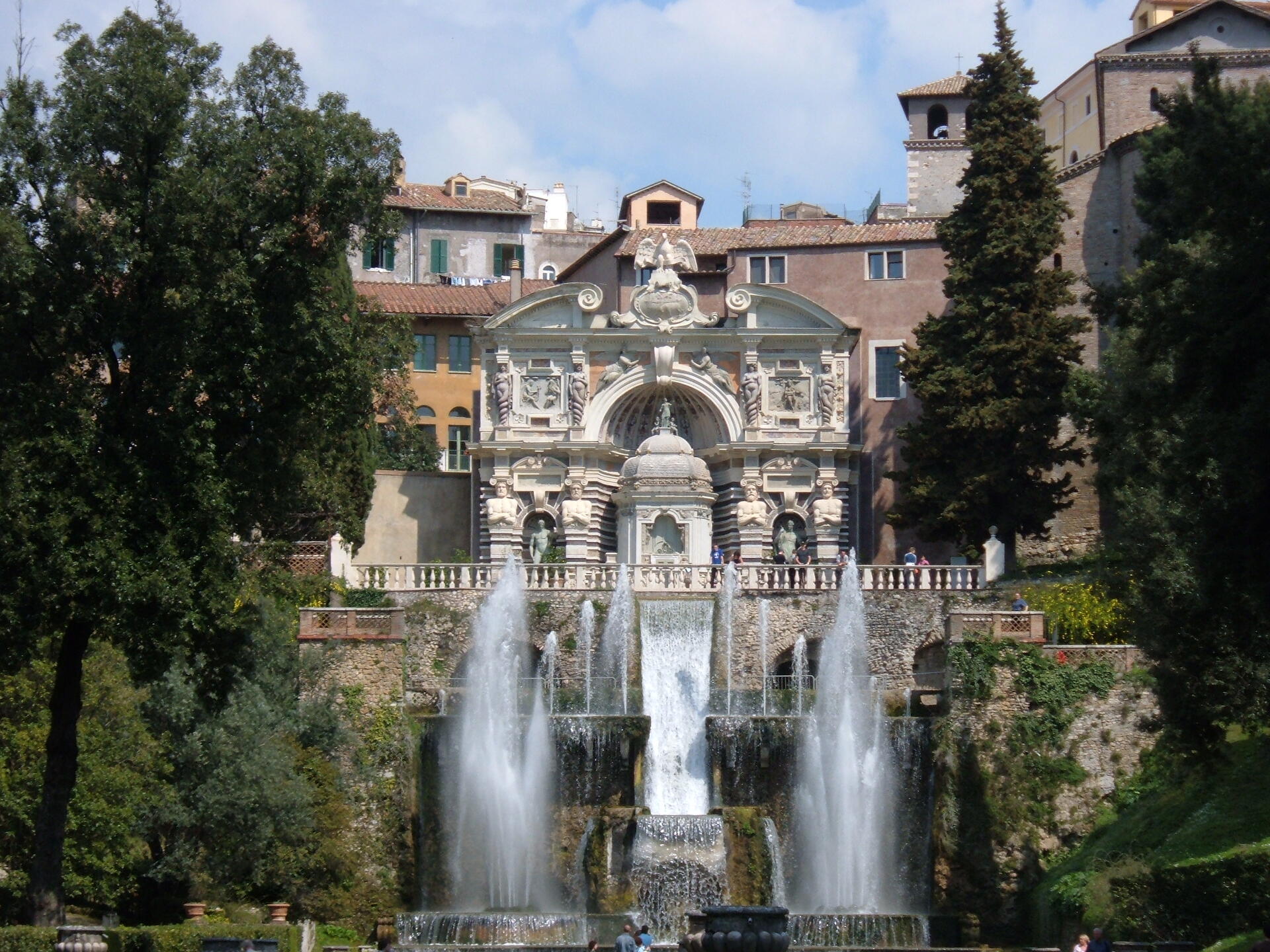
Unknown, Public domain
World Heritage Research
Discover scientific research and academic studies that deepen our understanding of Villa d'Este, Tivoli from its history and significance to its conservation, management, and contemporary challenges.
-
An Integration Framework for Heritage Maintenance coupling HBIM towards Cognitive Digital Twin (CDT): concept and ongoing implementation at Villa d'Este, Tivoli
A novel integration framework for heritage maintenance, coupling Heritage Building Information Modelling (HBIM) with Internet of Things (IoT) monitoring and evolving toward a Cognitive Digital Twin (CDT), demonstrates operational feasibility in complex environments like the Grotta di Diana at Villa d'Este. This approach reconciles quantitative performance objectives with occupant needs and conservation constraints through a four-phase early-stage workflow. While predictive components remain under development, the study highlights the potential of non-invasive IoT sensor networks to support informed decision-making in heritage refurbishment, bridging technological integration gaps in the AECO sector.
Rossini, F. L., Piras, G., Mollo, L., & Vendettti, E. (2026). An Integration Framework for Heritage Maintenance coupling HBIM towards Cognitive Digital Twin (CDT): concept and ongoing implementation at Villa d'Este, Tivoli (Version ECPPM 2026 conference-proceedings version). Zenodo. https://doi.org/10.5281/ZENODO.22680132
View Publication Record | Read Publication -
Dissonant Symphonies: The Villa d'Este in Tivoli and the Grotesque
Pirro Ligorio's design of the Villa d'Este gardens in Tivoli, Italy, offers a unique case study in sixteenth-century attitudes toward grotesque ornamentation. This work compares Ligorio's theoretical writings on the grotesque with his garden designs, particularly focusing on the depiction of Artemis of Ephesus in both interior frescoes and the adjacent landscape, where she is represented as the Fountain of Nature. The analysis reveals a sophisticated integration of monstrous imagery into landscape design, challenging conventional perceptions of ornamentation during this period.
Morgan, L. (2025). Dissonant Symphonies: The Villa d’Este in Tivoli and the Grotesque. Ornament and Monstrosity in Early Modern Art, 73–92. https://doi.org/10.5117/9789462984967_ch02
View Publication Record | Read Publication -
Analysis of the Spatial Axis of Italian Renaissance Garden—Taking Villa Lante and Villa d'Este as Examples
Italian Renaissance garden axes, exemplified by Villa Lante and Villa d'Este, demonstrate an evolution from simplicity to complexity in spatial structure, integrating aesthetic principles of order, symmetry, and balance with environmental context. These designs serve as a foundational 'toolbox' for modern landscape architects, illustrating how historical prototypes can be adapted to explore diverse spatial design possibilities. The study reveals the intricate organization of garden elements along these axes, highlighting their enduring influence on contemporary landscape design practices.
(Ed.). (2024). Analysis of the Spatial Axis of Italian Renaissance Garden—Taking Villa Lante and Villa d’Este as Examples. Frontiers in Art Research, 6(2). https://doi.org/10.25236/far.2024.060214
View Publication Record | Read Publication -
Design Analysis: Research experiences from Alexandrian manuals to Imperial Architecture
A multidisciplinary research team has developed a novel method for studying and disseminating ancient architectural design, combining advanced technological surveying with philological analysis. This approach integrates laser scanning, photogrammetry, and the interpretation of ancient texts to create 2D/3D synthesis models that visually represent the design process of Imperial Roman architecture. The study focuses on buildings at Hadrian's Villa near Tivoli, Italy, offering new insights into how ancient designers translated theoretical knowledge from Alexandrian manuals into monumental structures like those at Villa d'Este.
Bertacchi, S., Juan-Vidal, F., & Fantini, F. (2023). Design Analysis: Research experiences from Alexandrian manuals to Imperial Architecture. Proceedings of the 2022 IMEKO TC4 International Conference on Metrology for Archaeology and Cultural Heritage, 382–387. https://doi.org/10.21014/tc4-arc-2023.073
View Publication Record | Read Publication -
I Giardini di Villa Lante, Villa d'Este ed Altri Ancora in Nuove Mappe Topografiche Basate su Spaceborne Digital Elevation Models
A groundbreaking study introduces innovative topographic maps of the renowned Villa d'Este gardens in Tivoli, leveraging advanced Spaceborne Digital Elevation Models (DEMs). These maps, developed using cutting-edge satellite data processing techniques, offer unprecedented precision and detail in visualizing the intricate landscapes of historic Italian villas. The research, building upon the 2017 methodology by Yamazaki et al., demonstrates how modern remote sensing can enhance our understanding and preservation of UNESCO World Heritage Sites. By applying these sophisticated DEMs, the study provides a new perspective on the topographical features that define the gardens' historical significance and aesthetic appeal.
Sparavigna, A. C. (2021). I Giardini di Villa Lante, Villa d'Este ed Altri Ancora in Nuove Mappe Topografiche Basate su Spaceborne Digital Elevation Models. Zenodo. https://doi.org/10.5281/ZENODO.5600506
View Publication Record | Read Publication -
Marie Luise Gotheins "Geschichte der Gartenkunst"
Marie Luise Gothein's seminal work, A History of Garden Art (1914), offers a groundbreaking ecocritical perspective on garden art, particularly through her analysis of sites like Villa d'Este. Her approach, shaped by the reform garden movement and contemporary challenges, reveals how historical narratives are deeply influenced by societal pressures. The study examines Gothein's intellectual and aesthetic frameworks, demonstrating their enduring relevance in understanding gardens as dynamic, evolving artworks. By blending textual and visual descriptions, Gothein’s work provides a foundational lens for interpreting garden art within its historical context.
Seeber, K. (2020). Marie Luise Gotheins "Geschichte der Gartenkunst" (Version 1). Heidelberg University Publishing. https://doi.org/10.17885/HEIUP.627
View Publication Record | Read Publication -
Structural characterization and performance assessment of the Villa d'Este Palace in Tivoli
A comprehensive structural and seismic assessment of the Villa d'Este Palace in Tivoli, Italy, reveals critical insights into the preservation challenges faced by this UNESCO World Heritage Site. The study highlights significant uncertainties in material properties and structural details, complicating accurate modeling and analysis. Notably, the palace's North-East side, which collapsed during World War II, required substantial post-war restoration efforts. The research also uncovered remnants of a monastery that predated the villa, adding historical depth to the site's significance. This assessment underscores the importance of advanced techniques in safeguarding architectural heritage in seismically active regions.
Marra, A., Brigante, D., Rainieri, C., & Fabbrocino, G. (2016). Structural characterization and performance assessment of the Villa d’Este Palace in Tivoli. Brick and Block Masonry, 645–652. https://doi.org/10.1201/b21889-80
View Publication Record | Read Publication