World Heritage Identification Number: 596
World Heritage since: 1993
Category: Cultural Heritage
WHE Type: Buildings & Architectural Ensembles
Transboundary Heritage: No
Endangered Heritage: No
Country: 🇷🇴 Romania
Continent: Europe
UNESCO World Region: Europe and North America
Map
Villages with Fortified Churches in Transylvania: A Unique Cultural Landscape
The "Villages with Fortified Churches in Transylvania" is a unique UNESCO World Heritage Site, located in the southern and central region of Transylvania. This designation encompasses seven distinct villages, each featuring a fortified church that serves as the focal point of the community's history, culture, and identity.
The seven villages included under the UNESCO designation are: Biertan (Sibiu County), Câlnic (Alba County), Dârjiu (Harghita County), Prejmer (Brașov County), Saschiz (Mureș County), Valea Viilor (Sibiu County), and Viscri (Brașov County). The initial inscription was granted to Biertan in 1993, with the other six villages added as an extension in 1999.
Established by the Transylvanian Saxons during the Late Middle Ages, these villages exhibit a distinctive land-use system, settlement pattern, and organization of the family farmstead. The preservation of this traditional layout can be attributed to the strategic importance of these settlements, which were designed to protect against invading forces.
Each village is dominated by its fortified church, which stands as a testament to various architectural styles spanning from the 13th to the 16th century. These churches not only serve as religious centers but also functioned as defensive strongholds during times of conflict. The churches' walls, towers, and battlements were strategically positioned to offer protection to the villagers within.
A notable example is the fortified church of Biertan, one of the most impressive in Transylvania. Surrounded by three concentric defensive walls and equipped with towers and gates, it served as the seat of the Saxon bishops for nearly three centuries. The church’s late-Gothic architecture, carved wooden pulpit, and monumental winged altarpiece reflect its religious significance, while its fortified precinct illustrates the exceptional craftsmanship and strategic design of the Saxon communities.
Another outstanding structure is the fortified church of Prejmer, widely regarded as one of the strongest and best preserved medieval fortified churchs in Eastern Europe. Its nearly circular defensive walls, some more than ten meters high, enclose hundreds of storage and refuge rooms once used by villagers during sieges. The church itself—built in Gothic style—dominates the enclosure, demonstrating the close union between religious life and communal defense.
In addition to the fortified churches, these villages showcase other architectural gems, such as the medieval houses, town halls, and defense towers. Many of these buildings feature elements of German, Romanian, and Hungarian influences, reflecting the diverse cultural heritage of Transylvania.
The villages themselves are arranged in a linear or circular pattern around the central church, with the farmsteads of individual families situated along the periphery. This layout facilitated communal defense while maintaining a sense of privacy and autonomy for each household.
The "Villages with Fortified Churches in Transylvania" offers visitors a glimpse into the rich history and cultural traditions of the region. By exploring these villages, one can gain insights into the lives of the Transylvanian Saxons, their religious practices, and their resilience in the face of adversity.
To wrap it up, the "Villages with Fortified Churches in Transylvania" represent a remarkable cultural landscape that has remained largely unchanged since the Middle Ages. Their preservation as a UNESCO World Heritage Site ensures that future generations will continue to appreciate the unique blend of history, architecture, and tradition found within these seven extraordinary villages.
UNESCO Description of the World Heritage Site
These Transylvanian villages with their fortified churches provide a vivid picture of the cultural landscape of southern Transylvania. The seven villages inscribed, founded by the Transylvanian Saxons, are characterized by a specific land-use system, settlement pattern and organization of the family farmstead that have been preserved since the late Middle Ages. They are dominated by their fortified churches, which illustrate building styles from the 13th to the 16th century.
Encyclopedia Record: Villages with fortified churches in Transylvania
The "Villages with Fortified Churches in Transylvania" UNESCO World Heritage Site consists of seven villages chosen from among over 150 such structures surviving in the Transylvania region of Romania. They are dominated by fortified churches and characterized by a specific settlement pattern that has been preserved since the Late Middle Ages.Additional Site Details
Area: 553 hectares
Number of Components: 7
Coordinates: 46.13583333 , 24.77305556
Image
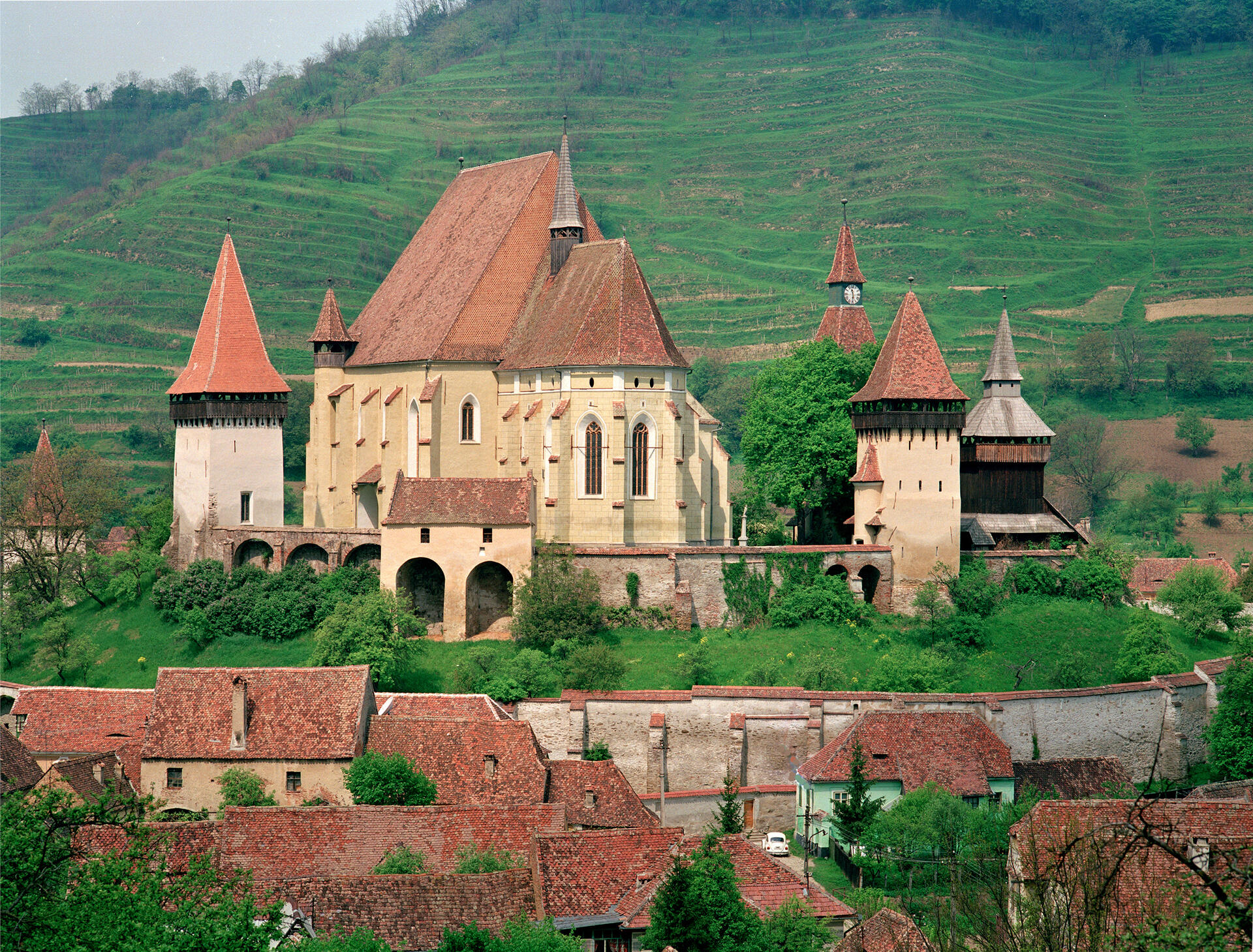
Otto Schemmel, Public domain
World Heritage Research
Discover scientific research and academic studies that deepen our understanding of Villages with Fortified Churches in Transylvania from its history and significance to its conservation, management, and contemporary challenges.
-
Regional identity and sustainable development in Transylvania: german cultural heritage
Transylvania's cultural landscape, shaped by over eight centuries of German influence, remains a significant driver for sustainable development through tourism. The study highlights that despite a dramatic decline in the German (Saxon) population—from 200,000 in 1930 to fewer than 10,000 today—their heritage persists strongly in southern Transylvania, particularly in Brașov and Sibiu counties. This legacy is embodied in fortified cities, churches, and architecture, with several sites, including the historic center of Sighișoara and six Saxon villages with fortified churches, recognized as UNESCO World Heritage Sites. These locations attract millions of visitors annually, solidifying their role as key tourist destinations in Romania. The research underscores how preserving this cultural identity not only sustains local economies but also fosters regional pride and development.
Bodocan, V., Rusu, R., Egresi, I., & Schreiber, W. (2025). Regional identity and sustainable development in Transylvania: german cultural heritage. Miscellanea Geographica, 29(3), 155–164. https://doi.org/10.2478/mgrsd-2025-0002
View Publication Record | Read Publication -
Assessment of UNESCO Cultural Heritage Sites Vulnerability through Multicriteria Analysis
A multicriteria analysis reveals that while Romania's UNESCO World Cultural Heritage Sites, including the Villages with Fortified Churches in Transylvania, are highly exposed to natural and human-induced hazards like earthquakes, landslides, and floods, their vulnerability varies significantly. Some sites exhibit lower vulnerability despite susceptibility, highlighting the importance of intrinsic factors such as structure age, height, construction materials, and infrastructure effectiveness in mitigating risks. The study integrates geophysical data and GIS mapping to assess multi-hazard susceptibility across nine heritage categories, providing actionable insights for site managers and authorities to enhance monitoring, maintenance, and budget allocation for protection efforts.
Popovici, D., Andra-Toparceanu, A., Chitea, F., Armaș, I., Ovreiu, A. B., Malvica, S., & Carboni, D. (2025). Assessment of UNESCO Cultural Heritage Sites Vulnerability through Multicriteria Analysis. https://doi.org/10.5194/egusphere-egu25-19597
View Publication Record | Read Publication -
Structural analysis and damage assessment of a fortified church – A case study: The Evangelical Church of Apos, Sibiu County
A detailed structural analysis of the Evangelical Church of Apos, Sibiu County, reveals significant damage caused by differential settlements, mechanical stress from buttress detachment, and seismic activity. The study identified pronounced cracks due to land sliding and brickwork disintegration, exacerbated by prolonged moisture exposure. Using advanced methods like three-dimensional laser scanning alongside traditional surveys, researchers documented the church's historical reconfigurations and incompatible material interventions that compromised its structural integrity. Proposed conservation measures prioritize reversibility and authenticity preservation, focusing on strengthening walls, arches, vaults, and addressing humidity sources to prevent further erosion.
Ana-Maria, P., & Larisa, P. D. E. (2024). Structural analysis and damage assessment of a fortified church – A case study: The Evangelical Church of Apos, Sibiu County. MATEC Web of Conferences, 396, 20002. https://doi.org/10.1051/matecconf/202439620002
View Publication Record | Read Publication -
Local Identity Transformations Reflected Through the Development of Mercheașa / Mirkvásár / Streitfort,Transylvania, Romania.
A study on Mercheașa, a declining Transylvanian village with a fortified church, reveals that external interventions can significantly alter local attitudes toward development and culture. The research, combining historical analysis and social investigation, demonstrates how projects initiated by an NGO have fostered greater openness among villagers to cultural and sustainable improvements. Key findings suggest that community involvement and consensus are critical for sustainable development, even in historically impoverished areas. The study also evaluates the fortified church as a potential local brand and provides a detailed assessment of its current state.
MAROŞI, Z. (2021). Local Identity Transformations Reflected Through the Development of Mercheașa / Mirkvásár / Streitfort,Transylvania, Romania. Territorial Identity and Development, 6(1), 39–46. https://doi.org/10.23740/tid120213
View Publication Record | Read Publication -
The Assessment of the Authenticity and Conservation Status of Cultural Landscapes in Southern Transylvania (Romania)
A critical assessment reveals that the vernacular architectural heritage of Hărman, Transylvania, is at risk due to depopulation and migration, threatening its authenticity and conservation. The study evaluates Hărman's eligibility for UNESCO World Heritage status under the Cultural Evolutive Landscape Category, applying rigorous criteria for tangible (form, materials, use, location) and intangible (traditions, techniques, language) heritage. Findings underscore the need for urgent intervention to preserve this unique expression of Saxon culture and its territorial relationships, while adhering to international legal frameworks like the Convention on Vernacular Architectural Heritage.
Pascu, M., & Pătru-Stupariu, I. (2021). The Assessment of the Authenticity and Conservation Status of Cultural Landscapes in Southern Transylvania (Romania). Geographies, 1(1), 3–21. https://doi.org/10.3390/geographies1010002
View Publication Record | Read Publication -
Villages with Fortified Churches in Transylvania: Architecture, History and Intangible Culture
A unique and well-preserved German (Saxon) heritage exists in southern Transylvania, Romania, where seven fortified villages—Biertan, Câlnic, Dârjiu, Prejmer, Saschiz, Valea Viilor, and Viscri—stand as a testament to nearly nine centuries of cultural and architectural influence. These UNESCO-listed sites, studied under the project '3d Past, Living & virtual visiting European World Heritage,' offer an unparalleled example of European medieval craftsmanship and feudal autonomy. The research analyzes conservation strategies to ensure the authenticity and integrity of these sites, contributing to their long-term preservation.
Cristini, V., García-Soriano, L., & Vegas, F. (2020). VILLAGES WITH FORTIFIED CHURCHES IN TRANSYLVANIA: ARCHITECTURE, HISTORY AND INTANGIBLE CULTURE. The International Archives of the Photogrammetry, Remote Sensing and Spatial Information Sciences, XLIV-M-1-2020, 249–254. https://doi.org/10.5194/isprs-archives-xliv-m-1-2020-249-2020
View Publication Record | Read Publication