World Heritage Identification Number: 1487
World Heritage since: 2015
Category: Cultural Heritage
WHE Type: Religious Sites & Sacred Architecture
Transboundary Heritage: No
Endangered Heritage: No
Country: 🇮🇹 Italy
Continent: Europe
UNESCO World Region: Europe and North America
Map
The Arab-Norman Palermo and the Cathedral Churches of Cefalú and Monreale: A Unique Blend of Cultures
The Arab-Norman Palermo and the Cathedral Churches of Cefalú and Monreale, collectively inscribed as a UNESCO World Heritage Site in 2015, offer a captivating glimpse into the rich cultural history of Sicily. These architectural marvels, located along the northern coast of the island, represent a unique fusion of Western, Islamic, and Byzantine influences that shaped the region during the Norman kingdom's reign (1130-1194).
More to come…UNESCO Description of the World Heritage Site
Located on the northern coast of Sicily, Arab-Norman Palermo includes a series of nine civil and religious structures dating from the era of the Norman kingdom of Sicily (1130-1194): two palaces, three churches, a cathedral, a bridge, as well as the cathedrals of Cefalú and Monreale. Collectively, they are an example of a social-cultural syncretism between Western, Islamic and Byzantine cultures on the island which gave rise to new concepts of space, structure and decoration. They also bear testimony to the fruitful coexistence of people of different origins and religions (Muslim, Byzantine, Latin, Jewish, Lombard and French).
UNESCO Justification of the World Heritage Site
Criterion (ii): Arab-Norman Palermo and the Cathedral Churches of Cefalù and Monreale bears witness to a particular political and cultural condition characterized by the fruitful coexistence of people of different origins (Muslim, Byzantine, Latin, Jewish, Lombard, and French). This interchange generated a conscious and unique combination of elements derived from the architectural and artistic techniques of Byzantine, Islamic, and Western traditions. This new style contributed to the developments in the architecture of the Tyrrhenian side of southern Italy and spread widely throughout the medieval Mediterranean region.
Criterion (iv): Arab-Norman Palermo and the Cathedral Churches of Cefalù and Monreale is an outstanding example of stylistic synthesis that created new spatial, constructive, and decorative concepts through the innovative and coherent re-elaboration of elements from different cultures.
Encyclopedia Record: Arab-Norman Palermo and the Cathedral Churches of Cefalù and Monreale
The Arab-Norman Palermo and the Cathedral Churches of Cefalù and Monreale are a series of nine religious and civic structures located on the northern coast of Sicily dating from the era of the Norman Kingdom of Sicily (1130-1194): two palaces, three churches, a cathedral, and a bridge in Palermo, as well as the cathedrals of Cefalù and Monreale. They have been designated together as a UNESCO World Heritage Site. This dedication took place in 2015.Additional Site Details
Area: 6.235 hectares
Number of Components: 9
(iv) — Outstanding example of a type of building or landscape
Coordinates: 38.1108333333 , 13.3530555556
Image
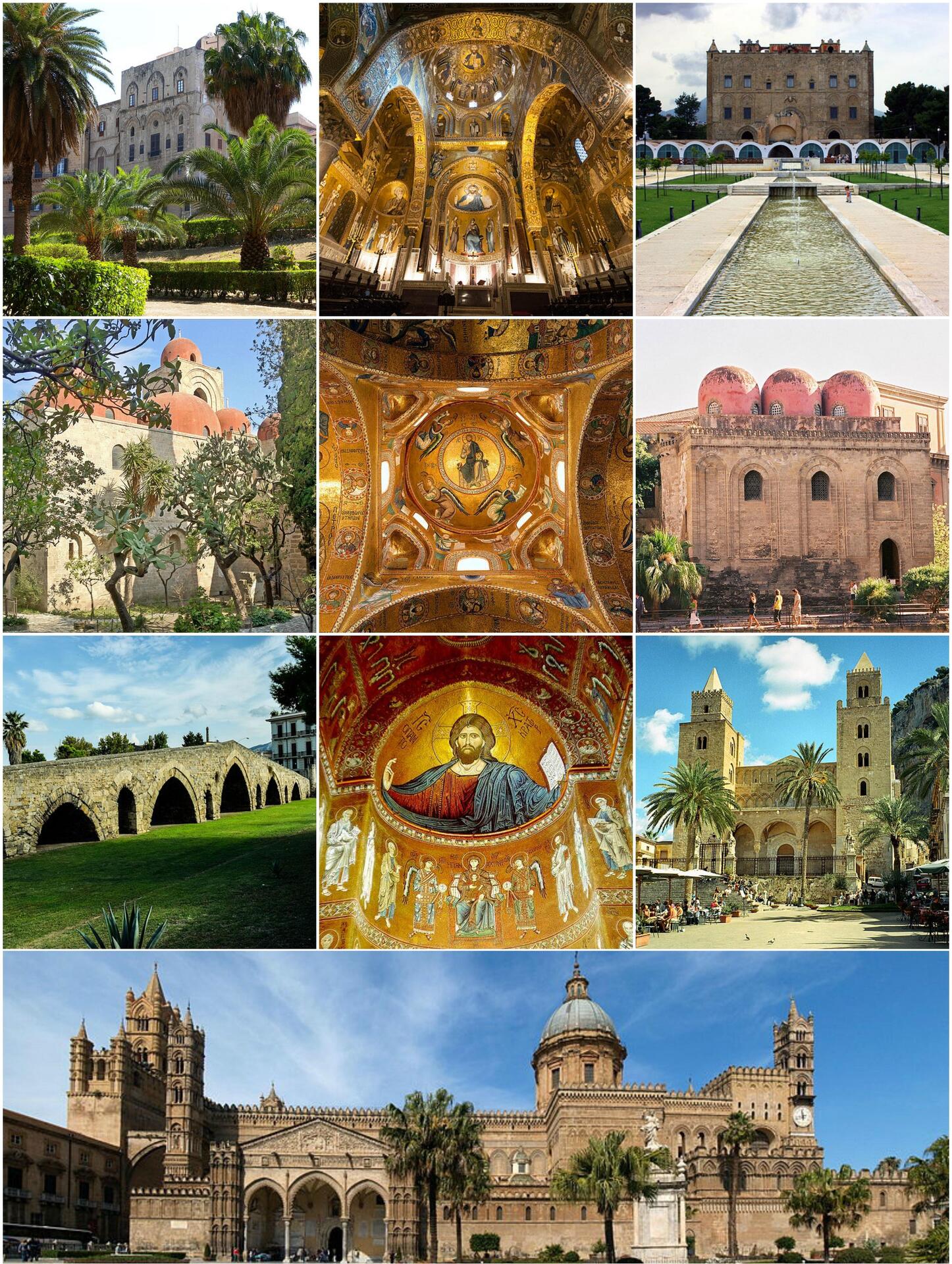
© Pro Regnum Siciliæ, CC BY-SA 4.0 Resized from original. (This derivative is under the same CC BY-SA license.)