World Heritage Identification Number: 132
World Heritage since: 1980
Category: Cultural Heritage
WHE Type: Archaeological Sites
Transboundary Heritage: No
Endangered Heritage: No
Country: 🇲🇹 Malta
Continent: Europe
UNESCO World Region: Europe and North America
Map
Prehistoric Marvels: The Megalithic Temples of Malta
The Megalithic Temples of Malta, initially inscribed as a UNESCO World Heritage Site in 1980 (and expanded in 1992), represent a remarkable chapter in human history. These ancient structures, scattered across the islands of Malta and Gozo, offer a captivating glimpse into the lives of our ancestors during the Neolithic period.
The temples, built during three distinct periods between roughly 3600 BC and 2500 BC, stand as testaments to the ingenuity, craftsmanship, and spiritual beliefs of the people who constructed them. Initially believed by many to be the oldest free-standing structures on Earth, they were later surpassed by the discovery of Göbekli Tepe in Turkey. However, the Megalithic Temples of Malta continue to fascinate archaeologists and historians worldwide due to their unique architectural features and the insights they provide into the cultural evolution of prehistoric societies.
The temples can be broadly categorized into seven distinct complexes, each exhibiting its own architectural style and characteristics. The two temples at Ġgantija on the island of Gozo are particularly noteworthy for their massive Neolithic structures. These temples, dating back to around 3600 BC, feature enormous limestone blocks, some weighing over fifty tons, skillfully arranged without the aid of mortar or and likely without the use of wheeled transport.
On the island of Malta, the temples of Ħaġar Qim, Mnajdra, and Tarxien stand out as architectural masterpieces. Despite the limited resources available to their builders, these temples exhibit intricate designs, sophisticated construction techniques, and a harmonious integration with the surrounding landscape. For instance, the Tarxien temple complex, dating from around 3150 BC, boasts a series of interconnected chambers adorned with carved spiral patterns, animal motifs, and other decorative elements.
The Ta’ Ħaġrat and Skorba complexes serve as compelling examples of how the tradition of temple-building was passed down through generations in Malta. These sites demonstrate a clear progression in architectural styles and techniques over time, reflecting the continued innovation and adaptation of the temple-building culture.
One of the most intriguing aspects of the Megalithic Temples of Malta is the purpose they served in the lives of their builders. While their exact function remains a subject of debate among scholars, it is widely accepted that these temples played a significant role in religious and ceremonial activities. Evidence suggests that they may have been used for rituals related to fertility, agriculture, and the worship of various deities.
In summary, the Megalithic Temples of Malta offer a fascinating window into the past, providing valuable insights into the lives, beliefs, and achievements of our prehistoric ancestors. Their enduring legacy serves as a reminder of the rich cultural heritage that has shaped the world we inhabit today. As we continue to unravel the mysteries of these ancient structures, we gain a deeper appreciation for the ingenuity, perseverance, and creativity that have characterized human civilization throughout history.
UNESCO Description of the World Heritage Site
Seven megalithic temples are found on the islands of Malta and Gozo, each the result of an individual development. The two temples of Ggantija on the island of Gozo are notable for their gigantic Bronze Age structures. On the island of Malta, the temples of Hagar Qim, Mnajdra and Tarxien are unique architectural masterpieces, given the limited resources available to their builders. The Ta'Hagrat and Skorba complexes show how the tradition of temple-building was handed down in Malta.
UNESCO Justification of the World Heritage Site
Criterion (iv): The Megalithic Temples of Malta are remarkable not only because of their originality, complexity and striking massive proportions, but also because of the considerable technical skill required in their construction.
Encyclopedia Record: Megalithic Temples of Malta
The Megalithic Temples of Malta are several prehistoric temples, some of which are UNESCO World Heritage Sites, built during three distinct periods approximately between 3600 BC and 2500 BC on the island country of Malta. They had been claimed as the oldest free-standing structures on Earth until the discovery of Göbekli Tepe in Turkey. Archaeologists believe that these megalithic complexes are the result of local innovations in a process of cultural evolution. This led to the building of several temples of the Ġgantija phase, culminating in the large Tarxien temple complex, which remained in use until 2500 BC. After this date, the temple-building culture disappeared.Additional Site Details
Area: 3.155 hectares
Number of Components: 6
Coordinates: 36.04908 , 14.26947
Image
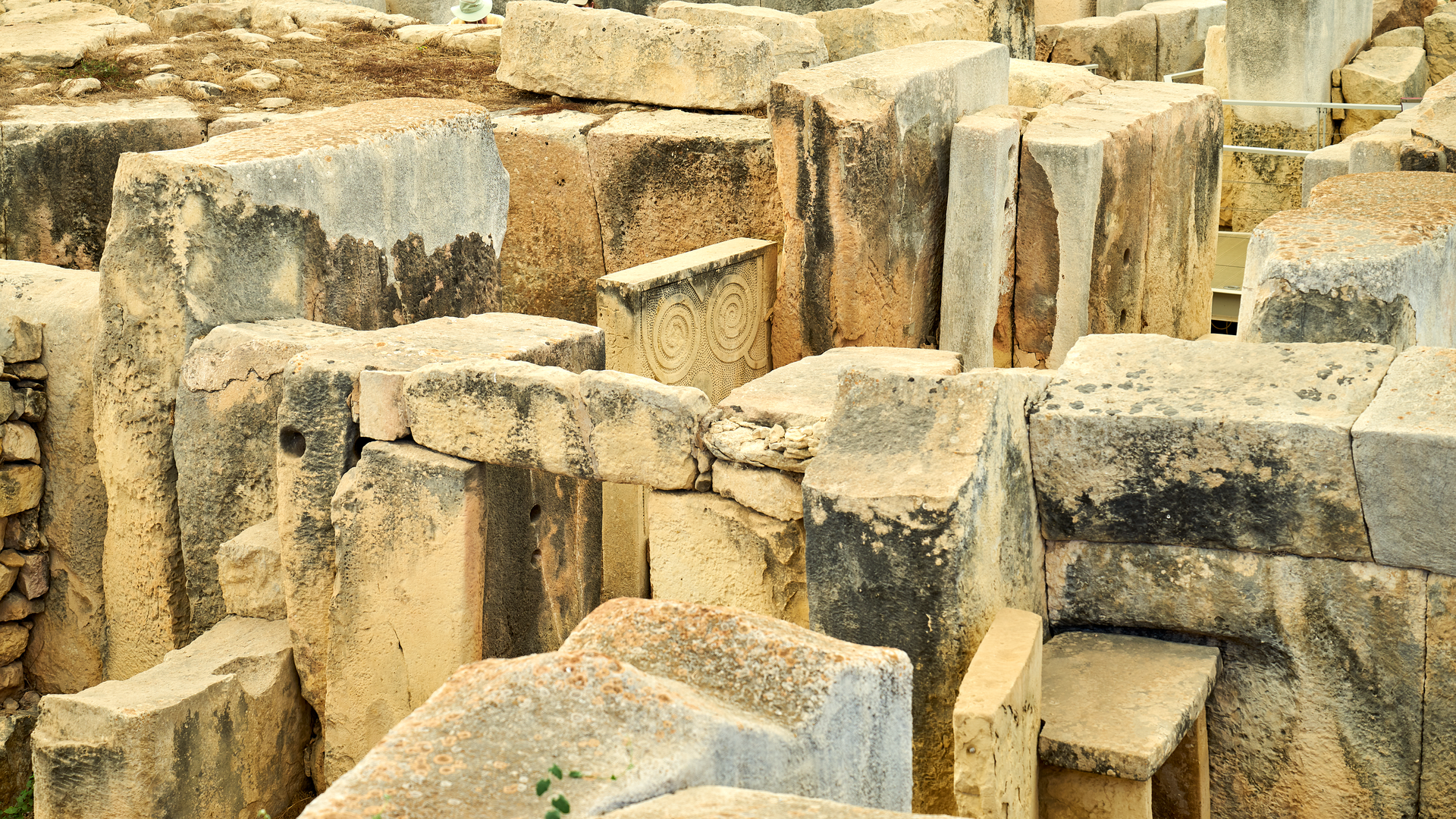
© Georg Karl Ell, CC BY-SA 4.0 Resized from original. (This derivative is under the same CC BY-SA license.)
World Heritage Research
Discover scientific research and academic studies that deepen our understanding of Megalithic Temples of Malta from its history and significance to its conservation, management, and contemporary challenges.
-
Understanding some of the effects of shelter design on deterioration at the Mnajdra Megalithic Temples of Malta
Significant surface temperature fluctuations were observed on the eastern façade of Mnajdra Megalithic Temples, with more pronounced variations in autumn compared to summer. These fluctuations are attributed to the angle of solar incidence and prolonged exposure to direct sunlight, which can lead to microcracks formation and material weakening. The study used thermal imaging data collected across two seasons to monitor temperature gradients and hotspots on the megaliths. This research is part of a broader project evaluating the efficacy of sheltering systems designed to mitigate weathering caused by environmental factors such as rain, wind, salt damage, and direct insolation. The findings aim to inform conservation strategies for these unique heritage sites, considering the impacts of climate change.
Faieta, R., Cassar, J., Valantinavičius, M., & Micallef, D. (2025). Understanding some of the effects of shelter design on deterioration at the Mnajdra Megalithic Temples of Malta. https://doi.org/10.5194/egusphere-egu25-18921
View Publication Record | Read Publication -
The impact of COVID-19 closures on the Megalithic Temples of Malta UNESCO world heritage site
COVID-19 closures significantly impacted the Megalithic Temples of Malta revealing variable effects on physical conservation, economic stability, and social engagement. While visitor-related deterioration decreased during lockdowns, the sites faced economic strain due to tourism dependence. Post-reopening, stricter safety measures and restrictions reshaped public access. This study highlights the vulnerability of Central Mediterranean archaeological sites to global crises and underscores their cultural importance to local communities.
Caruana, J., Debono, E., Stroud, K., & Zammit, M. (2021). The impact of COVID-19 closures on the Megalithic Temples of Malta UNESCO world heritage site. Journal of Cultural Heritage Management and Sustainable Development, 13(1), 15–27. https://doi.org/10.1108/jchmsd-12-2020-0173
View Publication Record | Read Publication -
An assessment of the contribution of air pollution to the weathering of limestone heritage in Malta
Malta's limestone megalithic temples, including those inscribed on the UNESCO World Heritage List, experience weathering primarily influenced by natural climatic factors and sea salt deposition rather than air pollution. A study found that annual stone surface loss due to air pollution is minimal (about one micrometer), overshadowed by variations caused by relative humidity, temperature, wind, rainfall, and ground water replenishment. The research used exposure–response functions from the ICP-materials program to compare atmospheric chemical weathering between urban and rural areas in Malta, evaluating the protective effect of open-sided shelters built over three temples. Findings suggest that while air pollution contributes to deterioration, its impact is less significant than other environmental factors, including salt crystallization events inside and outside shelters.
Grøntoft, T., & Cassar, J. (2020). An assessment of the contribution of air pollution to the weathering of limestone heritage in Malta. Environmental Earth Sciences, 79(12). https://doi.org/10.1007/s12665-020-09027-x
View Publication Record | Read Publication -
Sheltering megalithic Temples in Malta – evaluating the process through data collection and modelling
Sheltering structures implemented at three UNESCO-listed megalithic temples in Malta—Ħaġar Qim, Mnajdra, and Tarxien—have shown promise in mitigating environmental stressors such as rainfall, surface weathering, and thermal stress. A decade-long research program, combining Computational Fluid Dynamics (CFD) modeling with long-term environmental monitoring, aims to quantify the shelters' effectiveness. By integrating macroscale regional models with mesoscale temple-specific analyses, researchers seek to establish correlations between environmental conditions and material deterioration patterns. This approach offers potential for targeted conservation strategies, though findings remain ongoing.
Valantinavicius, M., Micallef, D., Cassar, J., Caruana, J., & Ciantelli, C. (2020). Sheltering megalithic Temples in Malta – evaluating the process through data collection and modelling. IOP Conference Series: Materials Science and Engineering, 949(1), 12035. https://doi.org/10.1088/1757-899x/949/1/012035
View Publication Record | Read Publication -
Sheltering archaeological sites in Malta: lessons learnt
Protective shelters installed over three megalithic temple sites in Malta have demonstrated both beneficial and transitional effects on structural stability. The study found that while shelters mitigate environmental threats such as wetting-drying cycles, thermal fluctuations, and salt corrosion—key factors in the deterioration of these ancient structures—their long-term impact requires sustained monitoring to distinguish between immediate benefits and enduring trends. Lessons learned emphasize the necessity for site-specific strategies, careful selection of monitored parameters, and adaptive management frameworks. The research highlights that shelters alone are insufficient without a comprehensive conservation strategy, advocating for performance indicators tailored to individual sites.
Cassar, J., Cefai, S., Grima, R., & Stroud, K. (2018). Sheltering archaeological sites in Malta: lessons learnt. Heritage Science, 6(1). https://doi.org/10.1186/s40494-018-0201-6
View Publication Record | Read Publication -
Immensity and Miniaturism: The Interplay of Scale and Sensory Experience in the Late Neolithic of the Maltese Islands
A striking interplay between immensity and miniaturism shaped sensory experiences and social relations during the Late Neolithic period (3600–2500 BC) on the Maltese Islands. While megalithic temples, with their monumental scale, dominate archaeological narratives, this study reveals that smaller objects—such as figurines and models—were equally significant in structuring human perception and interaction within these grand structures. By analyzing the contrast between large-scale architecture and miniature artifacts, researchers demonstrate how varying scales influenced social dynamics and sensory engagement, challenging traditional interpretations of Neolithic material culture.
Gregory, I. V. (2016). Immensity and Miniaturism: The Interplay of Scale and Sensory Experience in the Late Neolithic of the Maltese Islands. Oxford Journal of Archaeology, 35(4), 329–344. Portico. https://doi.org/10.1111/ojoa.12092
View Publication Record | Read Publication -
The Islandscape of the Megalithic Temple Structures of Prehistoric Malta
Prehistoric Malta's megalithic temples suggest a sophisticated cosmology integrating land, sea, and sky, likely central to the Temple Period society (5th–4th millennium BCE). Analysis of temple orientation, location, and material culture—including artifacts and iconography—reveals patterns indicative of an islanders' worldview that harmonized terrestrial, maritime, and celestial elements. This interpretation challenges conventional narratives by proposing a cohesive cosmological framework without relying on later historical evidence. The study employs thick description to reconstruct this lost belief system, offering new insights into the cultural and symbolic dimensions of one of the Mediterranean's most enigmatic archaeological sites.
Lomsdalen, T. (2013). The Islandscape of the Megalithic Temple Structures of Prehistoric Malta. Culture and Cosmos, 17(2), 77–103. https://doi.org/10.46472/cc.0217.0209
View Publication Record | Read Publication