World Heritage Identification Number: 614
World Heritage since: 1994
Category: Cultural Heritage
WHE Type: Historic Cities & Urban Areas
Transboundary Heritage: No
Endangered Heritage: No
Country: 🇹🇷 Türkiye
Continent: Asia
UNESCO World Region: Europe and North America
Map
Historical Significance and Architectural Wonders of the City of Safranbolu
The City of Safranbolu, nestled in the Black Sea region of Turkey, offers a unique blend of history, culture, and architectural splendor that has earned it a place on the prestigious list of UNESCO World Heritage Sites since 1994. Situated approximately 9 kilometers north of the city of Karabük, this ancient town boasts a rich heritage dating back to the 13th century.
More to come…UNESCO Description of the World Heritage Site
From the 13th century to the advent of the railway in the early 20th century, Safranbolu was an important caravan station on the main East–West trade route. The Old Mosque, Old Bath and Süleyman Pasha Medrese were built in 1322. During its apogee in the 17th century, Safranbolu's architecture influenced urban development throughout much of the Ottoman Empire.
UNESCO Justification of the World Heritage Site
Criterion (ii): By virtue of its key role in the caravan trade over many centuries, Safranbolu enjoyed great prosperity. As a result, it set a standard in public and domestic architecture that exercised a great influence on urban development over a large area of the Ottoman Empire.
Criterion (iv): For centuries, the caravan trade was the main commercial link between the Orient and Europe. As a result, characteristic towns developed along its route. With the emergence of railways in the 19th century, these towns abruptly lost their raison d’être, and most of them were adapted to other economic purposes. After the collapse of the caravan trade, Safranbolu’s proximity to the Karabük steel works gave it a new socio-economic role, although it preserved its original form and buildings to a remarkable extent.
Criterion (v): Safranbolu is a typical Ottoman city that displays an interesting interaction between its topography and historic settlement.
Encyclopedia Record: Safranbolu
Safranbolu is a town in Karabük Province in the Black Sea region of Turkey. It is the seat of Safranbolu District. Its population is 52,999 (2022). It is about 9 km north of the city of Karabük, 200 kilometres (120 mi) north of Ankara and about 100 km south of the Black Sea coast. The town's historic names in Greek were Theodoroupolis, Dadybra (Δάδυβρα) and later Saphrampolis (Σαφράμπολις). Its former names in Turkish were Zalifre and Taraklıborlu. It was part of Kastamonu Province until 1923 and Zonguldak Province between 1923 and 1995. The town lies at an elevation of 508 m (1,667 ft).Additional Site Details
Area: 193 hectares
Number of Components: 3
(iv) — Outstanding example of a type of building or landscape
(v) — Outstanding example of traditional human settlement
Coordinates: 41.26 , 32.68972
Image
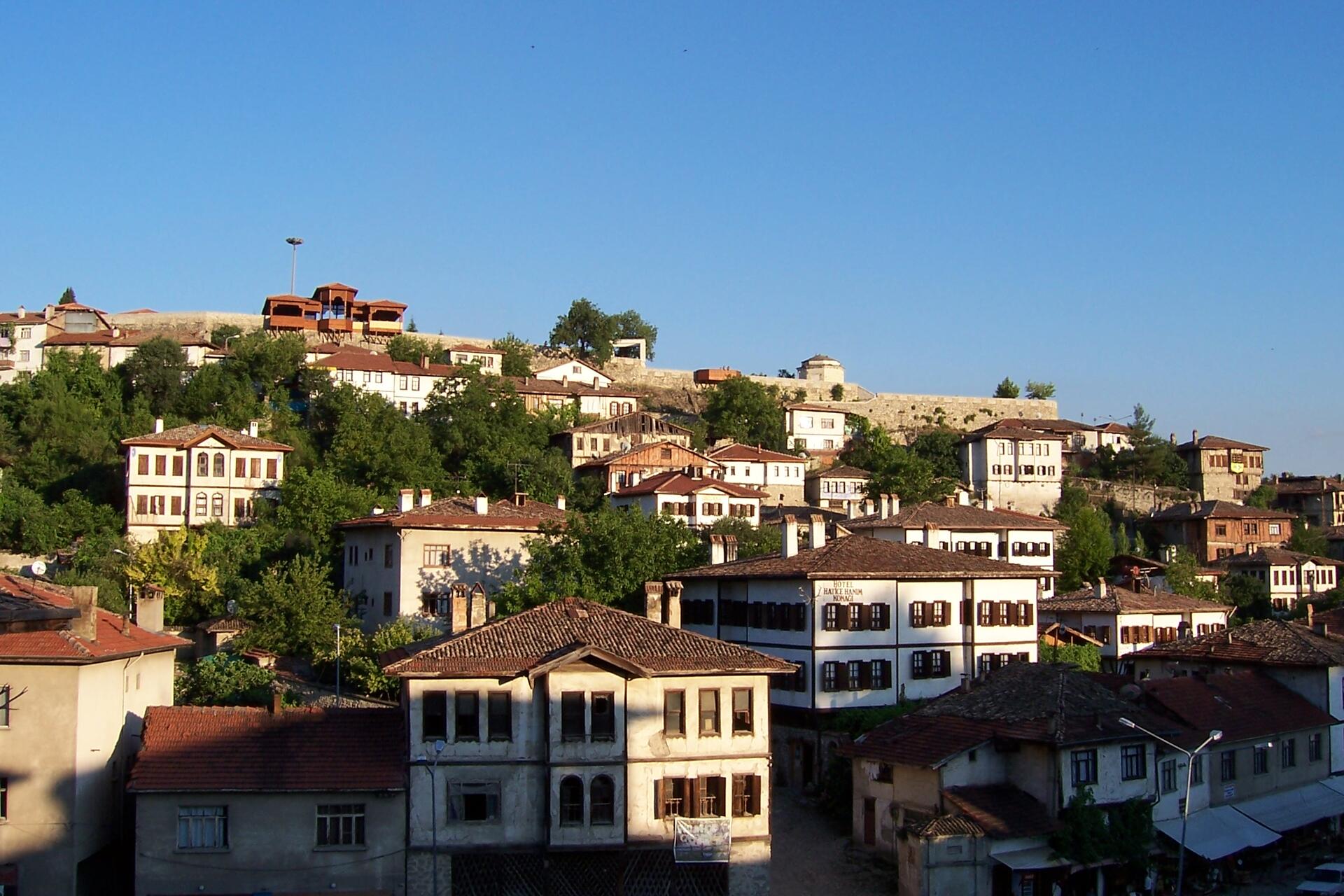
© Uğur Başak, CC BY-SA 3.0 Resized from original. (This derivative is under the same CC BY-SA license.)
World Heritage Research
Discover scientific research and academic studies that deepen our understanding of City of Safranbolu from its history and significance to its conservation, management, and contemporary challenges.
-
Yöresel Ürünlerin Sürdürülebilirliği: Sakin Şehir Safranbolu Örneği (Sustainability of Local Products: The Case of Cittaslow City Safranbolu)
Despite being part of the Cittaslow network, Safranbolu's status as a tranquil city has had limited impact on tourism and local businesses. Research reveals that while most participants were aware of the Cittaslow designation, tourist influx remains low compared to its UNESCO World Heritage recognition. All studied local gastronomic products hold commercial potential, with perohi, etli sarma (stuffed vine leaves), and Safranbolu saffron being the most recognized and sold. However, participants noted significant gaps in marketing efforts and limited knowledge about protected geographical indications. Products like perohi, bükme (a type of dumpling), and zerde show strong potential for such recognition. The study employed semi-structured interviews with 18 managers from food-and-beverage businesses in Safranbolu's historic district to assess sustainability practices under the Cittaslow framework.
ÖZER ALTUNDAĞ, Ö. (2026). Yöresel Ürünlerin Sürdürülebilirliği: Sakin Şehir Safranbolu Örneği (Sustainability of Local Products: The Case of Cittaslow City Safranbolu). Journal of Tourism & Gastronomy Studies, 14(1), 1–21. https://doi.org/10.63556/jotags.2026.1777
View Publication Record | Read Publication -
Identifying and Mapping Plant Species on Historical Buildings Using UAV-Based Imaging: The Case of the Safranbolu City
Researchers identified eight plant species colonizing historical stone mosques in Safranbolu using UAV-based imaging, revealing that Ailanthus altissima and Tortula muralis pose significant structural risks. The study mapped plant distribution patterns, showing colonization concentrated on roof and dome rim areas, with building material and microclimatic conditions driving species diversity. High-resolution UAV imagery proved an effective, non-damaging method for documenting cultural heritage threats while enabling rapid threat detection. This approach offers a scalable solution for monitoring and preserving at-risk structures without physical intervention.
Kartal, S., İyican, A. B., & Bakar, S. (2026). Identifying and Mapping Plant Species on Historical Buildings Using UAV-Based Imaging: The Case of the Safranbolu City. Mersin Photogrammetry Journal, 8(1), 17–35. https://doi.org/10.53093/mephoj.1812839
View Publication Record | Read Publication -
Reading The Cultural Landscape Through Place Names: A Micro-Toponymic Analysıs of Three Villages Around Safranbolu
Micro-toponyms in the cultural landscapes of three villages around Safranbolu reveal a multi-layered heritage that intertwines natural components, tangible and intangible values, and historical processes. The analysis of 210 place names shows that approximately 45% relate to geographical and biological features such as water resources, landforms, vegetation, and wildlife; 21% pertain to archaeological and tangible cultural heritage; and 22% reflect intangible values like production methods, ethnic origins, and beliefs. These toponyms serve as essential cultural heritage elements, carrying traditional land-use practices, historical processes, socio-economic values, and collective memory. The study underscores the importance of integrating micro-toponyms into holistic heritage management strategies to address conservation challenges driven by depopulation, human intervention, and natural disasters.
Karataş, E., & Heyik, M. A. (2026). Reading The Cultural Landscape Through Place Names: A Micro-Toponymic Analysıs of Three Villages Around Safranbolu. Zenodo. https://doi.org/10.5281/ZENODO.22831548
View Publication Record | Read Publication -
Sustainable Heritage Planning for Urban Mass Tourism and Rural Abandonment: An Integrated Approach to the Safranbolu–Amasra Eco-Cultural Route
A resilient eco-cultural tourism route for Safranbolu and Amasra, Türkiye, offers a solution to the dual challenges of urban mass tourism and rural abandonment. This approach, inspired by historical travel itineraries, integrates participatory planning, crowdsourcing, GIS analysis, AI clustering, and multi-criteria decision-making to strengthen heritage conservation while fostering sustainable development. The study identifies critical gaps in site management strategies, capacity-building, and stakeholder engagement, highlighting the need for more inclusive and adaptive governance models. By leveraging advanced technologies and collaborative methodologies, this framework mitigates the negative impacts of tourism pressures on UNESCO-listed sites, providing a replicable model for other heritage destinations.
Karataş, E., Özköse, A., & Heyik, M. A. (2025). Sustainable Heritage Planning for Urban Mass Tourism and Rural Abandonment: An Integrated Approach to the Safranbolu–Amasra Eco-Cultural Route. Sustainability, 17(7), 3157. https://doi.org/10.3390/su17073157
View Publication Record | Read Publication -
‘Being a woman’ in the gastronomy industry: entrepreneurial experiences of women from a cultural tourism destination
Women's entrepreneurship in heritage-based gastronomy, particularly in Safranbolu—a UNESCO World Heritage Site and Cittaslow member city—reveals a dual role: it serves as both an economic necessity and a catalyst for cultural preservation and sustainable local development. Despite facing barriers such as gender norms, institutional challenges, and skill deficits, female entrepreneurs in this sector leverage informal support networks, cultural capital, and the city's slow tourism ethos to thrive. This study, grounded in gender theory and aligned with Sustainable Development Goals (SDGs), highlights the complex interplay of motivations and enablers that shape their entrepreneurial trajectories. By adopting an embedded single case study design and analyzing semi-structured interviews, it contributes to the literature by theorizing women’s gastronomic entrepreneurship as a mechanism for social inclusion and sustainable development.
Yilmaz, G., Yumuk, Y., & Şahin-Yilmaz, A. (2025). ‘Being a woman’ in the gastronomy industry: entrepreneurial experiences of women from a cultural tourism destination. Journal of Qualitative Research in Tourism, 6(1-2), 138–170. https://doi.org/10.4337/jqrt.2025.0027
View Publication Record | Read Publication -
Exploring the potentials of adaptive reuse of cisterns in historic cities: Case of Safranbolu
Adaptive reuse of historic cisterns could significantly enhance water efficiency in heritage cities, offering a sustainable solution to the growing demand for water resources. A study focusing on Safranbolu, known for its preserved architecture, found that local cisterns have the potential to manage and treat water consumed by buildings when combined with greywater reuse and limited rainwater collection. The research involved a field study of 11 cisterns and detailed water consumption data from 25 buildings, suggesting that such structures could play a supplementary role in sustainable water management. However, economic feasibility, technical capacity, and maintenance processes remain critical considerations for implementation.
Kahyaoğlu, İ., & Harputlugil, T. (2025). Exploring the potentials of adaptive reuse of cisterns in historic cities: Case of Safranbolu. GRID - Mimarlık Planlama Ve Tasarım Dergisi, 8(2), 486–518. https://doi.org/10.37246/grid.1491361
View Publication Record | Read Publication -
Consumption of Historical Space: Spatial Transformation of Safranbolu Historical Bazaar
Safranbolu's Historical Bazaar faces threats to its unique cultural identity due to tourism-driven commodification, risking the loss of its distinct heritage. This study reveals that spatial transformations in historical cities are often shaped by a consumption-focused discourse, which can undermine sustainability. To address this, researchers propose alternative conservation approaches aimed at preserving and strengthening the bazaar's unique value. The study employed qualitative methods, including observations and in-depth interviews, to analyze spatial practices and suggest frameworks for sustainable development. By examining the interplay between production-consumption dynamics and tourism, the research offers insights into safeguarding cultural heritage while mitigating the homogenizing effects of global consumer culture.
Korkmaz, S. M., & Yamaçlı, R. (2025). Consumption of Historical Space: Spatial Transformation of Safranbolu Historical Bazaar. Periodica Polytechnica Architecture. https://doi.org/10.3311/ppar.41411
View Publication Record | Read Publication