World Heritage Identification Number: 1623
World Heritage since: 2021
Category: Cultural Heritage
WHE Type: Buildings & Architectural Ensembles
Transboundary Heritage: No
Endangered Heritage: No
Country: 🇮🇹 Italy
Continent: Europe
UNESCO World Region: Europe and North America
Map
A Journey Through Time: The Fourteenth-Century Fresco Cycles of Padua
The city of Padua, nestled in the Veneto region of Italy, boasts a rich artistic heritage that spans centuries. One such treasure is the collection of fourteenth-century fresco cycles, inscribed as a UNESCO World Heritage Site in 2021. Comprising eight religious and secular building complexes, this ensemble offers a captivating glimpse into the evolution of mural painting during the Middle Ages.
More to come…UNESCO Description of the World Heritage Site
This property is composed of eight religious and secular building complexes, within the historic walled city of Padua, which house a selection of fresco cycles painted between 1302 and 1397 by different artists for different types of patron and within buildings of diverse functions. Nevertheless, the frescos maintain a unity of style and content. They include Giotto’s Scrovegni Chapel fresco cycle, considered to have marked the beginning of a revolutionary development in the history of mural painting, as well as other fresco cycles of different artists, namely Guariento di Arpo, Giusto de’ Menabuoi, Altichiero da Zevio, Jacopo Avanzi and Jacopo da Verona. As a group, these fresco cycles illustrate how, over the course of a century, fresco art developed along a new creative impetus and understanding of spatial representation.UNESCO Justification of the World Heritage Site
Criterion (ii): The Padua fresco cycles illustrate the important interchange of ideas which existed between leading figures in the worlds of science, literature and the visual arts in the pre-humanist climate of Padua in the early 14th century. New exchanges of ideas also occurred between clients commissioning works and the artists from other Italian cities that had been called to Padua to collaborate on the various fresco cycles inspired by scientific and astrological allegories or ideas on sacred history gleaned from contemporary intellectuals and scholars. The artists showed great skill in giving these ideas visual form and their technical abilities allowed the Padua fresco cycles not only to become a model for others but also to prove remarkably resistant to the passage of time. The group of artists striving for innovation who gathered within Padua at the same time fostered an exchange of ideas and know-how which led to a new style in fresco illustration. This new fresco style not only influenced Padua throughout the 14th century but formed the inspirational basis for centuries of fresco work in the Italian Renaissance and beyond. With this veritable rebirth of a pictorial technique, Padua supplied a new way of both seeing and depicting the world, heralding the advent of Renaissance perspective. The innovations mark a new era in the history of art, producing an irreversible change in direction.
Encyclopedia Record: Padua's fourteenth-century fresco cycles
Padua's fourteenth-century fresco cycles is a UNESCO World Heritage Site in Padua, Italy, listed in 2021.Additional Site Details
Area: 19.96 hectares
Number of Components: 4
Coordinates: 45.4118888889 , 11.8796111111
Image
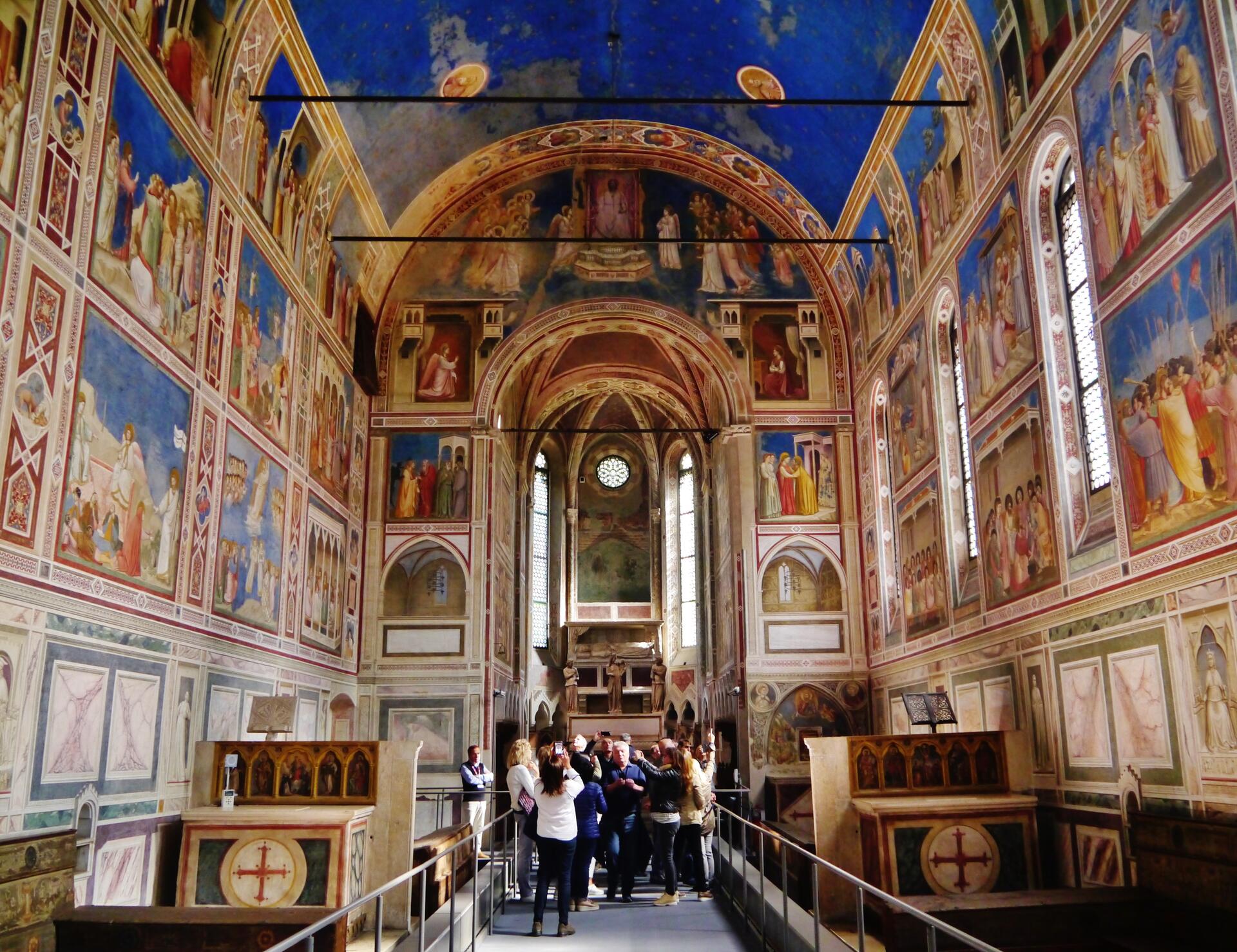
© Zairon, CC BY-SA 4.0 Resized from original. (This derivative is under the same CC BY-SA license.)