World Heritage Identification Number: 394
World Heritage since: 1987
Category: Cultural Heritage
WHE Type: Historic Cities & Urban Areas
Transboundary Heritage: No
Endangered Heritage: No
Country: 🇮🇹 Italy
Continent: Europe
UNESCO World Region: Europe and North America
Map
Venice and Its Lagoon: A Unique Urban Landscape
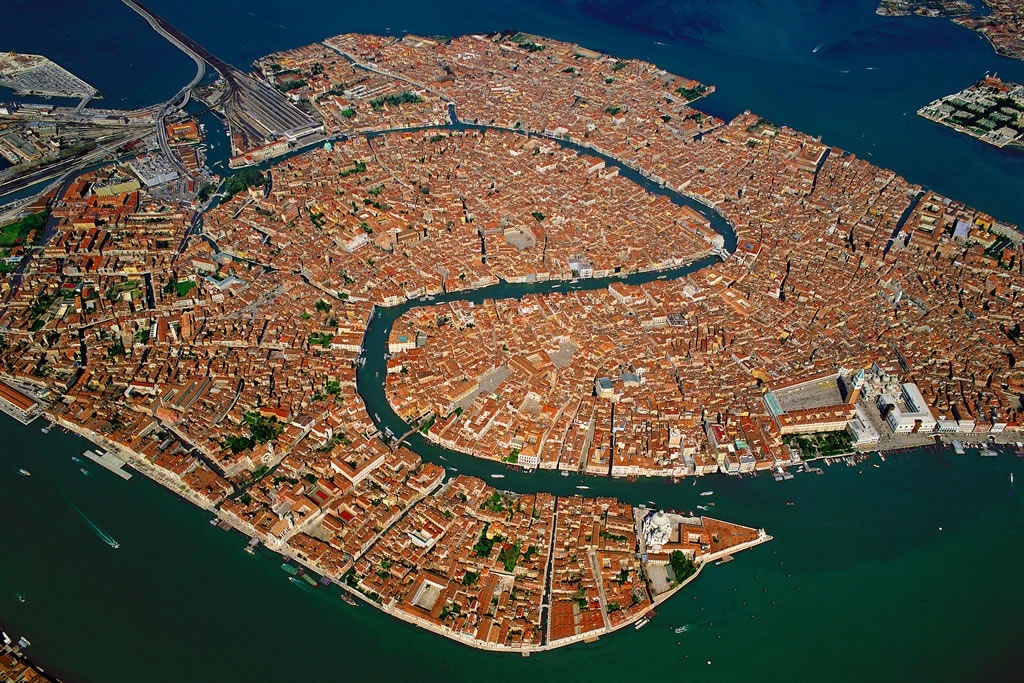
Venice and Its Lagoon, inscribed as a UNESCO World Heritage Site in 1987, offers a captivating blend of history, art, and engineering marvels. Situated in northeastern Italy, this unique urban landscape is built upon a cluster of 118 islands, interconnected by 438 bridges and traversed by a network of canals.
The origins of Venice date back to the 5th century, when it was founded as a refuge for the Roman inhabitants of the mainland who were fleeing barbarian invasions. Over time, Venice evolved into a significant maritime power during the 10th century. This transformation was facilitated by its strategic location along the Adriatic Sea and the Venetian Lagoon, which provided access to trade routes connecting Europe with the Middle East and North Africa.
One of the most striking aspects of Venice is its architectural splendor. The city boasts a rich tapestry of buildings adorned with works from some of the world's most celebrated artists, including Giorgione, Titian, Tintoretto, Veronese, and many others. These artistic treasures can be found even within the humblest of structures, reflecting the city's commitment to aesthetics and artistic expression.
A notable example of Venice's architectural grandeur is St. Mark's Basilica, a Byzantine-style cathedral that serves as the city's patron church. Constructed in the 11th century, the basilica features a stunning array of mosaics, marble columns, and intricate frescoes. Another iconic structure is the Doge's Palace, which served as the seat of Venetian political power for centuries. The palace showcases a harmonious fusion of Gothic, Renaissance, and Byzantine architectural styles.
In addition to its architectural wonders, Venice and Its Lagoon also demonstrate remarkable feats of engineering. The city's complex system of canals and bridges has enabled it to thrive despite being built on unstable ground. The Venetians have employed innovative solutions to manage the city's water levels, such as using the MOSE system, which consists of large mobile barriers at the three inlets that separate the lagoon from the Adriatic Sea.
Moreover, the Venetian Lagoon itself plays a crucial role in preserving the city's unique character. The lagoon acts as a natural barrier against storm surges and high tides, while also providing a rich ecosystem teeming with diverse flora and fauna. The lagoon's delicate balance between freshwater inflow and saltwater tidal influence supports a variety of plant species, fish populations, and migratory birds.
To wrap it up, Venice and Its Lagoon stands as a testament to human ingenuity, artistic prowess, and historical resilience. As a UNESCO World Heritage Site, it invites visitors to immerse themselves in the city's enchanting atmosphere, appreciate its architectural masterpieces, and gain insights into its rich cultural heritage. The city's enduring allure continues to captivate travelers from around the globe, ensuring that Venice will remain a cherished destination for generations to come.
UNESCO Description of the World Heritage Site
Founded in the 5th century and spread over 118 small islands, Venice became a major maritime power in the 10th century. The whole city is an extraordinary architectural masterpiece in which even the smallest building contains works by some of the world's greatest artists such as Giorgione, Titian, Tintoretto, Veronese and others.
UNESCO Justification of the World Heritage Site
Criterion (i): Venice is a unique artistic achievement. The city is built on 118 small islands and seems to float on the waters of the lagoon, composing an unforgettable landscape whose imponderable beauty inspired Canaletto, Guardi, Turner and many other painters. The lagoon of Venice also has one of the highest concentrations of masterpieces in the world: from Torcello’s Cathedral to the church of Santa Maria della Salute.The years of the Republic’s extraordinary Golden Age are represented by monuments of incomparable beauty: San Marco, Palazzo Ducale, San Zanipolo, Scuola di San Marco, Frari and Scuola di San Rocco, San Giorgio Maggiore, etc.
Criterion (ii): The influence of Venice on the development of architecture and monumental arts is considerable; first through the Serenissima’s fondachi or trading stations, along the Dalmatian coast, in Asia Minor and in Egypt, in the islands of the Ionian Sea, the Peloponnesus, Crete, and Cyprus, where the monuments were clearly built following Venetian models. But when it began to lose its power over the seas, Venice exerted its influence in a very different manner, thanks to its great painters. Bellini and Giorgione, then Tiziano, Tintoretto, Veronese and Tiepolo completely changed the perception of space, light and colour thus leaving a decisive mark on the development of painting and decorative arts in the whole of Europe.
Criterion (iii): With the unusualness of an archaeological site which still breathes life, Venice bears testimony unto itself. This mistress of the seas is a link between the East and the West, between Islam and Christianity and lives on through thousands of monuments and vestiges of a time gone by.
Criterion (iv): Venice possesses an incomparable series of architectural ensembles illustrating the hight of the Republic’s splendour. From great monuments such as Piazza San Marco and Piazzetta (the cathedral, Palazzo Ducale, Marciana, Museo Correr Procuratie Vecchie), to the more modest residences in the calli and campi of its six quarters (Sestieri), including the 13th century Scuole hospitals and charitable or cooperative institutions, Venice presents a complete typology of medieval architecture, whose exemplary value goes hand-in-hand with the outstanding character of an urban setting which had to adapt to the special requirements of the site.
Criterion (v): In the Mediterranean area, the lagoon of Venice represents an outstanding example of a semi-lacustral habitat which has become vulnerable as a result of irreversible natural and climate changes. In this coherent ecosystem where the muddy shelves (alternately above and below water level) are as important as the islands, pile-dwellings, fishing villages and rice-fields need to be protected no less than the palazzi and churches.
Criterion (vi): Venice symbolizes the people’s victorious struggle against the elements as they managed to master a hostile nature. The city is also directly and tangibly associated with the history of humankind. The Queen of the Seas”, heroically perched on her tiny islands, extended her horizon well beyond the lagoon, the Adriatic and the Mediterranean. It was from Venice that Marco Polo (1254-1324) set out in search of China, Annam, Tonkin, Sumatra, India and Persia. His tomb at San Lorenzo recalls the role of Venetian merchants in the discovery of the world - after the Arabs, but well before the Portuguese.
Encyclopedia Record: Venice
Venice is a city in northeastern Italy and the capital of the region of Veneto. It is built on a group of 118 islands that are separated by expanses of open water and by canals; portions of the city are linked by 438 bridges.Additional Site Details
Area: 70,176.4 hectares
Number of Components: 1
(ii) — Significant interchange of human values
(iii) — Unique or exceptional testimony to a cultural tradition
(iv) — Outstanding example of a type of building or landscape
(v) — Outstanding example of traditional human settlement
(vi) — Directly associated with events or living traditions
Coordinates: 45.43430556 , 12.33894444
World Heritage Research
Discover scientific research and academic studies that deepen our understanding of Venice and its Lagoon from its history and significance to its conservation, management, and contemporary challenges.
-
Long-term adaptation pathways for Venice and its lagoon under sea-level rise
Under current greenhouse gas mitigation policies, Venice and its lagoon are likely to face hard limits within the 21st century due to sea-level rise (SLR). The study maps long-term adaptation pathways, revealing that the current strategy of mobile barriers and accommodation measures will become unsustainable. Alternative strategies, such as ring-dikes or permanent coastal dams, could preserve different combinations of environmental, heritage, and socio-cultural values but entail significant ecological and social transitions. Under extreme SLR scenarios, including potential Antarctic ice-sheet collapse, relocation of monuments or abandonment may become unavoidable by the 22nd century. Rapid mitigation could still prevent these drastic outcomes.
Lionello, P., Di Fant, V., Pasquier, U., Tosi, L., Cozannet, G. L., Nicholls, R. J., Cramer, W., Cremades, R., Giupponi, C., Hinkel, J., Sfriso, A., Teatini, P., Vafeidis, A. T., Umgiesser, G., & Haasnoot, M. (2026). Long-term adaptation pathways for Venice and its lagoon under sea-level rise. Scientific Reports, 16(1). https://doi.org/10.1038/s41598-026-39108-z
View Publication Record | Read Publication -
The Venice Charter sixty years on: legacy, relevance and new heritage challenges
The Venice Charter, adopted by ICOMOS in 1964, remains a cornerstone in heritage conservation despite the emergence of new challenges such as mass tourism, digital transformation, and shifting cultural dynamics. While its principles continue to guide global heritage safeguarding efforts, contemporary pressures question its adequacy in addressing modern dilemmas. This special issue of Conservar Património critically examines the Charter's legacy, proposing reforms to align it with 21st-century demands, including a focus on human and non-human wellbeing, urban cultural values, and co-production of knowledge between stakeholders. Contributions explore innovative frameworks for heritage management, such as integrating Vitruvian criteria into religious monument preservation, signaling potential paradigm shifts in European heritage conservation.
Rodrigues dos Santos, J., & Moura Soares, C. (2026). The Venice Charter sixty years on: legacy, relevance and new heritage challenges. Conservar Património. https://doi.org/10.14568/cp52fm2
View Publication Record | Read Publication -
Multi-Temporal Relative Sea Level Rise Scenarios up to 2150 for the Venice Lagoon (Italy)
By 2150, the Venice Lagoon could face severe flooding under high-emission scenarios, with up to 65% of its land area at risk. This study projects relative sea level rise (RSLR) using geodetic data and climate models from the IPCC's Sixth Assessment Report, revealing that extreme water levels could temporarily reach 3.47 meters above current levels. The research integrates GNSS and InSAR data to analyze vertical land movements (VLM), showing rates of 1–3 mm/year with peaks up to 7 mm/year, which significantly influence RSLR across the lagoon. Projections indicate that over 112 km² could be flooded under a low-emission scenario, while a high-emission scenario risks 139 km². These findings challenge the long-term viability of the MoSE barrier system, designed to protect against tides and storm surges up to 3 meters, which may be submerged by 2100. The study underscores the urgent need for enhanced flood resilience strategies to safeguard Venice and its unique lagoon ecosystem.
Anzidei, M., Tolomei, C., Trippanera, D., Alberti, T., Bosman, A., Brunori, C. A., Serpelloni, E., Vecchio, A., Falciano, A., & Deli, G. (2025). Multi-Temporal Relative Sea Level Rise Scenarios up to 2150 for the Venice Lagoon (Italy). Remote Sensing, 17(5), 820. https://doi.org/10.3390/rs17050820
View Publication Record | Read Publication -
Operational and Structural Solutions for a Sustainable Navigation in the Malamocco – Marghera Channel (Venice Lagoon)
A groundbreaking study has identified sustainable solutions to increase the navigational capacity of the Malamocco-Marghera Channel, a critical route in Venice Lagoon, while addressing erosion risks to surrounding tidal flats. The research, part of the CEF European-funded project 'Channeling the Green Deal for Venice,' combines advanced navigation and hydrodynamic/sediment transport models to ensure safe, environmentally friendly access to the port of Venice, respecting its UNESCO World Heritage status. This interdisciplinary approach, led by a consortium including DHI S.r.l., marks the first time such models have been integrated in real-time to optimize morphological and operational solutions for the lagoon.
Pedroncini, A., & Menegazzo, P. (2025). OPERATIONAL AND STRUCTURAL SOLUTIONS FOR A SUSTAINABLE NAVIGATION IN THE MALAMOCCO – MARGHERA CHANNEL (VENICE LAGOON). Coastal Engineering Proceedings, (38), 102. https://doi.org/10.9753/icce.v38.management.102
View Publication Record | Read Publication -
The Anthropocene Waterscapes of Venice
Venice, Italy's iconic water city, serves as a paradigm for understanding the Anthropocene epoch, where human impact on Earth systems rivals natural forces. This interdisciplinary handbook examines the historical, political, and epistemological dimensions of this transformation, focusing on Venice's cultural-natural ecology. It integrates environmental humanities research, particularly hydrosociology, supported by UNESCO initiatives. The work explores the evolution of human-nature relationships from antiquity to modernity, comparing Venice with other water cities like Tenochtitlán and Bangkok. Key themes include the social underpinnings of science, eco-artistic movements, resistance to resource extractivism, and the fight for nature's rights against ecocide. Through comparative perspectives, it offers a nuanced view of humanity's ongoing geoanthropological influence on aquatic environments.
Omodeo, P. D., & Consolandi, P. (2025). The Anthropocene Waterscapes of Venice. https://doi.org/10.30687/978-88-6969-933-7
View Publication Record | Read Publication -
The Venice and its Lagoon UNESCO site (Italy): Cultural Heritage and Climate Change
Climate change poses significant risks to Venice's UNESCO-listed cultural heritage, with gradual shifts in temperature, precipitation, and humidity, as well as extreme events like floods and droughts, threatening the integrity of monumental structures. Research integrating studies from Iuav University of Venice, CORILA Venezia2021, and the Venice Climate Change Adaptation Plan identified critical vulnerabilities across macro morphological categories, including potential impacts from the MOSE flood barrier system. Analytical campaigns involving multiple laboratories developed targeted mitigation strategies to enhance resilience while ensuring material and formal compatibility with historic lagoon architecture. These actions aim to balance effectiveness with preservation, safeguarding Venice's unique cultural landscape against climate-induced damage.
Trovò, F., & Bruschi, G. (2025). The Venice and its Lagoon UNESCO site (Italy): Cultural Heritage and Climate Change. HERITAGE2025 International Conference on Earthen & Vernacular Heritage Conservation, Adaptive Reuse & Urban Regeneration. https://doi.org/10.4995/heritage2025.2025.19512
View Publication Record | Read Publication -
The Wetland Contract as a Governance Tool to Manage Conflicts in the Venetian Lagoon
A novel governance approach, the Wetland Contract for the Northern Lagoon of Venice, demonstrates potential as a tool to reconcile competing priorities of socioeconomic development and biodiversity conservation. This participatory initiative brings together diverse stakeholders to commit to coordinated management, restoration, and protection of wetlands, addressing the complex challenges posed by climate change in this vulnerable UNESCO World Heritage Site. The contract serves as a living laboratory for testing innovative strategies that balance human needs with ecological preservation.
Tosi, M. C., Franzese, A., & Jessen, M. J. (2025). The Wetland Contract as a Governance Tool to Manage Conflicts in the Venetian Lagoon. Blue Papers, 4(2). https://doi.org/10.58981/bluepapers.2025.2.06
View Publication Record | Read Publication