World Heritage Identification Number: 115
World Heritage since: 1979
Category: Cultural Heritage
WHE Type: Buildings & Architectural Ensembles
Transboundary Heritage: No
Endangered Heritage: No
Country: 🇮🇷 Iran (Islamic Republic of)
Continent: Asia
UNESCO World Region: Asia and the Pacific
Map
Meidan Emam, Esfahan: A Glimpse into the Safavid Era
Meidan Emam, also known as Naqsh-e Jahan Square or Shah Square, is a significant historical site located at the heart of Isfahan, Iran. Inscribed as a UNESCO World Heritage Site in 1979, this expansive square is a testament to the grandeur and cultural richness of the Safavid era.
More to come…UNESCO Description of the World Heritage Site
Built by Shah Abbas I the Great at the beginning of the 17th century, and bordered on all sides by monumental buildings linked by a series of two-storeyed arcades, the site is known for the Royal Mosque, the Mosque of Sheykh Lotfollah, the magnificent Portico of Qaysariyyeh and the 15th-century Timurid palace. They are an impressive testimony to the level of social and cultural life in Persia during the Safavid era.
UNESCO Justification of the World Heritage Site
Criterion (i): The Meidan Emam constitutes a homogenous urban ensemble, built over a short time span according to a unique, coherent, and harmonious plan. All the monuments facing the square are aesthetically remarkable. Of particular interest is the Royal Mosque, which is connected to the south side of the square by means of an immense, deep entrance portal with angled corners and topped with a half-dome, covered on its interior with enamelled faience mosaics. This portal, framed by two minarets, is extended to the south by a formal gateway hall (iwan) that leads at an angle to the courtyard, thereby connecting the mosque, which in keeping with tradition is oriented northeast/southwest (towards Mecca), to the square’s ensemble, which is oriented north/south. The Royal Mosque of Esfahan remains the most famous example of the colourful architecture which reached its high point in Iran under the Safavid dynasty. The pavilion of Ali Qapu forms the monumental entrance to the palatial zone and to the royal gardens which extend behind it. Its apartments, completely decorated with paintings and largely open to the outside, are renowned. On the square is its high portal (48 metres) flanked by several storeys of rooms and surmounted by a terrace (tâlâr) shaded by a practical roof resting on 18 thin wooden columns. All of the architectural elements of the Meidan Imam, including the arcades, are adorned with a profusion of enamelled ceramic tiles and with paintings, where floral ornamentation is dominant – flowering trees, vases, bouquets, etc. – without prejudice to the figurative compositions in the style of Riza-i Abbasi, who was head of the school of painting at Esfahan during the reign of Shah Abbas and was celebrated both inside and outside Persia.
Criterion (v): The royal square of Esfahan is an exceptional urban realisation in Iran, where cities are usually tightly laid out without open spaces, except for the courtyards of the caravanserais (roadside inns). This is an example of a form of urban architecture that is inherently vulnerable.
Criterion (vi): The Meidan Imam was the heart of the Safavid capital. Its vast sandy esplanade was used for promenades, for assembling troops, for playing polo, for celebrations, and for public executions. The arcades on all sides housed shops; above the portico to the large Qeyssariyeh bazaar a balcony accommodated musicians giving public concerts; the tâlâr of Ali Qapu was connected from behind to the throne room, where the shah occasionally received ambassadors. In short, the royal square of Esfahan was the preeminent monument of Persian socio-cultural life during the Safavid dynasty (1501-1722; 1729-1736).
Encyclopedia Record: Naqsh-e Jahan Square
The Naqsh-e Jahan Square, also known as the Shah Square prior to 1979, and sometimes known as the Imam Square, is a square situated at the center of Isfahan, Iran. Constructed between 1598 and 1629, it is now an important historical site, and one of UNESCO's World Heritage Sites. It is 160 metres (520 ft) wide by 560 metres (1,840 ft) long – an area of 89,600 square metres (964,000 sq ft). The square is surrounded by buildings from the Safavid era. The Shah Mosque is situated on the south side of this square. On the west side is the Ali Qapu Palace. Sheikh Lotfollah Mosque is situated on the eastern side of this square and at the northern side Qeysarie Gate opens into the Isfahan Grand Bazaar. Today, Namaaz-e Jom'eh is held in the Shah Mosque.Additional Site Details
Area: Not available
Number of Components: 1
(v) — Outstanding example of traditional human settlement
(vi) — Directly associated with events or living traditions
Coordinates: 32.65745 , 51.6777777777
Image
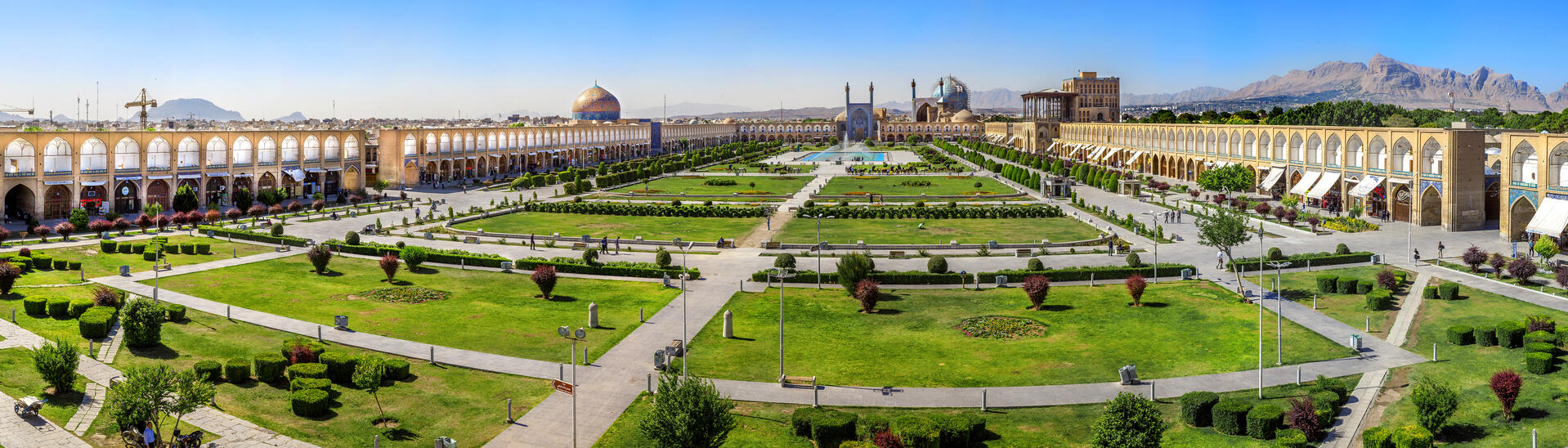
© Arosha-photo(Reza Sobhani), CC BY-SA 4.0 Resized from original. (This derivative is under the same CC BY-SA license.)
World Heritage Research
Discover scientific research and academic studies that deepen our understanding of Meidan Emam, Esfahan from its history and significance to its conservation, management, and contemporary challenges.
-
Handicrafts as cultural creative clusters: a spatial-cultural planning approach for the regeneration of the urban historical fabrics
A quantitative analysis of 227 handicraft production units in Isfahan's historical fabric reveals that creative industries, spatial design, and socio-cultural factors significantly boost tourism, with mean impacts of 14.19, 19.07, and 15.11 respectively. Clustering, cultural resources, and tourism emerge as key drivers for the growth of Cultural Creative Clusters (CCCs), while innovation and cultural identity play lesser roles. These clusters enhance urban attractiveness and social cohesion, particularly around Naqsh-e Jahan Square, where handicrafts reinforce economic vitality and local identity. The study highlights a novel approach to urban regeneration through CCCs, offering insights for heritage conservation and tourism development in historical contexts.
Taheri, S., Khalilpour, F., Ashayeri, M., & Shabani, A. (2024). Handicrafts as cultural creative clusters: a spatial-cultural planning approach for the regeneration of the urban historical fabrics. International Journal of Tourism Cities, 10(4), 1393–1413. https://doi.org/10.1108/ijtc-02-2024-0042
View Publication Record | Read Publication -
Study of identifying formation process in recognizing the Geometric pattern of Naqsh-e Jahan Square and surrounding building in point of view of formalisms
A formalist analysis reveals that the geometric patterns of Naqsh-e Jahan Square and its surrounding buildings in Isfahan, Iran, follow structured design principles rooted in Islamic architecture. The study identifies a systematic formation process underlying these patterns, which integrates mathematical precision with artistic expression. Researchers employed a comparative approach, examining architectural elements such as symmetry, proportion, and spatial organization to decode the formalistic rules governing the square's design. This work contributes to the understanding of how geometric complexity in UNESCO-listed sites is achieved through deliberate formal structures, offering insights into both historical craftsmanship and modern conservation efforts.
Hosseinian, H., Soheili, J., Alborzi, F.,. (2023). Study of identifying formation process in recognizing the Geometric pattern of Naqsh-e Jahan Square and surrounding building in point of view of formalisms. Journal of Research in Islamic Architecture, 11(1), 0. https://doi.org/10.52547/jria.11.1.8
View Publication Record | Read Publication -
Dynamic Symmetry, Harmony, and Balance in Naqsh-E-Jahan Square of Ispahan
Naqsh-e-Jahan Square in Isfahan, a prototype of Persian urban design, exemplifies dynamic symmetry—a nuanced approach to balance and harmony that transcends traditional definitions. Unlike absolute symmetry, its architectural elements embody relative asymmetry within symmetrical frameworks, creating a fluid interplay that enhances visual and spatial coherence. This study redefines symmetry by analyzing the square's design, revealing how it achieves harmony through layered, evolving patterns rather than rigid uniformity. The research contrasts this dynamic approach with contemporary understandings of symmetry, offering insights into the adaptability of architectural principles across eras.
Alizadeh, M., & Pimenta do Vale, C. (2022). Dynamic Symmetry, Harmony, and Balance in Naqsh-E-Jahan Square of Ispahan. Symmetry: Art and Science | 12th SIS-Symmetry Congress, 104–112. https://doi.org/10.24840/1447-607x/2022/12-12-104
View Publication Record | Read Publication -
The role of architectural acoustics in advancing the aural tradition during the Safavid era
During the Safavid era (1501–1736), the Imam Mosque in Naqsh-e-Jahan Square, Esfahan, demonstrated groundbreaking advancements in architectural acoustics. The mosque's design, influenced by Shaykh Baha'i's expertise in sound science and hyperbolic mathematics, created a tranquil soundscape capable of accommodating up to 15,000 people for synchronized prayer rituals with clear speech intelligibility. This study reveals how the mosque's volumetric design, material selection, ornamentation, and acoustic coupling mechanisms contributed to its sonic identity. The research analyzes sound energy exchange patterns and decay, providing insights into the connection between the soundscape and the intended function of these monumental spaces.
Farzaneh, N., & Braasch, J. (2020). The role of architectural acoustics in advancing the aural tradition during the Safavid era. The Journal of the Acoustical Society of America, 148(4_Supplement), 2797. https://doi.org/10.1121/1.5147787
View Publication Record | Read Publication -
Excavations at the Jahānnamā complex: urban archaeology at Isfahan, Iran
Recent excavations at the Jahānnamā complex in Isfahan, Iran, have uncovered significant insights into the urban development of the city during the Safavid dynasty (AD 1501–1722), particularly under Shah Abbas I. The study revealed that a new avenue or boulevard, known as the Charbagh (Ḵiyābān-e Čahārbāğ), was constructed between AD 1595 and 1596. This boulevard not only served as a leisure attraction outside the city walls but also connected key institutions of the capital, reflecting the strategic urban planning of the era. The research utilized archaeological methods to explore the historical layers of Isfahan, providing a deeper understanding of its architectural and urban evolution during this pivotal period.
Esfahani, A. S., Aarab, A., Arab, E. A., Kalantar, S., Hadi, Z., & Hashemi, F. (2017). Excavations at the Jahānnamā complex: urban archaeology at Isfahan, Iran. Antiquity, 91(355). https://doi.org/10.15184/aqy.2016.230
View Publication Record | Read Publication -
A Review on the Identity in Iranian Architecture (Case Study: Naqsh-E Jahan Square in Esfahan)
Naqsh-e Jahan Square in Esfahan, Iran, embodies the dynamic identity of Iranian architecture, reflecting its evolution and resilience over centuries. This study identifies key identifier characteristics that define this urban space as a significant manifestation of Iranian civilization, tracing its formation and transformation from inception to the present day. The research employs a descriptive-analytical approach, leveraging historical texts and field data to document interventions and extract lessons for future conservation efforts. By focusing on Naqsh-e Jahan Square, the study offers insights into how urban spaces preserve cultural identity, providing a model for understanding and safeguarding similar heritage sites globally.
Hayaty, H., Fazeli, Z., & Alipoor, N. (2016). A REVIEW ON THE IDENTITY IN IRANIAN ARCHITECTURE (CASE STUDY: NAQSH-E JAHAN SQUARE IN ESFAHAN). The Turkish Online Journal of Design, Art and Communication, 6(AGSE), 1518–1532. https://doi.org/10.7456/1060agse/036
View Publication Record | Read Publication -
Regenerating the “Creative Place”: A New Approach in Promoting Contemporary Heritage of Islamic -Iranian City (Case Study: Naqsh-E-Jahan Square of Isfahan)
A new model for sustainable urban development, rooted in cultural identity and contemporary heritage, has been proposed through the concept of 'creative place.' This approach integrates art, culture, knowledge-based organizations, and community projects to regenerate historic Islamic-Iranian cities, such as Naqsh-e-Jahan Square in Isfahan. By analyzing environmental components and leveraging the unique features of Iranian-Islamic architecture and urbanism, this study demonstrates how recognizing and utilizing contemporary heritage can establish a foundation for sustainable regeneration. The research employs content analysis and literature review to identify key factors that contribute to the realization of creative places, offering a strategic framework for balancing tradition with modern needs.
Gharehbaglou, M., Ebrahimi, A., & Aghajni, E. (2014). Regenerating the “Creative Place”: A New Approach in Promoting Contemporary Heritage of Islamic -Iranian City (Case Study: Naqsh-E-Jahan Square of Isfahan). Current World Environment, 9(3), 1017–1027. https://doi.org/10.12944/cwe.9.3.57
View Publication Record | Read Publication