World Heritage Identification Number: 1260
World Heritage since: 2007
Category: Cultural Heritage
WHE Type: Infrastructure & Industry
Transboundary Heritage: No
Endangered Heritage: No
Country: 🇧🇦 Bosnia and Herzegovina
Continent: Europe
UNESCO World Region: Europe and North America
Map
The Architectural Marvel: Mehmed Paša Sokolović Bridge in Višegrad
The Mehmed Paša Sokolović Bridge, nestled in the picturesque town of Višegrad, stands as a testament to the harmonious blend of artistry and engineering prowess that characterized the Ottoman Empire's golden age. This architectural marvel, completed in 1577, is a masterpiece designed by the renowned Ottoman court architect, Mimar Sinan, under the commission of Grand Vizier Mehmed Paša Sokolović.
More to come…UNESCO Description of the World Heritage Site
The Mehmed Paša Sokolović Bridge of Višegrad across the Drina River in the east of Bosnia and Herzegovina was built at the end of the 16th century by the court architect Mimar Koca Sinan on the orders of Grand Vizier Mehmed Paša Sokolović. Characteristic of the apogee of Ottoman monumental architecture and civil engineering, the bridge has 11 masonry arches with spans of 11 m to 15 m, and an access ramp at right angles with four arches on the left bank of the river. The 179.5 m long bridge is a representative masterpiece of Sinan, one of the greatest architects and engineers of the classical Ottoman period and a contemporary of the Italian Renaissance, with which his work may be compared. The unique elegance of proportion and monumental nobility of the whole site bear witness to the greatness of this style of architecture.
UNESCO Justification of the World Heritage Site
Criterion (ii): Located in a position of geostrategic importance, the bridge bears witness to important cultural exchanges between the Balkans, the Ottoman Empire and the Mediterranean world, between Christianity and Islam, through the long course of history. The management of the bridge and repairs made it to have also involved different political and cultural powers: after the Ottomans came the Austro-Hungarians, the Yugoslav Federation, and the Republic of Bosnia and Herzegovina.
Criterion (iv): The Višegrad bridge is a remarkable architectural testimony to the apogee of the classical age of the Ottoman Empire, whose values and achievements mark an important stage in the history of humankind.
Encyclopedia Record: Mehmed Paša Sokolović Bridge
The Mehmed Paša Sokolović Bridge is a historic bridge in Višegrad, over the Drina River in eastern Bosnia and Herzegovina part of the Republika Srpska entity. It was completed in 1577 by the Ottoman court architect Mimar Sinan on the order of the Grand Vizier Mehmed Paša Sokolović. In 2003 bridge was included into the List of National Monuments of Bosnia and Herzegovina by KONS, and UNESCO inclusion into the World Heritage List followed in 2007.Additional Site Details
Area: 1.5 hectares
Number of Components: 1
(iv) — Outstanding example of a type of building or landscape
Coordinates: 43.7814444444 , 19.288025
Image
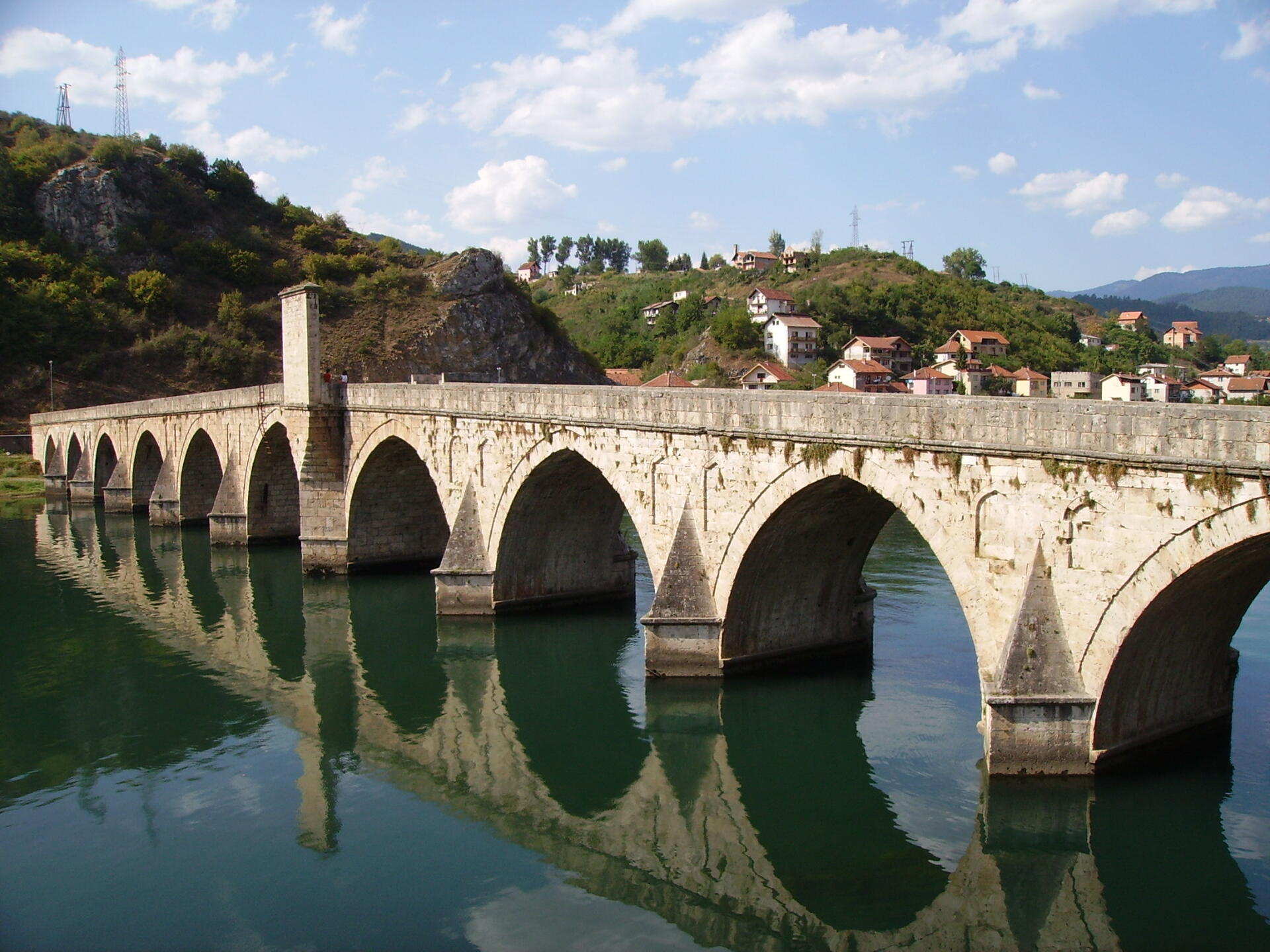
© Julian Nyča, CC BY-SA 3.0 Resized from original. (This derivative is under the same CC BY-SA license.)
World Heritage Research
Discover scientific research and academic studies that deepen our understanding of Mehmed Paša Sokolović Bridge in Višegrad from its history and significance to its conservation, management, and contemporary challenges.
-
Reconstructing Heritage in the Aftermath of Civil War: Re-Visioning the Nation and the Implications of International Involvement
Post-conflict heritage reconstruction can both aid reconciliation and perpetuate symbolic violence, depending on the intentionality behind rebuilding efforts. This study reveals that while international interventions often promote a universalized 'heritage of mankind' framework, they may overlook local valuations and long-term ethical consequences, potentially undermining reconciliation. The research examines three key aspects: the guiding principles behind reconstruction choices, the resulting symbolic landscape, and the ethical dilemmas posed by third-party involvement. By analyzing the Mehmed Paša Sokolović Bridge in Višegrad, Bosnia and Herzegovinathe study highlights the tension between global heritage standards and local interpretations, emphasizing the need for a nuanced approach to post-conflict reconstruction that balances international values with community perspectives.
Viejo-Rose, D. (2013). Reconstructing Heritage in the Aftermath of Civil War: Re-Visioning the Nation and the Implications of International Involvement. Journal of Intervention and Statebuilding, 7(2), 125–148. https://doi.org/10.1080/17502977.2012.714241
View Publication Record | Read Publication