World Heritage Identification Number: 389
World Heritage since: 1986
Category: Cultural Heritage
WHE Type: Religious Sites & Sacred Architecture
Transboundary Heritage: No
Endangered Heritage: No
Country: 🇷🇸 Serbia
Continent: Europe
UNESCO World Region: Europe and North America
Map
Studenica Monastery: A Jewel of Medieval Serbian Architecture
The Studenica Monastery, nestled in the heart of central Serbia, stands as a testament to the rich cultural heritage and architectural prowess of the medieval Serbian state. Established in the late 12nd century by Stevan Nemanja, the founder of the medieval Serb state, this monumental complex has been inscribed as a UNESCO World Heritage Site since 1986.
More to come…UNESCO Description of the World Heritage Site
The Studenica Monastery was established in the late 12th century by Stevan Nemanja, founder of the medieval Serb state, shortly after his abdication. It is the largest and richest of Serbia’s Orthodox monasteries. Its two principal monuments, the Church of the Virgin and the Church of the King, both built of white marble, enshrine priceless collections of 13th- and 14th-century Byzantine painting.
UNESCO Justification of the World Heritage Site
Criterion (i): The King’s Church houses the most beautiful frescoes painted by Michael and Eutychios, the famous painters from Salonica. Not long after the church was built, they painted the Cycle of the Life of the Virgin Mary, which is among the leading works of Byzantine art. After having worked at the Church of Peribleptos in Ohrid and having painted a series of Serbian churches for King Milutin (those of the Virgin of Ljevisa, Zica, Staro Nagoricino, Gracanica, etc.), these painters found the most perfect expression of their style in the Studenica King’s Church. With highlighting in bright colors, shadows and light executed a secco, the density of forms and volumetric rendering of faces are combined with an astounding execution, the perfection of which is very close to that of icons,.
Criterion (ii): The Church of the Virgin served as a model for other churches built in a distinctive style called the Raška School, which constitutes a special branch in eastern medieval church architecture. This royal mausoleum was imitated at Banjska, Dečani and the Holy Archangels of Prizren. The wall paintings of the naos and the sanctuary, executed in 1208-1209, are among the first examples of the “monumental style” which emerged in various regions after the fall of Constantinople in 1204 to the Crusaders. These paintings, which are characterized by a new concept of space and a new expressiveness, are an essential milestone in the history not only of Byzantine art, but also of Western art. Cimabue, Duccio and Giotto were also a part of this trend in the second half of the 13th century.
Criterion (iv): Studenica is an outstanding example of a monastery in the Serbian Orthodox Church. It has had the good fortune of preserving not only an array of exceptional monuments (churches, refectories, monks’ quarters from the 13th to the 18th centuries) inside its circular wall, which has two fortified gates, but also extremely significant surroundings. In the protected zone there is a host of churches and hermitages, the marble quarries from which the blocks for the Church of the Virgin Mary were drawn and the remains of a medieval settlement for the quarry workers and stonecutters.
Criterion (vi): Studenica represents the high point of Serbian history. The monastery contains the remains of the first Serbian ruler and the Studenica founder, Saint Simeon, the remains of his wife Anastasia, and also the remains, shroud and coffin of the first Serbian king, Stephen the First-Crowned (Stefan Prvovenčani). This is where Saint Sava Nemanjić, the founder’s youngest son, wrote the first literary work in the Serbian language. From here he also founded the Serbian Orthodox Church, which gained independence from the Ecumenical Patriarchate. Up until the 19th century, Studenica remained the symbol of this culture, in somewhat the same way that Rila Monastery (included on the World Heritage List in 1983) was that of Bulgarian culture.
Encyclopedia Record: Studenica Monastery
The Studenica Monastery is a 12th-century Serbian Orthodox monastery situated 39 kilometres (24 mi) southwest of Kraljevo and 40.9 kilometres (25.4 mi) east of Ivanjica, in central Serbia.Additional Site Details
Area: 1.16 hectares
Number of Components: 1
(ii) — Significant interchange of human values
(iv) — Outstanding example of a type of building or landscape
(vi) — Directly associated with events or living traditions
Coordinates: 43.4865277778 , 20.5316666667
Image
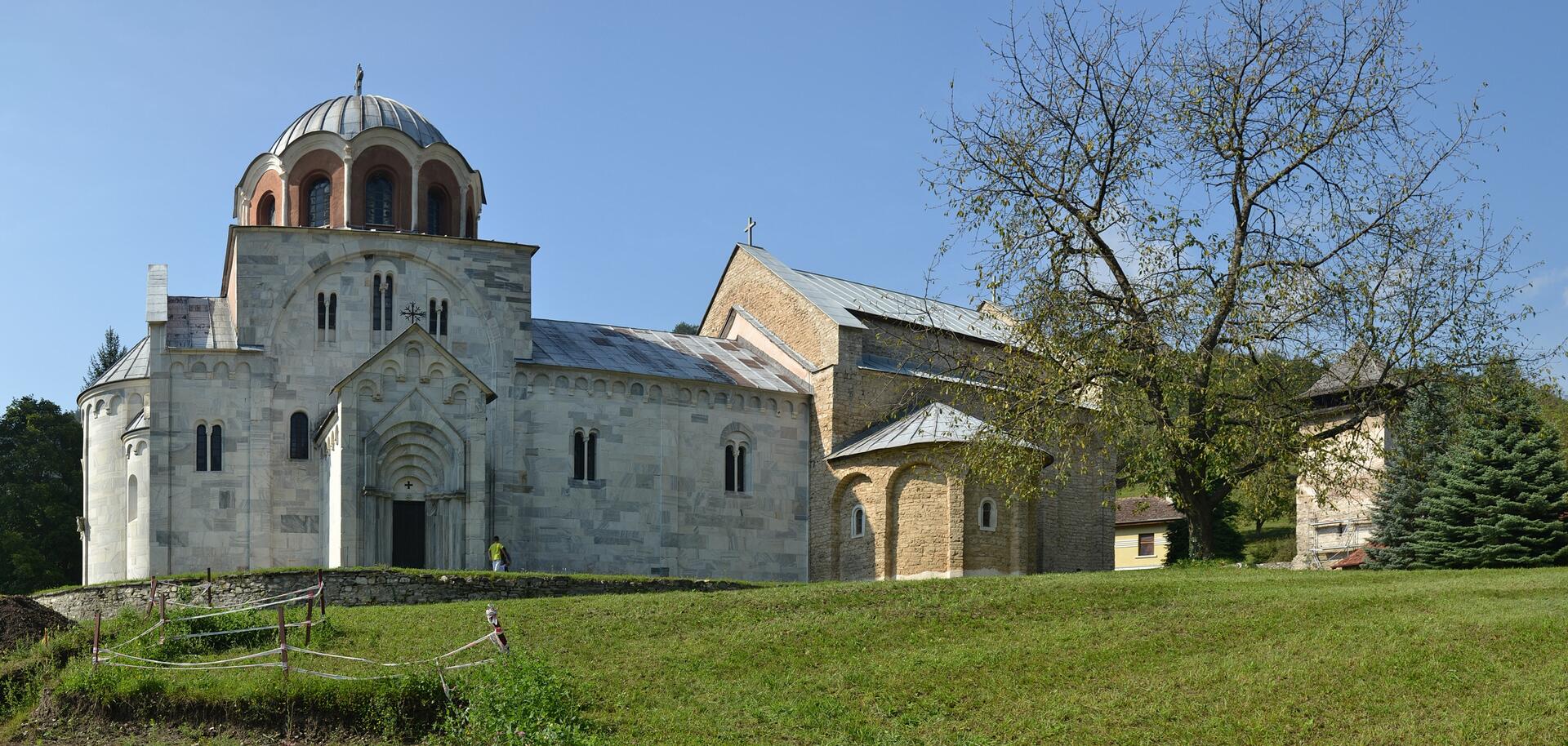
© Pudelek (Marcin Szala), CC BY-SA 3.0 Resized from original. (This derivative is under the same CC BY-SA license.)
World Heritage Research
Discover scientific research and academic studies that deepen our understanding of Studenica Monastery from its history and significance to its conservation, management, and contemporary challenges.
-
Relativization of conflicts in the area of UNESCO World Heritage Site: The case of Studenica Monastery, Serbia
A key insight from this study is that the successful relativization of conflicts—such as those between heritage protection and infrastructure development—in UNESCO World Heritage Sites like Studenica Monastery, Serbia, depends not only on spatial planning but also on its effective implementation, monitoring, and evaluation. The research identifies significant conflicts in the area, including those arising from transport infrastructure, water management, and mineral resource exploitation, which threaten the preservation of this 1986-listed cultural landscape. By analyzing these tensions, the study highlights that while spatial plans are crucial, their real-world impact hinges on corresponding institutional capacities and sustained oversight. This work underscores the need for adaptive planning frameworks to balance competing interests in heritage conservation and development.
Dobričić, M. (2024). Relativization of conflicts in the area of UNESCO World Heritage Site: The case of Studenica Monastery, Serbia. Tehnika, 79(1), 34–40. https://doi.org/10.5937/tehnika2401034d
View Publication Record | Read Publication -
Medieval templon with inseparable objects of prostration. A case of Saints Joachim and Anna church in the Studenica Monastery
A groundbreaking analysis reveals that the medieval templon—a stone sanctuary barrier—at Studenica Monastery was not a static structure but integrated frescoes of Christ and the Holy Virgin, painted directly onto its northern and southern sides. This challenges traditional views on templon architecture, which had remained largely unchanged since the Middle Ages. The study re-evaluates existing data from the 14th-century Saints Joachim and Anna church, where remnants of marble closure slabs suggest a stone templon's presence. By proposing an original form that included these frescoes as inseparable components, researchers offer new insights into the functional and symbolic significance of this architectural element in Byzantine religious spaces.
Rakicevic, T. A., & Debljovic-Ristic, N. (2022). Medieval templon with inseparable objects of prostration. A case of Saints Joachim and Anna church in the Studenica Monastery. Zograf, (46), 73–98. https://doi.org/10.2298/zog2246073r
View Publication Record | Read Publication -
Modeling the Sunlight Illumination of the Church at Studenica Monastery
A sophisticated analysis of sunlight illumination within the Church of the Mother of God at Studenica Monastery, Serbia, reveals how its architectural design—particularly its Byzantine-rite structure with a square-based domical core and narrow barrel vaults—optimizes natural light distribution. The study combines detailed geometric modeling with historical context to demonstrate how Stefan Nemanja's 12th-century church leverages its condensed Greek-cross form to enhance visual dynamics through strategic light penetration, offering insights into medieval architectural ingenuity.
Yeager, T., Bogdanović, J., Forehand, L., Danilović, D., Dragović, M., Chatterjee, D., Gasper, J., Pejić, M., Čučaković, A., Martinenko, A., & Kerton, C. (2022). Modeling the Sunlight Illumination of the Church at Studenica Monastery. Natural Light in Medieval Churches, 253–277. https://doi.org/10.1163/9789004527980_012
View Publication Record | Read Publication -
Evidence of continuous pottery production during the late Byzantine period in the Studenica Monastery, a UNESCO World Heritage Site
A comprehensive analysis of pottery shards from the Studenica Monastery, Serbiareveals continuous production during the late Byzantine period (13th to 15th century). Using advanced techniques like spectroscopy and X-ray diffraction, researchers found no significant differences in mineralogical or chemical composition between samples from two distinct cultural strata, indicating sustained craftsmanship. The pottery was made from non-calcareous clay, glazed with lead-based coatings, and colored with copper and iron, fired at temperatures ranging from 600–700 °C for cookware to 800–1000 °C for tableware. A clay rod with glaze traces, likely from a kiln, further supports the site's role in pottery production during this period.
Stojanović, S., Bikić, V., Miličić, L., Evans, I. R., Scarlett, N. V. Y., Brand, H. E. A., & Damjanović-Vasilić, L. (2019). Evidence of continuous pottery production during the late Byzantine period in the Studenica Monastery, a UNESCO World Heritage Site. Microchemical Journal, 146, 557–567. https://doi.org/10.1016/j.microc.2019.01.056
View Publication Record | Read Publication -
Food worthy of kings and saints: fish consumption in the medieval monastery Studenica (Serbia)
Archaeozoological evidence from the medieval Studenica Monastery in Serbia reveals that large sturgeon species, likely transported over 200 km from the Danube region, were consumed at the site during the 14th and early 15th centuries. The presence of these high-value fish, including beluga and Russian sturgeon, suggests sophisticated long-distance trade networks and their significance in monastic dietary practices, particularly during religious observances like Lent and celebrations honoring the Virgin Mary and monastery founder. Skeletal analysis indicates that large specimens were brought whole, possibly dried or salted, reinforcing historical records of monasteries as key consumers of premium fish alongside royalty and nobility.
Živaljević, I., Marković, N., & Maksimović, M. (2019). Food worthy of kings and saints: fish consumption in the medieval monastery Studenica (Serbia). Anthropozoologica, 54(1), 179. https://doi.org/10.5252/anthropozoologica2019v54a16
View Publication Record | Read Publication -
The sculpture of the church of the holy virgin of the Studenica Monastery. Origin and models
A groundbreaking analysis reveals that the twelfth-century sculpture of Studenica Monastery's Church of the Holy Virgin, previously thought to be influenced by Byzantine art, actually originates from Romanesque models in Italy's Emilia Romagna and Apulia regions. The study demonstrates that nearly all motifs—including the dominant 'peopled or inhabited scrolls'—stem from ancient Roman sources, challenging long-standing academic assumptions about its stylistic influences. By meticulously comparing Studenica’s decoration with Italian counterparts, researchers trace a direct lineage to Romanesque art, offering new insights into medieval European artistic exchange and the monastery's cultural significance.
Babic, V. (2019). The sculpture of the church of the holy virgin of the Studenica Monastery. Origin and models. Zograf, (43), 89–112. https://doi.org/10.2298/zog1943089b
View Publication Record | Read Publication -
Microstructural, Mineralogical and Petrographical Characteristics of the Medieval Ceramics from the Studenica Monastery (UNESCO World Heritage Site): Implications on the Pottery Technology and Provenance of The Raw Material
A detailed analysis of medieval ceramics from the Studenica Monastery reveals that most vessels were locally produced using raw materials consistent with the geology of the surrounding area. The study, employing optical microscopy, scanning electron microscopy with energy-dispersive spectrometry, and X-ray powder diffraction, identified four potential imports linked to Byzantine sgraffito wares and ceramics from the Peloponnese (13th century). The findings indicate a standardized pottery production process, with cooking wares fired at 600–700°C and glazed tablewares and cooking pots fired at minimum 800–900°C. This suggests a blend of traditional skills and Byzantine artistic influences within the pottery craft circle.
Šarić, K., Bikić, V., & Erić, S. (2018). Microstructural, Mineralogical and Petrographical Characteristics of the Medieval Ceramics from the Studenica Monastery (UNESCO World Heritage Site): Implications on the Pottery Technology and Provenance of The Raw Material. Microscopy and Microanalysis, 24(6), 744–761. https://doi.org/10.1017/s1431927618015349
View Publication Record | Read Publication -
World Heritage as a placebo brand: a comparative analysis of three sites and marketing implications
A comparative analysis of three UNESCO World Heritage Sites—Studenica Monastery (Serbia), Independence Hall (USA), and Volubilis (Morocco)—reveals that the World Heritage brand may function as a placebo, with visitors showing higher awareness but no significant motivation tied to it. Survey data from 771 participants across these sites identified distinct visitor clusters, suggesting that the WH designation's appeal is more politically driven than economically beneficial. This challenges the assumption that the WH List is a powerful tourism driver, potentially posing long-term risks for site sustainability and local livelihoods dependent on tourism.
Adie, B. A., Hall, C. M., & Prayag, G. (2017). World Heritage as a placebo brand: a comparative analysis of three sites and marketing implications. Journal of Sustainable Tourism, 26(3), 399–415. https://doi.org/10.1080/09669582.2017.1359277
View Publication Record | Read Publication -
Who visits World Heritage? A comparative analysis of three cultural sites
Visitors to UNESCO World Heritage Sites exhibit distinct demographic trends that diverge from the broader heritage tourism profile. A comparative analysis of three iconic sites—Independence Hall (USA), Studenica Monastery (Serbia), and Volubilis (Morocco)—revealed that while these tourists are highly educated, they lack uniformity in age, income, or residence, contrasting with the typical middle-class, middle-aged heritage tourist. The study employed survey-based research and descriptive statistics to highlight these nuanced patterns, suggesting that World Heritage tourism may represent a specialized segment within the broader tourism landscape. Though limited to three sites, this work lays groundwork for deeper demographic studies on this globally significant visitor group.
Adie, B. A., & Hall, C. M. (2016). Who visits World Heritage? A comparative analysis of three cultural sites. Journal of Heritage Tourism, 12(1), 67–80. https://doi.org/10.1080/1743873x.2016.1151429
View Publication Record | Read Publication -
Pottery manufacture in the Studenica Monastery: Preliminary considerations
Archaeological evidence from Studenica Monastery reveals significant insights into pottery production within the early Nemanjic state. The study identifies a dedicated pottery kiln and manufacturing area, shedding light on the organization of this craft and its role in the monastery's economy. Clay rods found at the site suggest specialized production techniques and raise questions about the users and economic significance of these findings. This research contributes to understanding the broader economic context of medieval Serbian monasteries.
Bikic, V. (2015). Pottery manufacture in the Studenica Monastery: Preliminary considerations. Starinar, (65), 131–144. https://doi.org/10.2298/sta1565131b
View Publication Record | Read Publication -
The chronology and the historical context of the construction of the Studenica monastery: Contribution to the study
A new analysis of early hagiographies and political records reveals that the construction of Studenica Monastery under Stefan Nemanja was closely tied to Byzantine influences, particularly during the reign of Emperor Isaac II Angelos. The study identifies a chrysobull issued by Nemanja, along with his title of 'samodrzac' (autokrator), as key historical markers that date the monastery's founding and contextualize its architectural development within broader political relations between Serbia and Byzantium.
Pirivatric, S. (2015). The chronology and the historical context of the construction of the Studenica monastery: Contribution to the study. Zograf, (39), 47–56. https://doi.org/10.2298/zog1539047p
View Publication Record | Read Publication -
Contributions to the study of the images of hierarchs in the catholicon of Studenica Monastery
A detailed analysis of the images of saint hierarchs in Studenica Monastery's Church of the Virgin reveals new insights into their representation and historical significance. The study, focusing on figures partially obscured by a 19th-century iconostasis, includes standing depictions of St. Achillius and an unidentified saint, as well as busts of St. Parthenius and St. Charalambos. Additionally, it examines other notable figures such as three saints named Gregory in the prothesis, St. Cyril of Alexandria in the apse, and busts of St. Clement of Rome on the west wall and a potential eponymous saint below the dome. The research employs iconographic analysis to uncover the layers of meaning embedded in these images, contributing to a deeper understanding of Byzantine religious art and its evolution.
Zivkovic, M. (2014). Contributions to the study of the images of hierarchs in the catholicon of Studenica Monastery. Zbornik Radova Vizantoloskog Instituta, (51), 215–248. https://doi.org/10.2298/zrvi1451215z
View Publication Record | Read Publication -
Mathematical-geographical analysis of the orientation of St John’s church of the Studenica monastery
A mathematical-geographical analysis of St. John’s Church at Studenica Monastery reveals that its orientation aligns with the sunrise on May 7th (Gregorian calendar) or April 30th (Julian calendar), dating back to the 13th century. This finding suggests a deliberate connection between the church's geometry and solar events, despite ecclesiastical rules not mandating such precision. The study employed a novel method combining gnomon measurements of the church’s longitudinal axis with cartometric determination of sunrise altitudes, enabling the identification of probable founding dates and the assessment of whether the structure was built on older foundations. This approach offers a template for analyzing medieval church orientations globally.
Tadic, M., & Petrovic, A. (2011). Mathematical-geographical analysis of the orientation of St John’s church of the Studenica monastery. Journal of the Geographical Institute Jovan Cviji?, SASA, 61(1), 1–11. https://doi.org/10.2298/ijgi1101001t
View Publication Record | Read Publication