World Heritage Identification Number: 1253
World Heritage since: 2007
Category: Cultural Heritage
WHE Type: Buildings & Architectural Ensembles
Transboundary Heritage: No
Endangered Heritage: No
Country: 🇷🇸 Serbia
Continent: Europe
UNESCO World Region: Europe and North America
Map
Gamzigrad-Romuliana, Palace of Galerius: A Unique Blend of Ceremonial and Memorial Functions
Gamzigrad-Romuliana, officially known as the Palace of Galerius, is a remarkable archaeological site and UNESCO World Heritage Site situated in the eastern region of Serbia, specifically near the city of Zaječar. This significant complex, dating back to the late 3rd and early 4th centuries, was commissioned by Emperor Caius Valerius Galerius Maximianus, who was renowned for naming it Felix Romuliana after his mother.
More to come…UNESCO Description of the World Heritage Site
The Late Roman fortified palace compound and memorial complex of Gamzigrad-Romuliana, Palace of Galerius, in the east of Serbia, was commissioned by Emperor Caius Valerius Galerius Maximianus, in the late 3rd and early 4th centuries. It was known as Felix Romuliana, named after the emperor’s mother. The site consists of fortifications, the palace in the north-western part of the complex, basilicas, temples, hot baths, memorial complex, and a tetrapylon. The group of buildings is also unique in its intertwining of ceremonial and memorial functions.
UNESCO Justification of the World Heritage Site
Criterion (iii): The fortifications, the palace, and the memorial complex are a unique testimony of the Roman construction tradition pervaded by the ideological programme of the Second Tetrachy and Galerius himself as their builder.
Criterion (iv): The group of buildings comprising the architectural complex of the Emperor Galerius is unique in that it intertwines the ceremonial and the memorial programme. The relation between two spatial ensembles is stressed by placing the Tetrapylon on the crossroads between the worldly fortification with the palace and the other-worldly mausoleums and consecration monuments.
Encyclopedia Record: Gamzigrad
Gamzigrad is an archaeological site, spa resort, and UNESCO World Heritage Site of Serbia, located south of the Danube river, in the city of Zaječar. It is the location of the ancient Roman complex of palaces and temples Felix Romuliana, built by Emperor Galerius in Dacia Ripensis. The main area covers 10 acres (40,000 m2).Additional Site Details
Area: 179.217 hectares
Number of Components: 1
(iv) — Outstanding example of a type of building or landscape
Coordinates: 43.8993055556 , 22.1861111111
Image
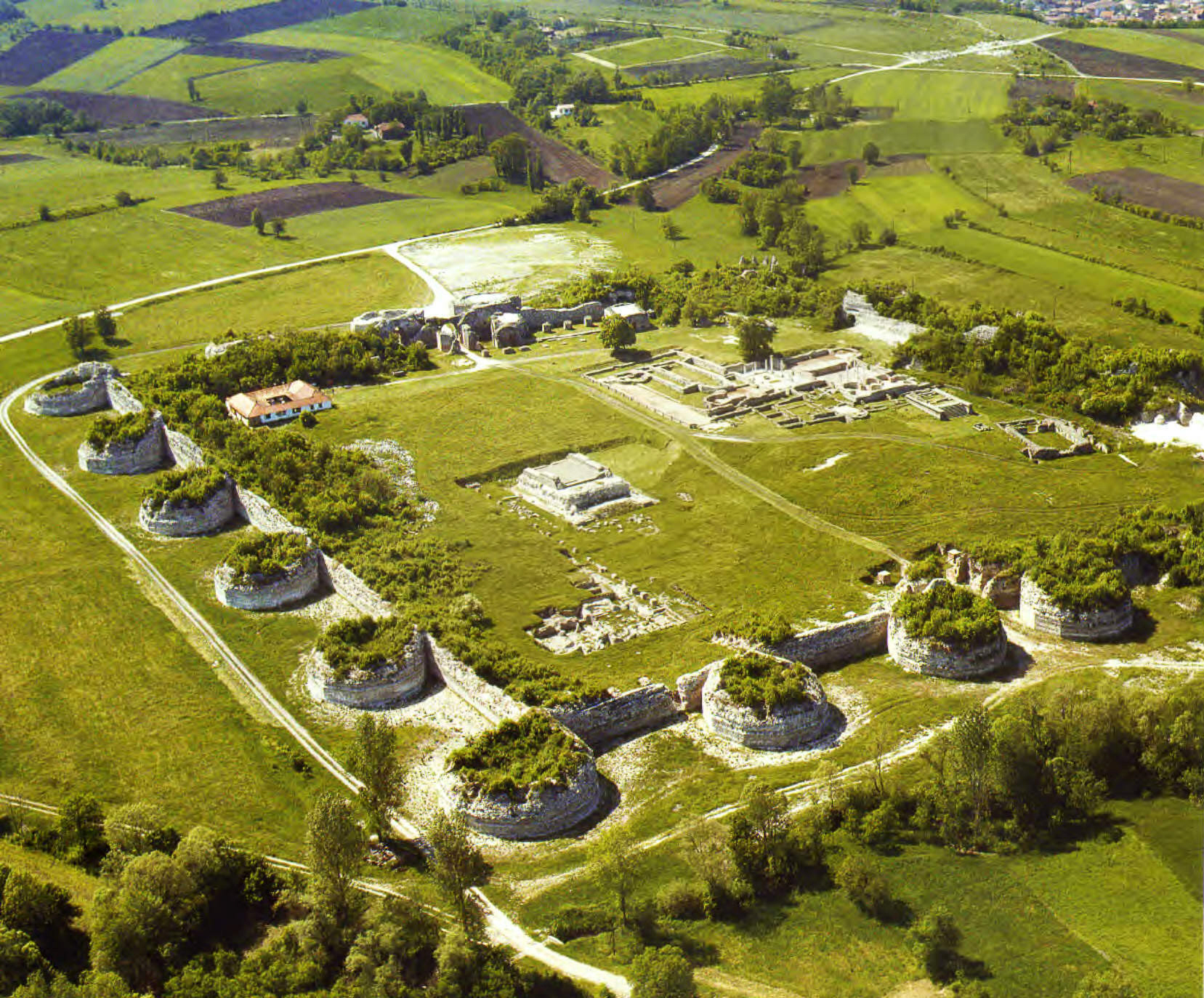
© Unknown author, CC BY-SA 3.0 Resized from original. (This derivative is under the same CC BY-SA license.)
World Heritage Research
Discover scientific research and academic studies that deepen our understanding of Gamzigrad-Romuliana, Palace of Galerius from its history and significance to its conservation, management, and contemporary challenges.
-
The Stones of Felix Romuliana (Gamzigrad, Serbia)
Felix Romuliana, an Imperial retreat palace located in Gamzigrad, Serbia, reveals a sophisticated use of diverse building materials. The palace and its fortifications primarily employ local hornblende andesite, volcaniclastic sandstone from Magura Hill, and regional Sarmatian sandy limestone, alongside Mediterranean marbles for decorative elements like column shafts and capitals. This study highlights the strategic selection of materials, including silty-marly limestone for the first fortification and lithic wacke for the tetrapylon on Magura Hill, reflecting both practical and aesthetic considerations in Roman architectural design.
Djurić, B. (2018). The Stones of Felix Romuliana (Gamzigrad, Serbia). ASMOSIA XI, Interdisciplinary Studies on Ancient Stone, Proceedings of the XI International Conference of ASMOSIA, 523–536. https://doi.org/10.31534/xi.asmosia.2015/03.02
View Publication Record | Read Publication -
Zaštita i Prezentacija Arhitektonskih Ansambala na Arheološkom Nalazištu Gamzigrad
The archaeological site of Gamzigrad, home to the late ancient imperial palace of Felix Romuliana built by Roman emperor Galerius, offers valuable insights into intensive building activities across its structures. A critical analysis of protection and presentation methods at this UNESCO World Heritage Site reveals both advantages and disadvantages, highlighting the need for improved integration of old and new elements. This study contributes significantly to the objective review of contemporary methodological approaches in the field of archaeological site protection and revitalization, with potential applications for other sites in Serbia and the region.
Nikolić, M. (2018). ZAŠTITA I PREZENTACIJA ARHITEKTONSKIH ANSAMBALA NA ARHEOLOŠKOM NALAZIŠTU GAMZIGRAD. Zbornik Radova Građevinskog Fakulteta, 34, 581–594. https://doi.org/10.14415/konferencijagfs2018.058
View Publication Record | Read Publication -
Gamzigrad, Serbien: Der spätantike Kaiserpalast Felix Romuliana und sein Umfeld
A comprehensive analysis of the late antique palace complex Felix Romuliana, associated with Emperor Galerius (283–311 AD), reveals significant insights into the diachronic development and historical framework of its micro-region. This study, part of the TOPOI Excellence Cluster in Berlin, goes beyond previous research by examining not only the palace itself but also its immediate and wider hinterland from prehistoric to medieval times. The findings provide a new understanding of settlement patterns, offering valuable context for the palace's role within its historic and topographic landscape.
Škundrić, J., & Wulf-Rheidt, U. (2017). Gamzigrad, Serbien: Der spätantike Kaiserpalast Felix Romuliana und sein Umfeld. e-Forschungsberichte, Faszikel 1 (2016). https://doi.org/10.34780/3WAM-1N9F
View Publication Record | Read Publication -
Romuliana (Gamzigrad, Serbia)
Gamzigrad, a fourth-century CE fortified villa complex attributed to the Roman emperor Galerius, stands as a monumental testament to Roman architectural ingenuity. Located in eastern Serbia's Black Timok Valley, the site features two rows of ramparts (300 m × 200 m) with 20 round towers, enclosing structures such as a palace, temples, a horreum (granary), thermae (baths), and other associated buildings. A key discovery is that this monumental phase was preceded by an earlier third-century corridor-style villa, indicating a significant evolution in architectural design and urban planning over the century. The study highlights Gamzigrad's strategic importance and its role as a symbol of Roman power during Galerius' reign.
Mladenović, D. (2012). Romuliana (Gamzigrad, Serbia). The Encyclopedia of Ancient History. Portico. https://doi.org/10.1002/9781444338386.wbeah16128
View Publication Record | Read Publication -
The Roman settlement on Gamzigrad prior to the imperial palace Felix Romuliana
Archaeological research at Gamzigrad-Romuliana has uncovered evidence of a significant Roman settlement predating the construction of Emperor Galerius' imperial palace, Felix Romuliana. Traces of earlier buildings, dating from the late 2nd to the end of the 3rd century AD, were found within the fortified residence, including a three-aisled structure south of the 'Large Temple,' a building beneath the early southern tower of the East Gate, a substantial edifice under the Galerius Baths, and another building in front of the later southern tower of the West Gate. This settlement likely functioned as a mining, metallurgical, and commercial hub (vici or civitas) in the Timok Valley during the 3rd century, providing new insights into the region's economic and social development before the imperial era.
Petkovic, S. (2011). The Roman settlement on Gamzigrad prior to the imperial palace Felix Romuliana. Starinar, (61), 171–190. https://doi.org/10.2298/sta1161171p
View Publication Record | Read Publication -
Crossbow fibulae from Gamzigrad (Romuliana)
A significant collection of 31 crossbow fibulae (Zwiebelknopffibeln) was discovered at the UNESCO World Heritage Site Gamzigrad-Romuliana, representing one of the largest assemblages from a single site in Serbia. These fibulae, primarily found in stratified archaeological units dating from the early 4th to mid-5th century, provide valuable insights into their function and production during this period. Through morphological-typological and stratigraphical-chronological analyses, researchers concluded that these artifacts were not merely decorative but served a functional purpose, likely related to military or ceremonial use.
Petkovic, S. (2010). Crossbow fibulae from Gamzigrad (Romuliana). Starinar, (60), 111–136. https://doi.org/10.2298/sta1060111p
View Publication Record | Read Publication -
Trepanning on Mediaeval Gamzigrad — Felix Romuliana
A rare case of medieval trepanning, or surgical drilling into the skull, has been identified at Gamzigrad-Romuliana. The discovery, made through archaeological excavations between 1974 and 1992, reveals a well-healed trepanation on the left parietal bone of a male skeleton aged up to 45 years, dating back to the 10th or 11th century. This finding sheds light on medieval surgical practices and the survival rates of such procedures in the region. The study analyzed 132 skeletons from three excavation sites within and around the palace complex, employing anthropological techniques to assess skeletal remains. The trepanation was performed using an old filling technique, indicating advanced but traditional surgical methods during that era.
Mikić, Ž. (2010). Trepanning on Mediaeval Gamzigrad — Felix Romuliana. Arheologija I Prirodne Nauke, 6, 185–197. https://doi.org/10.18485/arhe_apn.2010.6.10
View Publication Record | Read Publication