
World Heritage Identification Number: 380
World Heritage since: 1986
Category: Natural Heritage
WHE Type: Protected Areas & National Parks
Transboundary Heritage: No
Endangered Heritage: No
Country: 🇪🇸 Spain
Continent: Europe
UNESCO World Region: Europe and North America
Map
Garajonay National Park: A Unique Biosphere Reserve in the Canary Islands
Garajonay National Park, located in the heart of the island of La Gomera in the Canary Islands archipelago, is a unique biosphere reserve that boasts a rich and diverse ecosystem. Established in 1981 as a national park and inscribed as a UNESCO World Heritage Site in 1986, this protected area spans over 40 square kilometers, encompassing each of the six municipalities on the island.
More to come…UNESCO Description of the World Heritage Site
Laurel forest covers some 70% of this park, situated in the middle of the island of La Gomera in the Canary Islands archipelago. The presence of springs and numerous streams assures a lush vegetation resembling that of the Tertiary, which, due to climatic changes, has largely disappeared from southern Europe.
UNESCO Justification of the World Heritage Site
Criterion (vii): Garajonay National Park contains an outstanding and well-preserved example of laurisilva (Laurel forest), an exceptional ecosystem typified by luxuriant evergreen trees with laurel-like leaves, which today is only found in the Macaronesian Islands. This relict ecosystem, a living remnant of the old rainforests and warm temperate forests that occupied much of Europe and North Africa during the Tertiary, is characterised by lush vegetation, fed by numerous springs and streams, and contains a rich and endemic flora and fauna. It is extraordinary that such a forest still exists at this latitude and proximity to the coasts of the Sahara.
Criterion (ix): The Canary Islands are renowned for their relict and endemic species of plants and animals, and present outstanding examples of island evolution. Garajonay National Park contains the best-preserved examples of this evolution in the region, with a recorded flora of 450 vascular plant species, of which 34 are endemic to the island and eight found only in the national park. Two relict and endemic species of pigeons are found almost exclusively in the Laurel forest, and an estimated 40-60% of the invertebrate fauna is endemic.
Encyclopedia Record: Garajonay National Park
Garajonay National Park is located in the center and north of the island of La Gomera, one of the Canary Islands (Spain). It was declared a national park in 1981 and a World Heritage Site by UNESCO in 1986. It occupies 40 km2 and it extends into each of the six municipalities on the island.Additional Site Details
Area: 3,984 hectares
Number of Components: 1
(ix) — Outstanding example representing ecological and biological processes
Coordinates: 28.12625 , -17.23722222
IUCN World Heritage Outlook
The 2025 Conservation Outlook on Garajonay National Park reports the following assessment:
Source: International Union for Conservation of Nature (IUCN) · View assessment
Image
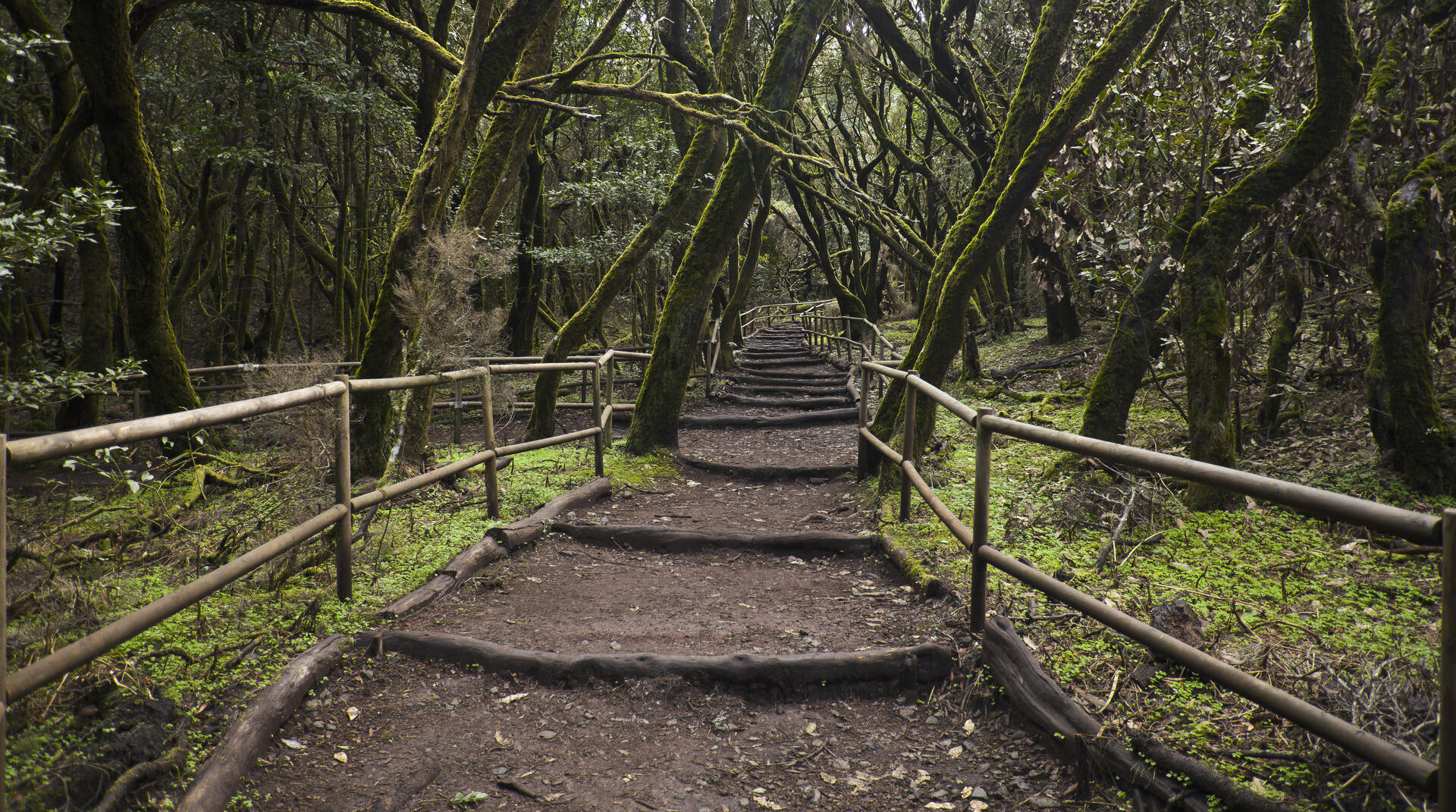
© Diego Delso, CC BY-SA 3.0 Resized from original. (This derivative is under the same CC BY-SA license.)
World Heritage Research
Discover scientific research and academic studies that deepen our understanding of Garajonay National Park from its history and significance to its conservation, management, and contemporary challenges.
-
Ecological assembly of natural soundscapes in the Garajonay National Park (Spain)
Soundscapes in Garajonay National Park, home to Europe's only well-preserved primary cloud forests, reveal nuanced acoustic assembly mechanisms that differ between mature and transitional forests. Mature forests exhibit stronger acoustic aggregation and niche partitioning, with higher acoustic diversity indices (ADI), while transitional forests show elevated lower-frequency sound levels. Notably, acoustic niche partitioning weakens as ADI increases, suggesting less temporal avoidance of similar frequencies in more diverse soundscapes. Seasonal comparisons indicate that burned areas are most vulnerable during harsh summer conditions but resemble intact vegetation in terms of ADI and sound levels during winter. These findings underscore the potential of soundscape monitoring to inform conservation strategies and restoration efforts in this unique UNESCO World Heritage Site.
Ortiz-Álvarez, R., García-Puig, M., & Garate, L. (2022). Ecological assembly of natural soundscapes in the Garajonay National Park (Spain). https://doi.org/10.1101/2022.12.21.521439
View Publication Record | Read Publication -
The Soil Microbiome of the Laurel Forest in Garajonay National Park (La Gomera, Canary Islands): Comparing Unburned and Burned Habitats after a Wildfire
A wildfire dramatically alters the soil microbiome of Garajonay National Park's laurel forest, reducing species richness and diversity while shifting bacterial community composition. Proteobacteria, Acidobacteria, and Actinobacteria dominated unburned soils, but burned areas saw significant decreases in these groups alongside a surge in Betaproteobacteria, Bacteroidetes, and Firmicutes. The study compared microbial communities across two topographical positions—slope and ridge crest—in both undisturbed and post-fire habitats, revealing the fire's profound impact on this unique subtropical ecosystem.
Villadas, P. J., Díaz-Díaz, S., Rodríguez-Rodríguez, A., del Arco-Aguilar, M., Fernández-González, A. J., Pérez-Yépez, J., Arbelo, C., González-Mancebo, J. M., Fernández-López, M., & León-Barrios, M. (2019). The Soil Microbiome of the Laurel Forest in Garajonay National Park (La Gomera, Canary Islands): Comparing Unburned and Burned Habitats after a Wildfire. Forests, 10(12), 1051. https://doi.org/10.3390/f10121051
View Publication Record | Read Publication -
The restoration of the endangered Sambucus palmensis after 30 years of conservation actions in the Garajonay National Park: genetic assessment and niche modeling
A genetic analysis of the endangered Canary Islands endemic Sambucus palmensis reveals that 30 years of conservation efforts, primarily through translocation using cuttings, have successfully increased population heterozygosity while preserving unique genetic diversity. The study, conducted in Garajonay National Park (La Gomera), genotyped 402 samples from restored and natural populations using seven microsatellite markers. While clonal reproduction remains prevalent due to propagation methods, the Liria population emerged as a critical genetic reservoir. Species distribution modeling identified new suitable reintroduction areas, guiding future conservation strategies. The findings underscore the effectiveness of targeted reinforcement while highlighting the importance of preserving native genetic variation.
Rodríguez-Rodríguez, P., Fernández de Castro, A. G., & Sosa, P. A. (2018). The restoration of the endangered Sambucus palmensis after 30 years of conservation actions in the Garajonay National Park: genetic assessment and niche modeling. PeerJ, 6, e4985. Portico. https://doi.org/10.7717/peerj.4985
View Publication Record | Read Publication -
The ancient forests of
L aG omera,C anaryI slands, and their sensitivity to environmental changeA rapid shift in forest composition occurred around 5500 years ago in Garajonay National Park, La Gomera, Canary Islands, coinciding with regional drying trends. This transition saw declines in hygrophilous species like the Canarian palm and willow, alongside an increase in Morella–Erica heath. Unlike other regions, human arrival between 3000 and 1800 years ago did not significantly alter vegetation dynamics, suggesting the park preserves a largely natural relict forest. The study used palaeoecological techniques—including pollen and charcoal analysis—to reconstruct environmental changes over the last 9600 years, highlighting its resilience to human impacts.
Nogué, S., de Nascimento, L., Fernández‐Palacios, J. M., Whittaker, R. J., & Willis, K. J. (2013). The ancient forests of
View Publication Record | Read PublicationL aG omera,C anaryI slands, and their sensitivity to environmental change. Journal of Ecology, 101(2), 368–377. Portico. https://doi.org/10.1111/1365-2745.12051 -
Comment on ‘García‐Santos G, Bruijnzeel LA. 2011. Rainfall, fog and throughfall dynamics in a subtropical ridge top cloud forest, National Park of Garajonay (La Gomera, Canary Islands, Spain). Hydrological Processes 25: 411–417’
A critical evaluation of a 2011 study on hydrological dynamics in Garajonay National Park's cloud forest reveals significant discrepancies with prior research at the site. The study, which analyzed rainfall, fog, and throughfall data from an upper watershed plot, was found to have methodological limitations—including large data dispersion and flawed assumptions—that undermined its conclusions. These issues cast doubt on the reported magnitudes of hydrological variables, highlighting the need for rigorous validation in future research. Published as a comment in Hydrological Processes, this analysis underscores the importance of robust methodologies in studying subtropical cloud forests.
Ritter, A., & Regalado, C. M. (2012). Comment on ‘García‐Santos G, Bruijnzeel LA. 2011. Rainfall, fog and throughfall dynamics in a subtropical ridge top cloud forest, National Park of Garajonay (La Gomera, Canary Islands, Spain). Hydrological Processes 25: 411–417’. Hydrological Processes, 27(7), 1123–1128. Portico. https://doi.org/10.1002/hyp.8428
View Publication Record | Read Publication -
Rainfall, fog and throughfall dynamics in a subtropical ridge top cloud forest, National Park of Garajonay (La Gomera, Canary Islands, Spain)
In subtropical ridge-top cloud forests of La Gomera, Canary Islands, fog interception significantly enhances water inputs, contributing up to 6% of wind-corrected fog water as throughfall (TF), while rainfall-only events yield 87% TF. The study reveals that fog screens capture fog water more efficiently than forest canopies, and prior canopy wetting by rain increases TF during mixed precipitation events. Researchers corrected measurements for wind-induced losses and topographic effects, addressing gaps in previous studies. This highlights the critical role of fog in water balance in dry-season environments (5 months) with low annual rainfall (600–700 mm).
García‐Santos, G., & Bruijnzeel, L. A. (2010). Rainfall, fog and throughfall dynamics in a subtropical ridge top cloud forest, National Park of Garajonay (La Gomera, Canary Islands, Spain). Hydrological Processes, 25(3), 411–417. Portico. https://doi.org/10.1002/hyp.7760
View Publication Record | Read Publication