World Heritage Identification Number: 136
World Heritage since: 1980
Category: Natural Heritage
WHE Type: Protected Areas & National Parks
Transboundary Heritage: No
Endangered Heritage: Yes
Country: 🇨🇩 Democratic Republic of the Congo
Continent: Africa
UNESCO World Region: Africa
Map
Garamba National Park: A Sanctuary for Endangered Species
Garamba National Park, located in the northeastern Democratic Republic of the Congo, is a vast expanse of savannahs, grasslands, woodlands, and gallery forests that stretches across nearly 5,200 square kilometers. Established in 1938, it is one of Africa's oldest national parks and holds significant importance due to its role in protecting critical habitats for several endangered species. In recognition of this conservation effort, UNESCO designated Garamba a World Heritage Site in 1980.
Garamba’s diverse ecosystems provide homes for a variety of wildlife, including elephants, hippopotamuses, buffalo, lions, chimpanzees, and one of the last remaining populations of Kordofan giraffes. Historically, the park was also the last refuge of the northern white rhinoceros, a subspecies that once thrived in the region. Unfortunately, due to decades of heavy poaching, the northern white rhino is now considered extinct in the wild.
In 2023, Garamba entered a new chapter in rhino conservation when 16 southern white rhinoceroses were reintroduced to the park from South Africa. While not native to the region, these rhinos are intended to restore lost ecological functions and support long-term restoration goals.
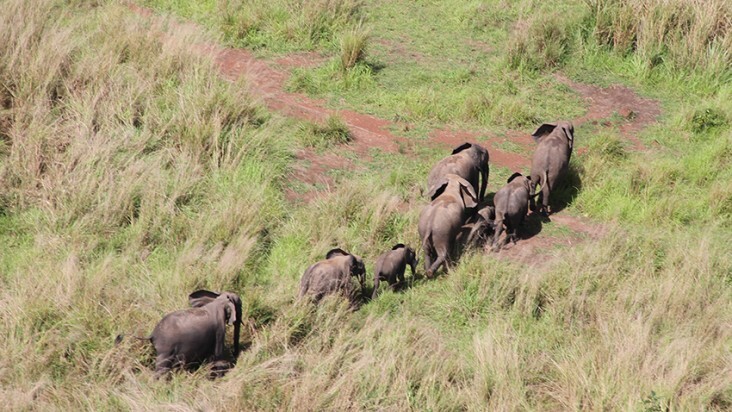
African elephants also inhabit the park, and although their numbers are far below historical levels, recent monitoring indicates that the population is stable or increasing. Garamba’s mosaic of wetlands and woodlands provides habitat for more than 300 bird species. The park's swampy depressions provide ideal breeding grounds for these birds, making Garamba an important stopover site for migratory birds.
However, Garamba National Park has faced numerous challenges in maintaining its status as a sanctuary for endangered species. Poaching, civil unrest, and armed conflict have threatened the park's biodiversity and undermined conservation efforts. To address these issues, the park has partnered with organizations such as African Parks since 2005. African Parks, a nonprofit conservation organization, works closely with local governments and communities to manage and protect national parks across Africa.
Today, Garamba National Park continues to serve as a vital haven for endangered species, thanks in part to the collaborative efforts of organizations like African Parks and the Institut Congolais pour la Conservation de la Nature (ICCN). Although many of its iconic species were pushed to the brink, ongoing conservation efforts offer hope for the future. As the world seeks to protect and restore its remaining biodiversity, Garamba demonstrates what determined, long-term commitment can achieve.
UNESCO Description of the World Heritage Site
The property, located in the north-eastern Democratic Republic of the Congo, forms part of one of the last extensive and continuous forest–savanna mosaic landscapes in Central Africa. Representing a major ecological transition zone between the Guineo-Congolian forest biome and the Sudanian savanna, it encompasses a diverse range of habitats, including grasslands, wooded savannas, semi-deciduous forests, rivers, gallery forests, marshes, and papyrus wetlands. Ecological processes such as fire, herbivory, and seasonal flooding continue to shape the landscape and maintain its forest–savanna dynamics. The park supports a rich assemblage of wildlife, including significant populations of African Forest Elephants, Kordofan Giraffes, Common Hippopotamuses, African buffaloes, lions, pangolins, and numerous primate species. It is home to more than 150 mammal species, 459 bird species, 83 reptile species, and 43 amphibian species, including threatened and regional endemic species.UNESCO Justification of the World Heritage Site
Criterion (ix): Garamba National Park contains a mosaic of grasslands, wooded savannas, and patches of semi-deciduous forest that reflect a long-standing ecological transition between the Guineo-Congolian forest and the Sudano-Zambezian savanna zones. In the property, open savannas cover approximately 30% of the area and represent the only large expanses of open savanna in northern Democratic Republic of the Congo (DRC). Their origin is most likely linked to historically high concentrations of large herbivores in the region. The park’s open savannas and woodlands form a dynamic system capable of shifting in either direction, primarily shaped by fire and herbivory, which operate independently within the park. Forest formations are relatively small but represent the climax vegetation of the region and contribute substantially to the ecosystem's richness.Within the park, ecological processes such as natural fires, herbivore grazing, and seasonal flooding continue to shape the landscape. These processes drive shifts in vegetation composition and structure, maintaining a balance between open and wooded habitats. The property supports a healthy assemblage of large herbivores, including African Forest Elephants, Kordofan Giraffes, Common Hippopotamuses, African buffaloes. These large herbivores drive key ecological processes, which are in turn shaped by predator-prey dynamics involving significant populations of northern lions, spotted hyenas, and leopards. These processes illustrate an ecosystem that remains largely functional within its protected boundaries.
Criterion (x): Garamba National Park is part of a larger ecological system that once supported some of the highest concentrations of large mammals in Central Africa. Together with its buffer zone, the property hosts a wide variety of natural habitats, ranging from open savannas to dense forests, representing the full gradient of the forest-savanna transition. In addition, the property contains a vast aquatic ecosystem that includes large, sandy-bottomed rivers, waterways lined with gallery forests, and marshes supporting extensive stands of papyrus. These habitats provide critical areas for the in-situ conservation of globally threatened species and regional endemics.Garamba National Park is home to over 150 mammal species, including 13 threatened species or subspecies, as well as seven species or subspecies that are endemic or sub-endemic to northeastern DRC and adjacent areas of South Sudan and northwestern Uganda. The property remains important for the conservation of a range of forest and savanna species including significant populations of African Forest Elephants, Kordofan Giraffes, Common Hippopotamuses, lions and four pangolins and several primate species. The avifauna comprises at least 459 species, including three regional endemic forms, 11 threatened species, and several species with highly restricted ranges. The reptile fauna includes 83 species, four of which are regional endemics and two of which are threatened. Amphibians account for 43 species, including three regional endemic forms.
Encyclopedia Record: Garamba National Park
Garamba National Park is a national park in the north-eastern Democratic Republic of the Congo covering nearly 5,200 km2 (2,000 sq mi). It is among Africa's oldest parks and was designated a World Heritage Site by UNESCO in 1980 for its protection of critical habitat for northern white rhinoceroses, African elephants, hippopotamuses, and giraffes. Garamba National Park has been managed by African Parks in partnership with the Institut Congolais pour la Conservation de la Nature since 2005.Additional Site Details
Area: 512.736 hectares
Number of Components: 1
(x) — Contains most important habitats for biodiversity
Coordinates: 4 , 29.25
IUCN World Heritage Outlook
The 2025 Conservation Outlook on Garamba National Park reports the following assessment:
Source: International Union for Conservation of Nature (IUCN) · View assessment
Image
USAID, Public domain
World Heritage Research
Discover scientific research and academic studies that deepen our understanding of Garamba National Park from its history and significance to its conservation, management, and contemporary challenges.
-
Afrolepisma zairense
A new species of silverfish, Afrolepisma zairense, has been documented exclusively within Garamba National Park, Democratic Republic of the Congo (DRC). This discovery highlights the unique biodiversity of the region, with the species found only at its type locality, Nalugwambala, in shrub savanna habitat. The study confirms its ecological association with soil at the base of Acacia sieneriana trees and adheres to recent taxonomic rulings regarding genus gender. This research contributes to the understanding of lesser-known invertebrate diversity within UNESCO World Heritage Sites.
Smith, G. B. (2026). Afrolepisma zairense. Zenodo. https://doi.org/10.5281/ZENODO.21182929
View Publication Record | Read Publication -
Freshwater invertebrates of Garamba National Park (Haut- Uele/ DRC): conservation assessment
A comprehensive assessment of Garamba National Park's freshwater invertebrate biodiversity reveals that 44 families were identified, with insects dominating the aquatic fauna. The study highlights significant correlations between water physicochemical properties—such as depth, temperature, total dissolved solids (TDS), and substrate types—and macrozoobenthos community composition and diversity. Notably, changes in vegetation and increased human activities within and around the park have altered invertebrate compositions over time. Researchers recommend long-term monitoring of these species and their habitats, accounting for seasonal variations, alongside stricter legislation to mitigate anthropogenic impacts.
Wembo Ndeo, O., & B, K. (2026). Freshwater invertebrates of Garamba National Park (Haut- Uele/ DRC): conservation assessment. Revue Des Carrefours Des Sciences et de l’Innovation, 1(1), 131–141. https://doi.org/10.68196/7q3v5p
View Publication Record | Read Publication -
Isognathotermes antennalis
A recent taxonomic revision reclassifies Isognathotermes antennalis as a junior synonym of I. ugandensis ugandensis, resolving a long-standing uncertainty in termite taxonomy. The study, based on examinations of syntype subsamples and historical literature review, clarifies the species' placement within the genus Isognathotermes and its relationship to other subspecies. The research confirms that the 14-segmented antennae of I. antennalis soldiers, previously noted as distinctive, align with the morphological range of I. ugandensis. This revision builds on prior work by Williams (1966) and Krishna et al. (2013), integrating new insights from Hellemans et al. (2021). The findings contribute to a clearer understanding of termite biodiversity, particularly in UNESCO World Heritage Sites like Garamba National Park, where the species was first documented by Emerson (1928).
Josens, G., Deligne, J., Harry, M., Roy, V., Akama, P. D., Coulibaly, T., Dosso, K., Goergen, G., Hasson, M., Kasangij, P. K. A., Kifukieto, C., Ru, B. L., Loko, L. E. Y., Ndiaye, A. B., Roisin, Y., Sion, N., Šobotnik, J., Stiblik, P., Kuenda, S. K. D., … Hellemans, S. (2025). Isognathotermes antennalis. Zenodo. https://doi.org/10.5281/ZENODO.17650355
View Publication Record | Read Publication -
Cartographie et analyse des dynamiques d'appropriation territoriale. Entre la conservation, l'exploitation minière et la migration: étude géopolitique et socio-environnementale des nouvelles formes contemporaines d'occupation du Territoire de Faradje
Rapid transformations in land use and governance are reshaping the Territory of Faradje, northeastern Democratic Republic of Congo (DRC), driven by refugee migration, park expansion, mining exploitation, and nomadic herding. These changes, often occurring outside legal frameworks, are fragmenting traditional territories, increasing resource pressure, and generating social tensions. The study reveals that conservation efforts in Garamba National Park conflict with local land-use practices, while unregulated mining causes ecological damage and displacement. Mbororo herders' presence further exacerbates land and security conflicts. Urgent reforms in territorial mapping and governance are needed to address these challenges through transparency, recognition of local rights, and inclusive dialogue.
TASILE AKUMA Jean Faustin. (2025). Cartographie et analyse des dynamiques d'appropriation territoriale. Entre la conservation, l'exploitation minière et la migration: étude géopolitique et socio-environnementale des nouvelles formes contemporaines d'occupation du Territoire de Faradje. Global Publication House. https://doi.org/10.5281/ZENODO.17710396
View Publication Record | Read Publication -
Micranops lacustris
A comprehensive taxonomic reassessment of the beetle species Micranops lacustris reveals its widespread distribution across northern sub-Saharan Africa, extending from Gambia and Senegal in the west to regions near Lake Victoria in Uganda. The study confirms new records for Burkina Faso, Cameroon, Gambia, Senegal, and South Sudan, while synonymizing Scopaeus fragilis under M. lacustris based on morphological analysis of type specimens. Researchers examined authentic syntypes from multiple collections, including those from the Field Museum of Natural History (Chicago) and the Natural History Museum (London), to validate taxonomic decisions. The species is characterized by its light brown to medium brown coloration, macropterous morphology, and distinct aedeagal structures in males. Collected using light traps, M. lacustris demonstrates flight capability, contributing to its broad geographic range.
Frisch, J. (2025). Micranops lacustris. Zenodo. https://doi.org/10.5281/ZENODO.18483370
View Publication Record | Read Publication -
Ethnozoological Knowledge of Buffalo (Syncerus Caffer, Sperman, 1779) in the Garamba National Park (Haut-Uélé, DRC) for DOI 10.35759/JAnmPlSci.v64-1.4
Local communities in Garamba National Park (DRC) hold deep ethnozoological knowledge about the African buffalo, highlighting its multifaceted role in their lives. The study reveals that buffalo are vital for food, medicine, and cultural practices, with meat serving as a primary protein source and by-products used in remedies. While 69% of participants view them as valuable tourist attractions, concerns about aggression were noted (24.5%), alongside recognition of their ecological role in seed dispersal (6.8%). Knowledge is predominantly transmitted orally (84%), underscoring its importance for conservation efforts. The research, based on surveys of 429 individuals using the Kobocollect app, emphasizes integrating local knowledge into sustainable biodiversity management strategies.
(Ed.). (2025). Ethnozoological Knowledge of Buffalo (Syncerus Caffer, Sperman, 1779) in the Garamba National Park (Haut-Uélé, DRC) for DOI 10.35759/JAnmPlSci.v64-1.4. Journal of Animal and Plant Sciences (J Anim Plant Sci ) ISSN 2071 – 7024. https://doi.org/10.35759/janmplsci.v64-1.4
View Publication Record | Read Publication -
Evaluation of an Innovative Rosette Flight Plan Design for Wildlife Aerial Surveys with UAS
An innovative rosette flight plan for UAS (unmanned aerial systems) wildlife surveys demonstrates comparable accuracy to traditional transect methods while significantly reducing sampling rates. Simulations showed that aggregating four repetitions of the rosette design achieves acceptable density estimates for antelopes, though it remains less precise for highly gregarious species like buffaloes. The study, conducted in Garamba National Park, highlights the potential of this method as a cost-effective alternative to manned aerial surveys, particularly for remote conservation areas. Despite logistical challenges, advancements such as solar-powered UASs could further enhance its feasibility.
Linchant, J., Lejeune, P., Quevauvillers, S., Vermeulen, C., Brostaux, Y., Lhoest, S., & Michez, A. (2023). Evaluation of an Innovative Rosette Flight Plan Design for Wildlife Aerial Surveys with UAS. Drones, 7(3), 208. https://doi.org/10.3390/drones7030208
View Publication Record | Read Publication