World Heritage Identification Number: 63
World Heritage since: 1979
Category: Natural Heritage
WHE Type: Protected Areas & National Parks
Transboundary Heritage: No
Endangered Heritage: Yes
Country: 🇨🇩 Democratic Republic of the Congo
Continent: Africa
UNESCO World Region: Africa
Map
Virunga National Park: A Biodiversity Haven in the Heart of Africa
Virunga National Park, located in the Democratic Republic of the Congo (DRC), is a testament to the rich biodiversity and geographical diversity that characterizes the African continent. Established in 1925, this expansive protected area spans an area of approximately 8,090 square kilometers, making it one of the largest national parks in Africa. The park's location within the Albertine Rift Valley, a region known for its unique species of flora and fauna, further enhances its significance.
More to come…UNESCO Description of the World Heritage Site
Virunga National Park (covering an area of 790,000 ha) comprises an outstanding diversity of habitats, ranging from swamps and steppes to the snowfields of Rwenzori at an altitude of over 5,000 m, and from lava plains to the savannahs on the slopes of volcanoes. Mountain gorillas are found in the park, some 20,000 hippopotamuses live in the rivers and birds from Siberia spend the winter there.
UNESCO Justification of the World Heritage Site
Criterion (vii): Virunga National Park offers the most spectacular montane landscapes in Africa. Mt Rwenzori with its jagged reliefs and snowy summits, their cliffs and steep valleys, and the volcanoes of the Virunga massif covered with an afro-alpine vegetation of tree ferns and Lobelia and their slopes covered by dense forests, are the places of exceptional natural beauty. The volcanoes, which erupt at regular intervals every few years, constitute the dominant land features of the outstanding landscape. The Park presents several other spectacular panoramas like the eroded valleys in the Sinda and Ishango regions. The Park also contains important concentrations of wildlife, notably elephants, buffalo and Thomas cobs, and the largest concentration of hippopotamuses in Africa, with 20,000 individuals living on the banks of Lake Edward and along the Rwindi, Rutshuru and Semliki Rivers.
Criterion (viii): Virunga National Park is located in the centre of the Albertine Rift, of the Great Rift Valley. In the southern part of the Park, tectonic activity due to the extension of the earth’s crust in this region has caused the emergence of the Virunga massif, comprising eight volcanoes, seven of which are located, totally or partially, in the Park. Among them, are the two most active volcanoes of Africa – Nyamuragira and nearby Nyiragongo - which between them are responsible for two-fifths of the historic volcanic eruptions on the African continent and which are characterized by the extreme fluidity of the alkaline lava. The activity of Nyiragongo is of world importance as a witness to volcanism of a lava lake: the bottom of its crater is in fact filled by a lake of quasi permanent lava that empties periodically with catastrophic consequences for the local communities. The northern sector of the Park includes about 20% of the massif of Monts Rwenzori – the largest glacial region of Africa and the only true alpine mountain chain of the continent. It borders the Rwenzori Mountains National Park of Uganda, inscribed as World Heritage, with which it shares the ‘Pic Marguerite’, third highest summit of Africa (5,109 m).
Criterion (x): Due to its variations in altitude (from 680 m to 5,109 m), rainfall and nature of the ground, Virunga National Park possesses a very wide diversity of plants and habitats, making it the top African National Park for biological diversity. More than 2,000 premier plant species have been identified, of which 10% are endemic to the Albertine Rift. The afro-montane forests represent about 15% of the vegetation. The Rift Albertine also contains more endemic vertebrate species than any other region of the African continent and the Park possesses numerous examples of them. The Park contains 218 mammal species, 706 bird species, 109 reptile species and 78 amphibian species. It also serves as refuge to 22 primate species of which three are the great ape – mountain gorilla (Gorilla beringei beringei), the eastern plain gorilla (Gorilla beringei graueri) and the eastern chimpanzee (Pan troglodytes schweinfurthi), with a third of the world population of mountain gorillas. The savannah zones of the Park contain a diverse population of ungulates and the density of biomass of wildlife is one of the highest on the earth Planet (27.6 ton/km2). Among the ungulates, there are certain rare animals such as the okapi (Okapi johnstoni), endemic to the Democratic Republic of the Congo, and the red forest duiker (Cephalophus rubidus), endemic to Monts Rwenzori. The Park also comprises important tropical zones essential for the wintering of Palearctic avifauna.
Encyclopedia Record: Virunga National Park
Virunga National Park is a national park in the Albertine Rift Valley in the eastern part of the Democratic Republic of the Congo. It was created in 1925. In elevation, it ranges from 680 m (2,230 ft) in the Semliki River valley to 5,109 m (16,762 ft) in the Rwenzori Mountains. From north to south it extends approximately 300 km (190 mi), largely along the international borders with Uganda and Rwanda in the east. It covers an area of 8,090 km2 (3,120 sq mi).Additional Site Details
Area: 8e+05 hectares
Number of Components: 1
(viii) — Outstanding example representing major earth stages
(x) — Contains most important habitats for biodiversity
Coordinates: 0.916666667 , 29.16666667
IUCN World Heritage Outlook
The 2025 Conservation Outlook on Virunga National Park reports the following assessment:
Source: International Union for Conservation of Nature (IUCN) · View assessment
Image
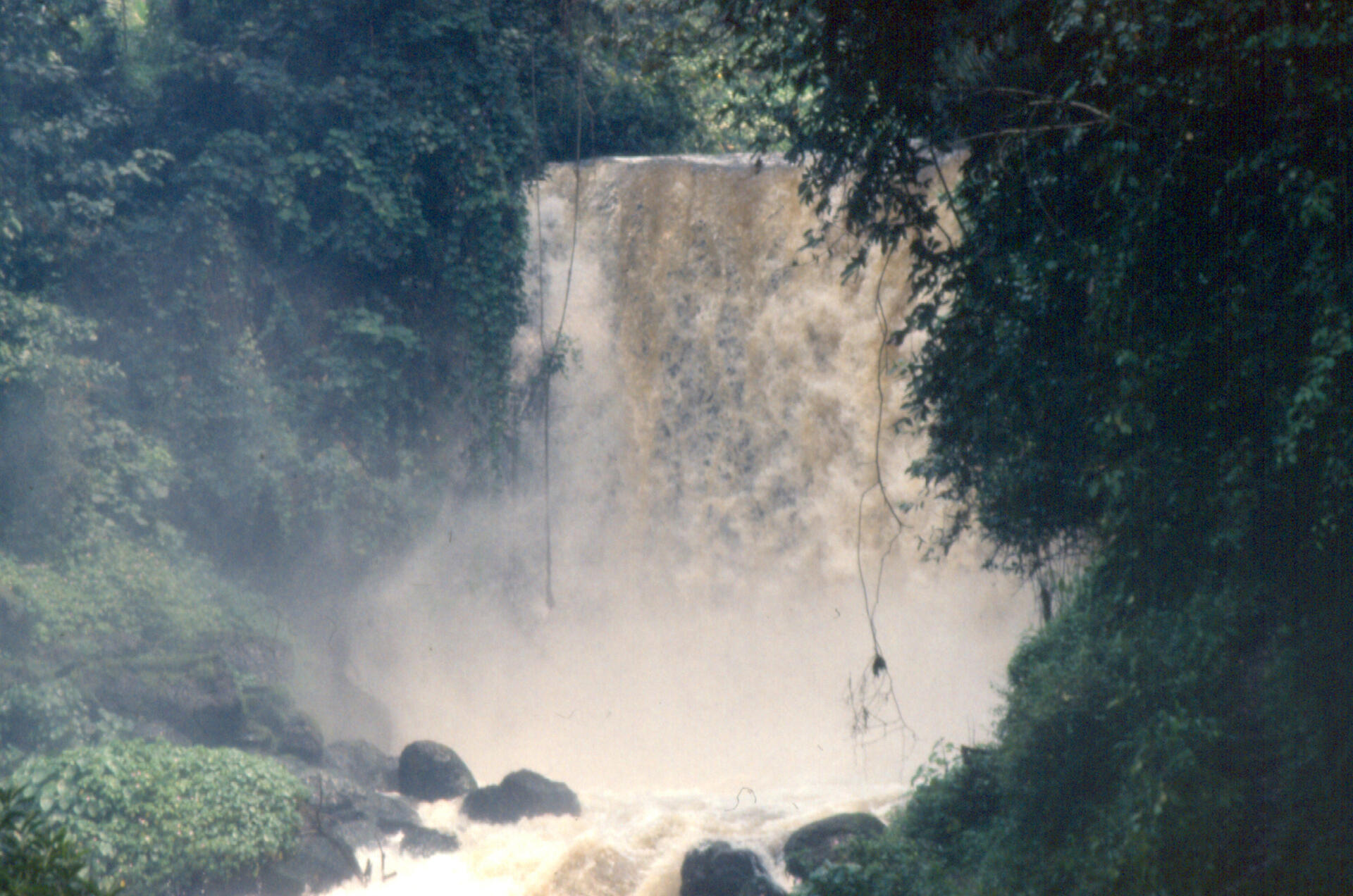
© Ad Meskens, CC BY-SA 3.0 Resized from original. (This derivative is under the same CC BY-SA license.)
World Heritage Research
Discover scientific research and academic studies that deepen our understanding of Virunga National Park from its history and significance to its conservation, management, and contemporary challenges.
-
Verbal autopsy and outbreak investigation of anthrax in Livestock and Wildlife at the Virunga National Park Interface Area, Democratic Republic of the Congo
A cross-sectional survey and outbreak investigation in North Kivu, Democratic Republic of the Congo, confirmed the presence of Bacillus anthracis, the etiological agent of anthrax, during an outbreak in 2021. The study revealed that while farmers in the region are knowledgeable about anthrax, they engage in unhealthy practices related to handling and consuming contaminated meat. Transhumance livestock management, anthropogenic activities, and the absence of a surveillance program were identified as primary contributors to anthrax outbreaks. The research highlights the need for collaborative efforts to manage these outbreaks effectively, reducing their threat to health and livelihoods in the area.
Muhindo, D. S., Pongombo, B. L., K., E. S., K., H. K., Mulinda, É. B., Mwehu, T. B., Malengela, L., Ngumuna, F., Dib, H. A.-A., Shawa, M., & Mulumbu, J. M. (2023). Verbal autopsy and outbreak investigation of anthrax in Livestock and Wildlife at the Virunga National Park Interface Area, Democratic Republic of the Congo. https://doi.org/10.21203/rs.3.rs-2697987/v1
View Publication Record | Read Publication -
The coloniality of crisis conservation: the transnationalization and militarization of Virunga National Park from an historical perspective
Current conservation practices in Virunga National Park, Democratic Republic of Congo, reflect deep-rooted colonial continuities that persist despite the park's transnationalization and militarization. The study reveals how historical colonial management structures have shaped strained relations between park authorities and local populations, even during periods labeled as 'crisis' due to prolonged conflict. These practices remain largely unchanged, operating within a colonial 'state of exception.' The research adopts an historical perspective, tracing pre-colonial history, the park's creation in 1925, and its management over time to uncover these continuities.
Marijnen, E. (2022). The coloniality of crisis conservation: the transnationalization and militarization of Virunga National Park from an historical perspective. The Violence of Conservation in Africa. https://doi.org/10.4337/9781800885615.00014
View Publication Record | Read Publication -
Comparing Factors Conditioning Landscape Change During Volcanic Eruption at Virunga National Park, East Africa
A study comparing landscape changes at Virunga National Park, East Africa, from 1990 to 2018 reveals that human activities are the primary drivers of transformation, particularly in central and northern regions. The research highlights how volcanic eruptions reshaped 8.36 km² of the park into new lava flows, while grasslands and shrublands also underwent significant changes due to volcanic plumes and gas emissions. Using remote sensing (RS) and geographic information systems (GIS), the study analyzed Landsat images and normalized difference vegetation index (NDVI) data to assess these dynamics. The findings underscore the need for targeted conservation strategies to mitigate human impacts and volcanic effects on protected areas, serving as a baseline for future management efforts.
UDAHOGORA, M., YANG, Z. P., NZABARINDA, V., AKBAR, I., MINDJE, R., & UMWALI, E. D. (2021). COMPARING FACTORS CONDITIONING LANDSCAPE CHANGE DURING VOLCANIC ERUPTION AT VIRUNGA NATIONAL PARK, EAST AFRICA. Applied Ecology and Environmental Research, 19(5), 3789–3803. https://doi.org/10.15666/aeer/1905_37893803
View Publication Record | Read Publication -
Conflicts around Virunga National Park: Grassroots perspectives
People living near Virunga National Park, a UNESCO World Heritage Site in the Democratic Republic of Congo, identify three key sources of conflict with the park: disputes over boundaries and natural resources, concerns about law enforcement practices by park guards, and dissatisfaction with community engagement and development initiatives. This study, based on long-term field research from 2012 to 2019, captures grassroots perspectives that highlight tensions between conservation goals and local livelihoods, offering critical insights for improving park management strategies.
Verweijen, J., Saidi Kubuya Batundi, Marijnen, E., Janvier Murairi, & Chrispin Mvano. (2020). Conflicts around Virunga National Park: Grassroots perspectives. Unpublished. https://doi.org/10.13140/RG.2.2.30747.69929
View Publication Record | Read Publication -
Stimulating Implementation of Sustainable Development Goals and Conservation Action: Predicting Future Land Use/Cover Change in Virunga National Park, Congo
A significant reduction in Virunga National Park's forest and open land areas is projected by 2030, driven primarily by agricultural expansion and urban development. This finding stems from a study that simulated future land cover changes using advanced modeling techniques, including machine learning algorithms and Markov chain analysis. Researchers analyzed satellite images from 2010, 2015, and 2019 to identify key drivers of these changes, such as landscape topography and proximity to human activities. The study provides critical insights for data-driven decision-making, aligning with the Sustainable Development Goals (SDGs) and offering recommendations to mitigate environmental degradation while supporting sustainable development in the region.
Christensen, M., & Jokar Arsanjani, J. (2020). Stimulating Implementation of Sustainable Development Goals and Conservation Action: Predicting Future Land Use/Cover Change in Virunga National Park, Congo. Sustainability, 12(4), 1570. https://doi.org/10.3390/su12041570
View Publication Record | Read Publication -
Public Authority and Conservation in Areas of Armed Conflict: Virunga National Park as a ‘State within a State’ in Eastern Congo
Virunga National Park, located in eastern Democratic Republic of Congo (DRC), exemplifies the complex interplay between conservation efforts and conflict dynamics. Research reveals that while transnational actors have increased their influence over park management, this has not strengthened state authority but instead contributed to a 'state within a state' phenomenon. The militarization of conservation in Virunga, often seen as extending state control, actually fosters extra-state territorialization practices. This challenges conventional notions of state authority and suggests that the intersection of conservation and territorialization should be analyzed through the lens of public authority rather than preconceived state frameworks.
Marijnen, E. (2018). Public Authority and Conservation in Areas of Armed Conflict: Virunga National Park as a ‘State within a State’ in Eastern Congo. Development and Change, 49(3), 790–814. Portico. https://doi.org/10.1111/dech.12380
View Publication Record | Read Publication -
Virunga National Park, the heart of darkness as UNESCO World Heritage
Virunga National Park, Africa's first and most renowned national park, faces an eco-crisis rooted in historical rhetoric. The study identifies problematic narrative patterns—echoing Joseph Conrad’s 'Heart of Darkness'—in both human rights campaigns from the Congo Reform Movement (1900) and animal rights movements led by figures like Dian Fossey in the 1970s. These campaigns, while advocating for justice, share responsibility for perpetuating ecological threats to Virunga's biodiversity, particularly its iconic mountain gorillas. The analysis highlights the documentary Virunga (2014) as a rhetorical model offering an alternative narrative path. This work critiques the long-term political and environmental consequences of such discourses, urging a reevaluation of their impact on conservation efforts.
Andersen, F. (2018). Virunga National Park, the heart of darkness as UNESCO World Heritage. Continents Manuscrits, 11. https://doi.org/10.4000/coma.2773
View Publication Record | Read Publication -
Beyond Contesting Limits: Land, Access, and Resistance at the Virunga National Park
Nature conservation strategies at Virunga National Park, implemented post-conflict in the Democratic Republic of Congo (DRC), face significant resistance from local populations. While elites employ overt political contestation, peasants utilize 'weapons of the weak,' engaging in covert, everyday resistance through customary land access practices. This multi-dimensional resistance reflects broader conflict dynamics in eastern DRC while embedding them within conservation efforts, which are tightly intertwined with global dynamics. The study highlights how these resistance strategies challenge re-enclosure practices and underscores the complex interplay between local agency and global conservation frameworks.
Hochleithner, S. (2017). Beyond Contesting Limits: Land, Access, and Resistance at the Virunga National Park. Conservation and Society, 15(1), 100. https://doi.org/10.4103/0972-4923.201397
View Publication Record | Read Publication -
The ‘green militarisation’ of development aid: the European Commission and the Virunga National Park, DR Congo
Development aid from the European Commission (EC) to Virunga National Park, DR Congo, is found to contribute to 'green militarisation'—a process where conservation efforts are intertwined with paramilitary practices. The EC funds salaries and training for park guards while supporting mixed patrols with the Congolese army, framing violent conflicts around the park as economic rather than political issues. This approach allows policymakers to avoid public scrutiny over the use of aid for (para)military purposes. Unlike prior studies that focus on securitised discourses, this research highlights mundane practices within international organisations that facilitate militarisation in conservation. The findings underscore the need to examine how institutional norms and networks obscure the political dimensions of conservation-related violence.
Marijnen, E. (2017). The ‘green militarisation’ of development aid: the European Commission and the Virunga National Park, DR Congo. Third World Quarterly, 38(7), 1566–1582. https://doi.org/10.1080/01436597.2017.1282815
View Publication Record | Read Publication -
The counterinsurgency/conservation nexus: guerrilla livelihoods and the dynamics of conflict and violence in the Virunga National Park, Democratic Republic of the Congo
Strict conservation enforcement and joint military operations in Virunga National Park, Democratic Republic of the Congo, paradoxically intensify armed mobilization by fueling guerrilla livelihoods. These unauthorized activities—such as cultivation, fishing, and logging—often occur under the protection of armed groups, creating a complex interplay between resource exploitation, conflict dynamics, and insurgent resistance. The study demonstrates that traditional conservation strategies may inadvertently exacerbate violence rather than mitigate it, highlighting the need for nuanced approaches that address both ecological preservation and local livelihood security.
Verweijen, J., & Marijnen, E. (2016). The counterinsurgency/conservation nexus: guerrilla livelihoods and the dynamics of conflict and violence in the Virunga National Park, Democratic Republic of the Congo. The Journal of Peasant Studies, 45(2), 300–320. https://doi.org/10.1080/03066150.2016.1203307
View Publication Record | Read Publication