World Heritage Identification Number: 1217
World Heritage since: 2006
Category: Cultural Heritage
WHE Type: Infrastructure & Industry
Transboundary Heritage: No
Endangered Heritage: No
Country: 🇪🇸 Spain
Continent: Europe
UNESCO World Region: Europe and North America
Map
Transforming Transportation: The Vizcaya Bridge - A Pioneering Feat of Engineering
The Vizcaya Bridge, nestled between the towns of Portugalete and Las Arenas in the Biscay province of Spain, stands as a testament to human ingenuity and the spirit of innovation during the Industrial Revolution. This remarkable structure, inscribed as a UNESCO World Heritage Site in 2006, offers a unique blend of traditional ironworking techniques and cutting-edge technology, making it a significant milestone in the annals of engineering history.
More to come…UNESCO Description of the World Heritage Site
Vizcaya Bridge straddles the mouth of the Ibaizabal estuary, west of Bilbao. It was designed by the Basque architect Alberto de Palacio and completed in 1893. The 45-m-high bridge with its span of 160 m, merges 19th-century ironworking traditions with the then new lightweight technology of twisted steel ropes. It was the first bridge in the world to carry people and traffic on a high suspended gondola and was used as a model for many similar bridges in Europe, Africa and the America only a few of which survive. With its innovative use of lightweight twisted steel cables, it is regarded as one of the outstanding architectural iron constructions of the Industrial Revolution.
UNESCO Justification of the World Heritage Site
Criterion (i): For being a surprising work that perfectly combines beauty, aesthetics and functionality: the Vizcaya Bridge is a spectacular and aesthetically pleasing addition to the river estuary and an exceptional expression of technical creativity, reflecting a completely satisfactory relationship between form and function.
Criterion (ii): For its innovative nature from the technological point of view and its condition of pioneer in this kind of constructions: the Vizcaya Bridge, by means of developing a hanging transporter mechanism and merging ironmaking technology with the use of new steel cables, created a new form of construction which influenced the design of bridges all over the world in the three subsequent decades, and exported French and Spanish technologies.
Encyclopedia Record: Vizcaya Bridge
The Vizcaya Bridge is a transporter bridge that links the towns of Portugalete and Las Arenas in the Biscay province of Spain, crossing the mouth of the Nervion River.Additional Site Details
Area: 0.8595 hectares
Number of Components: 1
(ii) — Significant interchange of human values
Coordinates: 43.323175 , -3.0168333333
Image
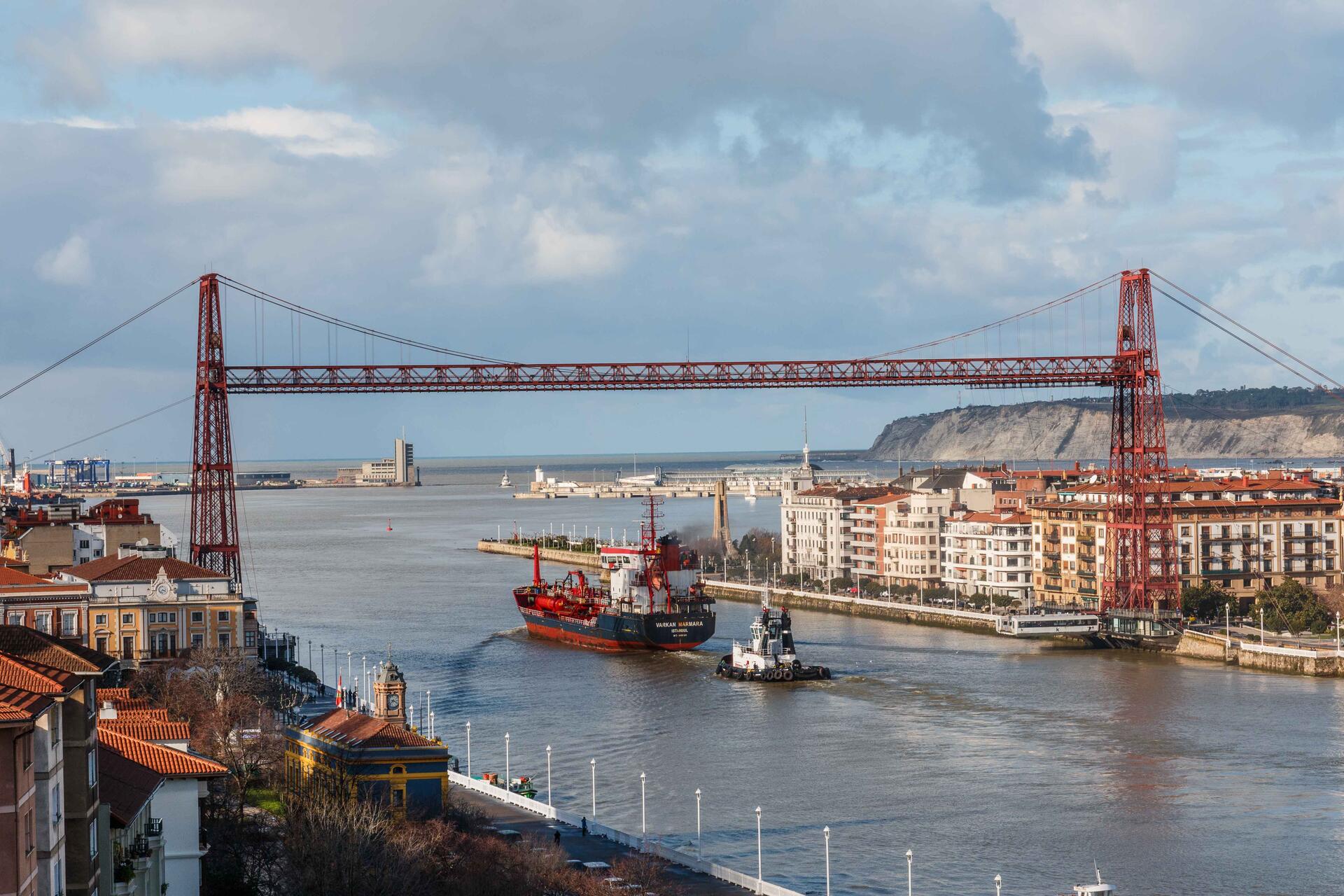
© Ebaki, CC BY-SA 4.0 Resized from original. (This derivative is under the same CC BY-SA license.)
World Heritage Research
Discover scientific research and academic studies that deepen our understanding of Vizcaya Bridge from its history and significance to its conservation, management, and contemporary challenges.
-
Bridges in the World Heritage List between Culture and Technical Development
UNESCO World Heritage Site bridges exemplify the fusion of culture and technical advancement. The Vizcaya Bridge, completed in 1893, pioneered high suspended gondola designs for people and traffic, influencing global bridge construction. This study highlights its significance alongside other iconic bridges like the Iron Bridge (first metal structure) and Forth Bridge (19th-century engineering pinnacle), showcasing their outstanding universal values in architecture, technology, and cultural symbolism. The research adopts a comparative approach to analyze these bridges' historical, technological, and societal impacts, emphasizing their enduring legacy as symbols of human ingenuity and heritage.
Siviero, E., & Martini, V. (2020). Bridges in the World Heritage List between Culture and Technical Development. IABSE Symposium, Wroclaw 2020: Synergy of Culture and Civil Engineering – History and Challenges, 116, 157–180. https://doi.org/10.2749/wroclaw.2020.0153
View Publication Record | Read Publication -
Spatial Arch Bridges Over the Galindo and Bidasoa Rivers
Two pioneering spatial arch bridges, the Galindo River Bridge and the Endarlatsa Bridge in Spain, demonstrate innovative structural solutions by incorporating warped geometries that curve both in plan and elevation. Unlike traditional planar arches, these bridges use curved decks supported by upper or lower arches, creating a unique aesthetic and functional approach. The study highlights distinct strategies to manage out-of-plane forces: auxiliary cables in the Galindo bridge and a tailored distribution of transverse stiffness with specific deck support conditions in the Endarlatsa bridge. These designs represent groundbreaking advancements in arch bridge engineering, offering both structural efficiency and architectural appeal.
Manterola, J., Gil, M. Á., & Muñoz-Rojas, J. (2011). Spatial Arch Bridges Over the Galindo and Bidasoa Rivers. Structural Engineering International, 21(1), 114–121. https://doi.org/10.2749/101686611x12910257102794
View Publication Record | Read Publication