World Heritage Identification Number: 840
World Heritage since: 1999
Category: Cultural Heritage
WHE Type: Cultural Landscapes
Transboundary Heritage: No
Endangered Heritage: No
Country: 🇨🇺 Cuba
Continent: Americas
UNESCO World Region: Latin America and the Caribbean
Map
Viñales Valley: A Unique Cultural Landscape in Cuba
The Viñales Valley, a designated UNESCO World Heritage Site since 1999, is a captivating and unique cultural landscape nestled within the Sierra de los Órganos mountains in western Cuba. Spanning over an area of approximately 132 square kilometers (51 square miles), the valley offers a mesmerizing blend of natural beauty and human ingenuity that reflects the rich cultural development of the Caribbean and Cuba.
More to come…UNESCO Description of the World Heritage Site
The Viñales valley is encircled by mountains and its landscape is interspersed with dramatic rocky outcrops. Traditional techniques are still in use for agricultural production, particularly of tobacco. The quality of this cultural landscape is enhanced by the vernacular architecture of its farms and villages, where a rich multi-ethnic society survives, illustrating the cultural development of the islands of the Caribbean, and of Cuba.
UNESCO Justification of the World Heritage Site
Criterion (iv): The Viñales Valley is an outstanding karst landscape in which traditional methods of agriculture (notably tobacco growing) have survived unchanged for several centuries. The region also preserves a rich vernacular tradition in its architecture, its crafts, and its music.
Encyclopedia Record: Viñales Valley
Viñales Valley is a karstic depression in Cuba. The valley has an area of 132 km2 (51 sq mi) and is located in the Sierra de los Órganos mountains, just north of Viñales in the Pinar del Río Province.Additional Site Details
Area: 13,200 hectares
Number of Components: 1
Coordinates: 22.61667 , -83.71667
Image
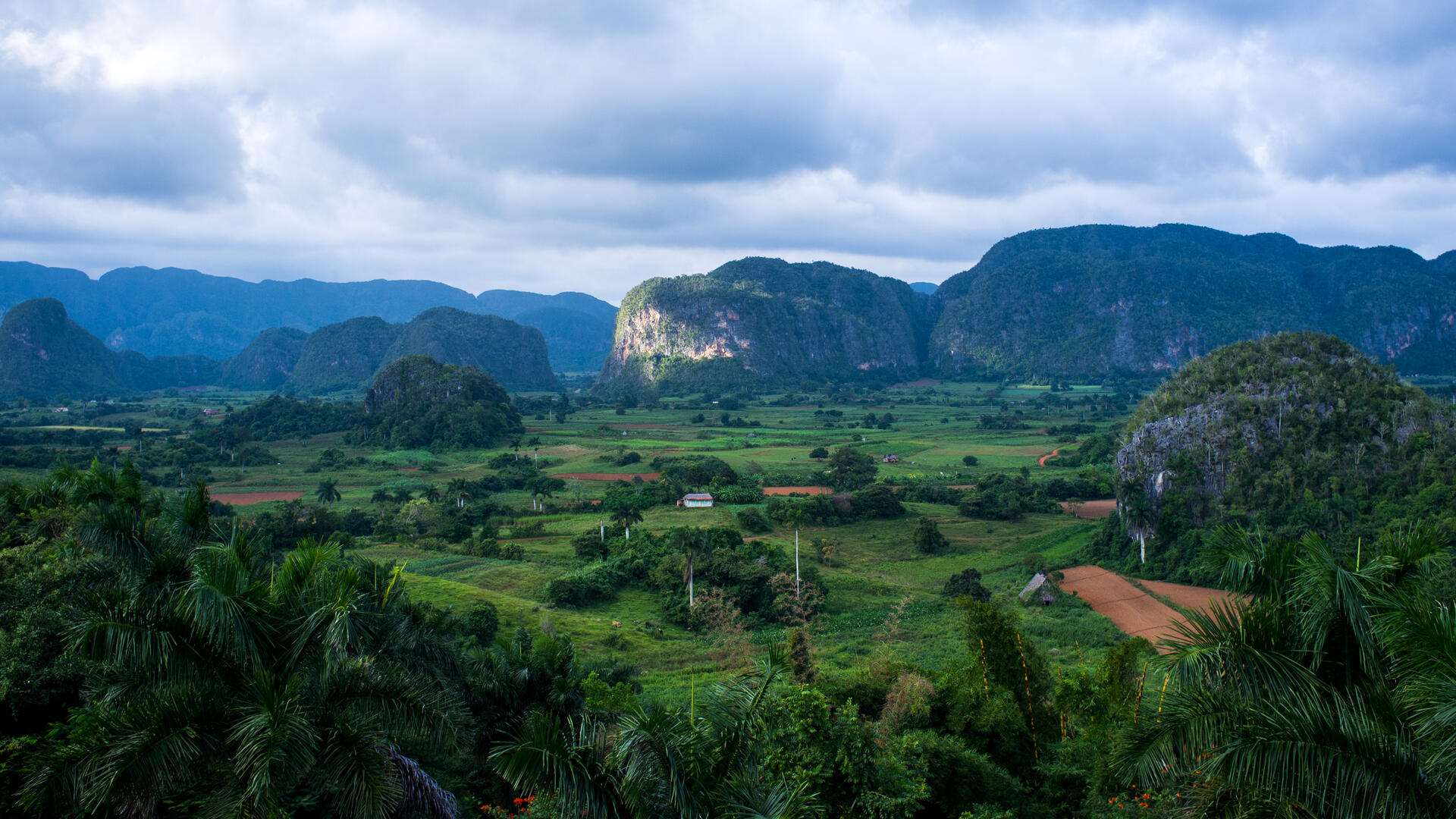
© Severin.stalder, CC BY-SA 3.0 Resized from original. (This derivative is under the same CC BY-SA license.)
World Heritage Research
Discover scientific research and academic studies that deepen our understanding of Viñales Valley from its history and significance to its conservation, management, and contemporary challenges.
-
Cultural heritage and the teaching of local history
Cultural heritage, including historical legacies and social practices, plays a pivotal role in social development. A study on the Viñales Valley, a UNESCO World Heritage Site since 1999, demonstrates that integrating cultural heritage into local history education can serve as an effective tool for knowledge preservation and reinterpretation across generations. The research highlights how tangible and intangible assets, deeply rooted in environmental interactions, contribute to societal growth when used as teaching content. By analyzing the relationship between cultural heritage and local history, the study underscores its potential for safeguarding heritage while fostering social development. This approach offers a model for heritage education that can be applied globally.
Corvea Gómez, D. (2024). Cultural heritage and the teaching of local history. Gentrification, 2, 48. https://doi.org/10.62486/gen202448
View Publication Record | Read Publication -
Geomorphological Heritage in Viñales National Park (Aspiring UNESCO Geopark): Geomatic Tools Applied to Geotourism in Pinar del Río, Cuba
A comprehensive analysis of Viñales National Park (VNP) has identified 20 geosites of significant geological interest, with the Viñales Valley and Santo Tomás Polje ranking highest for their geoheritage value. Using advanced geomatic tools—including digital terrain modeling and virtual itineraries—the study mapped key geomorphological features such as poljes, valleys, and mountain fronts to assess their potential for geotourism and conservation. The research employed a multi-layered approach, integrating relief, drainage, slope, lithology, and geomorphology data to evaluate sites based on criteria from the Spanish Institute of Geology and Mining. Findings highlight the park's diverse geological landscapes, with values ranging up to 1050 for the Viñales Valley, underscoring its importance as an aspiring UNESCO Geopark.
Goy, J. L., Corvea, J. L., de Bustamante, I., Martínez-Graña, A. M., Díaz-Guanche, C., Zazo, C., Dabrio, C. J., González-Delgado, J. Á., Blanco, A., & Nieto, C. E. (2023). Geomorphological Heritage in Viñales National Park (Aspiring UNESCO Geopark): Geomatic Tools Applied to Geotourism in Pinar del Río, Cuba. Sustainability, 15(7), 5704. https://doi.org/10.3390/su15075704
View Publication Record | Read Publication -
Impacts of ‘home stays’ on the protected urban landscape and the social environment (Viñales, Cuba)
Home stay tourism in Viñales Valley, Cuba, significantly alters the protected urban landscape and social dynamics. The study found that 392 rental homes contribute to the reduction of green spaces, introduction of modern building materials, and architectural changes, while also imposing labor burdens primarily on women, disrupting daily routines and exacerbating social inequalities. Researchers interviewed 74 landlords to assess these impacts, revealing both economic gains and social costs. This work highlights the dual-edged nature of tourism in heritage sites, where development benefits come at the expense of cultural integrity and equity.
Pérez Albert, Y., Muro Morales, J. I., & Nel-lo Andreu, M. (2020). Impacts of ‘home stays’ on the protected urban landscape and the social environment (Viñales, Cuba). Journal of Tourism and Cultural Change, 19(3), 277–294. https://doi.org/10.1080/14766825.2020.1722142
View Publication Record | Read Publication -
Agriculture in Viñales Valley, Cuba
Viñales Valley, a UNESCO World Heritage Site in western Cuba, showcases a unique living cultural landscape where traditional agriculture thrives amidst bulbous limestone cliffs. This study highlights the valley's significance as both an agricultural and artistic destination, emphasizing its imaginative qualities through visual submissions such as drawings, illustrations, or photographs. The research approach involves inviting readers to contribute their creative works alongside explanatory information, fostering a dynamic interaction between scientific documentation and artistic expression. By blending traditional farming practices with artistic representation, Viñales Valley stands out as a model of sustainable cultural heritage preservation.
Schlösser, T. P. C. (2015). Agriculture in Viñales Valley, Cuba. Spine, 40(15), i. https://doi.org/10.1097/01.brs.0000470334.58180.39
View Publication Record | Read Publication