World Heritage Identification Number: 76
World Heritage since: 1979
Category: Natural Heritage
WHE Type: Protected Areas & National Parks
Transboundary Heritage: No
Endangered Heritage: Yes
Country: 🇺🇸 United States of America
Continent: Americas
UNESCO World Region: Europe and North America
Map
Everglades National Park: A Unique Tropical Wilderness in the United States
The Everglades National Park, located in the southernmost part of Florida, is a unique and significant natural wonder that offers a diverse ecosystem unlike any other in the United States. This expansive park, covering approximately 20% of the original Everglades, is the largest subtropical wilderness in North America, the largest wilderness area east of the Mississippi River, and the third-largest national park in the contiguous United States, surpassed only by Death Valley and Yellowstone.
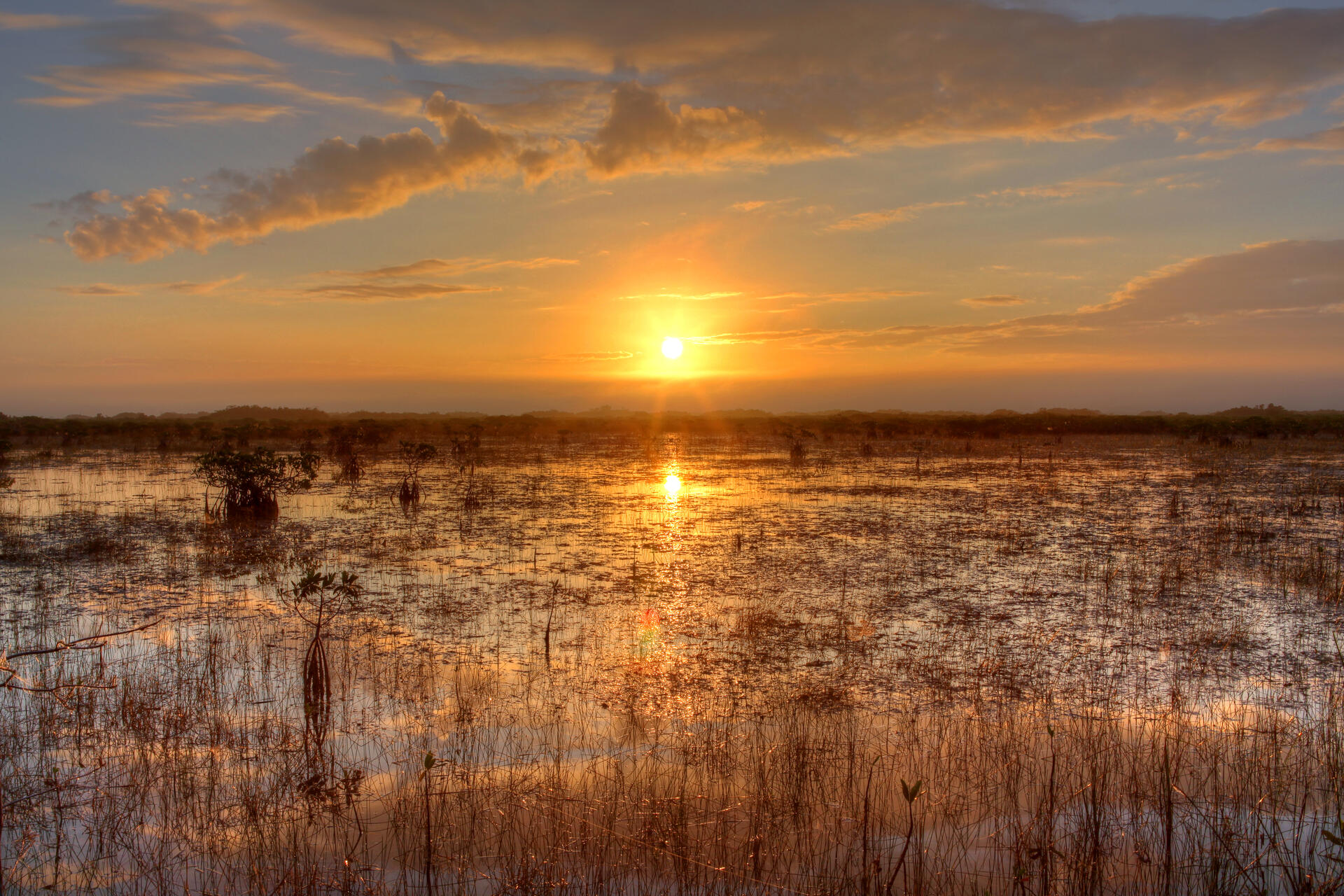
The park's official short description by UNESCO aptly refers to it as “a river of grass flowing imperceptibly from the hinterland into the sea,” a phrase coined and popularized by conservationist Marjory Stoneman Douglas. This description highlights the park's distinctive landscape, which consists primarily of marshy grasslands and wetlands. The Everglades National Park is a vast, interconnected system of waterways, including rivers, sloughs, marshes, and mangrove forests, that support an extraordinary array of plant and animal life.
One of the most notable aspects of the Everglades National Park is its exceptional variety of water habitats. These diverse water environments have made it a sanctuary for a multitude of bird and reptile species. Among these are the American crocodile, which exists here alongside the iconic American alligator, the Florida panther, and the endangered West Indian manatee (Trichechus manatus latirostris). The park is also home to more than 350 bird species, making it a popular destination for birdwatchers.
In addition to its rich wildlife, the Everglades National Park holds cultural significance for various indigenous communities. While the Calusa and Tequesta have ancient historical ties to the land, the park today maintains active collaborations with the Miccosukee Tribe of Indians of Florida and the Seminole Tribe of Florida to preserve and share their cultural heritage through educational programs and partnerships.
The Everglades National Park was established as a national park in 1947, following decades of efforts to protect this fragile ecosystem from development and exploitation. In 1976, UNESCO designated the Everglades & Dry Tortugas Biosphere Reserve, recognizing the park's global importance. Two years later, in 1979, the Everglades was listed as a World Heritage Site. The Ramsar Convention, an international treaty for the conservation and sustainable utilization of wetlands, included the park on its list of Wetlands of International Importance in 1987.
Notably, the Everglades is the only site in the United States to appear on all three international conservation lists: World Heritage Site, Biosphere Reserve, and Ramsar Wetland. Despite these recognitions, the park remains on the UNESCO List of World Heritage in Danger—a status it has held continuously since 2010 due to ongoing threats from nutrient pollution, invasive species (such as the Burmese python), and deteriorating water levels.
Today, an average of one million people visit the Everglades National Park each year, drawn by its breathtaking beauty and unique biodiversity. Visitors can explore the park via guided tours, hiking trails, boat trips, and wildlife observation platforms. The park's visitor centers offer educational exhibits, ranger-led programs, and opportunities to learn about the park's history, culture, and conservation efforts.
Overall, the Everglades National Park stands as a testament to the remarkable diversity and resilience of nature. Its designation as a World Heritage Site reflects the global community's recognition of its outstanding universal value. By preserving and protecting this unique tropical wilderness, we ensure not only the survival of its incredible flora and fauna but also the continued enrichment of our collective human experience.
UNESCO Description of the World Heritage Site
This site at the southern tip of Florida has been called 'a river of grass flowing imperceptibly from the hinterland into the sea'. The exceptional variety of its water habitats has made it a sanctuary for a large number of birds and reptiles, as well as for threatened species such as the manatee.
UNESCO Justification of the World Heritage Site
Criterion (viii): The Everglades is a vast, nearly flat, seabed that was submerged at the end of the last Ice Age. Its limestone substrate is one of the most active areas of modern carbonate sedimentation.
Criterion (ix): The Everglades contains vast subtropical wetlands and coastal/marine ecosystems including freshwater marshes, tropical hardwood hammocks, pine rocklands, extensive mangrove forests, saltwater marshes, and seagrass ecosystems important to commercial and recreational fisheries. Complex biological processes range from basic algal associations through progressively higher species and ultimately to primary predators such as the alligator, crocodile, and Florida panther; the food chain is superbly evident and unbroken. The mixture of subtropical and temperate wildlife species is found nowhere else in the United States.
Criterion (x): Everglades National Park is a noteworthy example of viable biological processes. The exceptional variety of its water habitats has made it a sanctuary for a large number of birds and reptiles and it provides refuge for over 20 rare, endangered, and threatened species. These include the Florida panther, snail kite, alligator, crocodile, and manatee. It provides important foraging and breeding habitat for more than 400 species of birds, includes the most significant breeding grounds for wading birds in North America and is a major corridor for migration.
Encyclopedia Record: Everglades National Park
Everglades National Park is a national park of the United States that protects the southern twenty percent of the original Everglades in Florida. The park is the largest tropical wilderness in the United States and the largest wilderness of any kind east of the Mississippi River. An average of one million people visit the park each year. Everglades is the third-largest national park in the contiguous United States after Death Valley and Yellowstone. It was declared a national park in 1947. UNESCO declared the Everglades & Dry Tortugas Biosphere Reserve in 1976 and listed the park as a World Heritage Site in 1979, and the Ramsar Convention included the park on its list of Wetlands of International Importance in 1987. Everglades is one of only three locations in the world to appear on all three lists.Additional Site Details
Area: 567,017 hectares
Number of Components: 1
(ix) — Outstanding example representing ecological and biological processes
(x) — Contains most important habitats for biodiversity
Coordinates: 25.55444444 , -80.99638889
IUCN World Heritage Outlook
The 2025 Conservation Outlook on Everglades National Park reports the following assessment:
Source: International Union for Conservation of Nature (IUCN) · View assessment
World Heritage Research
Discover scientific research and academic studies that deepen our understanding of Everglades National Park from its history and significance to its conservation, management, and contemporary challenges.
-
Negotiating Constraints to Recreation in Everglades National Park Among Underserved South Florida Residents
Underserved South Florida residents face significant constraints to visiting Everglades National Park, with barriers identified at individual, interpersonal, contextual, and systemic levels. This study reveals that while these constraints limit park visitation, residents employ both collective and individual strategies to negotiate them. The research highlights the importance of place-based approaches in understanding wilderness recreation among traditionally underserved communities, offering critical insights for park managers aiming to better serve diverse urban populations like Miami-Dade County's 2.7 million residents, 71.6% of whom identify as Hispanic or Latino. By using semistructured interviews, the study provides a nuanced, qualitative perspective that critiques quantitative modeling approaches, emphasizing the need for collective negotiation strategies to address these barriers.
Fox Rushing, J., Thomas, E. R., Thomsen, J. M., Armatas, C. A., & Rice, W. L. (2025). Negotiating Constraints to Recreation in Everglades National Park Among Underserved South Florida Residents. Annals of the American Association of Geographers, 115(10), 2406–2421. https://doi.org/10.1080/24694452.2025.2493826
View Publication Record | Read Publication -
The large‐scale restoration of fire and water regimes in Everglades National Park reveal little change in plant diversity along an elevational gradient
Despite significant restoration efforts aimed at restoring natural fire and water regimes in the Everglades National Park, no systematic shifts in plant diversity or composition have been observed along an elevational gradient. The study, conducted between 1997–1999 and 2024, resampled transects spanning from seasonally inundated marl prairie to frequently burned pine rockland on Long Pine Key. Researchers used generalized linear mixed models to analyze the effects of fire frequency, water depth, and elevation on plant species richness and composition. While no overall changes were detected, complex interactions between fire and water were found to structure plant communities, maximizing species richness under varying conditions: low burn frequencies in wet sites, moderate frequencies in moderately wet sites, and high frequencies in dry sites.
Schneider, O., Crandall, R. M., & Baiser, B. (2024). The large‐scale restoration of fire and water regimes in Everglades National Park reveal little change in plant diversity along an elevational gradient. Restoration Ecology, 32(5). Portico. https://doi.org/10.1111/rec.14138
View Publication Record | Read Publication -
Quantification of Evapotranspiration and Water Chemistry in a Remediated Wetland in Everglades National Park, USA
Restoration efforts at the Hole-in-the-Donut (HID) wetland in Everglades National Park significantly reduced evapotranspiration rates and lowered ion and nutrient concentrations in surface water and groundwater. Over a 15-year period, evapotranspiration decreased from 1083.4 mm/year to 891.6 mm/year as the restored area expanded to 4893 acres. The study, which used remotely sensed data and water chemistry analysis, found that removing vegetation and soil cover contributed to these changes, offering insights into effective wetland restoration techniques for similar ecosystems.
Reio, D. N., Price, R. M., Melesse, A. M., & Ross, M. (2023). Quantification of Evapotranspiration and Water Chemistry in a Remediated Wetland in Everglades National Park, USA. Water, 15(4), 611. https://doi.org/10.3390/w15040611
View Publication Record | Read Publication -
Research of Foreign Experience of World Heritage Protection (Using the Example of the Everglades National Park)
Effective economic and legal mechanisms for protecting unique natural heritage sites, such as land acquisition by the state and inclusion in the List of World Heritage in Danger, have been identified through a study of Everglades National Park. The research highlights how these strategies can be applied to address threats facing Lake Baikal's ecosystem, particularly from proposed hydraulic structures on the transboundary Selenga River. By analyzing foreign scientific literature and legal documents, the study underscores the critical role of the World Heritage Committee in preserving vulnerable sites like the Everglades, which has twice been listed as endangered due to internal political processes in the United States. The findings offer potential solutions for global heritage conservation challenges.
Ditsevich, Y. B. (2023). Research of Foreign Experience of World Heritage Protection (Using the Example of the Everglades National Park). Siberian Law Herald, 2, 118–124. https://doi.org/10.26516/2071-8136.2023.2.118
View Publication Record | Read Publication -
Decadal trends of mercury cycling and bioaccumulation within Everglades National Park
Despite declines in atmospheric mercury (Hg) concentrations elsewhere in the U.S., Everglades National Park (ENP) showed no reduction in Hg deposition or related contaminants like dissolved organic carbon and sulfate from 2008 to 2018. A multimedia study across 76 sites revealed strong correlations between methylmercury (MeHg) levels in water and fish, particularly in the Shark River Slough (SRS) and coastal regions, where geochemical conditions favor bioaccumulation. The findings underscore that improved water quality and flow—key restoration targets—could mitigate MeHg exposure. The study highlights the complex interplay between hydrology, climate, and Hg cycling, offering critical insights for Everglades conservation efforts.
Janssen, S. E., Tate, M. T., Poulin, B. A., Krabbenhoft, D. P., DeWild, J. F., Ogorek, J. M., Varonka, M. S., Orem, W. H., & Kline, J. L. (2022). Decadal trends of mercury cycling and bioaccumulation within Everglades National Park. Science of the Total Environment, 838, 156031. https://doi.org/10.1016/j.scitotenv.2022.156031
View Publication Record | Read Publication -
Improved Prediction of Managed Water Flow into Everglades National Park Using Empirical Dynamic Modeling
A new approach using empirical dynamic modeling (EDM) significantly improves the accuracy and simplifies predictions of managed water flows into Everglades National Park. Unlike the previous linear model, which relied on six variables, EDM demonstrated that only two—upstream and downstream water levels—are necessary to forecast weekly target flows more effectively. This advancement addresses the nonlinear dynamics of flow drivers, enhancing management strategies under the Comprehensive Everglades Restoration Plan (CERP). The findings highlight the potential for more efficient hydrologic forecasting, benefiting both scientific research and practical conservation efforts in this critical ecosystem.
Saberski, E., Park, J., Hill, T., Stabenau, E., & Sugihara, G. (2022). Improved Prediction of Managed Water Flow into Everglades National Park Using Empirical Dynamic Modeling. Journal of Water Resources Planning and Management, 148(12). https://doi.org/10.1061/(asce)wr.1943-5452.0001598
View Publication Record | Read Publication -
From Swamp to Wetland: The Creation of Everglades National Park
Everglades National Park, the largest subtropical wilderness in the United States, underwent a transformative shift from being dismissed as a 'useless swamp' to becoming a globally recognized ecological treasure. This transformation, spanning 1928–1958, was pivotal in shaping modern environmentalism. Advocates for its preservation leveraged emerging ecological principles—highlighting biodiversity, habitat protection, and the intrinsic value of wetlands—to redefine the region's significance. Unlike traditional national parks, the Everglades lacked dramatic landscapes or geological monuments, yet its unique wetland ecosystems became a cornerstone for conservation efforts. The book 'From Swamp to Wetland' documents this paradigm shift, underscoring how scientific understanding and advocacy reshaped public perception and policy, ultimately securing its status as a UNESCO World Heritage Site.
Wilhelm, C. (2022). From Swamp to Wetland: The Creation of Everglades National Park. https://doi.org/10.1353/book101472
View Publication Record | Read Publication