World Heritage Identification Number: 1270
World Heritage since: 2008
Category: Cultural Heritage
WHE Type: Historic Cities & Urban Areas
Transboundary Heritage: No
Endangered Heritage: No
Country: 🇨🇺 Cuba
Continent: Americas
UNESCO World Region: Latin America and the Caribbean
Map
The Historic Centre of Camagüey: A Unique Urban Layout in Cuban History
The Historic Centre of Camagüey, inscribed as a UNESCO World Heritage Site in 2008, offers a captivating glimpse into the rich history and architectural evolution of Cuba. Situated in the heart of the country, this vibrant city serves as the capital of the Camagüey Province and boasts a population exceeding 333,000 inhabitants.
More to come…UNESCO Description of the World Heritage Site
One of the first seven villages founded by the Spaniards in Cuba, Camagüey played a prominent role as the urban centre of an inland territory dedicated to cattle breeding and the sugar industry. Settled in its current location in 1528, the town developed on the basis of an irregular urban pattern that contains a system of large and minor squares, serpentine streets, alleys and irregular urban blocks, highly exceptional for Latin American colonial towns located in plain territories. The 54 ha Historic Centre of Camagüey constitutes an exceptional example of a traditional urban settlement relatively isolated from main trade routes. The Spanish colonizers followed medieval European influences in terms of urban layout and traditional construction techniques brought to the Americas by their masons and construction masters. The property reflects the influence of numerous styles through the ages: neoclassical, eclectic, Art Deco, Neo-colonial as well as some Art Nouveau and rationalism.
UNESCO Justification of the World Heritage Site
Criterion (iv): The Historic Centre of Camagüey constitutes an outstanding urban architectural type in Latin America, featured by its irregular urban layout that produced an unusual system of squares, minor squares, serpentine streets, alleys, urban blocks and plots system. Monumental and domestic architecture form a homogeneous urban fabric where it is possible to find architectural expressions corresponding to different periods of the evolution of the town.
Criterion (v): The Historic Centre of Camagüey constitutes an exceptional example of a traditional urban settlement relatively isolated from main trade routes, where the Spanish colonizers were subject to European medieval urban influences in the urban layout and to traditional construction techniques brought to the Americas by the first masons and construction masters. The nominated property is of adequate size and contains all the necessary material components to guarantee the integrity of the historic centre. The persistence of the original urban layout, of the architectural types and materials, of the traditional craftsmanship and of uses and spirit allows the historic centre to meet the required conditions of authenticity. The legal protection and the management system and instruments have proved to be adequate for ensuring the proper conservation of the nominated area and its buffer zone.
Encyclopedia Record: Camagüey
Camagüey is a city and municipality in central Cuba and is the nation's third-largest city with more than 333,000 inhabitants. It is the capital of the Camagüey Province.Additional Site Details
Area: 54 hectares
Number of Components: 1
(v) — Outstanding example of traditional human settlement
Coordinates: 21.3786111111 , -77.9186111111
Image
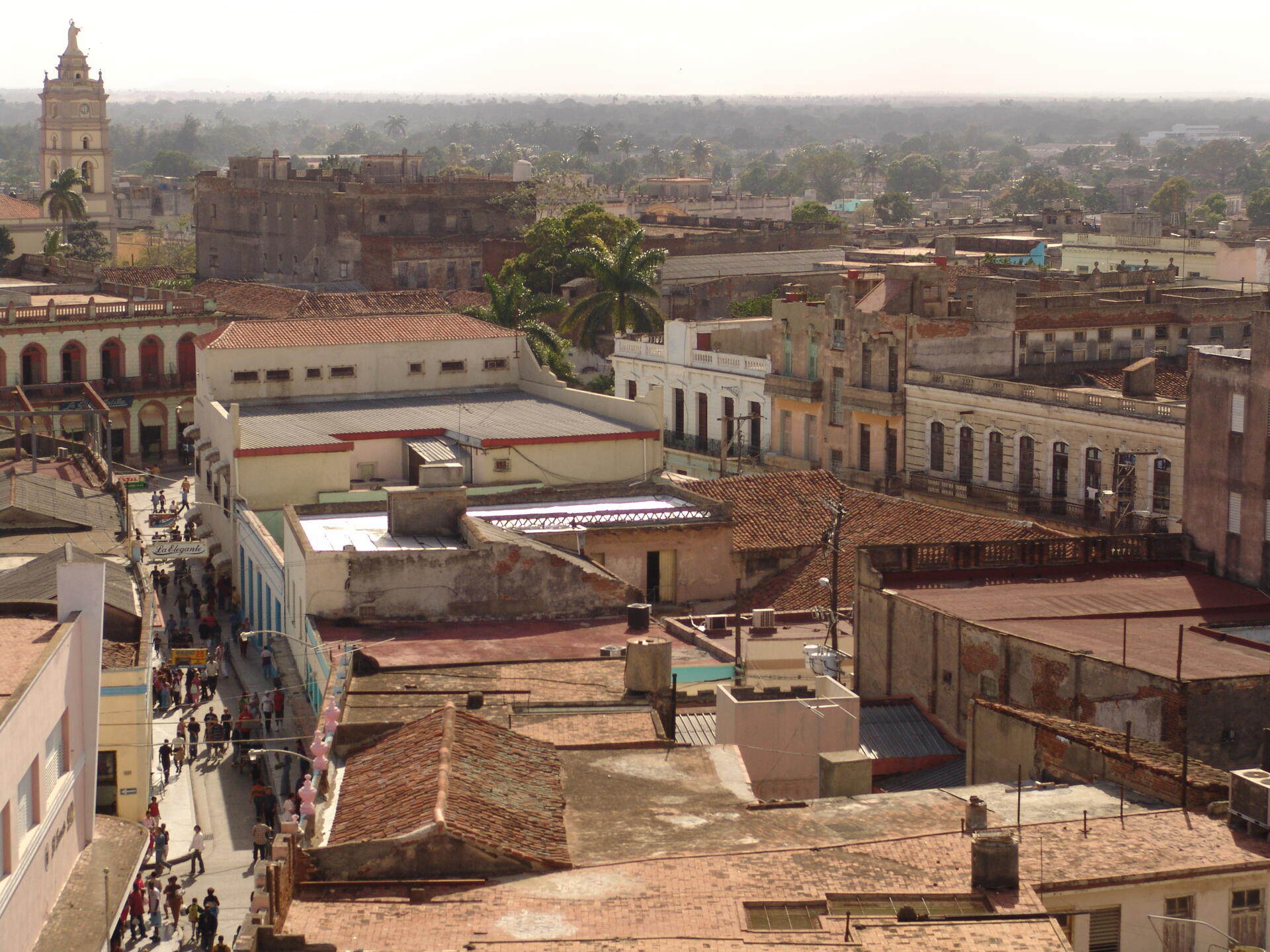
© No machine-readable author provided. Danleo~commonswiki assumed (based on copyright claims)., CC BY 2.5 Resized from original.
World Heritage Research
Discover scientific research and academic studies that deepen our understanding of Historic Centre of Camagüey from its history and significance to its conservation, management, and contemporary challenges.
-
Propuesta para la gestión de vistas relevantes del paisaje urbano histórico de Camagüey
A novel urban management framework for preserving visually significant landscapes in historic cities has been developed, addressing the negative impacts of globalization on heritage integrity. The proposal integrates systemic and strategic approaches to protect key visual elements such as building height, scale, rhythm, and functional diversity while enabling socio-economic benefits. Validated through expert criteria and applied in Camagüey's historic center, this instrument demonstrates strong links with other planning scales and enhances current urban-heritage management. Its adaptability suggests potential for broader application across other historic sites.
Almeida-Torrens, M., Gómez-Consuegra, L., & Zúñiga-Igarza, L. M. (2024). Propuesta para la gestión de vistas relevantes del paisaje urbano histórico de Camagüey. Revista de Urbanismo, (50), 77–99. https://doi.org/10.5354/0717-5051.2024.71857
View Publication Record | Read Publication -
Camagüey un destino urbano seguro, experiencias desde los procesos de formación interprofesional
Camagüey, a UNESCO World Heritage Site with its historic center declared a National Monument, presents a unique opportunity for urban tourism due to its architectural diversity and cultural heritage. The study proposes a set of actions to enhance health and safety in high-value patrimonial zones, integrating preventive conservation strategies with sanitary protocols. This approach, rooted in interprofessional education (EIP), demonstrates that coordinated efforts across disciplines can lead to viable solutions for secure tourist destinations. The research highlights the importance of updating professional training through EIP to address complex challenges, particularly post-pandemic, ensuring sustainable and safe urban tourism experiences.
Dr.C. Mabel Teresa Chaos Yeras, MSc. Raúl Alberto Morales Rivero, MSc. Belkis Sonora Álvarez, & Dr.C. Jorge García Batán. (2023). Camagüey un destino urbano seguro, experiencias desde los procesos de formación interprofesional. Zenodo. https://doi.org/10.5281/ZENODO.7915067
View Publication Record | Read Publication -
Ciudad Patrimonial Inteligente y Gestión Turística en el centro histórico de la ciudad de Camagüey
A preliminary diagnostic study of Camagüey's historic center identifies key characteristics and challenges for its development into a 'Smart Heritage City,' integrating digital innovation with sustainable tourism. The research highlights the potential of leveraging technology—such as internet and smartphones—to enhance heritage preservation, urban management, and tourist experiences while drawing from international models of smart city governance. By analyzing existing frameworks, the study proposes a strategic roadmap for Cuba to adapt these concepts, focusing on Camagüey's unique cultural and architectural assets. The findings underscore the need for a tailored approach that balances technological advancement with heritage conservation, offering a blueprint for similar efforts across the country.
MSc. Jennifer María De La Cruz Saavedra., & Dr.C. Gerson Herrera Pupo. (2023). Ciudad Patrimonial Inteligente y Gestión Turística en el centro histórico de la ciudad de Camagüey. Zenodo. https://doi.org/10.5281/ZENODO.7915650
View Publication Record | Read Publication -
Mapa de riesgo de desastre para el centro histórico de la ciudad de Camagüey. Su incidencia en la gestión turística.
A comprehensive disaster risk map for the historic center of Camagüey, Cuba, has been developed, identifying critical vulnerabilities and potential threats to institutions, including high-value tourist infrastructure. This study adapts international strategies for disaster risk mapping (EIRD) to the unique context of Camagüey's prioritized zone, providing a practical tool for mitigating risks in one of Cuba's key UNESCO World Heritage Sites. The map not only pinpoints areas at risk but also proposes evacuation and mitigation routes, offering actionable insights for local authorities and tourism managers to enhance disaster preparedness and protect both cultural heritage and economic assets.
DrC Gersón Herrera Pupo, MSc. Ibrahim León Herrera, & MSc. Carmen J. Leyva Fontes. (2023). Mapa de riesgo de desastre para el centro histórico de la ciudad de Camagüey. Su incidencia en la gestión turística. Zenodo. https://doi.org/10.5281/ZENODO.7941091
View Publication Record | Read Publication -
El área de protección de vistas relevantes urbanas como zona de amortiguamiento del centro histórico de Camagüey, Cuba
A precise urban buffer zone for protecting the historic center of Camagüey, Cuba, has been identified using a landscape analysis approach. This study introduces a tool to delineate key visual units and safeguard significant urban views, addressing gaps in existing protection strategies. By integrating perceptual perspectives into urban planning, it provides a comprehensive framework that complements broader city development plans. The proposed buffer zone is essential for harmonizing contemporary elements with historic environments, ensuring sustainable preservation.
Almeida Torrens, M., & Gómez Consuegra, L. (2022). El área de protección de vistas relevantes urbanas como zona de amortiguamiento del centro histórico de Camagüey, Cuba. Apuntes: Revista de Estudios Sobre Patrimonio Cultural, 34(1), 23. https://doi.org/10.11144/javeriana.apu34.apvr
View Publication Record | Read Publication -
Problemáticas y potencialidades espaciales de los centros históricos (Camagüey, Cuba)
A study of Camagüey's historic center reveals the complex interplay between society and nature, highlighting spatial challenges and opportunities that emerge from their interaction. The research identifies key conflicts and potential solutions, emphasizing the role of local inhabitants in shaping urban heritage. By integrating theoretical frameworks with empirical analysis—including graphic documentation—the study demonstrates how academic research can bridge the gap between public institutions and community participation. This approach underscores the importance of conscious spatial transformation in preserving and enhancing historic centers while fostering a collaborative model for urban development.
Yeras, M. T. C. (2022). Problems and spatial potential of the historic centers, approach to Camagüey, Cuba. PatryTer, 5(9), 104–124. https://doi.org/10.26512/patryter.v5i9.39606
View Publication Record | Read Publication -
El habitar en el centro histórico de Camagüey, Cuba
Buildings in Camagüey's historic center blend international Modern Movement principles with local adaptations, creating unique spatial solutions that define urban living. The study analyzes a sample of apartment buildings to highlight their distinctive features—such as interior-exterior relationships—and explores how residents perceive and value these designs. By focusing on the interplay between global architectural trends and local context, this research reveals how Camagüey’s Modernist heritage offers innovative approaches to spatial organization and habitation in Latin America.
Falls Valdivieso, D., & Chaos Yeras, M. T. (2021). El habitar en el centro histórico de Camagüey, Cuba. PatryTer, 4(8), 36–59. https://doi.org/10.26512/patryter.v4i8.29252
View Publication Record | Read Publication