World Heritage Identification Number: 841
World Heritage since: 1997
Category: Cultural Heritage
WHE Type: Buildings & Architectural Ensembles
Transboundary Heritage: No
Endangered Heritage: No
Country: 🇨🇺 Cuba
Continent: Americas
UNESCO World Region: Latin America and the Caribbean
Map
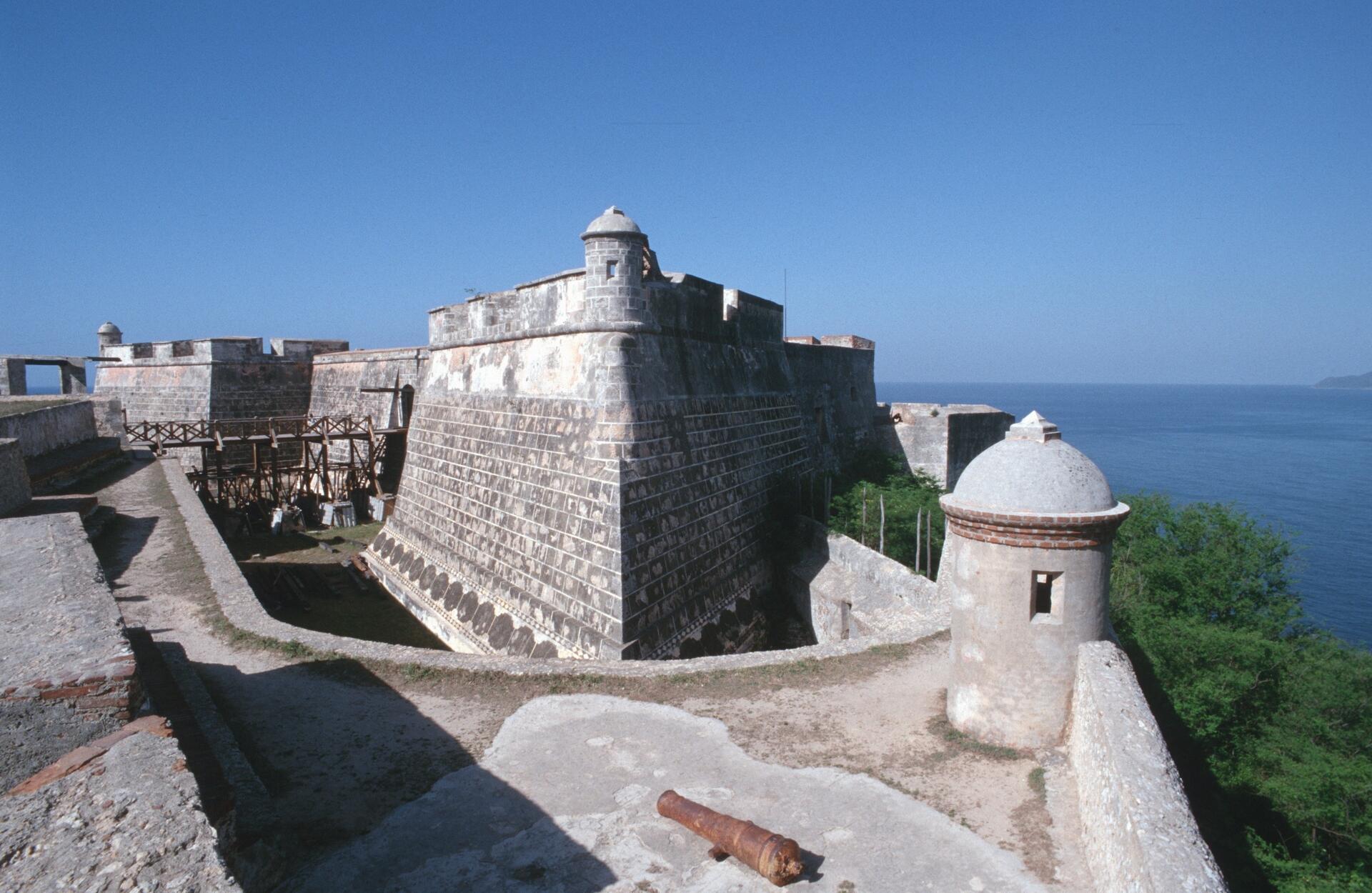
A Fortress of Grandeur: San Pedro de la Roca Castle, Santiago de Cuba
The Castillo de San Pedro de la Roca, nestled on the rugged coastline of Santiago de Cuba, stands as a testament to the architectural prowess of the Spanish colonial era. Inscribed as a UNESCO World Heritage Site in 1997, this formidable fortification offers a glimpse into the strategic military designs of the 17th century.
More to come…UNESCO Description of the World Heritage Site
Commercial and political rivalries in the Caribbean region in the 17th century resulted in the construction of this massive series of fortifications on a rocky promontory, built to protect the important port of Santiago. This intricate complex of forts, magazines, bastions and batteries is the most complete, best-preserved example of Spanish-American military architecture, based on Italian and Renaissance design principles.
UNESCO Justification of the World Heritage Site
Criterion (iv): Constructed in response to the aggressive commercial and political rivalries that menaced the Caribbean during the 17th and 18th centuries, the Castle of San Pedro de la Roca and its associated defensive works are of exceptional value because they constitute the largest and most comprehensive example of the principles of Renaissance military engineering adapted to the requirements of European colonial powers in the Caribbean.
Criterion (iv): The Castle, a classic bastioned fortification in which geometrical form, symmetry and proportionality between sides and angles predominate, is an outstanding representative of the Spanish-American school of military architecture.
Encyclopedia Record: Castillo de San Pedro de la Roca
The Castillo de San Pedro de la Roca is a fortress located on the coast of the Cuban city of Santiago de Cuba. About 6 miles (10 km) southwest of the city centre, it overlooks the bay. The fortress was declared a World Heritage Site by UNESCO in 1997, cited as the best preserved and most complete example of Spanish-American military architecture.Additional Site Details
Area: 93.88 hectares
Number of Components: 1
(v) — Outstanding example of traditional human settlement
Coordinates: 19.968446 , -75.870441
World Heritage Research
Discover scientific research and academic studies that deepen our understanding of San Pedro de la Roca Castle, Santiago de Cuba from its history and significance to its conservation, management, and contemporary challenges.
-
Política y defensa en el suroriente cubano: el castillo de San Pedro de la Roca, 1635-1800
San Pedro de la Roca Castle, a key UNESCO World Heritage Site in Santiago de Cuba, played a pivotal role in the defensive strategy of the Spanish Empire in the Caribbean from 1635 to 1800. The study reveals how the castle's fortification system evolved in response to imperial political shifts and military engineering advancements, reflecting broader trends in colonial defense architecture. By analyzing archival records—including reports, inventories, and projects—researchers traced the transformation of the castle from its early 17th-century origins through the 18th century, highlighting its strategic significance in the region's geopolitical landscape.
Padrón Reyes, L. (2025). Política y defensa en el suroriente cubano: el castillo de San Pedro de la Roca, 1635-1800. Memorias, 55, 7–30. https://doi.org/10.14482/memor.55.256.365
View Publication Record | Read Publication -
Crame, Cermeño y la reforma del Morro de Santiago de Cuba (1766-1767)
A new analysis of the reconstruction efforts at San Pedro de la Roca Castle, Santiago de Cuba, following the 1766 earthquake, reveals the significant contributions of military engineers Agustín Crame and Juan Martín Cermeño. Through unprecedented documentation, this study clarifies their roles in shaping the fortification's final design, offering fresh insights into 18th-century military architecture and disaster response. The research methodically examines archival records to reconstruct the project's evolution, providing a detailed account of its technical and historical context.
López Hernández, I. J. (2021). Crame, Cermeño y la reforma del Morro de Santiago de Cuba (1766-1767). Quiroga. Revista de Patrimonio Iberoamericano, 88–101. https://doi.org/10.30827/quiroga.v0i17.0008
View Publication Record | Read Publication