World Heritage Identification Number: 839
World Heritage since: 2001
Category: Natural Heritage
WHE Type: Protected Areas & National Parks
Transboundary Heritage: No
Endangered Heritage: No
Country: 🇨🇺 Cuba
Continent: Americas
UNESCO World Region: Latin America and the Caribbean
Map
Alejandro de Humboldt National Park: A Biodiversity Haven in Cuba
The Alejandro de Humboldt National Park, located in the Cuban provinces of Holguín and Guantánamo, stands as a testament to the rich biodiversity found within the Caribbean region. Named after the renowned German scientist Alexander von Humboldt, who visited the island in 1800 and 1801, this national park was inscribed as a UNESCO World Heritage Site in 2001 due to its significant size, altitude range, complex geology, diverse topography, and abundance of endemic flora and fauna.
More to come…UNESCO Description of the World Heritage Site
Complex geology and varied topography have given rise to a diversity of ecosystems and species unmatched in the insular Caribbean and created one of the most biologically diverse tropical island sites on earth. Many of the underlying rocks are toxic to plants so species have had to adapt to survive in these hostile conditions. This unique process of evolution has resulted in the development of many new species and the park is one of the most important sites in the Western Hemisphere for the conservation of endemic flora. Endemism of vertebrates and invertebrates is also very high.
UNESCO Justification of the World Heritage Site
Criterion (ix): The scientifically assumed history as a Pleistocene Refuge, as well as the size, altitudinal range and complexity and diversity of land forms and soil types of Alejandro de Humboldt National Park have resulted in ongoing processes of local speciation and development of ecological communities both on land and in the freshwater, which are unmatched in the Insular Caribbean and indeed of global significance. The toxic serpentines and peridotites in the rocks and soils of the region poses very particular challenges to plants and plays an important role in the evolution of the outstanding ecological features of the property, including the high degree of endemism.
Criterion (x): Alejandro de Humboldt National Park harbours some of the most significant natural habitats for the conservation of terrestrial and freshwater biodiversity in Cuba and is of global importance as one of the most biologically diverse tropical ecosystems in an island setting anywhere on Earth. The property contains 16 out of 28 plant formations defined on the island of Cuba, considered a distinct and unique biogeographic province. There is a consensus that many species remain to be discovered in the property. The high degree of endemism across numerous taxonomic groups both on land and in freshwater is of particular importance, reaching almost three quarters of all known species in the case of the extremely diverse flora with many being local endemics. Endemism rates for vertebrates and invertebrates found in the park are also very high. Countless species are severely restricted in their range, which adds to the importance of the property. The ongoing evolutionary processes in a largely intact and conserved setting provide extraordinary insights for scientists and conservation practitioners.
Encyclopedia Record: Alejandro de Humboldt National Park
Alejandro de Humboldt National Park is a national park in the Cuban provinces of Holguín and Guantánamo. It is named after the German scientist Alexander von Humboldt who visited the island in 1800 and 1801. The park was inscribed as a UNESCO World Heritage Site in 2001 for its size, altitude range, complex lithology, landform diversity, and wealth of endemic flora and fauna.Additional Site Details
Area: 71,140 hectares
Number of Components: 1
(x) — Contains most important habitats for biodiversity
Coordinates: 20.45 , -75
IUCN World Heritage Outlook
The 2025 Conservation Outlook on Alejandro de Humboldt National Park reports the following assessment:
Source: International Union for Conservation of Nature (IUCN) · View assessment
Image
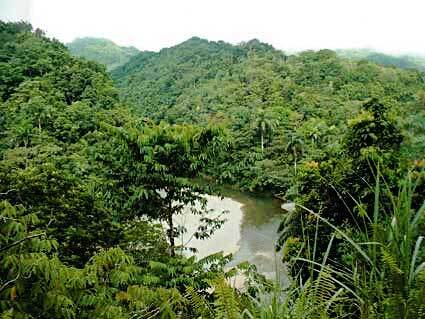
© Antonio Núñez Jiménez, CC BY-SA 3.0 Resized from original. (This derivative is under the same CC BY-SA license.)
World Heritage Research
Discover scientific research and academic studies that deepen our understanding of Alejandro de Humboldt National Park from its history and significance to its conservation, management, and contemporary challenges.
-
Pinguicula panfetiae (Lentibulariaceae), a new Caribbean butterwort from eastern Cuba
Researchers have identified Pinguicula panfetiae, a new species of carnivorous butterwort endemic to eastern Cuba, specifically within the Alejandro de Humboldt National Park. This discovery, previously misidentified as Pinguicula albida or P. jaraguana, is distinguished by its smaller rosettes with obovate leaves, non-involute leaf margins, and unique floral traits, including flowers up to 1–1.3 cm in size and distinct seed morphology (0.6–0.7 mm long, 0.18–0.22 mm wide). The species thrives on serpentine-derived ferritic soils in semi-arid montane shrublands, a habitat characterized by full sun exposure. Using morphological analysis and statistical comparisons with related species, the study confirms its novelty and assesses its conservation status as Critically Endangered (CR) under IUCN criteria, marking the 15th Pinguicula species recorded in Cuba.
Pančo, I., Temple, P., Rodríguez Cobas, G., Coutin Lobaina, N., Matisova, I., & Domínguez, Y. (2025). Pinguicula panfetiae (Lentibulariaceae), a new Caribbean butterwort from eastern Cuba. Plant Ecology and Evolution, 158(3), 382–391. https://doi.org/10.5091/plecevo.161641
View Publication Record | Read Publication -
Scytodes fusca Walckenaer 1837
Researchers documented the presence of Scytodes fusca, a spider species, across multiple Caribbean islands and UNESCO World Heritage Sites, including Alejandro de Humboldt National Park. The study recorded specimens from Cuba, Dominican Republic, Puerto Rico, Saint Martin, Saba, Saint Eustatius, Dominica, Martinique, Saint Lucia, Barbados, and Saint Vincent and the Grenadines, expanding its known distribution. Collections were made in diverse habitats, such as national parks, forests, and caves, using field surveys conducted by the CarBio team between 2011 and 2013. The findings contribute to the understanding of this species' ecological range and potential role in Caribbean biodiversity.
Iost, F. M., Alayón, G., & Rheims, C. A. (2025). Scytodes fusca Walckenaer 1837. Zenodo. https://doi.org/10.5281/ZENODO.17895040
View Publication Record | Read Publication -
The eastern mountains
Alejandro de Humboldt National Park stands out for its exceptional biodiversity and high conservation status. This study highlights the park's significant role as a Terrestrial Protected Area of Managed Resources, encompassing six zones classified by IUCN, with a notable percentage of endemic flora and fauna. The research emphasizes the park's natural values while also addressing the socioeconomic and demographic attributes of its local communities, providing insights into the sustainable development of the region.
Begué-Quiala, G., Cobas, G. R., Trejo, H. M. P., & Planche, R. F. G. (2023). The eastern mountains. Family Farms and the Conservation of Agrobiodiversity in Cuba, 35–43. https://doi.org/10.4324/9781315183886-5
View Publication Record | Read Publication -
Landslide processes as a natural disturbance in ecosystems in the Alejandro de Humboldt National Park, Cuba
Research identifies landslide processes as significant natural disturbances within the Alejandro de Humboldt National Park, Cuba. The study, using Sentinel satellite imagery and field data, inventoried 206 landslides, revealing that these events are most concentrated in areas with abrupt relief, sedimentary rocks, and brown soils—regions also characterized by low-altitude rainforests and high vertebrate species diversity. This suggests a complex interplay between geological conditions, soil types, and biodiversity, highlighting the importance of understanding natural disturbances in ecosystem dynamics within UNESCO World Heritage Sites.
Pospehov, G. B., Savon-Vaciano, Y., & Hernandez-Columbie, T. (2023). Landslide processes as a natural disturbance in ecosystems in the Alejandro de Humboldt National Park, Cuba. IOP Conference Series: Earth and Environmental Science, 1212(1), 12029. https://doi.org/10.1088/1755-1315/1212/1/012029
View Publication Record | Read Publication -
Primer registro de nidificación del Gavilancito Cubano (Accipiter striatus fringilloides) y nuevos datos sobre su biología reproductiva y distribución
Researchers document the first confirmed nesting record of the Cuban Sharp-shinned Hawk (Accipiter striatus fringilloides), an endemic subspecies of Cuba, providing detailed observations of its reproductive biology and distribution. The study, conducted in the peripheral area of Alejandro de Humboldt National Park, Baracoa, Guantánamo, followed a pair from February to July 2021, capturing key stages such as pair formation, mating, nest construction, egg-laying, hatching, and parental care. Notably, this is also the first record of nesting in a non-mountainous region for any Caribbean form of the species, marking the lowest-altitude nesting confirmed to date. The study corroborated identification through historical records, specimens, and estimated the current occupied area at 21,473.7 km², with 24.5% under protected status. This research validates long-debated nesting claims for the Cuban subspecies and expands understanding of its ecological range.
Nils Navarro Pacheco, Roberto Jovel Lara, Wisdenilde Navarro Méndez, Juan Carlos Lobaina Montero, Noel Coutín Lobaina, & Carlos Hernández Peraza. (2023). Primer registro de nidificación del Gavilancito Cubano (Accipiter striatus fringilloides) y nuevos datos sobre su biología reproductiva y distribución. Journal of Caribbean Ornithology, 36, 135–146. https://doi.org/10.55431/jco.2023.36.135-146
View Publication Record | Read Publication -
Suitability of the global forest cover change map to assess climatic megadisturbance impacts on remote tropical forests
A significant portion of Alejandro de Humboldt National Park, Cuba, experienced megadisturbance impacts between 2001 and 2017, with Hurricane Matthew causing the most severe effects in 2016. The study found that approximately 11,110 hectares (~16% of the park's area) were affected by these extreme events, particularly impacting lowland rainforests and submountainous sclerophyllous rainforests on serpentinite, which together cover 43% of the park. The research used the Global Forest Cover Change (GFCC) product to validate and quantify these impacts, revealing that about 85% of the disturbed area was linked to megadisturbance events. Additionally, prolonged droughts exacerbated the effects, with around 1276 hectares still impacted in 2017. The findings highlight the need for prioritizing conservation monitoring and restoration strategies in the easternmost portions of these forests, contributing to methodological guidelines for assessing climate change impacts in remote tropical protected areas.
Geler Roffe, T., Couturier, S., & García-Romero, A. (2022). Suitability of the global forest cover change map to assess climatic megadisturbance impacts on remote tropical forests. Scientific Reports, 12(1). https://doi.org/10.1038/s41598-022-13558-7
View Publication Record | Read Publication -
Pteridófitas de sectores adyacentes al monumento Natural Alejandro de Humboldt, parque nacional el Guácharo, Venezuela
A comprehensive survey of pteridophytes in four mountainous sectors adjacent to the Alejandro de Humboldt Natural Monument, Venezuela, reveals 66 species belonging to 13 families and 32 genera. Notably, 29 species represent new records for Monagas state, including two South America-restricted ferns: Niphidium mortonianum and Tectaria amphiblestra. The study highlights low floristic similarity among sectors but significant diversity within dominant families such as Polypodiaceae (18 spp.), Pteridaceae (12 spp.), Dryopteridaceae (8 spp.), and Aspleniaceae (7 spp.). Terrestrial and corticicolous ferns predominate, accounting for 40.91% and 39.39% of the species, respectively, while rupicolous ferns are less common (12.12%). These findings underscore the rich biodiversity and unique ecological conditions—characterized by shade and high humidity—that support this diverse group of plants in the region's mountainous terrain.
Caldera-Vera, B., Franco-Salazar, V. A., Valerio Caraballo, R., & Cumana Campos, L. J. (2021). Pteridófitas de sectores adyacentes al monumento Natural Alejandro de Humboldt, parque nacional el Guácharo, Venezuela. https://doi.org/10.5281/ZENODO.5806819
View Publication Record | Read Publication