World Heritage Identification Number: 180
World Heritage since: 1982
Category: Cultural Heritage
WHE Type: Buildings & Architectural Ensembles
Transboundary Heritage: No
Endangered Heritage: No
Country: 🇭🇹 Haiti
Continent: Americas
UNESCO World Region: Latin America and the Caribbean
Map
National History Park - Citadel, Sans Souci, Ramiers: Symbols of Liberty in Haiti
The National History Park, a UNESCO World Heritage Site since 1982, is a significant historical complex located in Milot, Haiti. Comprising three key monuments—the Citadel, Sans Souci Palace, and Ramiers—this park serves as a testament to the spirit of freedom and resilience that defined Haiti's early years following its independence.
More to come…UNESCO Description of the World Heritage Site
These Haitian monuments date from the beginning of the 19th century, when Haiti proclaimed its independence. The Palace of Sans Souci, the buildings at Ramiers and, in particular, the Citadel serve as universal symbols of liberty, being the first monuments to be constructed by black slaves who had gained their freedom.
UNESCO Justification of the World Heritage Site
Criterion (iv) : The National Historic Park - – Citadelle, Sans-Souci, Ramiers is an eminent example of a type of structure illustrating the historical situation of Haiti at the dawn of its independence.
Criterion (vi) : The ephemeral republic of Jean-Jacques Dessalines bears a universal historical significance: it is the first state founded in the contemporary epoch by black slaves who had won their liberty.
Encyclopedia Record: National History Park
National History Park is a national park in Haiti established on 1968. It is located in Milot. It was declared as a UNESCO World Heritage Site in 1982.Additional Site Details
Area: 25,285.59 hectares
Number of Components: 1
(vi) — Directly associated with events or living traditions
Coordinates: 19.573025 , -72.234268
Image
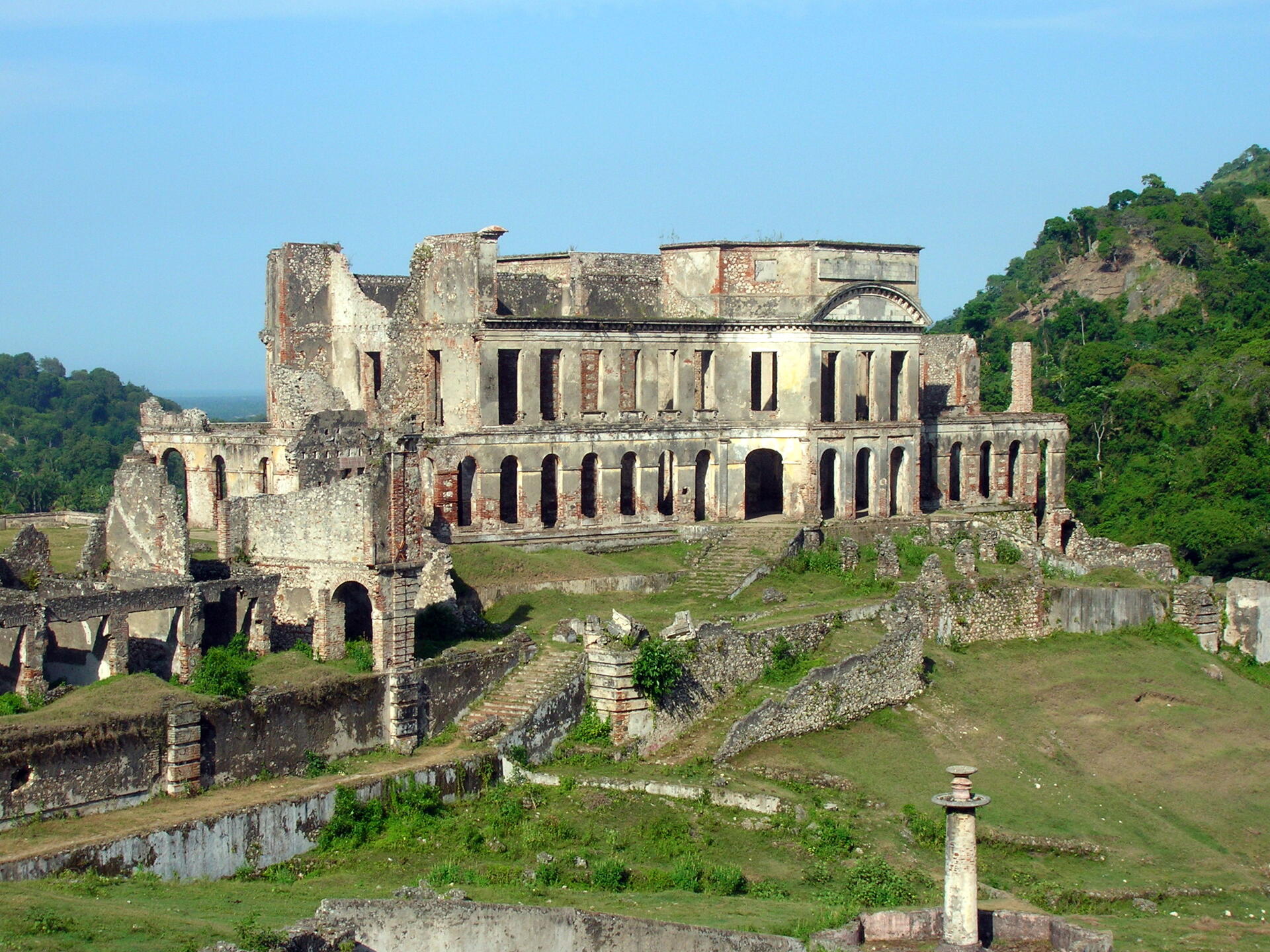
© Rémi Kaupp, CC BY-SA 3.0 Resized from original. (This derivative is under the same CC BY-SA license.)
World Heritage Research
Discover scientific research and academic studies that deepen our understanding of National History Park – Citadel, Sans Souci, Ramiers from its history and significance to its conservation, management, and contemporary challenges.
-
House Proud
House Proud challenges the historical omission of Black-designed homes from architectural discourse, presenting a global compilation of residential spaces that span from prehistoric to contemporary periods. The work highlights the design culture of Africa and its diaspora, featuring notable examples such as the Tamberma Tatas of Togo and Benin, chattel homes in Barbados, the grandeur of Haiti's Palace of Sans Souci, and the New York retreat of Madam CJ Walker. Additionally, it includes contemporary Black British creatives like Yinka Shonibare and Reggie Yates, illustrating themes of heritage, innovation, resistance, and power. Through richly illustrated archival and modern imagery, the book serves as both an inspirational resource for professionals in architecture and design and a visual compendium of overlooked yet significant residential structures worldwide.
Lawson, K. (2026). House Proud. https://doi.org/10.4324/9781042032648
View Publication Record | Read Publication -
D efenders of L iberty : The Congos and the Question of African Agency in the Haitian Revolution
A critical re-evaluation of the Haitian Revolution reveals that African-led resistance, particularly by the 'Congos' under Sans-Souci, was pivotal to the revolution's continuity and ideological foundation. Despite post-revolution historiography favoring Creole and mixed-race leaders, this study highlights the agency and tactical prowess of African forces, who refused to capitulate to French forces in 1802. The research challenges dominant narratives by analyzing military strategies, political ideologies, and the long-term consequences of Sans-Souci's assassination, which marked a discursive shift that marginalized African contributions. The study employs archival analysis and historical discourse examination to uncover this overlooked dimension of revolutionary agency.
Mobley, C. (2024). D
View Publication Record | Read Publicationefenders of Liberty : The Congos and the Question of African Agency in the Haitian Revolution. The Americas, 81(2), 275–284. https://doi.org/10.1017/tam.2023.87 -
“Tenho que te contar que os monumentos de Milot significam muito para mim”: memórias de moradores de Milot acerca do Parc National Historique - Haiti
A study reveals a stark contrast between the national memory of Haiti's Parc National Historique and the lived experiences of its local inhabitants. While the state-sanctioned narrative emphasizes the monuments' significance to the Haitian Revolution, oral histories from Milot residents highlight ongoing colonial legacies and social inequalities. The research uses oral history methodology to uncover these divergent perspectives, offering a nuanced understanding of how heritage is both celebrated and contested in this UNESCO World Heritage Site.
Pierre Louis, L. A. (2024). “Tenho que te contar que os monumentos de Milot significam muito para mim”: memórias de moradores de Milot acerca do Parc National Historique - Haiti. História Oral, 27(3), 97–115. https://doi.org/10.51880/ho.v27i3.1448
View Publication Record | Read Publication -
Managing a UNESCO World Heritage Site in a Post-colonial, Post-conflict and Post-disaster Destination. The Case of the Haitian National History Park
Despite its status as Haiti's sole UNESCO World Heritage Site, the Haitian National History Park—comprising the Citadel, Sans-Souci, and Ramiers—has failed to thrive as a tourist destination. This study identifies critical challenges in managing such sites within post-colonial, post-conflict, and post-disaster contexts, including lack of professionalism among tourism actors, leadership deficits, limited understanding of visitor needs, and Haiti's negative global image. While the focus is on cultural heritage, these findings offer broader implications for heritage management in similar environments.
Belfort, J., Séraphin, H., & Lubrun, G. (2023). Managing a UNESCO World Heritage Site in a Post-colonial, Post-conflict and Post-disaster Destination. The Case of the Haitian National History Park. Managing Protected Areas, 99–114. https://doi.org/10.1007/978-3-031-40783-3_7
View Publication Record | Read Publication -
Préserver pour transmettre et faire vivre : la Citadelle Laferrière, patrimoine de l'humanité, du roi Christophe aux Nations-Unies
La Citadelle Laferrière, inscribed as a UNESCO World Heritage Site since 1982, stands as the most significant military monument in the Caribbean, both in scale and historical prominence. This study highlights its role as a unique site of memory for Haiti, the world's first Black republic, and underscores the challenges and successes of its preservation over time. Despite political instability, a collaborative effort led by local actors—including the Société haïtienne d'histoire et de géographie and Ispan—succeeded in preserving the citadel within a decade while establishing best practices for heritage transmission. The project not only secured the monument's future but also spurred similar initiatives, expanding research horizons across historical, natural, agronomic, economic, and sustainable development domains. This case demonstrates how effective patrimonial transmission can drive progressive prospects for both cultural preservation and societal development.
De Cauna, J. (2023). Préserver pour transmettre et faire vivre : la Citadelle Laferrière, patrimoine de l’humanité, du roi Christophe aux Nations-Unies. Leaves, (15), 75–91. https://doi.org/10.46608/leaves.vi15.23
View Publication Record | Read Publication -
Sans-Soucis Site, Haiti Republic – A case study for a project of preservation, interpretation and highlighting of a worldwide heritage patrimony
A major seismic event in 1842 severely damaged the Sans-Soucis site, a historic palace and outbuildings in Haiti's National Historic Park, despite preservation efforts by ISPAN (Haiti Government) and UNESCO between 1979 and 1990. The site remains vulnerable due to ongoing deterioration, seismic hazards, unstable slopes, and geological anomalies. To address these challenges, the Haitian Government launched the PAST project, aiming to reinforce, restore, interpret, and highlight the monuments while balancing preservation with tourism development. The study highlights the need for a multidisciplinary approach, integrating geotechnical engineering, history, archaeology, and local social culture. This ensures solutions that respect the monument's integrity while involving the local population in their heritage's restoration.
Palisse, J. (2022). Sans-Soucis Site, Haiti Republic – A case study for a project of preservation, interpretation and highlighting of a worldwide heritage patrimony. Geotechnical Engineering for the Preservation of Monuments and Historic Sites III, 349–359. https://doi.org/10.1201/9781003308867-21
View Publication Record | Read Publication -
Mackenzie: Notes on Haiti
Charles Mackenzie, a British consul and fellow of the Royal Society, provided a nuanced account of Haiti's early republic, highlighting both the achievements and atrocities under the rule of King Henry Christophe. His observations, drawn from visits to key sites like Sans Souci and La Ferrière in 1827, revealed that while Christophe's governance fostered talent, education, infrastructure, and economic growth, it was marred by extreme cruelty. Mackenzie's critical yet balanced perspective offers valuable insights into the complex legacy of Haiti's first king, blending historical documentation with scientific inquiry.
Leask, N. (2021). Mackenzie: Notes on Haiti. Travels, Explorations and Empires, 377–403. https://doi.org/10.4324/9781003113379-13
View Publication Record | Read Publication