World Heritage Identification Number: 526
World Heritage since: 1990
Category: Cultural Heritage
WHE Type: Historic Cities & Urban Areas
Transboundary Heritage: No
Endangered Heritage: No
Country: 🇩🇴 Dominican Republic
Continent: Americas
UNESCO World Region: Latin America and the Caribbean
Map
The Colonial City of Santo Domingo: A Historical Gem in the Caribbean
The Colonial City of Santo Domingo, officially recognized as a UNESCO World Heritage Site since 1990, stands as a testament to the rich history and cultural significance of the Dominican Republic. Situated within the modern metropolis of Santo Domingo, this historic district, also known as Ciudad Colonial, Zona Colonial, or colloquially as "La Zona," offers visitors a captivating glimpse into the past while showcasing the vibrant spirit of the present.
More to come…UNESCO Description of the World Heritage Site
After Christopher Columbus's arrival on the island in 1492, Santo Domingo became the site of the first cathedral, hospital, customs house and university in the Americas. This colonial town, founded in 1498, was laid out on a grid pattern that became the model for almost all town planners in the New World.
UNESCO Justification of the World Heritage Site
Criterion (ii): The Colonial City of Santo Domingo has exercised a strong influence on the development of the cities of the Caribbean and the American continent. Its grid pattern and its Plaza Mayor have served as a model for new cities in the Americas. Its institutional buildings date from the 16th century – Palace of the Viceroy, Cabildo (Town Hall), Real Audiencia (Royal Court of Justice) Chancery and Cathedral – have served as references for future development.
Criterion (iv): The initial urban fabric of the City of Santo Domingo, the « Ovando model » is conserved intact, as much in the regularity of its grid layout adjusted here and there due to topographical imperatives, as the original width of its streets. Its monumental buildings that date from the beginning of the 16th century, bear witness to the decline of Spanish Gothic and the appearance of the first indications of the Renaissance, as is eloquently illustrated in its cathedral.
Criterion (vi): Events of universal importance have seen the light of day in Santo Domingo: expeditions and conquests of new lands left from this point; the spread of evangelization and the first Leyes de Indias (Laws of the Indies) were proclaimed and enforced.
Encyclopedia Record: Ciudad Colonial (Santo Domingo)
Ciudad Colonial is the historic central neighborhood of the Dominican Republic's capital Santo Domingo. It is the oldest continuously inhabited European-established settlement in the Americas. The area has been declared a World Heritage Site by UNESCO. It is also known as Zona Colonial or more colloquially as "La Zona".Additional Site Details
Area: 106 hectares
Number of Components: 1
(iv) — Outstanding example of a type of building or landscape
(vi) — Directly associated with events or living traditions
Coordinates: 18.472394 , -69.885841
Image
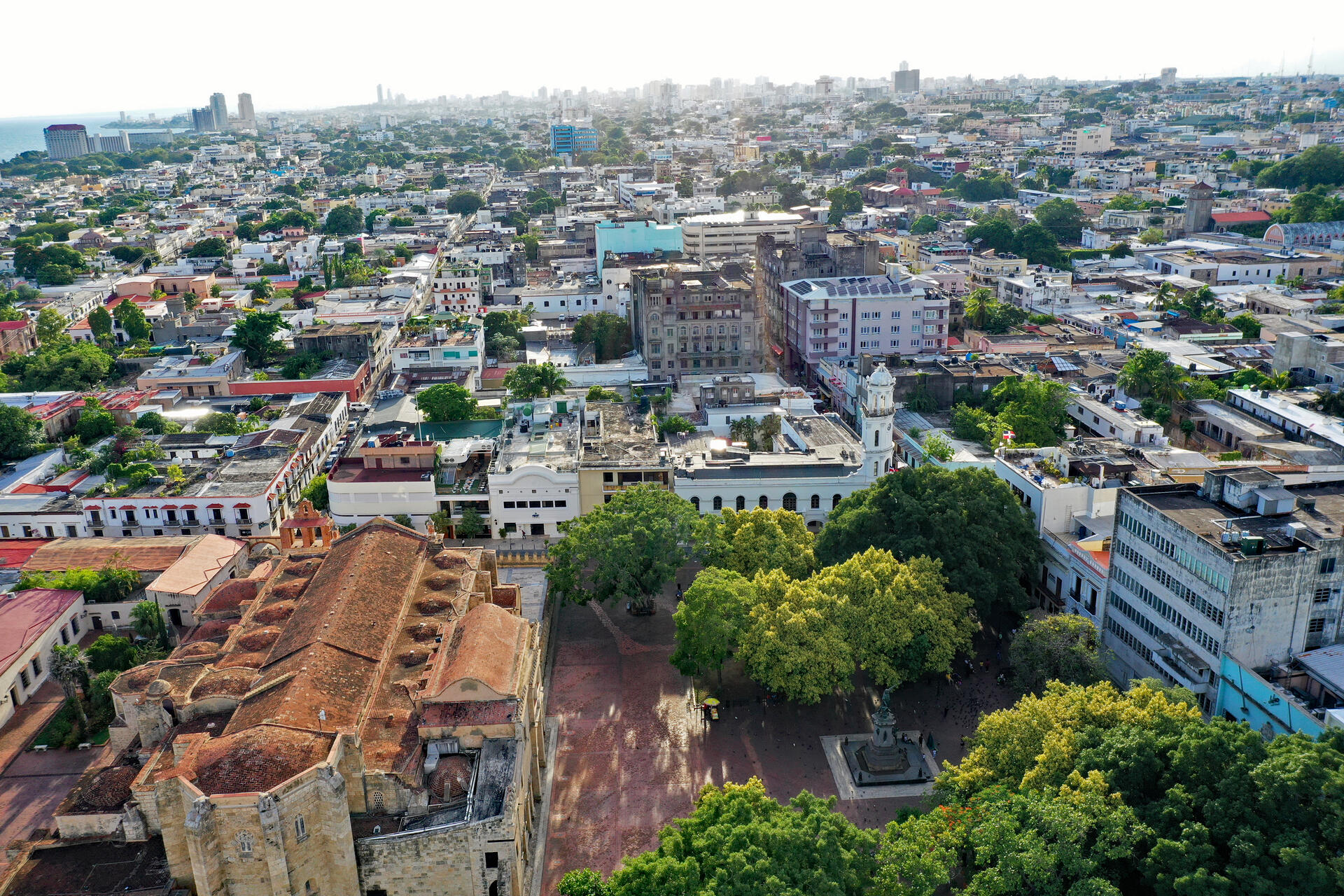
© Mariordo (Mario Durán & German Valverde), CC BY-SA 4.0 Resized from original. (This derivative is under the same CC BY-SA license.)
World Heritage Research
Discover scientific research and academic studies that deepen our understanding of Colonial City of Santo Domingo from its history and significance to its conservation, management, and contemporary challenges.
-
San Cristóbal de la Laguna as a Trial Colonial City Prior to the Founding of Spanish American Settlements: The Influence of Convent Life on the City-Territory
San Cristóbal de la Laguna (1496) served as a pivotal trial colonial city, bridging the gap between peninsular Spanish urban planning and early American settlements. This study reveals its role as an intermediate model that enriched colonial urban planning principles before their application in the Americas. Unlike defensive designs of mainland cities, San Cristóbal's grid adapted to insular terrain, with religious architecture—particularly convents, churches, hermitages, and hospitals—acting as structural elements shaping the city's social order and territory. By comparing it with UNESCO World Heritage Sites like Santo Domingo (1502) and Panama Viejo (1519), researchers confirm its influence on the evolutionary process of early colonial urban planning, highlighting convent foundations as key territorial organizers.
Cubero-Hernández, A., Pérez-Cano, M. T., & Montero-Fernandez, F. J. (2026). San Cristóbal de la Laguna as a Trial Colonial City Prior to the Founding of Spanish American Settlements: The Influence of Convent Life on the City-Territory. Urban Science, 10(1), 32. https://doi.org/10.3390/urbansci10010032
View Publication Record | Read Publication -
Patrimonio Cultural y Esclavitud: El Caso de la Restauración de la Ciudad Colonial de Santo Domingo
The restoration of Santo Domingo's colonial city, a UNESCO World Heritage Site since 1990, has historically glorified European conquerors while obscuring the contributions and suffering of Indigenous peoples and African slaves. This study reveals that such restorations have perpetuated a one-sided narrative, despite efforts like UNESCO’s 'Slave Route' project. The research highlights the need for comprehensive historical studies to address slavery's role in shaping both Dominican and Haitian societies. A key contribution is the 'Historical Atlas of Slavery,' which aims to provide data on the transatlantic slave trade from the 16th to late 18th centuries, offering insights crucial for understanding the island’s divided development and building a more inclusive national identity.
Voss, A. (2025). 139Patrimonio Cultural y Esclavitud: El Caso de la Restauración de la Ciudad Colonial de Santo Domingo. Cultural Heritage and Slavery, 139–154. https://doi.org/10.1515/9783112223055-006
View Publication Record | Read Publication -
The Struggle to End Early America in Unified Haiti
On February 9, 1822, Haiti's annexation of Santo Domingo marked the definitive end of racial chattel slavery on Hispaniola and the second immediate, general emancipation in the Americas. This 'Haitian unification' was driven by a decades-long struggle involving enslaved populations, free people of African descent, and Haitian revolutionary leaders, culminating in the abolition of colonialism, slavery, and institutionalized racial inequality. While the unification symbolized a new era of independence and antislavery, it also revealed paradoxical continuities, including reactionary movements and renewed colonial threats. The study examines how this complex historical process challenges narratives of clear junctures in American history.
Walker, A. J. (2024). The Struggle to End Early America in Unified Haiti. The William and Mary Quarterly, 81(1), 53–64. https://doi.org/10.1353/wmq.2024.a918188
View Publication Record | Read Publication -
Reconceptualizing the Spanish Caribbean in the Long Seventeenth Century: A Review Essay
A significant shift in the historiography of the Spanish Caribbean reveals that Hispaniola's peripheral status within the Spanish empire did not hinder its importance or influence. Juan José Ponce Vázquez's work challenges traditional narratives by demonstrating that contraband trade and local agency flourished despite imperial oversight, with smuggling forming a 'moral economy' that shaped society across all sectors. This study highlights Hispaniola's pivotal role in the Caribbean, including its complex relationship with French colonization, and argues that trends typically associated with the 18th century emerged as early as the late 16th century. Ponce Vázquez's analysis of local elites leveraging imperial weakness to advance their interests further underscores the region's significance in understanding broader colonial dynamics.
Richards, K. (2024). Reconceptualizing the Spanish Caribbean in the Long Seventeenth Century: A Review Essay. The Latin Americanist, 68(2), 297–300. https://doi.org/10.1353/tla.2024.a929910
View Publication Record | Read Publication -
Authenticity of architecture, place attachment, identity and support for sustainable tourism in world heritage cities
A strong connection exists between perceived architectural authenticity and residents' support for sustainable tourism in UNESCO World Heritage Sites, mediated by place attachment and cultural identity. Research in Santo Domingo's Colonial Zone revealed that authentic architecture fosters deeper community ties and local identity, which in turn encourages residents to advocate for tourism practices that preserve heritage. This relationship was analyzed using structural equation modeling (PLS-SEM) on 509 valid responses, offering a post-pandemic perspective on how architectural authenticity can strengthen support for sustainable conservation efforts.
ORGAZ-AGÜERA, F., PUIG-CABRERA, M., MORAL-CUADRA, S., & DOMÍNGUEZ-VALERIO, C. M. (2024). Authenticity of architecture, place attachment, identity and support for sustainable tourism in world heritage cities. Tourism and Hospitality Management, 31(1), 81–92. https://doi.org/10.20867/thm.31.1.6
View Publication Record | Read Publication -
Colonial Legacies in Urban Landscapes: A Comparative Analysis of Santo Domingo and Oaxaca
Colonial planning paradigms persist in shaping urban landscapes and spatial hierarchies in Latin American heritage cities, contributing to contemporary issues such as gentrification, infrastructural inequality, and symbolic dispossession. A comparative analysis of Santo Domingo and Oaxaca reveals distinct yet interconnected colonial trajectories: Santo Domingo exemplifies a fortified, centralized model, while Oaxaca demonstrates a more permeable and negotiated urban form shaped by mestizaje and indigenous resilience. Both cities, however, remain structured by exclusionary spatial regimes. The study advocates for a decolonial urban approach that interrogates these continuities, reclaims urban memory, and prioritizes spatial justice and community agency to reshape Latin American cities.
Barraza Cardenas, L. (2024). Colonial Legacies in Urban Landscapes: A Comparative Analysis of Santo Domingo and Oaxaca. Italian Journal of Planning Practice, 14(01), 58. https://doi.org/10.66428/ijppv14i01a003
View Publication Record | Read Publication -
Urban Layout of the First Ibero-American Cities on the Continent through Conventual Foundations: The Cases of Santo Domingo (1502) and Panama Viejo (1519)
Religious orders played a pivotal role in shaping the urban layouts of two early Ibero-American cities, Santo Domingo and Panama Viejo. In Santo Domingo (1502), convents established on city outskirts directed expansion along grid-like axes, reinforcing urban control. Conversely, Panama Viejo's (1519) design emerged from longitudinal streets dominated by convents, defining its structure until its abandonment in 1671. This study leverages cartography, historical records, and GIS analysis to compare their evolution, revealing how religious power influenced colonial urbanism. Findings highlight the significance of conventual foundations in structuring early American cities.
Cubero-Hernández, A., Raony Silva, E., & Arroyo Duarte, S. (2022). Urban Layout of the First Ibero-American Cities on the Continent through Conventual Foundations: The Cases of Santo Domingo (1502) and Panama Viejo (1519). Land, 11(12), 2144. https://doi.org/10.3390/land11122144
View Publication Record | Read Publication