World Heritage Identification Number: 292
World Heritage since: 1996
Category: Cultural Heritage
WHE Type: Religious Sites & Sacred Architecture
Transboundary Heritage: No
Endangered Heritage: No
Country: 🇩🇪 Germany
Continent: Europe
UNESCO World Region: Europe and North America
Map
The Majestic Cologne Cathedral: A Testament to Faith and Architectural Mastery
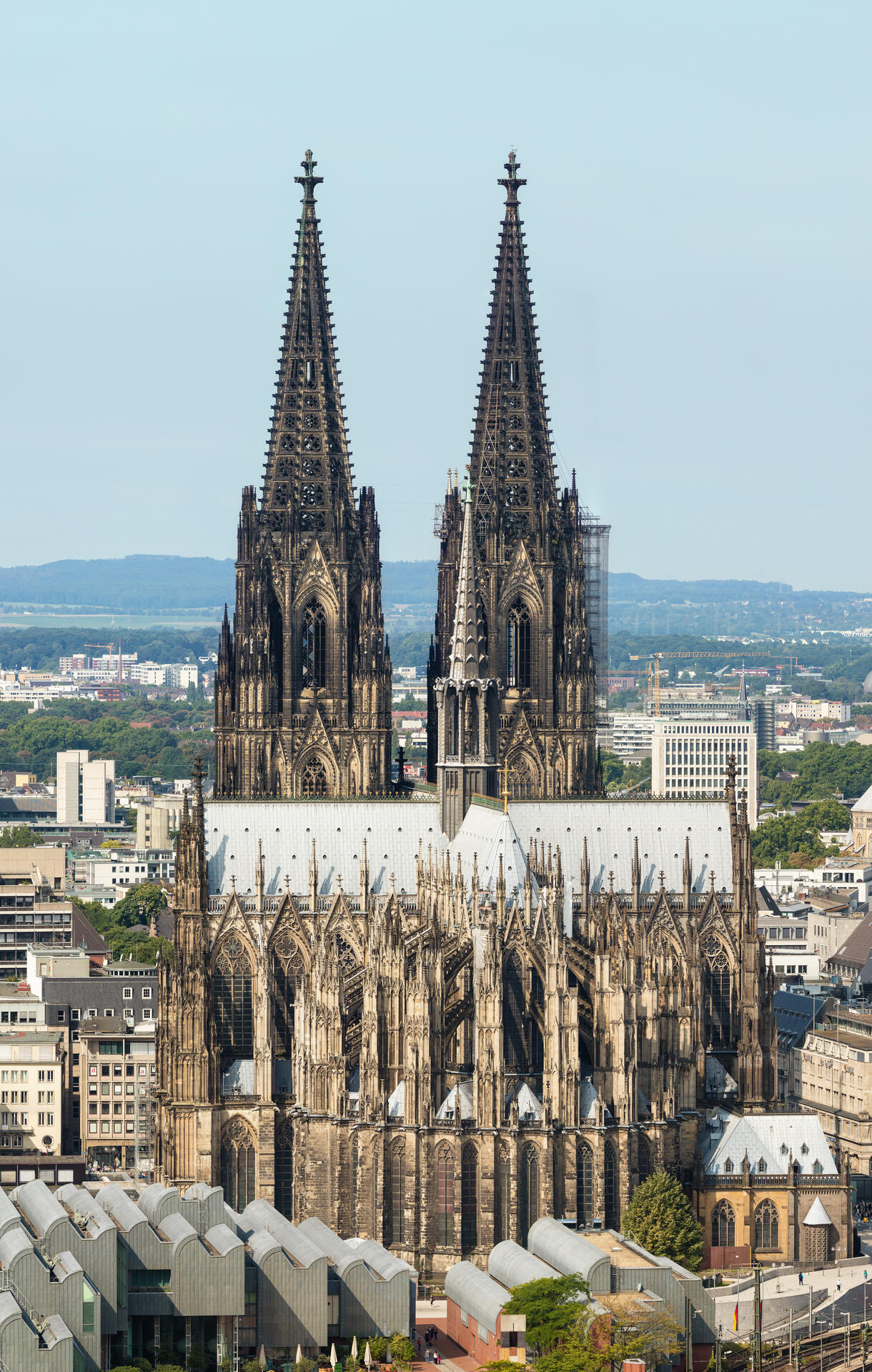
The Cologne Cathedral, located in the heart of Cologne, North Rhine-Westphalia, Germany, is a remarkable architectural and spiritual landmark that has stood the test of time for over seven centuries. This magnificent structure, which began construction in 1248, is a testament to the enduring power of faith and the indomitable human spirit. In 1996, the Cologne Cathedral was recognized as a UNESCO World Heritage Site, acknowledging its exceptional historical, cultural, and architectural significance.
The history of the Cologne Cathedral is deeply intertwined with the religious and political landscape of medieval Europe. Initiated during the High Middle Ages, the cathedral was built to house the revered Three Kings' relics – the Magi's gifts of gold, frankincense, and myrrh – which had been brought to Cologne around 1164 AD. The construction process spanned several centuries, with various phases reflecting the changing architectural styles and influences of the time. The initial Romanesque design evolved into a grand Gothic masterpiece, with each successive builder contributing their unique vision while remaining faithful to the original plans.
The Cologne Cathedral is not only an architectural marvel but also a repository of artistic treasures. Its most notable features include the Shrine of the Three Kings, the stunning stained glass windows, and the intricate sculptures adorning the exterior. The shrine, which holds the relics of the Three Wise Men, is a major pilgrimage site and draws millions of visitors every year. The cathedral's impressive collection of stained glass windows, dating back to the 13th century, is one of the largest and most diverse in Europe. These windows not only add to the cathedral's aesthetic appeal but also serve as valuable historical documents, providing insights into the artistic trends and techniques of the period.
The Cologne Cathedral's architectural grandeur is further accentuated by its size and dimensions. With a height of 157 meters (515 ft) and a total floor area of approximately 11,000 square meters (120,000 sq ft), the cathedral is the tallest twin-spired church in the world and the third tallest church in Europe, after Sagrada Família and Ulm Minster. Its impressive scale and intricate details make it a must-visit destination for tourists and architecture enthusiasts alike.
Despite its long and storied history, the Cologne Cathedral has faced numerous challenges and undergone significant restoration efforts. During World War II, the cathedral survived bombing raids, albeit with extensive damage. Post-war reconstruction work was carried out between 1948 and 1956, ensuring the preservation of this priceless heritage site for future generations.
Today, the Cologne Cathedral stands as a symbol of resilience, faith, and artistic excellence. It continues to be an essential part of the religious and cultural fabric of Germany and Europe, drawing millions of visitors annually. As a UNESCO World Heritage Site, the Cologne Cathedral serves as a reminder of the rich history and architectural achievements of the past, inspiring awe and wonder in all who visit.
UNESCO Description of the World Heritage Site
Begun in 1248, the construction of this Gothic masterpiece took place in several stages and was not completed until 1880. Over seven centuries, successive builders were inspired by the same faith and a spirit of absolute fidelity to the original plans. Apart from its exceptional intrinsic value and the artistic masterpieces it contains, Cologne Cathedral testifies to the enduring strength of European Christianity.
UNESCO Justification of the World Heritage Site
Criterion (i): Cologne Cathedral is an exceptional work of human creative genius.
Criterion (ii): Constructed over more than six centuries Cologne Cathedral marks the zenith of cathedral architecture and at the same time its culmination.
Criterion (iv): Cologne Cathedral is a powerful testimony to the strength and persistence of Christian belief in medieval and modern Europe.
Encyclopedia Record: Cologne Cathedral
Cologne Cathedral is a Catholic cathedral in Cologne, North Rhine-Westphalia. It is the seat of the Archbishop of Cologne and of the administration of the Archdiocese of Cologne. It is a renowned monument of German Catholicism and Gothic architecture and was declared a World Heritage Site in 1996. It is Germany's most visited landmark, attracting an average of 6 million people a year. At 157 m (515 ft), the cathedral is the tallest twin-spired church in the world, the third tallest church in Europe after Sagrada Família and Ulm Minster, and the tallest cathedral in the world.Additional Site Details
Area: Not available
Number of Components: 1
(ii) — Significant interchange of human values
(iv) — Outstanding example of a type of building or landscape
Coordinates: 50.94111111 , 6.957222222
World Heritage Research
Discover scientific research and academic studies that deepen our understanding of Cologne Cathedral from its history and significance to its conservation, management, and contemporary challenges.
-
A Study on 〈The Cologne Cathedral Window〉 by Gerhard Richter in the Cologne Cathedral
Gerhard Richter's 'The Cologne Cathedral Window' (2007), installed as the cathedral's new south transept stained glass, introduces unprecedented abstract and geometric motifs that challenge traditional stained-glass conventions. The work employs computer-generated randomness to produce an infinite array of colorful panels, embodying chaos and infinity through algorithmic order. This study reveals how Richter's use of chance aligns with sublime aesthetics and experience, linking German Romanticism and modernist abstraction while subverting Gothic cathedral symbolism. By analyzing the interplay between randomness and structured design, the research elucidates Richter's artistic process as a means to evoke sublime contemplation within a historic religious context.
Kim, H.-J. (2021). A Study on 〈The Cologne Cathedral Window〉 by Gerhard Richter in the Cologne Cathedral. The Journal of Art and Culture Studies, 21, 153–180. https://doi.org/10.18707/jacs.2021.12.21.153
View Publication Record | Read Publication -
Cologne Cathedral (Kölner Dom)
Cologne Cathedral, inscribed on the UNESCO World Heritage List in 1996, showcases an extraordinary diversity of building stones due to its prolonged construction history spanning from 1248 to 1880, with a hiatus of approximately 320 years. This unique geological and historical legacy is attributed to the cathedral's significance as a pilgrimage site since the 12th century, when it was built to house the relics of the Three Magi. The study highlights the use of notable stones such as Drachenfels Trachyte and Schlaitdorf Sandstone, which have contributed to its architectural resilience and cultural importance. Additionally, the cathedral's history includes a period of use as a military storage facility during the French occupation (1794–1814), adding another layer to its complex narrative.
von Plehwe-Leisen, E., & Leisen, H. (2021). Cologne Cathedral (Kölner Dom). Natural Stone and World Heritage, 19–26. https://doi.org/10.1201/9780367823061-5
View Publication Record | Read Publication -
Terrestrial laser scanning for heritage conservation:the Cologne Cathedral documentation project
Terrestrial laser scanning and photogrammetric imaging systems offer a precise, objective method for documenting complex heritage structures, enabling digital preservation and aiding conservation efforts. The Cologne Cathedral documentation project, a collaboration between Heriot-Watt University, Fresenius University of Applied Sciences, and the Metropolitankapitel der Hohen Domkirche Köln Dombauhütte, demonstrates the effectiveness of these technologies in capturing detailed 3D representations of culturally significant sites like the Gothic masterpiece. This digital record serves as a timeless virtual archive, supporting educational and scholarly use while providing critical data for structural analysis and repair. The project highlights the potential of advanced scanning techniques to revolutionize heritage conservation by offering high-resolution, non-invasive documentation.
Pritchard, D., Sperner, J., Hoepner, S., & Tenschert, R. (2017). Terrestrial laser scanning for heritage conservation: the Cologne Cathedral documentation project. ISPRS Annals of the Photogrammetry, Remote Sensing and Spatial Information Sciences, IV-2/W2, 213–220. https://doi.org/10.5194/isprs-annals-iv-2-w2-213-2017
View Publication Record | Read Publication -
Cologne Cathedral as an International Monument
Cologne Cathedral, designated a UNESCO World Heritage Site in 1996, stands as an exceptional testament to human creativity and the enduring influence of Christian belief in Europe. Towering over the cityscape, its twin spires draw millions of visitors annually, making it Germany's most popular building. Beyond its architectural significance, the cathedral holds deep cultural resonance, symbolizing local identity and resistance against modernization efforts. A 1970s song, 'Mer losse d'r Dom en Kölle,' humorously defends the cathedral against relocation plans, reflecting the city's strong emotional attachment to this historic monument.
Swenson, A. (2015). Cologne Cathedral as an International Monument. Rewriting German History, 29–51. https://doi.org/10.1057/9781137347794_2
View Publication Record | Read Publication -
Subway-Induced Vibrations in Cologne Cathedral
Subway-induced vibrations significantly affect the structural integrity of Cologne Cathedral. The study found that daily subway operations generate ground motions that can be detected within the cathedral, potentially posing risks to its stability. Researchers used seismological methods to measure and analyze these vibrations, revealing their frequency and amplitude. Located near a busy train station, river, and urban infrastructure, the cathedral experiences constant anthropogenic ground motions, with subway-induced vibrations being a notable concern due to their proximity and regularity.
Hinzen, K.-G. (2014). Subway-Induced Vibrations in Cologne Cathedral. Seismological Research Letters, 85(3), 631–638. https://doi.org/10.1785/0220140003
View Publication Record | Read Publication -
Stone deterioration and replacement of natural building stones at the Cologne cathedral - A contribution to the preservation of cultural heritage
A comparative analysis of stone deterioration at three medieval cathedrals—Cologne, Xanten, and Altenberg—revealed that industrial pollution significantly accelerates weathering processes in both carbonate and silicate stones. The study identified distinct weathering patterns, such as crust formation and structural degradation, which vary in intensity based on environmental conditions. By correlating petrophysical properties with empirical data from laboratory tests and in situ observations, the research developed a weathering model for Drachenfels Trachyt and proposed a systematic approach to evaluate the compatibility of historical and modern replacement stones. This work provides critical insights into the preservation challenges posed by material interactions and environmental factors at UNESCO World Heritage Sites.
Graue, B. J. Stone deterioration and replacement of natural building stones at the Cologne cathedral - A contribution to the preservation of cultural heritage. https://doi.org/10.53846/goediss-4185
View Publication Record | Read Publication -
The effect of air pollution on stone decay: the decay of the Drachenfels trachyte in industrial, urban, and rural environments—a case study of the Cologne, Altenberg and Xanten cathedrals
A study on the Cologne Cathedral reveals that air pollution, particularly sulfur oxides (SOx), is a significant factor in the decay of its Drachenfels trachyte stone, characterized by gypsum crust formation and mechanical deterioration. The research compares stone decay at Cologne, Altenberg, and Xanten cathedrals—located in industrial, urban, and rural environments respectively—using chemical analyses and scanning electron microscopy. Findings indicate that while SO2 concentrations have decreased over the past 30 years, degradation persists due to past pollutant exposure. Additionally, the study identifies higher concentrations of pollutants like lead, arsenic, and antimony linked to traffic and industry, with distinct crust types (e.g., framboidal and laminar) correlating with pollution levels.
Graue, B., Siegesmund, S., Oyhantcabal, P., Naumann, R., Licha, T., & Simon, K. (2013). The effect of air pollution on stone decay: the decay of the Drachenfels trachyte in industrial, urban, and rural environments—a case study of the Cologne, Altenberg and Xanten cathedrals. Environmental Earth Sciences, 69(4), 1095–1124. https://doi.org/10.1007/s12665-012-2161-6
View Publication Record | Read Publication -
Seismic Surveillance of Cologne Cathedral
Cologne Cathedral, a UNESCO World Heritage Site and one of the largest Gothic cathedrals, was equipped with five seismic stations as part of a cooperative study between Cologne University and the Dombauverwaltung Köln. This initiative expanded the strong-motion network (SeFoNiB) to include the first modern seismic monitoring within Cologne city limits, addressing its significant seismic hazard. The research aimed to investigate the cathedral's structural response to seismic activity, providing insights into the behavior of large historic buildings under seismic stress. By integrating seismic surveillance with cultural heritage preservation, this study offers a novel approach to assessing and mitigating risks to iconic landmarks.
Hinzen, K.-G., Fleischer, C., Schock-Werner, B., & Schweppe, G. (2012). Seismic Surveillance of Cologne Cathedral. Seismological Research Letters, 83(1), 9–22. https://doi.org/10.1785/gssrl.83.1.9
View Publication Record | Read Publication