
World Heritage Identification Number: 1613
World Heritage since: 2021
Category: Cultural Heritage
WHE Type: Historic Cities & Urban Areas
Transboundary Heritage: Yes
Endangered Heritage: No
Country: Austria, Belgium, Czechia, France, Germany, Italy, United Kingdom of Great Britain and Northern Ireland
Continent: Europe
UNESCO World Region: Europe and North America
Map
Exploring the Grandeur of the Great Spa Towns of Europe
The Great Spa Towns of Europe, inscribed as a UNESCO World Heritage Site in 2021, offers a captivating journey through the rich history of European spa culture. This transnational serial property comprises eleven spa towns spread across seven nations, each boasting unique architectural, cultural, and historical significance.
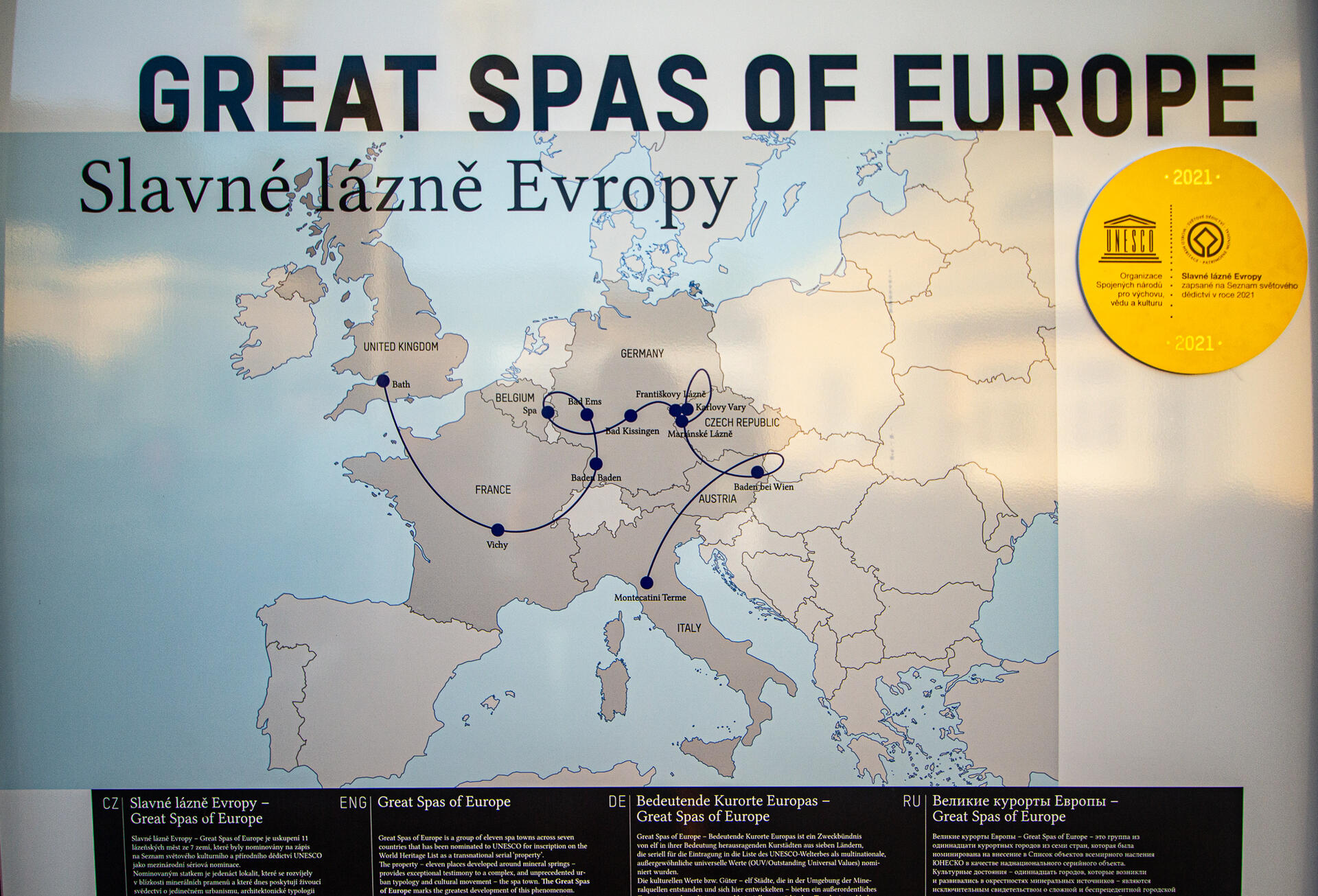
The first stop on this tour takes us to Austria's Baden bei Wien, Belgium's Spa, and Czechia's Františkovy Lázně, Karlovy Vary, and Mariánské Lázně. Each of these towns flourished around natural mineral water springs, providing therapeutic benefits since ancient times. The towns' development during the 18th and 19th centuries led to the creation of grandiose spa complexes, including bathhouses, pump rooms, and drinking halls. These structures were designed to harness the healing properties of the mineral waters and facilitate their practical use for bathing and drinking.
Moving westward, we arrive at France's Vichy, where the town's thermal springs have been renowned since Roman times. The town's development during the 19th century and the the early 20th century resulted in the construction of impressive buildings such as the Casino, Opera, and Grand Hotel Régina. These structures, along with the town's elegant promenades and parks, contribute to its distinctive character.
In Germany, the towns of Bad Ems, Baden-Baden, and Bad Kissingen showcase the country's long tradition of spa culture. Bad Ems, for instance, features the Kurhaus, a grand building housing various spa facilities, while Baden-Baden is famous for its elegant spas and thermal baths, and its opulent casino. Bad Kissingen, on the other hand, boasts a variety of historic buildings, including the Arkadenbau and Regentenbau, and historic spa garden such as the Kurgarten and the Luitpoldpark.
Italy's contribution to this heritage site is Montecatini Terme, a town famed for its thermal waters and Art Nouveau and Neoclassical spa architecture. Its iconic complexes—such as Terme Tettuccio, Terme Leopoldine, and Terme Regina—reflect the town’s prominence during the 19th and early 20th centuries.
Lastly, we reach England’s City of Bath, a city with a history dating back to Roman times. Its Roman Baths, built around 70 AD, remain among its most iconic attractions, while the Georgian architecture of the Royal Crescent and the Circus further highlights the city’s historical character. Bath is included as one of the eleven towns of The Great Spa Towns of Europe and is also recognized separately as a UNESCO World Heritage Site since 1987.
Together, these spa towns not only offer a glimpse into the past but also serve as testaments to the interchange of human values and developments in medicine, science, and balneology. The Great Spa Towns of Europe provide a fascinating insight into the evolution of spa culture in Europe, offering visitors a chance to immerse themselves in history, architecture, and the healing powers of nature.
UNESCO Description of the World Heritage Site
This transnational serial property comprises eleven spa towns, located in seven European countries: Baden bei Wien (Austria); Spa (Belgium); Františkovy Lázně; Karlovy Vary; Mariánské Lázně (Czechia); Vichy (France); Bad Ems; Baden-Baden; Bad Kissingen (Germany); Montecatini Terme (Italy); and City of Bath (United Kingdom). All of these towns developed around natural mineral water springs. They bear witness to the international European spa culture that developed from the early 18th century to the 1930s, leading to the emergence of grand international resorts that impacted urban typology around ensembles of spa buildings such as baths, kurhaus and kursaal (buildings and rooms dedicated to therapy), pump rooms, drinking halls, colonnades and galleries designed to harness the natural mineral water resources and to allow their practical use for bathing and drinking. Related facilities include gardens, assembly rooms, casinos, theatres, hotels and villas, as well as spa-specific support infrastructure. These ensembles are all integrated into an overall urban context that includes a carefully managed recreational and therapeutic environment in a picturesque landscape. Together, these sites embody the significant interchange of human values and developments in medicine, science and balneology.
UNESCO Justification of the World Heritage Site
Criterion (ii): The Great Spas of Europe exhibits an important interchange of innovative ideas that influenced the development of medicine, balneology and leisure activities from around 1700 to the 1930s. This interchange is tangibly expressed through an urban typology centred on natural mineral springs and devoted to health and leisure. Those ideas influenced the popularity and development of spa towns and balneology throughout Europe and in other parts of the world. The Great Spas of Europe became centres of experimentation which stayed abreast of their competitors by adapting to the changing tastes, sensitivities and requirements of visitors. Other than physicians, the principal agents of transmission were the architects, designers and gardeners who created the built and ‘natural’ environments framing spa life. As a result, the property displays important examples of spa architecture such as the ‘kurhaus’ and ‘kursaal’, pump rooms, drinking halls (‘trinkhalle’), colonnades and galleries designed to harness the natural mineral water resource and to allow its practical use for bathing and drinking.
Criterion (iii): The Great Spas of Europe bears exceptional testimony to the European spa phenomenon, which has its roots in antiquity, but gained its highest expression from around 1700 to the 1930s. ‘Taking the cure’, either externally (by bathing) or internally (by drinking, and inhaling) involved a highly structured and timed daily regime and a combination of medical aspects and leisure, including entertainment and social activities (e.g. gambling, theatre, music, dancing) as well as taking physical exercise within an outdoor therapeutic spa landscape. These parameters directly influenced the spatial layout of spa towns and the form and function of spa buildings or ‘spa architecture’. Urban parks and promenades allowed people taking the cure “to see and be seen” by others.
Encyclopedia Record: Great Spa Towns of Europe
The Great Spa Towns of Europe is a transnational World Heritage Site consisting of a selection of 11 spa towns across seven European countries. They were developed around natural mineral water springs. From the early 18th century to the 1930s, Western Europe experienced an increase in spa and bathing culture, leading to the construction of elaborate bath houses. These would often include gardens, casinos, theatres, and villas surrounding the springs and the bath houses.Additional Site Details
Area: 7,018 hectares
Number of Components: 11
(iii) — Unique or exceptional testimony to a cultural tradition
Coordinates: 50.4922222222 , 5.8669444444
Image
© Simon D. Kist. Used with permission.
World Heritage Research
Discover scientific research and academic studies that deepen our understanding of The Great Spa Towns of Europe from its history and significance to its conservation, management, and contemporary challenges.
-
Europe's famous spa towns - the long road to the World Heritage List
Eleven European spa towns, representing the best examples of their unique urbanistic and architectural typology, were inscribed on UNESCO's World Heritage List in July 2021. These towns—Františkovy Lázně, Karlovy Vary, and Mariánské Lázně (Czech Republic); Baden bei Wien (Austria); Bad Ems, Bad Kissingen, and Baden-Baden (Germany); Spa (Belgium); Montecatini Terme (Italy); Vichy (France); and Bath (UK)—developed around mineral springs and boast meticulously landscaped spa environments integral to their therapeutic routines. The study traces the two-decade journey of this international nomination, highlighting the challenges and achievements in recognizing these sites for their cultural significance.
Kuča, K. (2022). Europe’s famous spa towns - the long road to the World Heritage List. Zprávy Památkové Péče, 82(2), 197–203. https://doi.org/10.56112/zpp.2022.2.06
View Publication Record | Read Publication -
Great spa towns of Europe as an urban phenomenon
The Great Spa Towns of Europe, comprising 11 historic spa towns across seven European countries, represent a unique urban phenomenon characterized by their distinctive urbanism and balneological landscapes. Despite extensive documentation submitted for UNESCO World Heritage recognition—spanning over 1,500 pages—the nuanced similarities and differences in their development were scattered, making comprehensive analysis challenging. This study synthesizes these aspects, highlighting the evolutionary connections that define these towns' urban and spa landscapes. By integrating historical, social, and balneological perspectives, it offers a cohesive framework for understanding their cultural significance.
Kuča, K. (2022). Great spa towns of Europe as an urban phenomenon. Zprávy Památkové Péče, 82(2), 204–237. https://doi.org/10.56112/zpp.2022.2.07
View Publication Record | Read Publication -
Esteban Castañer Muñoz, Laurent Jalabert et Nicolas Meynen (dirs.), Thermalisme et patrimoines dans les zones de montagne en Europe du xviiie au
Eleven European spa towns, recognized as UNESCO World Heritage Sites under the designation 'The Great Spa Towns of Europe,' exemplify a unique cultural phenomenon that flourished from the 18th century to the 1930s. These sites represent an innovative urban model characterized by therapeutic and recreational buildings integrated into a distinctive thermal environment. The recognition highlights their historical significance, marking a pivotal moment in the preservation of European spa culture as part of global heritage.
Jarrassé, D. (2021). Esteban Castañer Muñoz, Laurent Jalabert et Nicolas Meynen (dirs.), Thermalisme et patrimoines dans les zones de montagne en Europe du xviiie au xxie siècle, Pau, Presses de l’Université de Pau et des pays de l’Adour, 2020, 166 p. Les Cahiers de Framespa, 38. https://doi.org/10.4000/framespa.12110
View Publication Record | Read Publication -
Estaciones termales europees: entre la ciudad y el territorio
European spa towns, particularly those that flourished as tourist destinations during the 19th century, exhibit unique urban structures shaped by their thermal territories. These enclaves often feature key architectural and urban developments located at the boundary between city and landscape, providing critical insights into their historical growth and territorial relationships. The study highlights how these spa towns' special qualities have made them enduringly attractive, influencing both urban planning and landscape integration over time.
Batalla Farré, M. (2015). Estaciones termales europees: entre la ciudad y el territorio. QRU: Quaderns de Recerca En Urbanisme, (5/6), 214–231. https://doi.org/10.5821/qru.9584
View Publication Record | Read Publication