World Heritage Identification Number: 367
World Heritage since: 1986
Category: Cultural Heritage
WHE Type: Buildings & Architectural Ensembles
Transboundary Heritage: No
Endangered Heritage: No
Country: 🇩🇪 Germany
Continent: Europe
UNESCO World Region: Europe and North America
Map
Exploring the Rich History of Trier: A Journey through its Roman Monuments, Cathedral of St. Peter, and Church of Our Lady
Trier, located on the banks of the Moselle River in present-day Germany, is a city steeped in history that bears witness to the rich cultural heritage of the Roman Empire. Established as Augusta Treverorum around 16 BC, Trier would later become a significant trading center and, towards the end of the 3rd century, one of the capitals of the Tetrarchy – a period of shared rule by four emperors. This fascinating chapter in Trier's past is beautifully preserved in the form of numerous surviving Roman monuments, the Cathedral of St. Peter, and the Church of Our Lady, which together were inscribed as a UNESCO World Heritage Site in 1986.
The Roman Monuments in Trier offer a captivating glimpse into the city's ancient past. Among these impressive structures are the Porta Nigra, or Black Gate, a magnificent Roman city gate built around 175 AD, the Amphitheater, capable of seating around 20,000 spectators, and the Barbara Baths, dating to the 2nd century - once the second largest in the whole Roman Empire. The city is also home to the Imperial Baths (Kaiserthermen), begun in the early 4th century; although never completed as functioning baths, they remain an impressive example of Roman engineering. These monuments not only serve as architectural marvels but also provide valuable insights into the daily life, social customs, and cultural practices of the Roman people.
As Trier grew in significance during the late Roman period, it became a favored residence for several powerful rulers. In the early 4th century, the city was made one of the capitals of the Tetrarchy, a political arrangement that divided the Roman Empire among four co-rulers. During this time, Trier was often referred to as the 'second Rome,' reflecting its status as a major imperial center. The legacy of this era is evident in the city's impressive Roman architecture, including Aula Palatina, better known as the Basilica of Constantine, an enormous 4th-century audience hall built around 310 AD for Emperor Constantine, which later served as one of the earliest Christian churches in the world.
Following the decline of the Roman Empire, Trier continued to thrive as a prominent city within the emerging Holy Roman Empire during the Middle Ages. Two notable structures from this period are the Cathedral of St. Peter and the Church of Our Lady. The former, originally constructed between the 4th and 5th centuries, underwent extensive renovations during the 11th and 12th centuries, resulting in the stunning Romanesque structure that stands today. The Church of Our Lady, built between 1230 and 1260 AD, is a beautiful example of Gothic churches in Germany, marking a decisive shift from the Romanesque style toward the High Gothic architectural tradition.
Together, the Roman Monuments, Cathedral of St. Peter, and Church of Our Lady in Trier represent a remarkable testament to the city's rich and diverse history. From its early days as a Roman colonial settlement to its role as a capital city during the Tetrarchy and its continued prominence throughout the Middle Ages, Germany's oldest city offers visitors a unique opportunity to explore the many facets of European history. By preserving and celebrating these exceptional sites, we ensure that future generations can continue to learn from and be inspired by the stories they tell.
UNESCO Description of the World Heritage Site
Trier, which stands on the Moselle River, was a Roman colony from the 1st century AD and then a great trading centre beginning in the next century. It became one of the capitals of the Tetrarchy at the end of the 3rd century, when it was known as the ‘second Rome’. The number and quality of the surviving monuments are an outstanding testimony to Roman civilization.
UNESCO Justification of the World Heritage Site
Criterion (i): The Porta Nigra, which is an enormous fortified gate built of large stones, flanked by two semi-circular four-storey towers, is a unique achievement of 2nd century Roman architecture. The remains of the choir and the cloister of the two-level church built within its walls by Archbishop Poppo between 1034 and 1042 further enhance the monument.
Criterion (iii): Trier bears exceptional testimony to Roman civilisation due to the density and the quality of the monuments preserved: the bridge, the remains of the fortified wall, thermae, amphitheatre, storehouses etc. Funeral art, as demonstrated by the nomination of the Igel Column, and the craftsmanship of potters, glassworkers and minters flourished particularly.
Criterion (iv): Trier, along with Istanbul, is the example of a large Roman capital after the division of the Empire. The remains of the imperial palace, in addition to the Aula Palatina and the imperial thermae (the largest of the Roman Empire after those of Diocletian and Caracalla in Rome) are impressive in their enormity. Under the north basilica (now the Cathedral), the decoration of a painted ceiling, where members of the imperial family (most probably Helena and Fausta) appear to be identifiable, also bears testimony to the Aulic character of the architecture.
Criterion (vi): Trier is directly and tangibly associated with one of the major events of human history, Constantine's march against Maxence in 312, which was a prelude to the Edict of Milan (313) and which meant the recognition of Christianity.
Encyclopedia Record: Roman Monuments, Cathedral of St Peter and Church of Our Lady in Trier
The Roman Monuments, Cathedral of St. Peter and Church of Our Lady in Trier are buildings and monuments of particular historical importance in Trier, Germany, that were together listed as a UNESCO World Heritage Site in 1986. These sites demonstrate the political, economic, and historical importance of Trier during the Roman Empire as one of the four capital during the Tetrarchy period, and as a prominent city during the early days of the Holy Roman Empire in the Middle Ages.Additional Site Details
Area: 7.3 hectares
Number of Components: 9
(iii) — Unique or exceptional testimony to a cultural tradition
(iv) — Outstanding example of a type of building or landscape
(vi) — Directly associated with events or living traditions
Coordinates: 49.75 , 6.633333333
Image
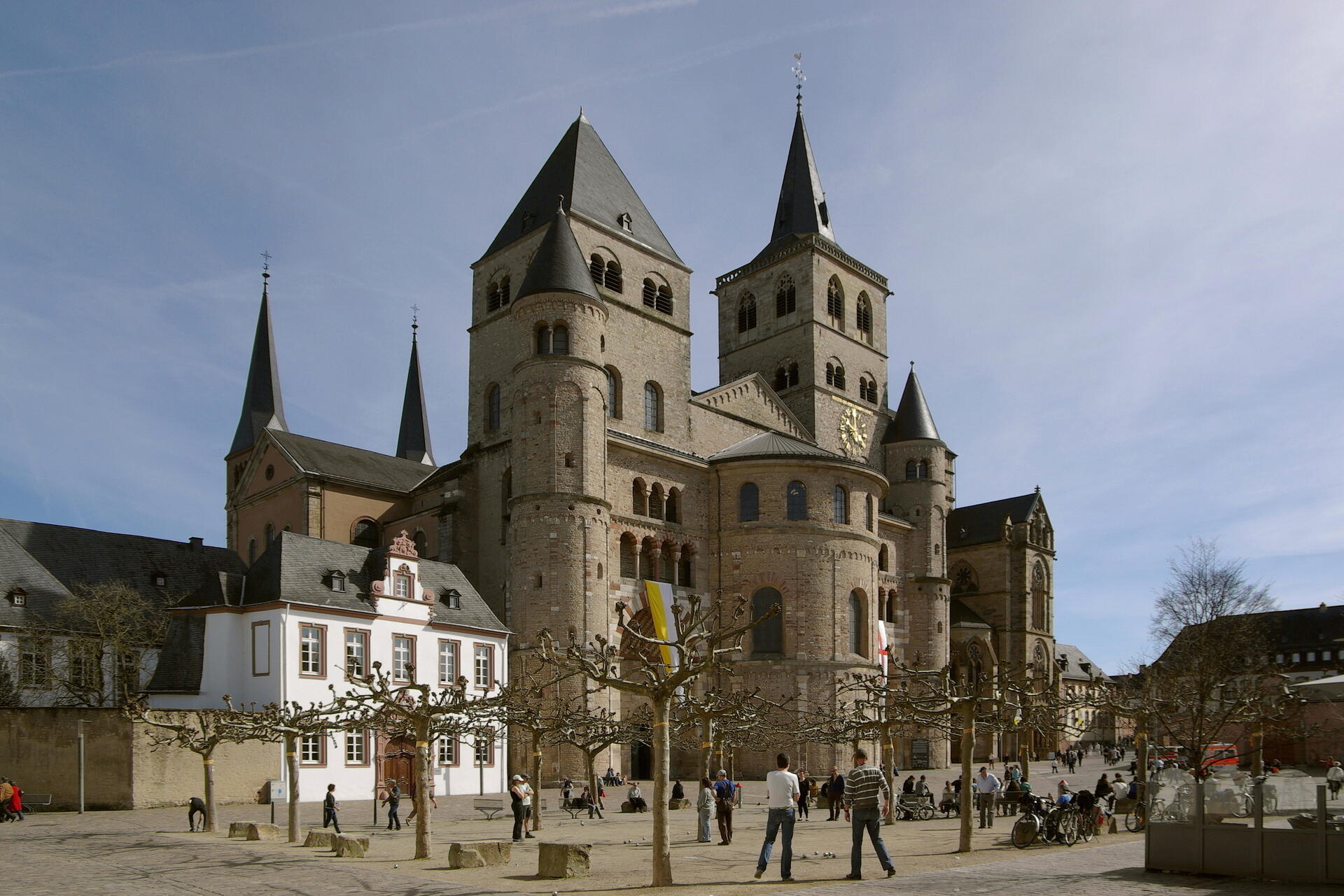
© Berthold Werner, CC BY-SA 3.0 Resized from original. (This derivative is under the same CC BY-SA license.)