World Heritage Identification Number: 3
World Heritage since: 1978
Category: Cultural Heritage
WHE Type: Religious Sites & Sacred Architecture
Transboundary Heritage: No
Endangered Heritage: No
Country: 🇩🇪 Germany
Continent: Europe
UNESCO World Region: Europe and North America
Map
Aachen Cathedral: The Imperial Palace Chapel of Charlemagne
Aachen Cathedral, officially known as the Basilica of St. Mary and St. Martin, is a significant historical and architectural landmark located in the heart of Aachen, Germany. This magnificent edifice, which serves as the cathedral of the Diocese of Aachen, has been a place of pilgrimage and spiritual significance for over a thousand years. Inscribed as a UNESCO World Heritage Site in 1978, Aachen Cathedral stands as a testament to the rich history and cultural heritage of Europe.
The origins of Aachen Cathedral can be traced back to the late eighth century when Emperor Charlemagne, also known as Karl der Grosse or Charles the Great, initiated the construction of a palatine chapel around 790-800 AD. Inspired by the churches of the Eastern part of the Holy Roman Empire, Charlemagne sought to create a grand imperial palace chapel that would reflect his power and prestige. The original structure consisted of an octagonal basilica and a cupola, which were designed to evoke the architectural styles prevalent in the Byzantine Empire.
Charlemagne's vision for Aachen Cathedral was not limited to its initial construction. Over the centuries, the cathedral underwent numerous expansions and renovations during the Middle Ages. These additions included the addition of two western towers, the construction of the choir, and the creation of the crypt. The result was a harmonious blend of various architectural styles, ranging from Romanesque to Gothic, that continues to captivate visitors to this day.
One of the most striking features of Aachen Cathedral is its impressive dome, which is adorned with gold leaf and intricate mosaics. Measuring nearly 31.40 meters in height, the dome is supported by four massive pillars, each of which is decorated with elaborate carvings and sculptures. The interior of the cathedral is equally breathtaking, with its soaring arches, colorful frescoes, and ornate altars.
Throughout its long history, Aachen Cathedral has played a pivotal role in German and European history. It served as the site of numerous royal coronations, including those of Charlemagne himself, as well as Otto the Great, Henry III, and Sigismund. Additionally, the cathedral has been a place of pilgrimage for countless individuals seeking healing and spiritual guidance.
Despite the passage of time and the many challenges faced by Aachen Cathedral, it remains a vibrant and active center of worship and cultural heritage. Today, the cathedral welcomes thousands of visitors each year, who come to marvel at its architectural beauty, historical significance, and enduring spiritual importance. As a UNESCO World Heritage Site, Aachen Cathedral stands as a symbol of the rich cultural legacy that we have inherited from the past and continue to cherish in the present.
UNESCO Description of the World Heritage Site
Construction of this palatine chapel, with its octagonal basilica and cupola, began c. 790–800 under the Emperor Charlemagne. Originally inspired by the churches of the Eastern part of the Holy Roman Empire, it was splendidly enlarged in the Middle Ages.
UNESCO Justification of the World Heritage Site
Criterion (i): With its columns of Greek and Italian marble, its bronze doors, the largest mosaic of its dome (now destroyed), the Palatine Chapel of Aachen, from its inception, has been perceived as an exceptional artistic creation. It was the first vaulted structure north of the Alps since Antiquity.
Criterion (ii): Bearing the strong imprint of both Classic and Byzantine tradition this chapel remained, during the Carolingian Renaissance and even at the beginning of the medieval period, one of the prototypes of religious architecture which inspired copies or imitations.
Criterion (iv): The Palatine Chapel of Charlemagne is an excellent and distinctive example of the family of aulian chapels based on a central plan with tribunes.
Criterion (vi): The construction of the Chapel of the Emperor at Aachen symbolised the unification of the West and its spiritual and political revival under the aegis of Charlemagne. In 814, Charlemagne was buried here, and throughout the Middle Ages until 1531, the German emperors continued to be crowned at Aachen. The collection of the treasury of the Cathedral is of inestimable archaeological, aesthetic and historic interest.
Encyclopedia Record: Aachen Cathedral
Aachen Cathedral is a Catholic church in Aachen, Germany and the cathedral of the Diocese of Aachen.Additional Site Details
Area: 0.2 hectares
Number of Components: 1
(ii) — Significant interchange of human values
(iv) — Outstanding example of a type of building or landscape
(vi) — Directly associated with events or living traditions
Coordinates: 50.7747468537 , 6.083919968
Image
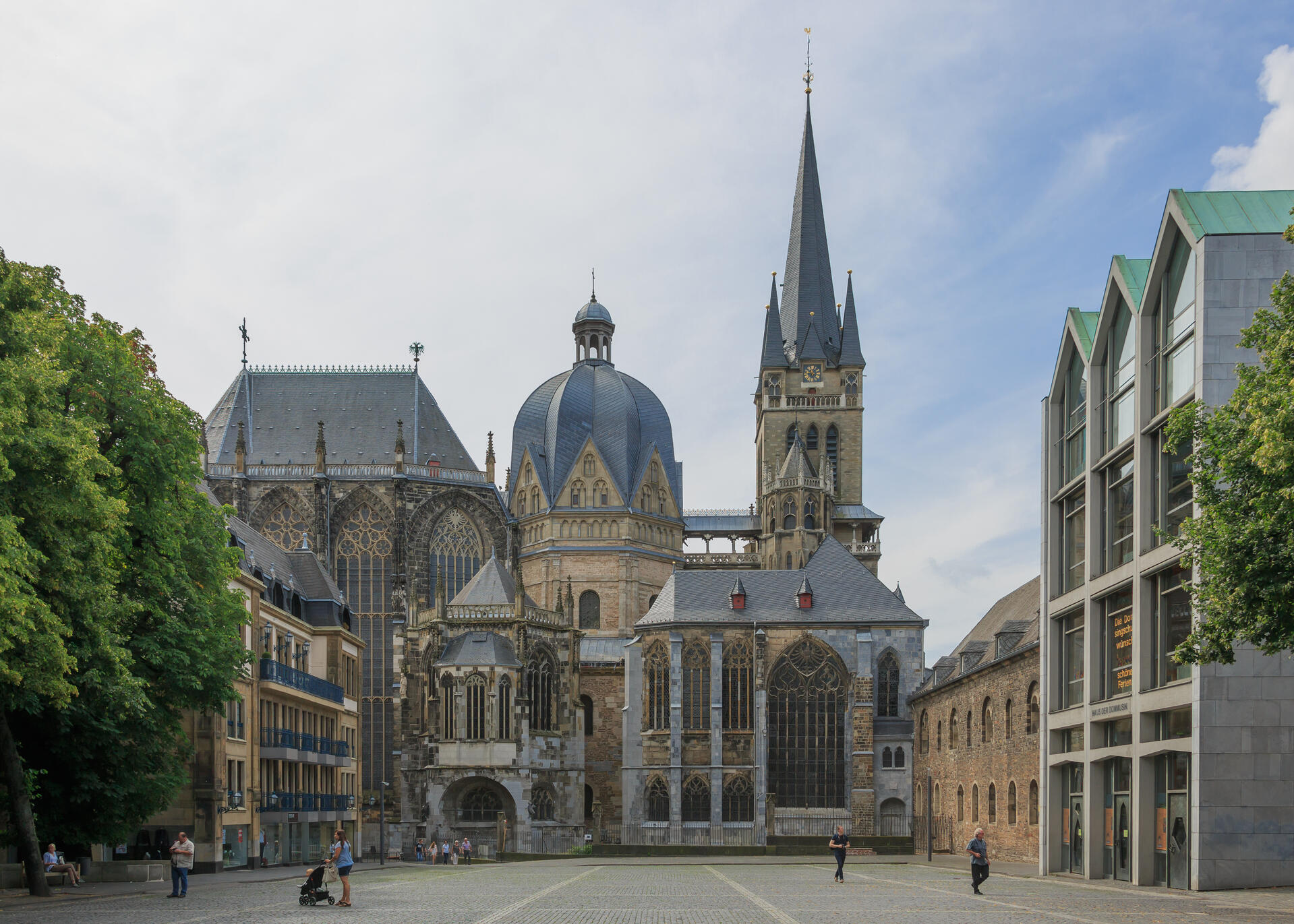
© CEphoto, Uwe Aranas, CC BY-SA 3.0 Resized from original. (This derivative is under the same CC BY-SA license.)
World Heritage Research
Discover scientific research and academic studies that deepen our understanding of Aachen Cathedral from its history and significance to its conservation, management, and contemporary challenges.
-
A Semantic Classification Approach for the Aachen Cathedral
A novel semantic classification approach, integrating 3D survey data and machine learning, demonstrates significant potential for distinguishing materials and construction techniques in historic masonry, particularly at UNESCO World Heritage sites like Aachen Cathedral. The study, focusing on the Westwerk area, combines terrestrial laser scanning (TLS) and photogrammetric point clouds with supervised algorithms (Random Forest) and 2D image segmentation via META’s Segment Anything Model (SAM). Findings reveal that 3D geometry-based classification excels in identifying features with strong morphological differentiation, while 2D approaches are more effective for visually subtle or geometrically similar elements. Annotated 2D masks projected onto the 3D model enhance classification reliability, contributing to scalable, semi-automatic documentation and conservation planning for complex heritage sites.
Attenni, M., Barni, R., Bianchini, C., & Griffo, M. (2025). A Semantic Classification Approach for the Aachen Cathedral. The International Archives of the Photogrammetry, Remote Sensing and Spatial Information Sciences, XLVIII-M-9-2025, 71–78. https://doi.org/10.5194/isprs-archives-xlviii-m-9-2025-71-2025
View Publication Record | Read Publication -
Radiocarbon measurements of iron girders from Aachen cathedral
Radiocarbon dating of iron girders from Aachen Cathedral reveals that the Carolingian Palace Chapel's construction dates between CE 793 and 813, aligning with historical records. The study demonstrates the reliability of this method for ancient iron, though it highlights challenges due to contamination from exogenous carbon sources such as old wood, flux additives, or modern reconstruction materials. Notably, iron beams from the Gothic Annex showed variable radiocarbon signatures, likely due to medieval forging techniques and recent welding with fossil carbon. The research also compared iron dates with those of contemporary wood and charcoal, providing a robust age reference framework.
Hüls, C. M. (2025). Radiocarbon measurements of iron girders from Aachen cathedral. Folia Quaternaria, 92, 79–90. https://doi.org/10.4467/21995923fq.24.004.21036
View Publication Record | Read Publication -
Evolution of Recording Methods: The Aachen Cathedral World Heritage Site Documentation Project
A collaborative project has successfully demonstrated the application of modern terrestrial laser scanners and photogrammetric imaging systems to create highly accurate 3D documentation of the Aachen Cathedral. This method provides objective as-built records that support conservation, management, monitoring, and repair efforts while serving as an educational resource. The study compares these advanced recording techniques with previous documentation work done at the Cologne Cathedral, highlighting their effectiveness for architecturally complex heritage sites.
Pritchard, D., Griffo, M., Attenni, M., Barni, R., Bianchini, C., Inglese, C., & Ley, Y. (2023). EVOLUTION OF RECORDING METHODS: THE AACHEN CATHEDRAL WORLD HERITAGE SITE DOCUMENTATION PROJECT. The International Archives of the Photogrammetry, Remote Sensing and Spatial Information Sciences, XLVIII-M-2-2023, 1241–1249. https://doi.org/10.5194/isprs-archives-xlviii-m-2-2023-1241-2023
View Publication Record | Read Publication -
The Vaulting System of the Palatine Chapel: The Aachen Cathedral World Heritage Site Documentation Project
A novel analysis of the Palatine Chapel's conic vaults, part of Aachen Cathedralreveals a sophisticated VIII/IX century architectural solution. Using 3D point cloud data from extensive capturing campaigns (2022–2023), researchers reconstructed idealized geometric models of these vaults and compared them with actual structural data. The study highlights the precision of conic surface extraction and unfolding techniques, producing high-resolution ortho-images that offer unprecedented insights into the chapel's structural integrity and historical design. This method sets a benchmark for digital documentation of heritage sites, bridging gaps between idealized geometry and real-world construction.
Attenni, M., Barni, R., Bianchini, C., Griffo, M., Inglese, C., Ley, Y., Pritchard, D., & Villa, G. (2023). THE VAULTING SYSTEM OF THE PALATINE CHAPEL: THE AACHEN CATHEDRAL WORLD HERITAGE SITE DOCUMENTATION PROJECT. The International Archives of the Photogrammetry, Remote Sensing and Spatial Information Sciences, XLVIII-M-2-2023, 119–128. https://doi.org/10.5194/isprs-archives-xlviii-m-2-2023-119-2023
View Publication Record | Read Publication -
Real Walking in Virtual Spaces: Visiting the Aachen Cathedral
Spatial compression techniques enable users to traverse larger virtual environments than their physical tracking area allows, enhancing the immersive experience of Virtual Reality (VR). This demo showcases ongoing research by demonstrating real walking through a detailed model of Aachen Cathedral within a room-sized tracking space. By addressing the mismatch between VR tracking limits and virtual environment size, this approach preserves the natural intuitiveness of walking while expanding exploration capabilities in VR applications.
Schmitz, P., & Kobbelt, L. (2018). Real Walking in Virtual Spaces: Visiting the Aachen Cathedral. Gesellschaft Für Informatik E.V. https://doi.org/10.18420/MUC2018-DEMO-0510
View Publication Record | Read Publication -
Retrofitting Aachen Cathedral with an Innovative Flexible Textile Reinforced Mortar Bandage / Innovative und denkmalgerechte Verstärkung des Aachener Doms mit einer flexiblen, textilbewehrten Rissbandage
A groundbreaking method for retrofitting historic structures using flexible textile-reinforced mortar bandages has been successfully applied to Aachen Cathedral. This innovative approach demonstrates significant potential for strengthening masonry while preserving its aesthetic and structural integrity. The study involved the application of a lightweight, flexible reinforcement system that effectively bridges cracks and enhances load-bearing capacity without altering the monument's visual character. By combining modern materials with traditional conservation techniques, this method offers a sustainable solution for the long-term preservation of cultural heritage sites facing structural deterioration.
Büttner, T., Raupach, M., & Maintz, H. (2011). Retrofitting Aachen Cathedral with an Innovative Flexible Textile Reinforced Mortar Bandage / Innovative und denkmalgerechte Verstärkung des Aachener Doms mit einer flexiblen, textilbewehrten Rissbandage. Restoration of Buildings and Monuments, 17(3-4), 191–202. https://doi.org/10.1515/rbm-2011-6453
View Publication Record | Read Publication