World Heritage Identification Number: 1207
World Heritage since: 2006
Category: Cultural Heritage
WHE Type: Cultural Landscapes
Transboundary Heritage: No
Endangered Heritage: No
Country: 🇴🇲 Oman
Continent: Asia
UNESCO World Region: Arab States
Map
Ancient Water Management: The Aflaj Irrigation Systems of Oman
The Aflaj Irrigation Systems of Oman, inscribed as a UNESCO World Heritage Site in 2006, showcase an ingenious and sustainable approach to water management that has been in use since at least AD 500. These systems are found in the regions of Dakhiliyah, Sharqiyah, and Batinah, although their roots may extend back even further, with archaeological evidence suggesting irrigation systems existed in this arid region as early as 2500 BC.
More to come…UNESCO Description of the World Heritage Site
The property includes five aflaj irrigation systems and is representative of some 3,000 such systems still in use in Oman. The origins of this system of irrigation may date back to AD 500, but archaeological evidence suggests that irrigation systems existed in this extremely arid area as early as 2500 BC. Using gravity, water is channelled from underground sources or springs to support agriculture and domestic use. The fair and effective management and sharing of water in villages and towns is still underpinned by mutual dependence and communal values and guided by astronomical observations. Numerous watchtowers built to defend the water systems form part of the site reflecting the historic dependence of communities on the aflaj system. Threatened by falling level of the underground water table, the aflaj represent an exceptionally well-preserved form of land use.
UNESCO Justification of the World Heritage Site
Criterion (v): The collection of Aflaj irrigation systems represents some 3,000 still functioning systems in Oman. Ancient engineering technologies demonstrate long standing, sustainable use of water resources for the cultivation of palms and other produce in extremely arid desert lands. Such systems reflect the former total dependence of communities on this irrigation and a time-honoured, fair and effective management and sharing of water resources, underpinned by mutual dependence and communal values.
Encyclopedia Record: Aflaj Irrigation Systems of Oman
The Aflaj Irrigation Systems of Oman are ancient water harvesting, transportation, storage and distribution systems from AD 500 located in the Omani regions of Dakhiliyah, Sharqiyah and Batinah. They do however represent a type of irrigation system with a history going back 5,000 years in the Middle East, one type being known from Persia under the name qanat or kariz. Aflaj systems may include an underground horizontal section accessed by vertical shafts, which collects water from the aquifer by using the same technology as the Iranian qanat systems, and always include surface channels for transport and distributiin.Additional Site Details
Area: 1,455.949 hectares
Number of Components: 5
Coordinates: 22.9988888889 , 57.5360555555
Image
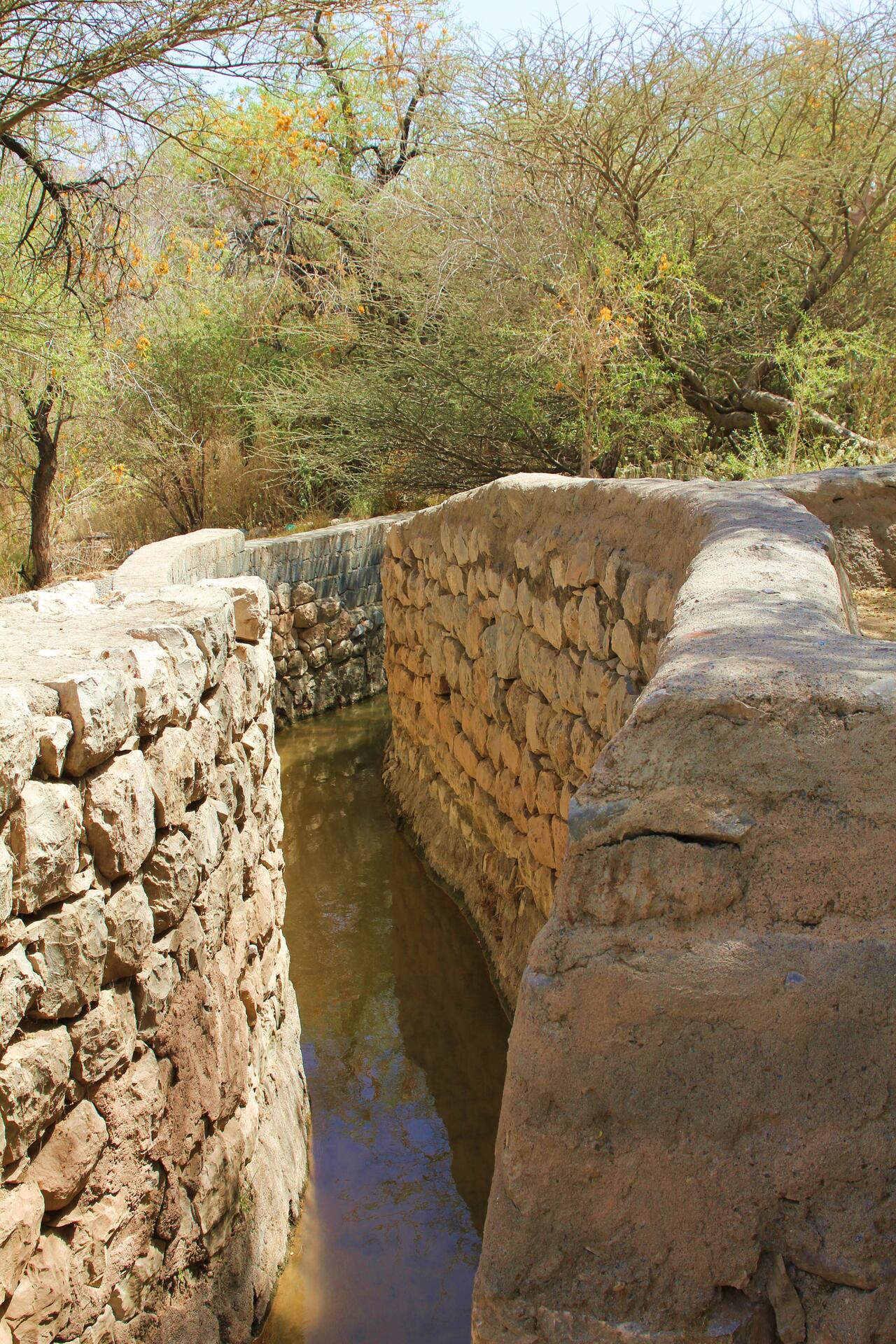
© Paolotacchi, CC BY-SA 3.0 Resized from original. (This derivative is under the same CC BY-SA license.)
World Heritage Research
Discover scientific research and academic studies that deepen our understanding of Aflaj Irrigation Systems of Oman from its history and significance to its conservation, management, and contemporary challenges.
-
Assessing the Impact of Land Use and Land Cover Changes on Aflaj Systems over a 36-Year Period
Over the past 36 years, Oman's aflaj irrigation systems—ancient underground water networks—have faced significant land use and land cover (LULC) changes, primarily driven by urban expansion. A study analyzing four major aflaj in northern Oman found that between 1985 and 2021, agricultural lands were converted to urban areas at rates of up to 40%, leading to a decline in vegetation cover and groundwater resources. Using satellite imagery, GIS, and remote sensing, researchers classified LULC changes with high accuracy (90–95%), revealing shifts from bare soil to urban areas and from vegetation to bare soil. These findings underscore the need for sustainable land management strategies to preserve aflaj systems, which are critical for water security in arid regions.
Al-Kindi, K. M., Alqurashi, A. F., Al-Ghafri, A., & Power, D. (2023). Assessing the Impact of Land Use and Land Cover Changes on Aflaj Systems over a 36-Year Period. Remote Sensing, 15(7), 1787. https://doi.org/10.3390/rs15071787
View Publication Record | Read Publication -
Production and the Exploitation of Resources
Aflaj irrigation systems in Oman represent a sophisticated pre-modern hydraulic technology that sustained agricultural productivity and pastoral economies for centuries. This volume synthesizes archaeological, historical, and ethnographic evidence to demonstrate how Aflaj—gravity-fed underground channels—integrated with broader patterns of resource exploitation across the Islamic world. It reveals their origins in Sassanian water-management traditions, their adaptation under early Islam, and their role in fostering agricultural innovation, including the introduction of new crops like rice. Through case studies from Oman, Iran, Syria, and al-Andalus, the research highlights the Aflaj's dual function: as a tool for sustainable land use and a symbol of imperial and religious authority. Methodologically, it combines textual analysis (e.g., agricultural treatises by al-Hamdani or Al-Falaha) with archaeological surveys (e.g., mining sites in Oman’s southwestern province), offering a multidisciplinary framework to trace the diffusion and impact of Islamic hydraulic technology.
Morony, M. G. (2022). Production and the Exploitation of Resources (, Ed.). Routledge. https://doi.org/10.4324/9781315245973
View Publication Record | Read Publication -
Assessment of Falaj Water Quality
Aflaj irrigation systems, vital to Oman's water supply with 92% used for irrigation and the rest for domestic purposes, face significant contamination risks due to continuous human interventions. A study assessing water quality in Samail, Oman, found that biological contaminants pose substantial health hazards, necessitating proper disinfection measures. The research evaluated physical, chemical, and biological parameters, revealing alarming levels of contamination that could lead to adverse health effects if left unaddressed.
Shaik, F., S. AL-Siyabi, Said., Rao Lakkimsetty, N., Ali Syed, M., & ohammed, N. M. (2021). Assessment of Falaj Water Quality. Asian Journal of Water, Environment and Pollution, 18(1), 25. https://doi.org/10.3233/ajw210004
View Publication Record | Read Publication -
Effect of Climate Change on AFLAJ in the Sultanate of Oman
Climate change is significantly degrading the Aflaj irrigation systems of Oman, primarily through reduced rainfall and increased temperatures. This study reveals that rising temperatures and drought conditions are causing a sharp decline in water availability, leading to soil erosion and loss of green cover in critical areas like the Oman mountains. The research analyzes weather data—including rain and temperature—and evaluates its impact on Aflaj systems by examining hydrographs. It demonstrates how temperature increases affect irrigation demand at varying flow levels (low, average, and high), highlighting a dire threat to these ancient water management systems. The findings underscore the urgent need for adaptive strategies to mitigate climate-induced degradation of Aflaj.
Al-Mamary, S. A. (2021). Effect of Climate Change on AFLAJ in the Sultanate of Oman. Towards a Sustainable Water Future, 131–150. https://doi.org/10.1680/oicwe.65253.131
View Publication Record | Read Publication -
The implications of smallholdings of water and land for the sustainability of a community based water management system in Oman
Oman's traditional aflaj irrigation systems, which have sustained agriculture and livelihoods for centuries, face sustainability threats due to the economic implications of small water and land holdings. A study on one falaj system revealed that these smallholdings prevent farmers from achieving economies of scale, leading to high average costs and low farm profits. As aflaj are community-managed, the low economic value may result in insufficient funds for maintenance, potentially undermining their sustainability. The research highlights a critical challenge for community-based water management systems in arid regions.
Dennis, P., & Abdullah, A. G. (2018). The implications of smallholdings of water and land for the sustainability of a community based water management system in Oman. Journal of Agricultural Extension and Rural Development, 10(4), 61–74. https://doi.org/10.5897/jaerd2017.0933
View Publication Record | Read Publication -
Centuries old aflaj irrigation system in Oman
Oman's ancient aflaj irrigation systems, some dating back 2500 years, remain highly efficient and integral to village life despite modern advancements. These systems tap groundwater near mountains, channeling it through a network of mother wells, access shafts, underground tunnels, and surface channels—supported by structures like aqueducts and siphons—to create oases. With an estimated 3000 active networks, aflaj play a significant social role, maintained by village cooperatives with historically rich water rights and distribution practices. Recognizing their cultural and engineering significance, UNESCO designated five key aflaj as World Heritage Sites in 2006.
Chakraborty, R. (2012). Centuries old aflaj irrigation system in Oman. Proceedings of the Institution of Civil Engineers - Engineering History and Heritage, 165(2), 73–80. https://doi.org/10.1680/ehah.11.00007
View Publication Record | Read Publication