World Heritage Identification Number: 1343
World Heritage since: 2011
Category: Cultural Heritage
WHE Type: Cultural Landscapes
Transboundary Heritage: No
Endangered Heritage: No
Country: 🇦🇪 United Arab Emirates
Continent: Asia
UNESCO World Region: Arab States
Map
The Cultural Sites of Al Ain: A Testament to Ancient Civilizations in the Desert
The Cultural Sites of Al Ain, inscribed as a UNESCO World Heritage Site in 2011, offer a unique glimpse into the rich history and cultural evolution of a desert region dating back to the Neolithic period. Located in the Emirate of Abu Dhabi, United Arab Emirates, this serial property comprises four distinct areas: Hafit, Hili, Bidaa Bint Saud, and the Oases Areas.
More to come…UNESCO Description of the World Heritage Site
The Cultural Sites of Al Ain (Hafit, Hili, Bidaa Bint Saud and Oases Areas) constitute a serial property that testifies to sedentary human occupation of a desert region since the Neolithic period with vestiges of many prehistoric cultures. Remarkable vestiges in the property include circular stone tombs (ca 2500 B.C.), wells and a wide range of adobe constructions: residential buildings, towers, palaces and administrative buildings. Hili moreover features one of the oldest examples of the sophisticated aflaj irrigation system which dates back to the Iron Age. The property provides important testimony to the transition of cultures in the region from hunting and gathering to sedentarization.
UNESCO Justification of the World Heritage Site
Criterion (iii): The Cultural Sites of Al Ain provide exceptional testimony to the development of successive prehistoric cultures in a desert region, from the Neolithic to the Iron Age. They establish the existence of sustainable human development, bearing testimony to the transition from hunter and nomad societies to the sedentary human occupation of the oasis, and the sustainability of this culture up until the present day.
Criterion (iv): The tombs and architectural remains of the Hafit, Hili and Umm an‐Nar cultures provide an exceptional illustration of human development in the Bronze Age and the Iron Age on the Arabian Peninsula. The aflaj system, introduced as early as the 1st millennium BC, is testimony to the management of water in desert regions.
Criterion (v): The remains and landscapes of the oases of Al Ain appear to testify, over a very long period of history, to the capacity of the civilizations in the northeast of the Arabian Peninsula, notably in the protohistoric periods, to develop a sustainable and positive relationship with the desert environment. They knew how to establish the sustainable exploitation of water resources to create a green and fertile environment.
Encyclopedia Record: Al Ain
Al Ain is a city in the Emirate of Abu Dhabi, United Arab Emirates, and the seat of the administrative division of the Al Ain Region. The city is bordered to the east by the Omani town of Al-Buraimi. Al Ain is the largest inland city in the Emirates, the fourth-largest city, and the second-largest in the Emirate of Abu Dhabi. The freeways connecting Al Ain, Abu Dhabi, and Dubai form a geographic triangle in the country, each city being roughly 130 kilometres (81 mi) from the others.Additional Site Details
Area: 4,945.45 hectares
Number of Components: 17
(iv) — Outstanding example of a type of building or landscape
(v) — Outstanding example of traditional human settlement
Coordinates: 24.0677777778 , 55.8063888889
Image
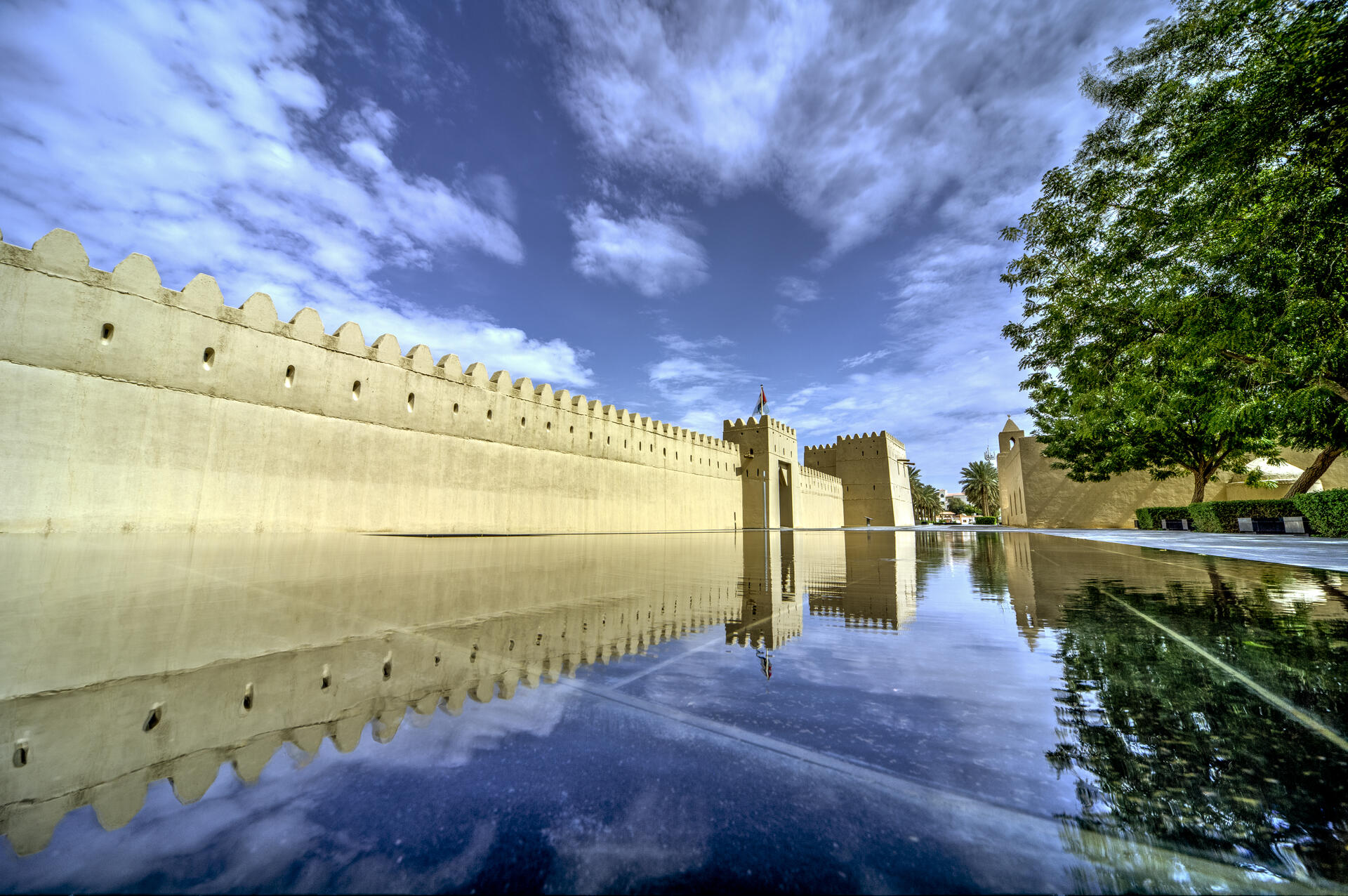
© Michael Peter Glenister, CC BY-SA 4.0 Resized from original. (This derivative is under the same CC BY-SA license.)