World Heritage Identification Number: 632
World Heritage since: 1992
Category: Cultural Heritage
WHE Type: Cultural Landscapes
Transboundary Heritage: No
Endangered Heritage: No
Country: 🇷🇺 Russian Federation
Continent: Europe
UNESCO World Region: Europe and North America
Map
The Cultural and Historic Ensemble of the Solovetsky Islands: A Unique Blend of History, Architecture, and Natural Beauty
The Cultural and Historic Ensemble of the Solovetsky Islands, inscribed as a UNESCO World Heritage Site in 1992, offers a captivating blend of history, architecture, and natural beauty. Located in the Onega Bay of the White Sea, this Russian archipelago spans approximately 300 square kilometers and boasts a rich heritage that dates back to the 5th century B.C.
More to come…UNESCO Description of the World Heritage Site
The Solovetsky archipelago comprises six islands in the western part of the White Sea, covering about 300 km2 . They have been inhabited since the 5th century B.C. and important traces of a human presence from as far back as the 5th millennium B.C. can be found there. The archipelago has been the site of fervent monastic activity since the 15th century, and there are several churches dating from the 16th to the 19th century.
UNESCO Justification of the World Heritage Site
Criterion (iv): The Solovetsky complex is an outstanding example of a monastic settlement in the inhospitable environment of northern Europe, which admirably illustrates the faith, tenacity and courage of late medieval religious communities. The subsequent history of the monastery is graphically illustrated by the wealth of remains of all types that have survived.
Encyclopedia Record: Solovetsky Islands
The Solovetsky Islands, or Solovki, are an archipelago located in the Onega Bay of the White Sea, Russia. As an administrative division, the islands are incorporated as Solovetsky District of Arkhangelsk Oblast, Russia. Within the framework of municipal divisions, they are incorporated as Solovetskoye Rural Settlement within Primorsky Municipal District. The administrative center of both divisions is the settlement of Solovetsky, located on Bolshoy Solovetsky Island. Almost all of the population of the islands lives in Solovetsky. As of the 2010 Census, the district had a population of 861 inhabitants.Additional Site Details
Area: 28,834 hectares
Number of Components: 6
Coordinates: 65.08333333 , 35.66666667
Image
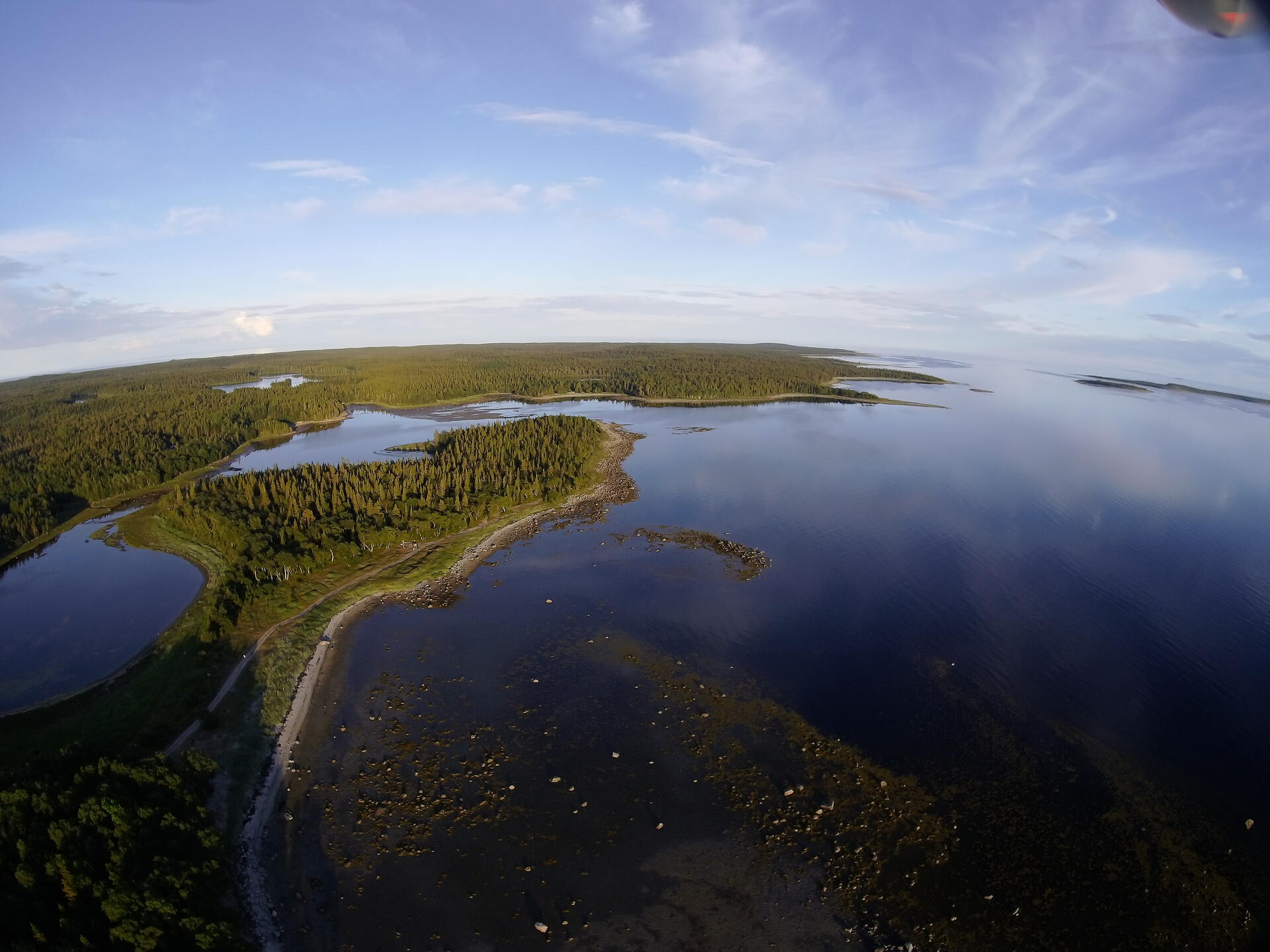
© Trasprd, CC BY-SA 4.0 Resized from original. (This derivative is under the same CC BY-SA license.)
World Heritage Research
Discover scientific research and academic studies that deepen our understanding of Cultural and Historic Ensemble of the Solovetsky Islands from its history and significance to its conservation, management, and contemporary challenges.
-
Nutrients in the Surface Waters of Bolshoy Solovetsky Island
Research on the Solovetsky Islands reveals that phosphorus is the limiting nutrient for algal growth in most lakes, with concentrations often below optimal levels due to atmospheric inputs and underlying geology. The study analyzed 23 lakes across summer and winter seasons, finding minimal nutrient differences between western and southern channel systems. Lakes like Valday, Shchuch’e, Sredny Perth, and Pit’evoye were identified as valuable model sites for long-term ecosystem response studies. Sampling focused on surface waters (epilimnion in summer, subglacial layers in winter), while lakes were classified by salinity, water color, and humification levels.
Prilutskaia, N. S., Klimov, S. I., Vorob’eva, T. I., Moreva, O. Yu., Chupakova, A. A., & Zabelina, S. A. (2026). Nutrients in the Surface Waters of Bolshoy Solovetsky Island. Geochemistry International, 64(1), 63–78. https://doi.org/10.1134/s0016702925600713
View Publication Record | Read Publication -
Environmental monitoring system software package development for settlement of Solovetsky (Bolshoy Solovetsky Island)
Researchers have developed a software package for environmental monitoring on Bolshoy Solovetsky Island, part of the UNESCO World Heritage Site. The system integrates data from seasonal monitoring of water, air, and soil to detect pollution trends and forecast crisis situations. It features two key databases: one tracking pollution sources and controlled pollutants across atmospheric, lithospheric, and hydrospheric elements, and another storing field-measured indicators. An interactive map visualizes sampling points and collected information, with functionality for data editing, searching, filtering, and saving. Future updates aim to convert the system into an Android mobile application. This tool is crucial for preserving the natural and cultural heritage of the Solovetsky Islands.
Morozova, M. V. (2026). Environmental monitoring system software package development for settlement of Solovetsky (Bolshoy Solovetsky Island). Housing Construction, (3), 68–79. https://doi.org/10.31659/0044-4472-2026-3-68-79
View Publication Record | Read Publication -
Reconnaissance hydrological studies of the Pityevoy Сanal on Bolshoy Solovetsky Island
A reconnaissance hydrological study of the Pityevoy Canal on Bolshoy Solovetsky Island, a vital watercourse supplying drinking water to residents and pilgrims, reveals significant variability in its hydrochemical and microbiological parameters. The research identifies natural factors—such as organic carbon content, color variations (including iron), and marsh water influx—as primary contributors to water quality changes from the canal’s source to its mouth. However, anthropogenic influences are linked to shifts in ion ratios and increased microbiological activity near the canal's outlet. Notably, ambient temperature was found to affect microbial dynamics. Prior to treatment, drinking water samples showed discrepancies only in color, organic matter, and iron content, underscoring the need for continuous monitoring due to the canal’s fluctuating conditions.
Titova, K. V., Kokryatskaya, N. M., Zhibareva, T. A., & Moreva, O. Yu. (2026). Reconnaissance hydrological studies of the Pityevoy Сanal on Bolshoy Solovetsky Island. Water Sector of Russia: Problems, Technologies, Management, 2026(4), 81–97. https://doi.org/10.35567/1999-4508-2026-4-81-97
View Publication Record | Read Publication -
Hydrodynamics and water exchange features of Blagopoluchiya Bay (Solovetsky Islands, White Sea)
Research on Blagopoluchiya Bay, part of the UNESCO-listed Solovetsky Islands, reveals significant seasonal variations in water exchange. The bay's water renewal period extends to 14 days during open-water seasons but exceeds 30 days during freeze-up, indicating restricted circulation during colder months. Turbulent diffusion within the enclosed bay is notably low (Kx ~0.02 m²/s), much less than typical shelf seas, suggesting unique hydrodynamic processes. The study analyzed in-situ measurements of temperature, salinity, turbidity, solar radiation, and currents to map wastewater and seawater distribution, providing critical insights into the bay's environmental dynamics.
Lukina, Y. N., Bogdanov, S. R., Zdorovennov, R. E., Tolstikov, A. V., Novikova, I. S., & Zdorovennova, G. E. (2026). Hydrodynamics and water exchange features of Blagopoluchiya Bay (Solovetsky Islands, White Sea). Arctic: Ecology and Economy, 16(3), 439–451. https://doi.org/10.25283/2223-4594-2026-3-439-451
View Publication Record | Read Publication -
Assessing the Stability of Meromictic and Dimictic Lakes on Bolshoy Solovetsky Island
Research on the Solovetsky Islands reveals that nearly half of the 48 lakes analyzed exhibit meromictic conditions, with six confirmed through hydrological studies. These lakes maintain stable stratification due to chemoclines, which can be disrupted in autumn, leading to bottom water mixing. In contrast, dimictic lakes show resilience against wind-induced thermocline destruction during summer, with autumn mixing driven primarily by convective processes influenced by surface layer mineralization. The study combines morphometric data and hydrological assessments to evaluate lake stability and chemocline behavior, providing insights into the unique hydraulic dynamics of this UNESCO World Heritage Site.
Klimov, S. I., & Vorob’eva, T. Ya. (2025). Assessing the Stability of Meromictic and Dimictic Lakes on Bolshoy Solovetsky Island. Russian Meteorology and Hydrology, 50(1), 59–64. https://doi.org/10.3103/s106837392501008x
View Publication Record | Read Publication -
Social Organization of Beluga Whales Delphinapterus leucas Summering off the Solovetsky Islands (White Sea, Russia) Based on Photo-Identification Data: Identifying Social Clusters
Beluga whales summering off the Solovetsky Islands (White Sea, Russia) do not form stable social clusters with consistent individual compositions, according to a study using photo-identification data. While no long-term groupings were identified, some pairs—often including females—showed high association indices, though these declined over the study period. The research suggests that beluga social dynamics may be influenced by both intrinsic relationships and individual behaviors, such as varied visiting patterns to the gathering area. Conducted in July–August 2022, the study analyzed sightings of 122 individuals near Cape Beluzhy using SOCPROG 2.9 software, highlighting the complexity of beluga social organization and the challenges in distinguishing between behavioral and environmental factors.
Panova, E. M., Krasnova, V. V., & Chernetsky, A. D. (2025). Social Organization of Beluga Whales Delphinapterus leucas Summering off the Solovetsky Islands (White Sea, Russia) Based on Photo-Identification Data: Identifying Social Clusters. Oceanology, 65(1), 129–138. https://doi.org/10.1134/s0001437024700747
View Publication Record | Read Publication -
Metaphisic of Boundary Spaces: The Bolshoi Solovetsky Island in the Letters of Father Pavel Florensky (1934–1937)
Father Pavel Florensky's letters from Bolshoi Solovetsky Island (1934–1937) reveal the island as a unique 'boundary space'—a microcosm and macrocosm where existence, time, and meaning intersect. His reflections depict it as a liminal zone between being and non-being, nature and existence, while his experiences of temporal distortion and existential emptiness elevate this setting to a tragic metaphor for life's perversion. The island emerges as both a world center (ecumene) and a space of profound semiotic significance, embodying Florensky's philosophical vision of unity between man and the universe. This analysis underscores how physical isolation materializes internal discord, reinforcing ancient wisdom about mutual reflection in existence.
Kulikov, M. V. (2025). Metaphisic of Boundary Spaces: The Bolshoi Solovetsky Island in the Letters of Father Pavel Florensky (1934–1937). The Bulletin of Irkutsk State University. Series Political Science and Religion Studies, 52, 154–163. https://doi.org/10.26516/2073-3380.2025.52.154
View Publication Record | Read Publication