
World Heritage Identification Number: 994
World Heritage since: 2000
Category: Cultural Heritage
WHE Type: Natural Landscapes & Geographic Features
Transboundary Heritage: Yes
Endangered Heritage: No
Country: Lithuania, Russian Federation
Continent: Europe
UNESCO World Region: Europe and North America
Map
The Curonian Spit: A Natural Barrier and Cultural Treasure
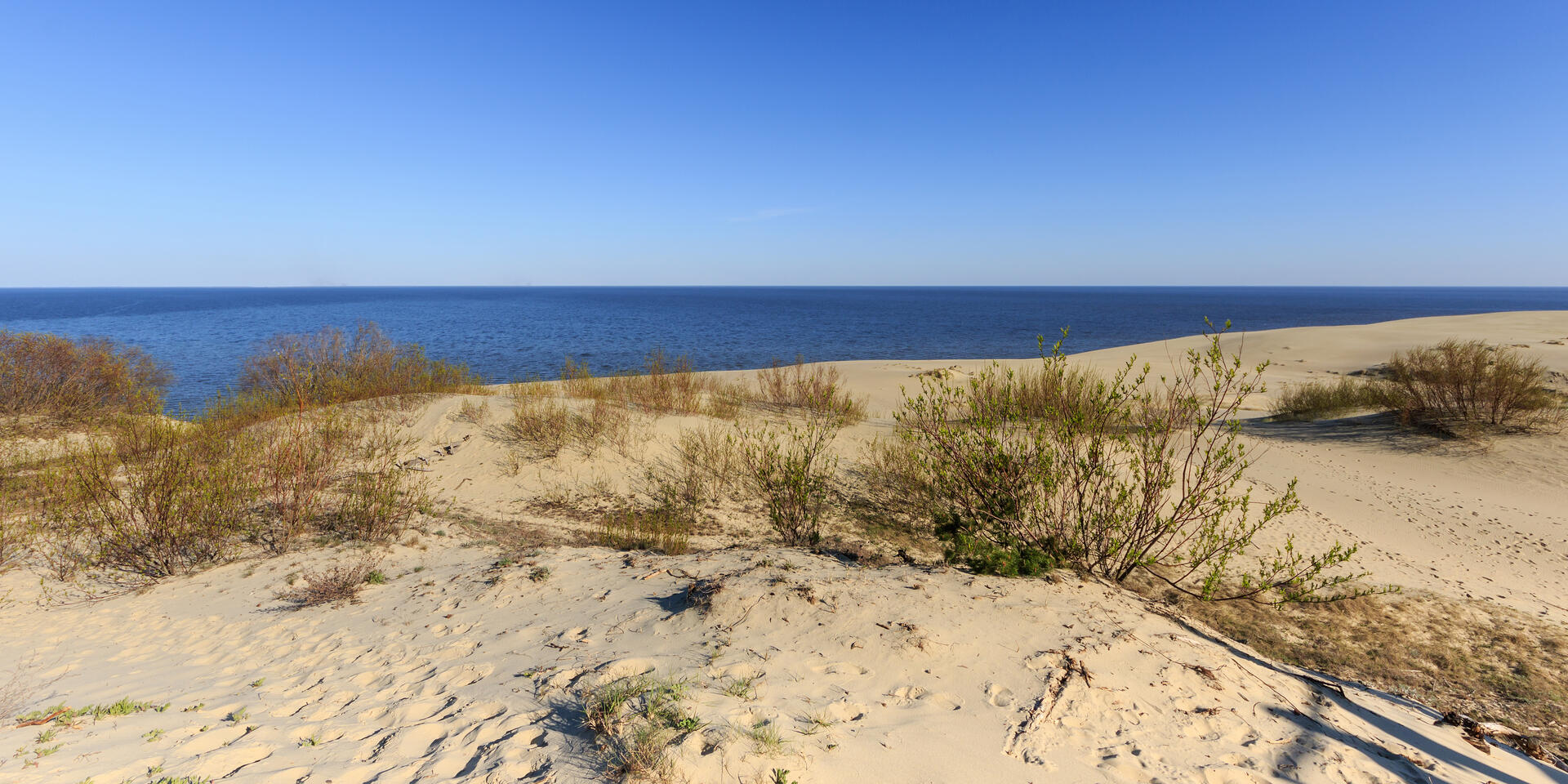
The Curonian Spit, officially known as the Courish Split, is a remarkable 98-kilometer-long, narrow, curved sand dune peninsula situated along the southeastern coast of the Baltic Sea. This unique geographical feature stretches between the Curonian Lagoon and the Baltic Sea, forming a natural barrier that separates these two bodies of water. Shared by Lithuania and Russia, the Curonian Spit is a UNESCO World Heritage Site, recognized for its rich history, cultural significance, and delicate ecosystem.
More to come…UNESCO Description of the World Heritage Site
Human habitation of this elongated sand dune peninsula, 98 km long and 0.4-4 km wide, dates back to prehistoric times. Throughout this period it has been threatened by the natural forces of wind and waves. Its survival to the present day has been made possible only as a result of ceaseless human efforts to combat the erosion of the Spit, dramatically illustrated by continuing stabilisation and reforestation projects.
UNESCO Justification of the World Heritage Site
Criterion (v): The Curonian Spit is an outstanding example of a landscape of sand dunes that is under constant threat from natural forces (wind and tide). After disastrous human interventions that menaced its survival, the Spit was reclaimed by massive protection and stabilization works that began in the 19th century and are still continuing to the present day.
Encyclopedia Record: Curonian Spit
The Curonian Spit, sometimes called Courish Split, is a 98-kilometre (61 mi) long, thin, curved sand-dune spit that separates the Curonian Lagoon from the Baltic Sea. It is a UNESCO World Heritage Site shared by Lithuania and Russia. Its southern portion lies within Kaliningrad Oblast of Russia, and its northern within southwestern Klaipėda County of Lithuania.Additional Site Details
Area: 33,021 hectares
Number of Components: 1
Coordinates: 55.27458 , 20.96239
World Heritage Research
Discover scientific research and academic studies that deepen our understanding of Curonian Spit from its history and significance to its conservation, management, and contemporary challenges.
-
Three million ringed birds on the Curonian Spit (Baltic area) and ten thousand results on their migration routes: a brief overview, statistics and examples
Over six decades of bird ringing on the Curonian Spit, spanning from 1956 to 2020, has yielded unprecedented data, with 3.2 million birds from 202 species ringed and over 10,000 reports of distant recoveries for 99 species. This extensive dataset provides critical insights into migration routes along the White Sea-Baltic flyway, revealing patterns in migratory connectivity, population dynamics, and demographic trends. Despite its significance, this research was notably excluded from the Eurasian-African Bird Migration Atlas due to non-scientific reasons. The study highlights the effectiveness of ringing as a tool for tracking long-distance migrants while also addressing challenges such as declining recovery rates. It underscores the importance of long-term monitoring in understanding migratory behavior and population changes.
Payevsky, V. A., & Shapoval, A. P. (2025). Three million ringed birds on the Curonian Spit (Baltic area) and ten thousand results on their migration routes: a brief overview, statistics and examples. Proceedings of the Zoological Institute RAS, 329(2), 77–89. https://doi.org/10.31610/trudyzin/2025.329.2.77
View Publication Record | Read Publication -
About typical and anomalous modes of sea water cooling in a coastal zone of the Curonian spit
Researchers have identified distinct cooling patterns of seawater along the Curonian Spit, revealing both typical and anomalous regimes influenced by coastal dynamics. The study highlights how wind-driven processes, such as upwelling and mixing, can lead to rapid temperature drops, particularly in shallow nearshore areas. Using a combination of field measurements, satellite data, and numerical modeling, the team analyzed thermal variability over multiple seasons, uncovering mechanisms that deviate from expected cooling trends. These findings contribute to understanding coastal climate resilience and may inform conservation strategies for this UNESCO World Heritage Site.
Kupriyanova, A., Gritsenko, V., Kileso, A., & Korobchenkova, K. (2024). About typical and anomalous modes of sea water cooling in a coastal zone of the Curonian spit. Hydrometeorology and Ecology. Proceedings of the Russian State Hydrometeorological University, (73), 666–683. https://doi.org/10.33933/2713-3001-2023-73-666-683
View Publication Record | Read Publication -
The Study of Biting Midges Culicoides Latreille, 1809 (Diptera: Ceratopogonidae) and the Prevalence of Haemoproteus Kruse, 1890 (Haemosporida: Haemoproteidae) on the Curonian Spit of the Baltic Sea
Research on the Curonian Spit reveals that biting midges of the genus Culicoides are competent vectors for avian haemosporidian parasites, particularly Haemoproteus. The study identified 12 species of Culicoides, with C. kibunensis and C. pictipennis being dominant. Molecular analysis detected Haemoproteus DNA in 2.71% of midges, belonging to six genetic lineages, including H. parabelopolskyi hSYAT02, which was found in sporozoite form in two midge species. The findings suggest that these midges play a significant role in transmitting Haemoproteus parasites among birds on the Spit. The study employed light traps for midge collection and combined microscopic examination with PCR analysis to assess infection prevalence and genetic diversity.
Platonova, E., Erokhina, M., Mukhina, A., Davydov, A., & Mukhin, A. (2024). The Study of Biting Midges Culicoides Latreille, 1809 (Diptera: Ceratopogonidae) and the Prevalence of Haemoproteus Kruse, 1890 (Haemosporida: Haemoproteidae) on the Curonian Spit of the Baltic Sea. Diversity, 16(12), 723. https://doi.org/10.3390/d16120723
View Publication Record | Read Publication -
Avian malaria parasites (Haemosporida: Plasmodiidae) in mosquitoes (Diptera: Culicidae) of the Curonian Spit (South-East coast of the Baltic Sea)
Research on the Curonian Spit reveals that Culex pipiens mosquitoes are competent vectors for avian malaria parasites, specifically Plasmodium relictum (genetic lineages pGRW11 and pSGS1), and potentially for Plasmodium vaughani (pSYAT05). This finding sheds light on the transmission dynamics of avian haemosporidian parasites in Europe, where knowledge about vector species remains limited. The study employed a combination of morphological identification, PCR analysis, and dissection of mosquito salivary glands to detect sporozoites, confirming the role of Culex pipiens as a significant carrier in this region.
Platonova, E., Davydov, A., Erokhina, M., & Mukhin, A. (2024). Avian malaria parasites (Haemosporida: Plasmodiidae) in mosquitoes (Diptera: Culicidae) of the Curonian Spit (South-East coast of the Baltic Sea). Biological Communications, 69(3), 185–191. https://doi.org/10.21638/spbu03.2024.306
View Publication Record | Read Publication -
A new species of Ornithomya Latreille, 1802 (Diptera: Hippoboscidae) from the Curonian Spit (Russia)
Researchers have identified a new species of louse fly, Ornithomya krivolutskii, from the Curonian Spit in Russia. This discovery distinguishes it from related species through unique morphological traits, including body size, head and thorax length, scutellum setae count, and wing microtrichia patterns. The study provides an updated identification key for Ornithomya species found in Russia, aiding in future taxonomic research. The Curonian Spit serves as a critical ecosystem for biodiversity studies.
A.A. Yatsuk, A.V. Matyukhin, A.P. Shapoval, & E.P. Nartshuk. (2023). A new species of Ornithomya Latreille, 1802 (Diptera: Hippoboscidae) from the Curonian Spit (Russia). Zenodo. https://doi.org/10.5281/ZENODO.8367753
View Publication Record | Read Publication -
Curonian Spit Coastal Dunes Landscape: Climate Driven Change Calls for the Management Optimization
Climate-driven changes on the Curonian Spit are accelerating vegetation overgrowth, threatening the survival of open-sand ecosystems—a priority habitat under EU protection. The study reveals significant hydroclimatic shifts, including rising temperatures, altered precipitation patterns, and sea-level changes, which have intensified succession trends in herbaceous ecosystems. To preserve mobile dunes, management strategies must prioritize tools like grazing while balancing biodiversity conservation with aesthetic ecosystem services. Researchers analyzed decades of phenological data (NDVI from MODIS, 2000–2020) alongside hydroclimatic and ecological patterns to inform adaptive policies.
Šimanauskienė, R., Linkevičienė, R., Povilanskas, R., Satkūnas, J., Veteikis, D., Baubinienė, A., & Taminskas, J. (2022). Curonian Spit Coastal Dunes Landscape: Climate Driven Change Calls for the Management Optimization. Land, 11(6), 877. https://doi.org/10.3390/land11060877
View Publication Record | Read Publication -
Analysis of Interannual and Seasonal Nearshore Bar Behaviour Observed from Decadal Optical Satellite Data in the Curonian Spit, Baltic Sea
A novel analysis of nearshore bar dynamics on the Curonian Spit reveals cyclic offshore migration with return periods ranging from 1.8 to 13.5 years—a first for this region. Using decadal optical satellite data (2011–2021), researchers quantified interannual and seasonal bar movements, finding offshore migration rates up to 9.7 meters per month and onshore rates up to 11 meters per month. Seasonal variability showed bars migrating faster during high wave energy (up to 12.9 m/month offshore) compared to low-energy periods. Clustering analysis identified regions with similar bar behavior, linking local hydrodynamics—wave climate and shoreline orientation—to morphological variability. The study demonstrates the potential of satellite-derived data for long-term coastal monitoring, offering insights critical for managing this dynamic UNESCO site.
Janušaitė, R., Jarmalavičius, D., Jukna, L., Žilinskas, G., & Pupienis, D. (2022). Analysis of Interannual and Seasonal Nearshore Bar Behaviour Observed from Decadal Optical Satellite Data in the Curonian Spit, Baltic Sea. Remote Sensing, 14(14), 3423. https://doi.org/10.3390/rs14143423
View Publication Record | Read Publication