World Heritage Identification Number: 847
World Heritage since: 1997
Category: Cultural Heritage
WHE Type: Buildings & Architectural Ensembles
Transboundary Heritage: No
Endangered Heritage: No
Country: 🇵🇱 Poland
Continent: Europe
UNESCO World Region: Europe and North America
Map
The Castle of the Teutonic Order in Malbork: A Gargantuan Brick Gothic Fortress
The Castle of the Teutonic Order in Malbork, colloquially known as Malbork Castle (in German Marienburg), stands as a testament to the architectural prowess of the Middle Ages. Situated in the picturesque town of Malbork, Poland, this imposing structure is not only the largest castle in the world in terms of land area but also a UNESCO World Heritage Site. Its unique blend of history, architecture, and artistry makes it a must-visit destination for anyone interested in exploring the rich tapestry of Europe's medieval past.
The origins of Malbork Castle can be traced back to the 13th century, when the Teutonic Order, a Catholic military and religious order, established a stronghold in the region. Initially, a wooden fortress was constructed, but its size and significance grew exponentially over time. In 1309, the seat of the Grand Master of the Teutonic Order was moved from Venice (though the Order was technically based in Prussia at the time) to Malbork, prompting a massive expansion and embellishment of the castle.
The castle's distinctive Brick Gothic style emerged during this period. This architectural style, characterized by the extensive use of red bricks, was pioneered by the Teutonic Knights and is most evident in Malbork Castle. The intricate designs, soaring spires, and grand halls that define the castle are all examples of this unique architectural tradition.
One of the most striking features of Malbork Castle is its sheer size. Covering an area of approximately 21 hectares (52 acres), the castle complex comprises several courtyards, towers, and buildings. The High Castle, the Grand Master's Palace, and the Marshals' Court are among the most notable structures within the complex. Each of these buildings showcases the castle's Brick Gothic style while also offering insights into the lives of the Teutonic Knights who inhabited the castle.
Following the Thirteen Years' War in 1457, the castle was sold to the Polish King Casimir IV to pay the Order's mercenary debts. It served as a Polish Royal Residence for over three centuries. Although it fell into disrepair during the Prussian period, the 19th and early 20th centuries saw a painstaking restoration. During this time, pioneering conservation techniques were developed that remain standard in heritage management today. These efforts ensured that the castle's original character was preserved, allowing modern visitors to experience the castle much as it would have appeared during its heyday.
Tragically, Malbork Castle suffered significant damage during World War II. Yet, once again, the castle was meticulously restored using the detailed documentation prepared by earlier conservators. Today, the castle stands as a symbol of resilience and endurance, a testament to the power of preservation and the importance of protecting our shared cultural heritage.
Overall, the Castle of the Teutonic Order in Malbork offers a captivating glimpse into the medieval past. Its vast size, unique Brick Gothic architecture, and rich history make it a truly remarkable destination. As a UNESCO World Heritage Site, it serves as a reminder of the importance of preserving our cultural heritage for future generations to appreciate and learn from.
UNESCO Description of the World Heritage Site
This 13th-century fortified monastery belonging to the Teutonic Order was substantially enlarged and embellished after 1309, when the seat of the Grand Master moved here from Venice. A particularly fine example of a medieval brick castle, it later fell into decay, but was meticulously restored in the 19th and early 20th centuries. Many of the conservation techniques now accepted as standard were evolved here. Following severe damage in the Second World War it was once again restored, using the detailed documentation prepared by earlier conservators.
UNESCO Justification of the World Heritage Site
Criterion (ii): Malbork Castle is an architectural work of unique character. Many of the methods used by its builders in handling technical and artistic problems greatly influenced not only subsequent castles of the Teutonic Order, but also other Gothic buildings in a wide region of north-eastern Europe. The castle also provides perfect evidence of the evolution of modern philosophy and practice in the field of restoration and conservation. It is a historic monument to conservation itself, both in its social aspect and as a scientific and artistic discipline.
Criterion (iii): Malbork Castle, a symbol of power and cultural tradition, is the most important monument to the monastic state of the Teutonic Order, a unique phenomenon in the history of Western civilization. The Castle is at the same time the major material manifestation of the Crusades in eastern Europe, the compulsory conversion to Christianity of the Baltic peoples, and the colonization of their tribal territories, which played a vital role in the history of Europe.
Criterion (iv): Malbork Castle is an outstanding example of the castles of the Teutonic Order, which evolved on the frontiers of medieval western Europe. It is a unique, perfectly planned architectural creation, with no equivalent in Gothic architecture. It was built utilizing a rich repertoire of medieval construction methods; these were applied on an exceptionally large scale and resulted in making a magnificent seat for the Grand Master of the Teutonic Order.
Encyclopedia Record: Malbork Castle
The Castle of the Teutonic Order in Malbork, commonly known as Malbork Castle, is a Brick Gothic castle complex located in the town of Malbork, Poland, built in the 13th and significantly expanded in the 14th century. It is the largest castle in the world measured by land area and a UNESCO World Heritage Site.Additional Site Details
Area: 18.038 hectares
Number of Components: 1
(iii) — Unique or exceptional testimony to a cultural tradition
(iv) — Outstanding example of a type of building or landscape
Coordinates: 54.041 , 19.0297222222
Image
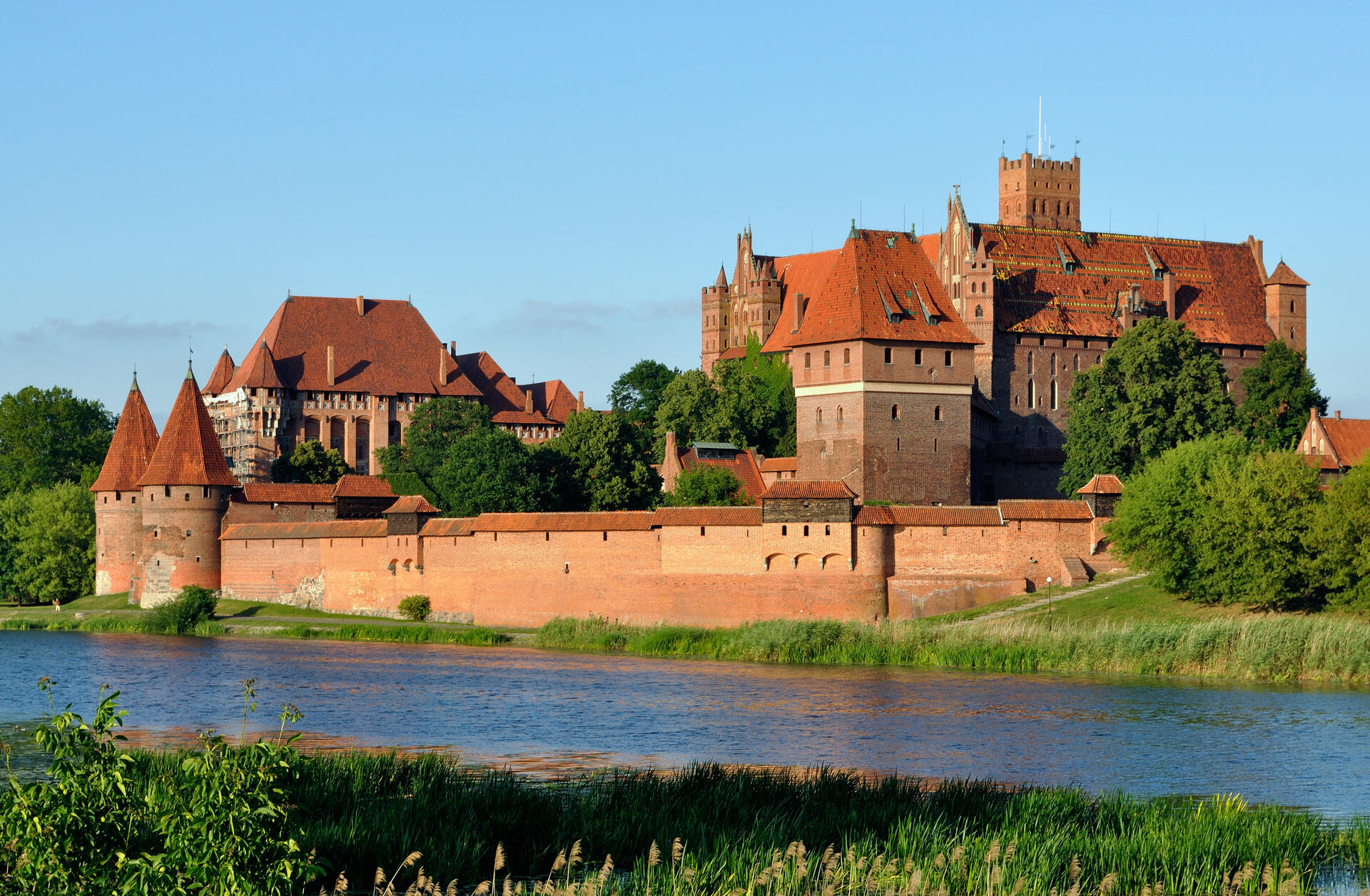
© DerHexer; derivate work: Carschten, CC BY-SA 3.0 Resized from original. (This derivative is under the same CC BY-SA license.)
World Heritage Research
Discover scientific research and academic studies that deepen our understanding of Castle of the Teutonic Order in Malbork from its history and significance to its conservation, management, and contemporary challenges.
-
Malbork Castle, the Knights of the Teutonic Order and the "German East" in the 19th and 20th Centuries
Malbork Castle, a symbol of the Teutonic Order's medieval power, became central to German historical narratives in the 19th and 20th centuries. Research reveals that interpretations of the 'German East'—a contested concept referring to territories historically associated with German settlement or influence—varied significantly depending on political contexts. The study demonstrates how Malbork Castle, rediscovered around 1800, was strategically used in nationalistic discourses, reflecting shifting boundaries and ideologies. By analyzing historical policies and cultural representations, the research highlights the fluidity of geographical and identity constructs in German history.
Daniel Stienen. (2023). Malbork Castle, the Knights of the Teutonic Order and the "German East" in the 19th and 20th Centuries. Herder-Institut Für Historische Ostmitteleuropaforschung - Institut Der Leibniz-Gemeinschaft. https://doi.org/10.25355/0XZ1-3E79
View Publication Record | Read Publication -
Mistrz Jan – architekt Pałacu Wielkich Mistrzów na zamku malborskim. "Oeuvre" i oryginalny styl wybitnego mistrza budowlanego działającego między 1375 a 1406 r.
Master John, architect of the Grand Master's Palace at Malbork Castle (1375–1406), emerges as a pioneering figure in Central European 'Reduction Gothic' architecture. His innovative and unconventional designs, evident in structures like the Grand Master's Palace and Malbork town hall, set him apart from contemporaries such as Peter Parler or Ulrich von Ensingen. Historical sources and stylistic comparisons suggest he trained in Bohemia before working on a Livonian residence (Arensburg), likely commissioned by Bishop Henry. After the bishop's murder in 1380—linked to the Teutonic Order—Master John moved to Malbork, where he designed the palace under Grand Master Winrich von Kniprode and later worked on the castle in Bytów. His creative independence and ability to transcend traditions highlight his significance in medieval European architecture.
Herrmann, C. (2023). Mistrz Jan – architekt Pałacu Wielkich Mistrzów na zamku malborskim. “Oeuvre” i oryginalny styl wybitnego mistrza budowlanego działającego między 1375 a 1406 r. Studia Z Dziejów Średniowiecza, (26), 61–85. https://doi.org/10.26881/sds.2023.26.03
View Publication Record | Read Publication -
Castles in the Teutonic Order State in Prussia as Medium of Ideology and Manifestation of Power
The Teutonic Order's castles in Prussia served as powerful symbols of centralized authority and ideological propaganda, reflecting their role as defenders of Christianity. Research reveals that the Order adapted the castell type fortress, a structure traditionally associated with strong state power, to reinforce their hierarchical governance and divine legitimacy. Towers, another key architectural element, symbolized feudal dominance, while the grand master's palace in Malbork drew from the tradition of donjons, representing sovereign rule. Additionally, the castle in Sztum exemplified court culture and prestige, serving as a leisure retreat for the overlord. The study analyzes these structures' geometric precision, repetitiveness, and symbolic significance to demonstrate their function as tools of power manifestation and ideological expression.
Wasik, B. (2022). Castles in the Teutonic Order State in Prussia as Medium of Ideology and Manifestation of Power. Światowit, (60), 133–155. https://doi.org/10.31338/0082-044x.swiatowit.60.8
View Publication Record | Read Publication -
Lokalizacja infirmerii w topografii krzyżackich zamków komturskich w Prusach w późnym średniowieczu
Research on the Teutonic Order's castles in late medieval Prussia reveals that infirmaries were predominantly located within the bailey, serving both religious brothers and secular servants. While earlier studies relied solely on architectural data, this study analyzed written sources from the 14th to 15th centuries, demonstrating that nearly all infirmaries adhered to this pattern, with sparse exceptions like Malbork and Königsberg castles. The findings challenge previous assumptions by providing a more comprehensive spatial understanding of healthcare facilities within these strongholds.
Jóźwiak, S., & Trupinda, J. (2020). Lokalizacja infirmerii w topografii krzyżackich zamków komturskich w Prusach w późnym średniowieczu. Studia Historica Gedanensia, 11, 64–83. https://doi.org/10.4467/23916001hg.20.005.13611
View Publication Record | Read Publication -
„Król się ślini na myśl o Gdańsku…” – cztery odsłony walki o symbole między miastem a władzą zwierzchnią z zamkiem krzyżackim w tle
Archaeological and historical analysis reveals that the Teutonic Order's castle in Gdańsk, constructed around 1340, was not only a strategic fortress but also a central symbol in the city's centuries-long struggle for autonomy against external rulers. The study identifies four key episodes of symbolic conflict: post-Battle of Grunwald (1410) political murders, a 1453 dispute over church tower construction, the Thirteen Years' War (1454–1466) demolition of the castle to prevent Polish sovereignty, and its indirect iconographic representation in later art. The research combines written records with archaeological evidence, including sandstone relics from the castle found in St. Mary's Church and the Artus Manor, to reconstruct the castle's lost silhouette and its political significance. A 2020 discovery in St. Mary's Church further supports the theory that architectural elements were repurposed symbolically after the castle's demolition.
Torbus, T. (2020). „Król się ślini na myśl o Gdańsku…” – cztery odsłony walki o symbole między miastem a władzą zwierzchnią z zamkiem krzyżackim w tle. Porta Aurea, (19), 231–256. https://doi.org/10.26881/porta.2020.19.12
View Publication Record | Read Publication -
How Violence Shapes Religion: Belief and Conflict in the Middle East and Africa
Violence profoundly shapes religious beliefs and conflicts, as evidenced by the 13th-century Marienburg Castle of the Teutonic Order near Malbork, Poland. This fortress, through its architecture and artifacts, reflects the interplay between Christian faith and violent encounters that defined its era. The study examines how such structures perpetuate myths of identity and belief, contributing to broader patterns of conflict in regions like the Middle East and Africa. By analyzing historical and material evidence, the research highlights the enduring impact of violence on religious narratives and societal dynamics.
Fabrycky, L. M. (2019). How Violence Shapes Religion: Belief and Conflict in the Middle East and Africa. The Review of Faith & International Affairs, 17(3), 122–124. https://doi.org/10.1080/15570274.2019.1643985
View Publication Record | Read Publication -
Not only the Golden Gate? A newly discovered fragment from the decoration of the castle chapel portal in Althaus (Starogród) as a contribution to the identification of ceramic sculpture in the Teutonic Order's State in Prussia
A newly discovered ceramic fragment from the decoration of the castle chapel portal in Althaus (Starogród), unearthed during archaeological excavations in Kulmerland, challenges previous assumptions about the role and significance of ceramic architectural sculpture in the Teutonic Order's State in Prussia. This small but significant finding suggests that such sculptures were more widespread than previously believed, not just as symbols of rank and power, but also as integral elements reflecting the 'genius loci'—the defining spirit or character—of the architecture from the first phase of construction campaigns by the Teutonic Order. The discovery, part of the project Castra Terrae Culmensis (2017), provides new insights into the types, manufacturing techniques, and layers of meaning associated with figural decorations in castles such as Marienburg (Malbork), Elbing (Elbląg), Thorn (Toruń), and Graudenz (Grudziądz). This fragment, dating to around 1300, offers a rare opportunity to revise our understanding of ceramic sculpture in this historical context.
Raczkowski, J. (2018). Not only the Golden Gate? A newly discovered fragment from the decoration of the castle chapel portal in Althaus (Starogród) as a contribution to the identification of ceramic sculpture in the Teutonic Order’s State in Prussia. Ordines Militares Colloquia Torunensia Historica, 23, 339. https://doi.org/10.12775/om.2018.012
View Publication Record | Read Publication -
Restoration of the monumental sculpture of Madonna in the Castle of the Teutonic Order in Malbork (Marienburg)
The monumental Madonna sculpture, once the largest medieval artwork in Europe and a defining symbol of Malbork Castle, was nearly entirely destroyed during World War II. Restoration efforts have since focused on reconstructing the 8-meter-tall mosaic-covered figure, known as the Malbork Colossus, from its surviving fragments and thousands of tesserae. While the castle underwent post-war reconstruction, the Madonna's restoration remained delayed, highlighting the challenges of preserving such iconic historical artifacts. This study underscores the significance of the sculpture not only as a work of art but also as a cultural symbol representing the Teutonic Order's legacy in Prussia.
Hochleitner, J. (2018). Restoration of the monumental sculpture of Madonna in the Castle of the Teutonic Order in Malbork (Marienburg). Echa Przeszłości, (XVIII). https://doi.org/10.31648/ep.2055
View Publication Record | Read Publication -
Kazimierz Pospieszny, Domus Malbork. Zamek krzyżacki w typie regularnym [Domus Malbork. Castle of the Teutonic Order of a regular type] (Monografie Uniwersytetu Mikołaja Kopernika w Toruniu), Wydawnictwo Naukowe Uniwersytetu Mikołaja Kopernika ...
The Castle of the Teutonic Order in Malbork stands as a rare example of medieval architecture characterized by its regular, symmetrical design. This monograph, authored by Kazimierz Pospieszny and published in 2014, delves into the architectural evolution and urban planning of this monumental complex, which served as the administrative center of the Teutonic Knights' state. Through meticulous analysis of historical documents, archaeological data, and comparative study with other medieval castles, the work reconstructs the castle's development from its foundation in 1274 to its later transformations. It highlights the innovative integration of military fortification with residential and administrative functions, setting a precedent for regular-type castles in Europe. The study is enriched by extensive visual documentation, including 283 black-and-white figures and 30 colored illustrations, providing a comprehensive insight into this architectural marvel's design and historical significance.
Raczkowski, J. (2017). Kazimierz Pospieszny, Domus Malbork. Zamek krzyżacki w typie regularnym [Domus Malbork. Castle of the Teutonic Order of a regular type] (Monografie Uniwersytetu Mikołaja Kopernika w Toruniu), Wydawnictwo Naukowe Uniwersytetu Mikołaja Kopernika ... Ordines Militares. Colloquia Torunensia Historica, 21, 240. https://doi.org/10.12775/om.2016.015
View Publication Record | Read Publication -
Die Marienburg: Vom Machtzentrum des Deutschen Ordens zum mitteleuropäischen Erinnerungsort, ed. Bernd Ulrich Hucker, Eugen Kotteand Christine Vogel
The Castle of Marienburg (Malbork) undergoes a complex transformation from a medieval power center to a contested symbol of European history. Originally the seat of the Teutonic Order and later a royal residence in Poland, its narrative shifts dramatically under Prussian rule, Nazi propaganda, and post-war conflicts. The castle's 50–60% destruction during World War II and subsequent restoration efforts highlight its layered significance as both a monument of German history and a site of collective memory. This study traces these transitions, revealing how the castle's physical and symbolic reconstruction reflects broader European historical narratives.
Harasimowicz, J. (2016). Die Marienburg: Vom Machtzentrum des Deutschen Ordens zum mitteleuropäischen Erinnerungsort, ed. Bernd Ulrich Hucker, Eugen Kotte and Christine Vogel. The English Historical Review, 131(550), 696–697. https://doi.org/10.1093/ehr/cew103
View Publication Record | Read Publication -
Honey in the Economy of the Malbork (Marienburg) Commandry (Komturei)
Honey played a significant role in the economy of the Malbork (Marienburg) Commandry, serving as a key ingredient for mead production and a sweetener for local wine. The Teutonic Order, which controlled the region, held exclusive rights to beekeeping, highlighting its economic importance during medieval times. This study sheds light on the historical significance of honey in Prussia, drawing from reliable but scarce sources. By analyzing the Commandry's records and practices, researchers reconstructed the role of honey in the local economy, emphasizing its multifunctional use beyond mere sustenance.
Długokęcki, W. (2016). Honey in the Economy of the Malbork (Marienburg) Commandry (Komturei). Przegląd Zachodniopomorski, 41–52. https://doi.org/10.18276/pz.2016.1-03
View Publication Record | Read Publication -
The position of the ‘master mason’ (‘magister lapidum’, ‘magister laterum’, ‘steinmeister’, ‘czygelmeyster’, ‘muwermeister’) in the Teutonic Order’s state in Prussia in the 14th and in the first half of the 15th centuries
Research reveals that the position of 'master mason' within the Teutonic Order's state in Prussia, spanning the 14th and early 15th centuries, played a pivotal role in coordinating brick castle construction. This role, held by knights for specified periods, involved overseeing labor, materials procurement, and work execution, thereby enabling the precise dating of several castles. Notably, the high castle in Ragnit was completed before 1406, while Marienburg (Malbork) underwent development in two phases during the 1340s and 1370s. Additional findings include the construction timeline for castles in Gdańsk, Schlochau, Tuchel, Lauenburg, Barten, Labiau, Neidenburg, and Memel, corroborating historical claims about their erection periods.
Jóźwiak, S., & Trupinda, J. (2016). The position of the ‘master mason’ (‘magister lapidum’, ‘magister laterum’, ‘steinmeister’, ‘czygelmeyster’, ‘muwermeister’) in the Teutonic Order’s state in Prussia in the 14th and in the first half of the 15th centuries. Ordines Militares. Colloquia Torunensia Historica, 20, 239. https://doi.org/10.12775/om.2015.010
View Publication Record | Read Publication