World Heritage Identification Number: 835
World Heritage since: 1997
Category: Cultural Heritage
WHE Type: Historic Cities & Urban Areas
Transboundary Heritage: No
Endangered Heritage: No
Country: 🇵🇱 Poland
Continent: Europe
UNESCO World Region: Europe and North America
Map
The Medieval Town of Toruń: A Glimpse into the Past
The Medieval Town of Toruń, located in the north-central region of Poland, stands as a testament to the rich history and cultural heritage of this ancient city. Inscribed as a UNESCO World Heritage Site in 1997, it offers visitors a unique opportunity to explore the remnants of a medieval trading city that has remarkably preserved its original street pattern and numerous early buildings.
More to come…UNESCO Description of the World Heritage Site
Torun owes its origins to the Teutonic Order, which built a castle there in the mid-13th century as a base for the conquest and evangelization of Prussia. It soon developed a commercial role as part of the Hanseatic League. In the Old and New Town, the many imposing public and private buildings from the 14th and 15th centuries (among them the house of Copernicus) are striking evidence of Torun's importance.
UNESCO Justification of the World Heritage Site
Criterion (ii): The small historic medieval trading and administrative city of Toruń preserves to a remarkable extent its original street pattern and outstanding early buildings. It set a standard for the evolution of towns in this region during Eastern Europe’s urbanisation process in the 13th and 14th centuries. The combination of two towns with a castle is a rare form of medieval settlement agglomeration that has survived almost intact, and numerous buildings of considerable intrinsic value have been faithfully preserved within the town. In its heyday, Toruń boasted a wide range of architectural masterpieces, which exerted a powerful influence on the whole of the Teutonic state and the neighbouring countries.
Criterion (iv): Toruń provides an exceptionally complete picture of the medieval way of life. Its spatial layout provides valuable source material for research into the history of urban development in medieval Europe, and many of its buildings represent the highest achievements in medieval ecclesiastical, military, and civil brick-built architecture.
Encyclopedia Record: Medieval Town of Toruń
Medieval Town of Toruń is the oldest historic district of the city of Toruń. It is one of Poland's World Heritage Sites and Seven Wonders of Poland. According to UNESCO, its value lies in its being "a small historic trading city that preserves to a remarkable extent its original street pattern and outstanding early buildings, and which provides an exceptionally complete picture of the medieval way of life". The Medieval Town has an area of 60 ha and a buffer zone of 300 ha. It is composed of the Toruń Old Town, Toruń New Town, and the Toruń Castle.Additional Site Details
Area: 48 hectares
Number of Components: 1
(iv) — Outstanding example of a type of building or landscape
Coordinates: 53.0105555556 , 18.6041666667
Image
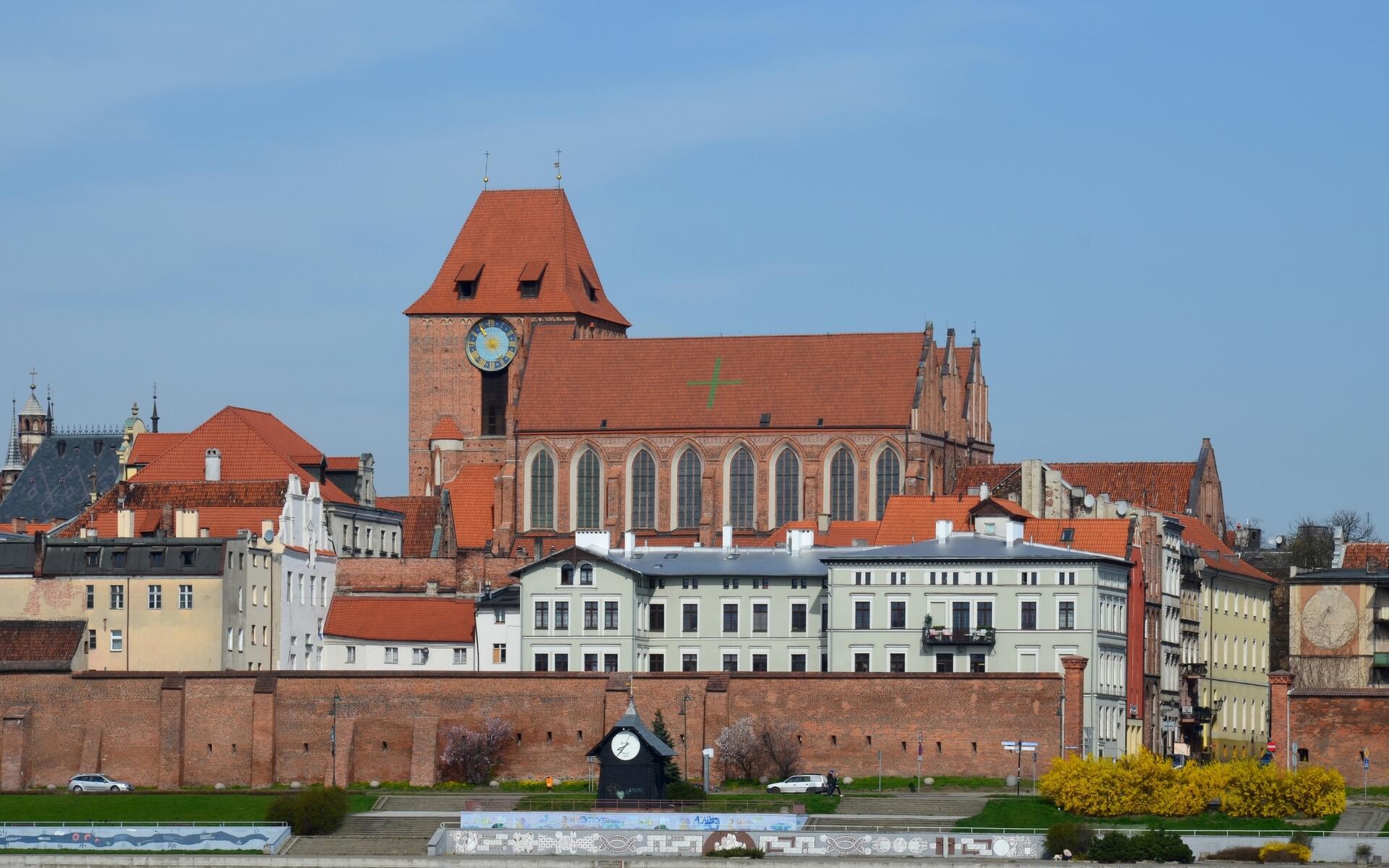
© 1bumer, CC BY-SA 4.0 Resized from original. (This derivative is under the same CC BY-SA license.)
World Heritage Research
Discover scientific research and academic studies that deepen our understanding of Medieval Town of Toruń from its history and significance to its conservation, management, and contemporary challenges.
-
The Future of World Heritage Cities: Heritage Governance and New Urban Commons
Grassroots heritage activism can effectively challenge institutional frameworks and lead to the creation of new urban commons, even outside officially protected World Heritage zones. This study highlights how residents of Toruń, a UNESCO World Heritage city since 1997, successfully advocated for the preservation and official recognition of contested heritage sites despite constraints like the Covid-19 pandemic. By joining decision-making bodies or involving recognized experts, citizens shaped the city's cultural landscape and future. The research combines semi-structured expert interviews with an analysis of local media, official statements, and planning documents to demonstrate the impact of resident-driven initiatives on heritage governance.
Eremenko, Iuliia. (2026). The Future of World Heritage Cities: Heritage Governance and New Urban Commons. KOBRA Universität Kassel. https://doi.org/10.17170/KOBRA-2026081012337
View Publication Record | Read Publication -
Local Voices, Global Goals: Participatory Planning for Localizing the UN SDGs in UNESCO Heritage Site Management
A groundbreaking approach to integrating the UN Sustainable Development Goals (SDGs) into UNESCO World Heritage Site management has emerged from research on Toruń, Poland. The study reveals that participatory planning, led by local actors like the Revitalization Committee, can effectively embed SDGs into urban development without requiring new governance structures. This polycentric framework leverages existing bodies to enhance social engagement and optimize resources, demonstrating a scalable model for balancing global sustainability targets with local heritage preservation. The research combines qualitative document analysis, expert interviews, and participant observations to highlight the committee's pivotal role in shaping Toruń’s Management Plan, bridging gaps between revitalization efforts and SDG integration.
Eremenko, I., & Kraski, T. (2025). Local Voices, Global Goals: Participatory Planning for Localizing the UN SDGs in UNESCO Heritage Site Management. Urban Planning, 10. https://doi.org/10.17645/up.9039
View Publication Record | Read Publication -
Clergyman as a Subject and Object of Death Commemoration in Late Medieval Prussian Town
A rare glimpse into the intersection of religious and civic life in Late Medieval Prussia emerges from detailed records of four priest-led foundations in Toruń. These institutions, established by affluent clergy who were also prominent town members, reveal that priests were not merely spiritual providers but active participants in commemorative practices benefiting both themselves and the community. The study highlights the financial underpinnings and societal roles of these foundations, offering unprecedented insights into the bourgeois religious culture of the era.
Sumowski, M. (2025). Clergyman as a Subject and Object of Death Commemoration in Late Medieval Prussian Town. Medievalista Online, 37. https://doi.org/10.4000/134b6
View Publication Record | Read Publication -
Mental Maps and Sacred Spaces: An Empirical Analysis of Late Medieval Towns of the Baltic Sea Region, 1420–1520
Late medieval towns along the Baltic Sea, including Toruń (Thorn), exhibited a practical emphasis on the visibility of religious landmarks in their mental landscapes. Despite local variations, urban dwellers integrated nominally Christian elements—such as named spaces or structures—into their daily spatial cognition, reflecting a deeper role for faith in shaping physical perception. The study analyzed written sources from Åbo (Turku), Reval (Tallinn), Stockholm, Stralsund, and Toruń between 1420–1520, revealing how religious elements were not merely symbolic but functionally significant in urban navigation and social life.
Hägglund, A.-S., Kołodziejczak, P., & Lamberg, M. (2025). Mental Maps and Sacred Spaces: An Empirical Analysis of Late Medieval Towns of the Baltic Sea Region, 1420–1520. Scandinavian Journal of History, 50(2), 121–146. https://doi.org/10.1080/03468755.2025.2474997
View Publication Record | Read Publication -
„Praenobiles et spectabiles Domini, domini amici observandissimi…”. Kontakty chełmińsko-toruńskie w okresie nowożytnym
In the early modern period, Chełmno's interactions with Toruń were markedly less frequent and limited compared to the medieval era. This decline in contact was attributed to Chełmno's unique situation, where its significance waned despite maintaining connections with other Prussian towns like Gdańsk and Toruń. The study analyzed various historical sources, including municipal law registers, treasurer office books, craft guilds' registers, and correspondence, particularly focusing on the content and frequency of letters exchanged between the two towns. This approach revealed that Chełmno's role in economic and political spheres diminished significantly by the eighteenth century, setting it apart from other major urban centers in Royal Prussia.
Superczyński, M. (2024). „Praenobiles et spectabiles Domini, domini amici observandissimi…”. Kontakty chełmińsko-toruńskie w okresie nowożytnym. Zapiski Historyczne, LXXXIX(3), 41. https://doi.org/10.15762/zh.2024.20
View Publication Record | Read Publication -
The So-called Copernicus’ Chapel: a Jubilee Creation in the Gothic St John’s Cathedral in Toruń
A notable transformation of the medieval St. Nicholas Chapel within Toruń's Gothic St John’s Cathedral, now known as 'Copernicus’ Chapel,' reflects a unique blend of historical preservation and contemporary commemoration. Originally serving multiple religious functions, including as a baptismal chapel, it was reimagined in 1973 to honor Nicolaus Copernicus, the renowned astronomer born in Toruń, during his 500th birth anniversary year. This study analyzes the chapel's evolution, focusing on its new arrangement that integrates medieval elements with Copernicus memorabilia and emotional narrative, offering a contemporary interpretation of historical heritage. The research delves into the symbolic significance and architectural principles guiding this jubilee creation, providing insights into how cultural landmarks can be recontextualized to honor scientific legacies.
Jakubek-Raczkowska, M., & Raczkowski, J. (2022). The So-called Copernicus’ Chapel: a Jubilee Creation in the Gothic St John’s Cathedral in Toruń. Ikonotheka, (31), 83–111. https://doi.org/10.31338/2657-6015ik.31.4
View Publication Record | Read Publication -
Buildings at 14 Franciszkańska Street and 24 Fosa Staromiejska Street in Toruń in the light of architectural research and source queries
Architectural research at 14 Franciszkańska and 24 Fosa Staromiejska Streets in Toruń's Old Town reveals a complex, multi-phase development spanning from the medieval period to the early 20th century. The study identified distinct construction stages, including the preservation of Gothic fragments in the southern part and the reuse of stone foundations for a basement in the northern section during a second Gothic phase. It also documented the functional integration of two previously independent plots through an 18th-century side outbuilding, as well as significant fires at the beginning of the 19th century that destroyed existing structures. A notable finding is the mid-19th century construction of a large five-story granary built on medieval and modern cellars, which was later demolished in 1906 to make way for two tenement houses with shared central routes. This research provides valuable insights into the evolutionary development of Toruń's walled Old Town, combining architectural analysis with historical source material.
Kucharzewska, J. (2022). Buildings at 14 Franciszkańska Street and 24 Fosa Staromiejska Street in Toruń in the light of architectural research and source queries. Architectus, (4(72)). https://doi.org/10.37190/arc220409
View Publication Record | Read Publication